
Dog Boot Camp in Chicago, IL
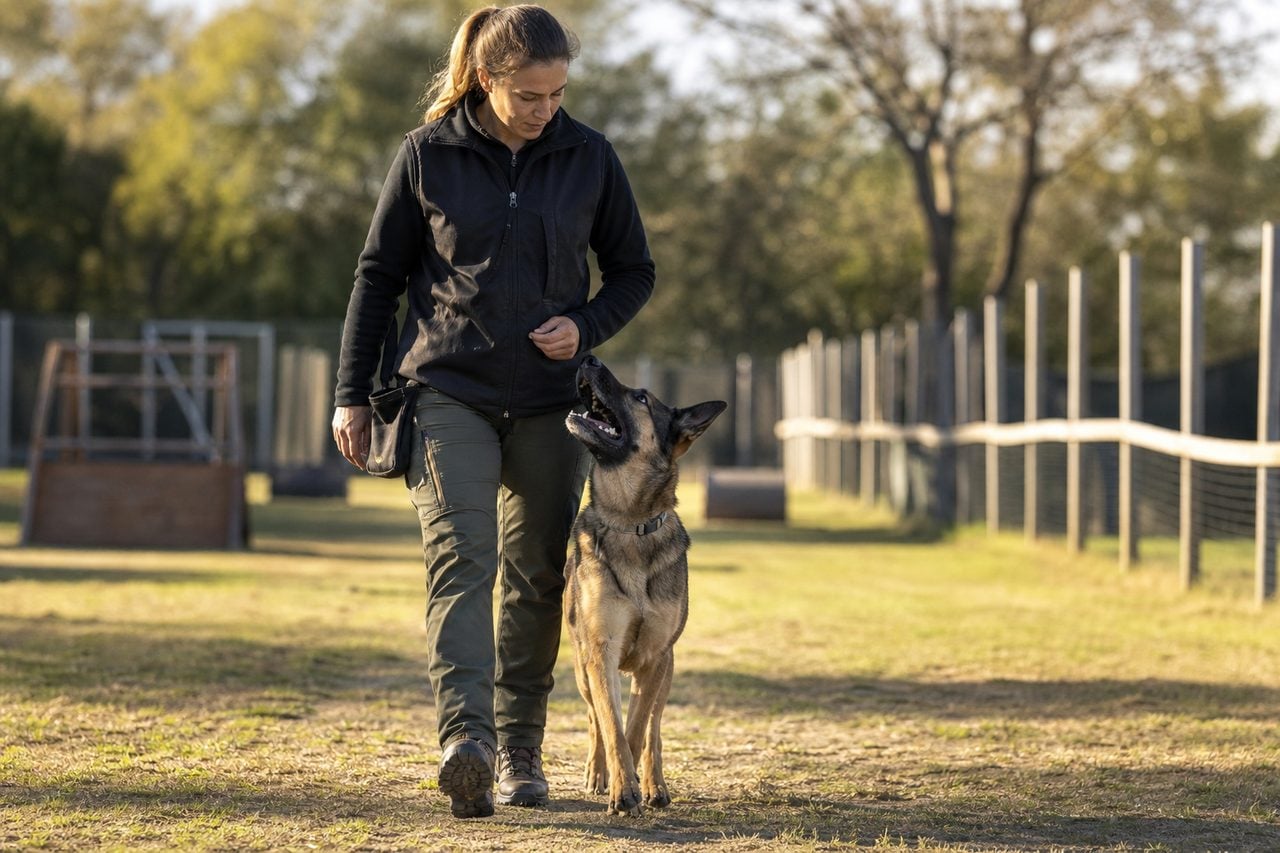
“Boot camp” is the marketing name for an intensive residential training block, and in Chicago it is used more or less interchangeably with board and train. The label carries a promise of speed and discipline, and it draws a particular kind of enquiry: an owner at the end of their patience with a dog that has become unmanageable in a city that leaves no margin for an unmanageable dog. This page is written for that owner.
Intensive programs are real and they work for the right problem. They also attract the loosest marketing in the industry, because the promise is easy to make and slow to verify. The dogs in Chicago that end up in a boot camp are frequently large adolescents in small flats whose owners have been physically overpowered, which is a genuinely urgent situation. What follows is what an intensive block can and cannot resolve, how to read a program’s claims, and how to make the investment stick once the dog is home.
What the intensive format is actually good at
Concentrated daily repetition, delivered by someone competent, in an environment set up for training. That is the mechanism, and where the deficit is skill and structure, it is powerful. An adolescent dog with no impulse control, no lead skills and no off-switch can change substantially in three weeks, because it is getting more correct repetitions per day than it has had in its life.
The second thing intensive programs are good at is breaking a rehearsal loop. A Chicago dog that has lunged at every dog on its block for eight months has practiced that behavior thousands of times in one context. Removing it entirely from that context for a few weeks, while building an incompatible pattern elsewhere, is a legitimate strategy, and it is genuinely difficult for an owner to replicate while still living their life on that block.
The third is safety in a crisis. Where an owner cannot physically manage a dog, or where a household has stopped functioning, taking the dog out of the situation buys everyone room to breathe and gives a professional the chance to establish handling that the owner can then be taught. That is a real service, and it is often the honest reason people call.
The claims to be sceptical of
Some marketing language should slow you down. Guaranteed results. Behavior is not a product with a warranty; what can be guaranteed is a process, a set of sessions, and a defined follow-up. A trainer who guarantees an outcome for a dog they have not assessed is either promising something they cannot control or planning to define success narrowly.
Fixed in two weeks. Some things genuinely can improve in two weeks. Fear, aggression with a bite history, and separation distress are not among them, and a two-week promise on any of those is a signal to keep looking.
Off-leash reliable in three weeks. Off-leash reliability in a city with unfenced parks, cyclists, squirrels and open streets is a long project and, for many dogs, a conditional one. A dog can absolutely be off-leash reliable in a specific environment after an intensive block. On the Lakefront Trail on a Saturday is a different claim entirely.
No tools, ever or tools always. Chicago has excellent trainers who work without aversives and excellent trainers who use lead or remote-collar pressure with skill. What should worry you is not the position but the absence of reasoning: a trainer who cannot explain when their approach would be the wrong choice has not thought about it hard enough.
Assessing an intensive program from the outside
You are buying something that happens while you are not there, so the assessment has to be structural. Start with the assessment itself: a good program evaluates your dog before quoting, in person or at minimum on video, and can articulate what specifically it plans to change. A program that quotes a price from a phone call without seeing the dog is selling a package, not a plan.
Then ask about the day. How many training sessions, how long, how much decompression, how much kennel time, how much time with other dogs. Ask what the ratio of dogs to handlers is. Ask who specifically will work your dog. In multi-dog facilities the answer is often staff rather than the owner-trainer, which can be perfectly fine if the staff are experienced and badly not fine if they are not.
Ask for references from clients whose dogs had a problem like yours, and ask what happened six months later rather than at pickup. And ask what the program does with a dog that is not responding — whether they extend, change approach, refund, or refer to a veterinary behaviorist. That last option matters: some cases in this city are medical or need medication alongside training, and a trainer who will never say so is a trainer who will keep taking your money.
The Chicago context that changes the calculation
Two local realities affect intensive programs here more than they would elsewhere. The first is that most Chicago dogs go home to a flat in a shared building. A dog that has spent three weeks in a facility with an outdoor run and constant activity returns to a two-bedroom apartment, a elevator and a hallway, and the contrast itself is a challenge. Programs that build in apartment-relevant work — settling on a mat, thresholds, quiet in confinement, calm passing in a corridor — transfer better than ones that train mostly in a yard.
The second is that the city supplies the trigger continuously. In a suburb, an owner can manage a reactive dog’s environment for a few weeks after handover by choosing quiet routes. In Lincoln Park you cannot; there will be a dog on the sidewalk within four minutes of leaving the building. That raises the bar for what the handover has to accomplish, and it is why so many Chicago trainers who run intensives insist on follow-up sessions on the client’s own street rather than at the facility.
Both points argue for the same thing: choose the program whose post-residency structure is strongest, even if its residency looks less impressive. The residency is the part you can see in photographs. The follow-up is the part that decides whether it worked.
Costs, and what a fair quote includes
Intensive residential programs are the highest-cost product in Chicago dog training, quoted as a program fee for a defined stay. What varies enormously between quotes is what is bundled. A defensible quote should state the length of stay, the number of training sessions per day, what happens at handover, how many follow-up sessions are included and over what window, and whether any group class or refresher access comes with it.
When comparing, normalize on the follow-up. A cheaper program with no follow-up is frequently the more expensive choice, because the additional private sessions you will end up buying afterwards close the gap and then some. It is entirely reasonable to ask a trainer to break the quote down that way, and the ones running a serious program will not find the question strange.
Also ask what happens to the price if the dog needs longer. Some programs extend at a reduced weekly rate, some at full rate, and a few will absorb an extension if they have under-scoped the case. Knowing in advance prevents an uncomfortable conversation in week three.
What to do in the first month after pickup
Treat the first four weeks home as part of the program, because they are. Keep the dog’s routine tight and predictable rather than immediately resuming normal life; the dog has just changed environments twice in a month. Use management — a lead in the flat, a gate, a crate — while the new patterns are still fragile, rather than testing them.
Practice deliberately in short sessions rather than relying on the walk to maintain the training. Five minutes twice a day of the exact exercises you were handed will hold a behavior; a forty-minute walk where you hope for the best will not. If the program gave you written criteria, follow them exactly for a month before you start improvising, because the criteria are usually the part owners loosen first.
And book the follow-ups even if things are going well. The predictable pattern is that weeks one and two are excellent, week three is a wobble as the dog tests the new arrangement, and week four is where the outcome is decided. A session scheduled into that window is worth far more than one arranged in a panic afterwards.
The trainers below publish an intensive, boot-camp or board-and-train program on their own sites, and serve Chicago and the near-western suburbs. Their profiles show what each says it offers, which is the right place to start a shortlist.
Dog Boot Camp in Chicago: Local Options & Nearest Specialists
Local Chicago-area options for dog boot camp:
- Suburban K9 Dog Training — 5.0★ (592 reviews)
Nearest dog boot camp specialists — Evanston
For complex cases, some families travel to the larger pool of specialists in the Evanston area for an assessment or a board-and-train stay. Top-reviewed options:
- Wolf’s Lair K9 — 4.9★ (65 reviews)
See all Evanston dog boot camp trainers →
Frequently Asked Questions
Is dog boot camp the same as board and train?
In practice yes — in Chicago the terms are used interchangeably for a residential program of two to four weeks. Boot camp sometimes signals a more structured or discipline-focused style, but the label is marketing rather than a defined standard, so judge the program on its schedule, its handover and its follow-up rather than on the name.
Can a boot camp fix aggression?
It can improve control and give the dog competent structured exposure, and for some cases that is genuinely valuable. It cannot install that outcome permanently without you: aggression cases are the most dependent on owner handling afterwards, so the follow-up plan matters more here than anywhere. Any program guaranteeing an aggression cure in a fixed number of weeks is over-promising.
How do I know the program is treating my dog well?
Ask specific questions before you book — hours out of the kennel, dogs per handler, who works your dog, what tools are used — and expect specific answers. Ask about updates during the stay; most reputable Chicago programs send regular video. A refusal to describe the daily routine or to show you anything is the clearest warning sign available.
My dog was great for a week and then slipped. What happened?
That is the normal curve, not a failure. Dogs test a new arrangement once the novelty of returning home fades, usually around week three. It is why follow-up sessions scheduled into weeks three and four are so valuable, and why tightening your own criteria — rather than relaxing them because things were going well — is the right response.
Would day training work instead?
For many Chicago owners, yes. Day training gives you most of the repetition benefit while the dog sleeps at home, which reduces the transfer problem and usually costs less. Residential makes more sense where the household needs a genuine reset, where the owner cannot safely handle the dog, or where the dog’s problem is tied to the home environment being unavoidable.
Related: read our complete dog boot camp guide or the full Chicago dog training overview.
Ready to find the right dog boot camp pro in Chicago?