
Dog Boot Camp in Elgin, IL
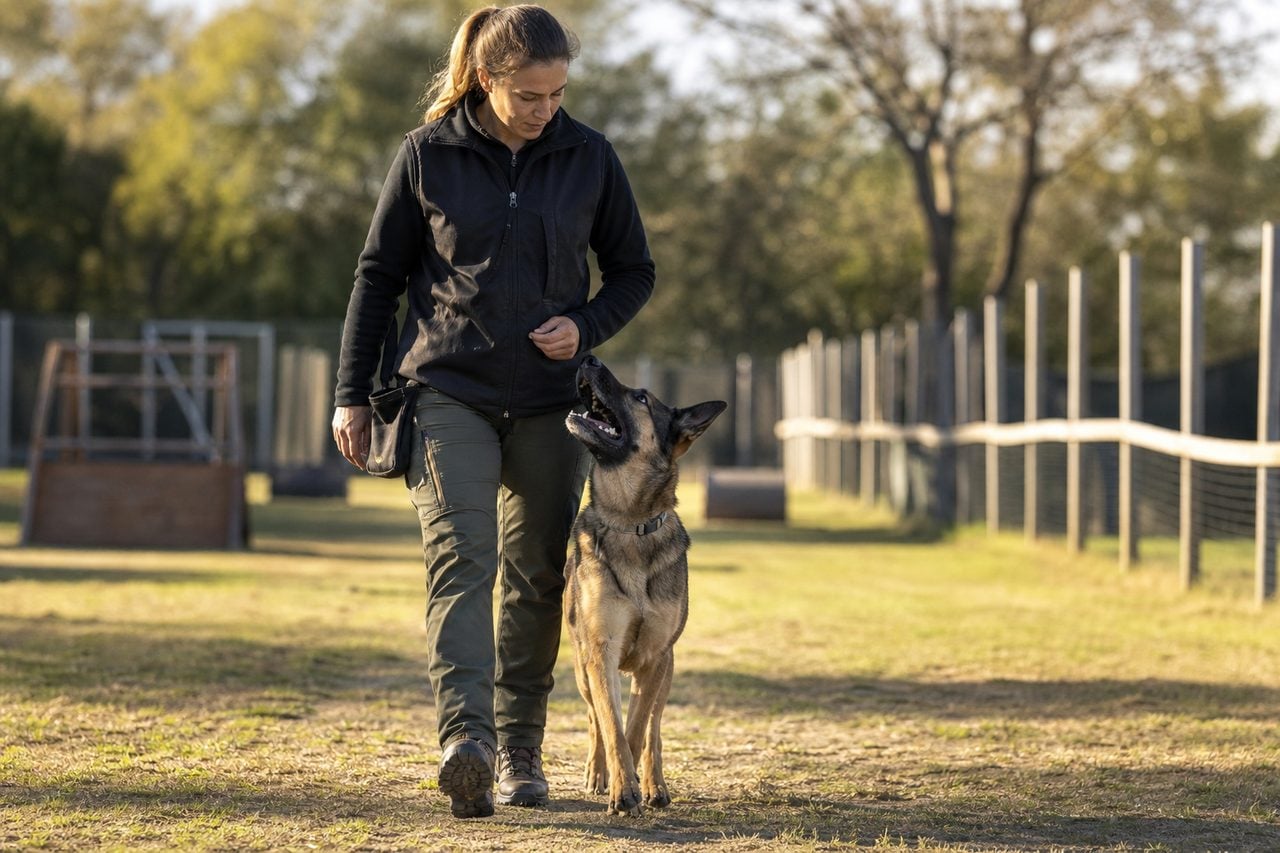
‘Boot camp’ is a marketing phrase rather than a technical one, and the first useful thing to know is that in Kane County it almost always refers to the same product described elsewhere on this site as board-and-train: your dog goes away for two to four weeks and trains intensively with a professional. A handful of local programs use the boot-camp framing explicitly — one nearby operation runs a 10-day and a 20-day ‘teen bootcamp’ aimed squarely at adolescent dogs — and the rest sell the same thing under plainer names.
- The adolescent dog, which is who this is really for
- Intensity is not the active ingredient
- How the local intensive programs are actually shaped
- Reading a program's methods before you book
- What a fortnight can and cannot deliver
- The Kane County alternative most owners have not considered
- Choosing well
- Reviewed trainers
- FAQ
The word is worth interrogating anyway, because it carries an implication that some owners are actively shopping for and others would run a mile from. Boot camp suggests discipline, correction and a dog who comes back subdued. In practice the local programs wearing that label are not doing anything of the sort — the published curricula are recall, heel, focus, impulse control, crate comfort, drop-and-leave-it, long-line work and socialization regression — which is simply adolescent obedience delivered daily.
This page covers what the boot-camp label actually means here, the adolescent problem that drives most of the enquiries, why intensity is not the active ingredient, how to read a program’s methods before you book, and what a realistic outcome looks like at the end of a fortnight.
The adolescent dog, which is who this is really for
The overwhelming majority of boot-camp enquiries in this metro are about a dog between seven and eighteen months old, and the story is almost always identical. He was a good puppy. He did a puppy class. Around eight months something changed: the recall stopped working, the lead walking fell apart, he started barking at dogs he used to ignore, he began counter-surfing and he developed selective hearing. The owner concludes the puppy training failed.
It did not fail. Adolescence in dogs involves a genuine reorganisation — the world becomes more interesting than you are, established behaviors become unreliable, and dogs frequently pass through a second period of increased caution in which things they previously ignored suddenly matter. This is developmental, it is normal, and it resolves with consistent handling rather than with severity.
It is also, honestly, the point at which a lot of households run out of road. An adolescent Labrador who needs ninety minutes of structured work a day is a difficult thing to fit around a commute from Big Timber Road into Union Station. That mismatch — a dog who needs more than the household has left to give — is the real reason intensive programs sell here, and it is a perfectly respectable reason to buy one.
Intensity is not the active ingredient
The intuition behind ‘boot camp’ is that the dog needs to be worked harder. What actually makes an intensive program effective is not intensity, it is frequency and consistency: many short, correct repetitions per day, every day, with someone who does not accidentally reward the wrong thing when they are tired. That is a bandwidth problem, not a toughness problem, and it is exactly what a residential fortnight fixes.
You can see this in the local curricula if you read them. The published content of the boot-camp-labelled programs in this area is recall, heel, focus, place, crate comfort, drop and leave-it, long-line work, counter-surfing, and re-doing socialization that regressed — plus, in one 20-day option, explicit work on mounting and other adolescent social problems. There is nothing punitive in any of that. It is a curriculum, delivered daily.
The corollary is that a program selling itself primarily on toughness, dominance or ‘fixing’ a dog is telling you about its marketing rather than its method. Ask what a training day contains hour by hour. The answer separates programs far better than the name on the brochure does.
How the local intensive programs are actually shaped
Program lengths in this metro cluster at 10, 14, 20, 21 and 28 days. The shorter options are usually foundation or adolescent-focused; the longer ones are usually behavior cases. One local facility runs a 10-day and a 20-day teen program with the 20-day adding social work; a St. Charles behavior-focused program sells 14, 21 and 28-day packages for dogs facing obedience challenges, anxiety, aggression or other behavioral hurdles, beginning with a 30-minute consultation; a Maple Park program sells a three-week foundation package for puppies from twelve weeks and dogs needing basics, with environmental exposure, leash handling, e-collar conditioning where appropriate, all tools included and four follow-up lessons; and a program near Elgin runs a two-week minimum on private land with a dedicated indoor training space.
Note how different those products are from each other despite sitting in the same category. One is a social-skills course for teenagers. One is a behavior-modification residency. One is a foundation and off-leash package. Choosing the wrong one is a more expensive mistake than choosing the wrong price point.
Also note what is missing. No program in this metro sells protection work, and none sells service-dog training. If a ‘boot camp’ anywhere is being marketed to you on the promise of producing a protection dog in three weeks, that is a claim about advertising rather than about dogs.
Reading a program's methods before you book
Tools are the fastest way to understand what will actually happen to your dog, and local programs are genuinely varied. Some include e-collar conditioning as standard where appropriate and include the equipment in the price. Some use prong or slip collars. Some work entirely with food, markers and management. Several describe themselves explicitly as balanced — using a wide range of tools from clickers to e-collars, and a range of rewards from toys to food to the environment itself.
None of those positions is disqualifying and this page is not going to pretend there is a single correct answer. What matters is that you know before collection, not after. Ask which tools will be used, why, whether the dog comes home wearing them, whether you will be trained to use them, and what the plan is for fading them.
Ask also about the conditioning process, because that is where the real difference lies. An e-collar introduced carefully over days, at a level the dog barely perceives, paired with a behavior the dog already knows, is a very different intervention from one used as a correction on day one. A program that can describe its conditioning protocol in detail is one that has one. One local program’s own description of introducing a tool ‘in a positive way and environment’ at the owner’s request is the shape of answer you want.
What a fortnight can and cannot deliver
Realistic outcomes from a two-to-three week intensive with an adolescent dog: markedly better leash manners, a recall that works in low and moderate distraction, a reliable place or crate behavior, better impulse control around doors and food, and a dog who has been physically and mentally worked every day and is therefore easier to live with. That is a genuinely valuable package and it is what the honest programs here describe.
Unrealistic outcomes: a dog who is bombproof in a Tri-Cities downtown on a Saturday, a resolved fear or aggression case, or a permanent personality change. Generalization to hard environments is your job afterwards, and it takes weeks. Fear and aggression need graduated work that continues long past collection day.
The other thing a fortnight cannot change is the household. If the dog is over-aroused because nobody has time to exercise him, or inconsistent because two adults enforce different rules, the residency buys you a reset and not a solution. The good local programs say this out loud during the consultation, which is one more reason to book programs that insist on one.
The Kane County alternative most owners have not considered
Before you commit to a residency, look seriously at day training, because it solves the same bandwidth problem for less money and without the separation. Some businesses in this metro publish it: the trainer works your dog directly — at your home, or out in public — several times a week, then transfers the finished behaviors to you in shorter handover sessions. Your dog sleeps at home. You do less of the repetition. The professional does the hard part.
For an adolescent dog with obedience gaps and no serious behavior problem, day training frequently delivers most of the outcome of a boot camp with a gentler curve and better transfer, precisely because the work is happening in the environment the dog actually lives in. Its weaknesses are that it takes longer in elapsed time and that it needs you to be available for the handovers.
The related option is a structured program of private lessons with real homework. Packages of three and five sessions with a discount at each step are the local norm, and several trainers here include free support group classes for eligible clients afterwards. If you genuinely have twenty minutes a day, this is the cheapest route to the same destination.
Choosing well
Start by naming the actual problem in one sentence. ‘My eleven-month-old ignores his recall and pulls like a train’ points at an adolescent foundation program. ‘My dog lunges and snarls at other dogs and I cannot walk him’ points at behavior modification, a longer program, and a very different consultation. ‘I do not have time’ points at day training. Programs here exist for all three, but they are not interchangeable.
Then visit. A significant share of this metro’s residency supply is on private property down a two-lane road, and you cannot evaluate a kennel run or a training field from a website. Ask where your dog sleeps, how many dogs are in at once, what the day contains, what updates you get, and what happens if he does not settle.
Finally, ask the two questions that matter most and are asked least. What will my dog still NOT be able to do when he comes home? And what happens in month three if it comes back? Programs that include four follow-up lessons, a go-home session, ongoing support or free graduate classes have already answered the second question in their pricing, which tells you something about how they think.
Dog Boot Camp in Elgin: Local Options & Nearest Specialists
Right now there are no listed Elgin trainers focused specifically on dog boot camp. Many general Elgin dog trainers can help you get started, and the nearest specialists for this focus are below.
Nearest dog boot camp specialists — Chicago
For complex cases, some families travel to the larger pool of specialists in the Chicago area for an assessment or a board-and-train stay. Top-reviewed options:
- Suburban K9 Dog Training — 5.0★ (592 reviews)
See all Chicago dog boot camp trainers →
Frequently Asked Questions
Is dog boot camp the same as board-and-train?
In this metro, yes, in almost every case. Both describe a residential program where your dog stays with a trainer for a set number of weeks and trains daily. Some local businesses prefer ‘board and train’, one nearby facility markets 10-day and 20-day ‘teen bootcamp’ options, and another calls its residency a boarding school. The label tells you about the marketing; the curriculum, the tools and the follow-up tell you about the product.
Does boot camp mean harsh training?
Not among the programs in this metro, whose published curricula are recall, heel, focus, place, crate comfort, impulse control, long-line work and social skills. Methods do vary — some local programs include e-collar conditioning where appropriate and include the tools in the price, others work entirely with food and markers, and several describe themselves as balanced. Ask which tools will be used, how they are introduced, and whether your dog comes home wearing them. Get the answer before you book, not at collection.
How old should my dog be for an intensive program?
Most local programs take dogs from around twelve weeks for foundation work, and the adolescent-focused ones are aimed at roughly seven to eighteen months, which is when most enquiries arrive. One nearby facility sets a four-month floor on its group teen program and recommends a puppy option below that. Older dogs are accepted everywhere; the ceiling is set by health and by whether the dog can cope with a kennel environment, not by age.
Is there a cheaper alternative that does the same job?
Often, yes. Day training — the trainer works your dog several times a week at your home or in public, then hands the behaviors over to you — is published by some businesses here and solves the same bandwidth problem without the separation, usually for less. A structured package of private lessons with real homework is cheaper still if you genuinely have twenty minutes a day. Local packages of three and five sessions with a discount at each step are the norm, and some trainers include free graduate support classes.
Will a boot camp fix my dog's aggression?
Not in a fortnight, and be sceptical of anyone who says otherwise. Several St. Charles-area residency programs do accept aggression and reactivity cases and run longer 21 and 28-day packages for exactly those dogs, which is the right shape — but aggression work is a months-long project that continues at home long after collection. Treat a residency as the start of the plan, insist on a proper consultation first, and expect the program to tell you what your ongoing role will be.
Related: read our complete dog boot camp guide or the full Elgin dog training overview.
Ready to find the right dog boot camp pro in Elgin?