
Board & Train in Bloomington, IN
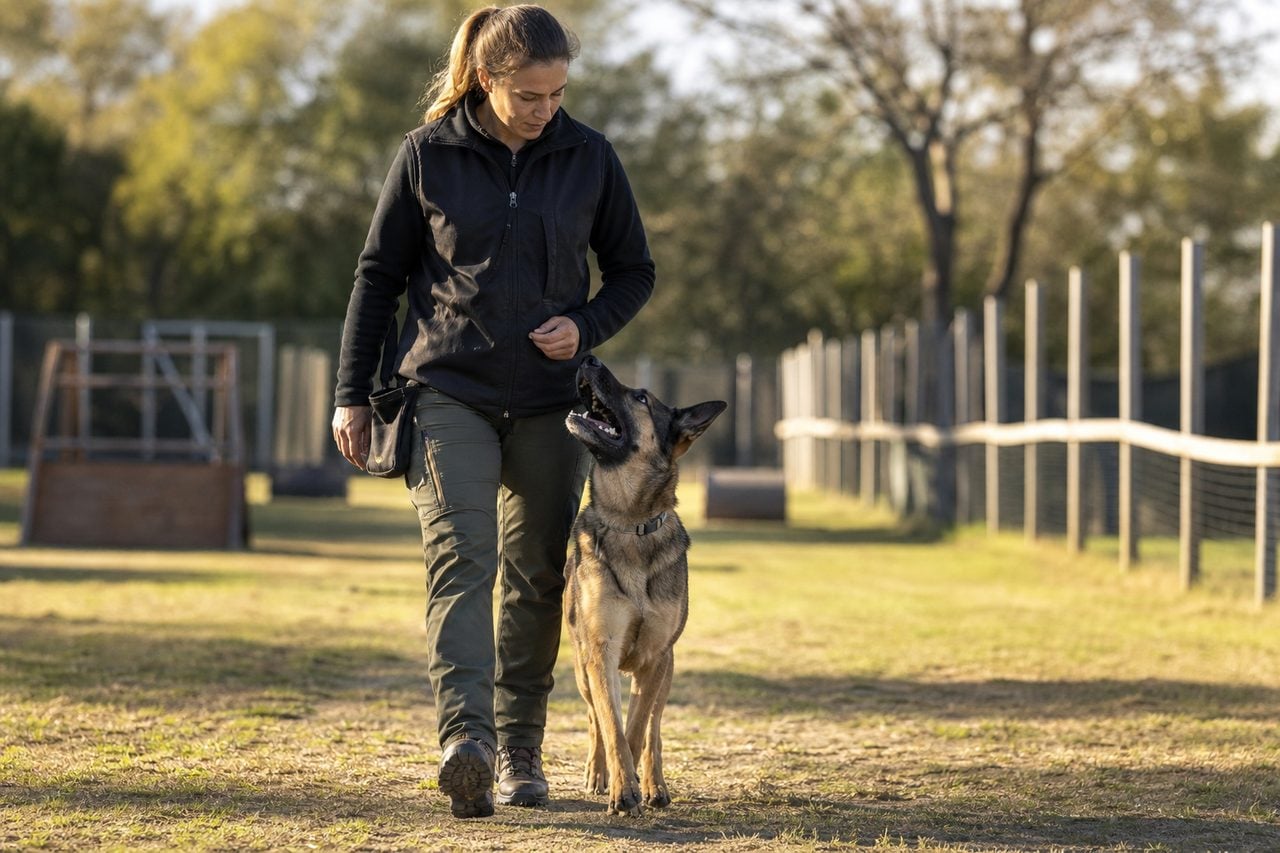
Board and train programs promise a tempting shortcut: hand your dog to a professional for a stretch of days or weeks, and get back a calmer, more responsive companion. For busy households across Monroe County — families juggling work near the Indiana University campus, folks commuting up SR-37 and I-69 toward Indianapolis, and everyone in between — the appeal is obvious. Someone else does the repetitive daily drilling while you keep your schedule intact.
- What a Board and Train Program Actually Is
- How In-Kennel Training Works Day to Day
- Training Methods: What to Look For and What to Avoid
- The Bloomington-Area Landscape for Board and Train
- The Transfer: Why the Handoff Makes or Breaks It
- Cost, Value, and Deciding If It Is Right for You
- Preparing Your Dog and Your Home
- Reviewed trainers
- FAQ
The reality is more nuanced. A well-run board and train can jump-start obedience and resolve stubborn habits faster than a once-a-week class, but the results only stick if the transfer back to you is handled properly. A poorly run one can teach your dog to behave for a stranger and no one else. This guide walks through how in-kennel training actually works, what the Bloomington area offers, how to vet a program, and how to protect the investment once your dog comes home.
The goal here is to help you decide whether board and train is the right tool for your situation — and if it is, how to choose a program that trains through cooperation rather than intimidation, and that treats the handoff back to your family as the most important part of the job.
What a Board and Train Program Actually Is
Board and train — sometimes called in-kennel or in-board training — means your dog lives with a trainer or at a training facility for a set period while receiving daily, structured instruction. Instead of you practicing skills between weekly lessons, the trainer handles the daily repetition, correction, and reinforcement. Programs commonly run anywhere from two to six weeks, though the length should be driven by the goals, not by a fixed package.
During the stay, a dog typically works on foundation obedience: reliable sit, down, place, recall, loose-leash walking, and impulse control around distractions. More advanced programs layer in off-leash reliability, duration commands, and real-world proofing — asking the dog to hold a behavior in a parking lot, near other dogs, or amid the ordinary chaos of daily life.
The distinguishing feature of board and train is immersion. A dog living in a training environment gets many short sessions across the day rather than one concentrated block. For dogs that learn well through consistency and clear structure, that density can accelerate progress. It is not magic, though — it is simply concentrated practice delivered by someone who does this for a living.
It helps to think of board and train as buying two things at once: the trainer’s time and the trainer’s environment. The time is obvious — hours of skilled repetition you would otherwise have to supply yourself. The environment is subtler but just as valuable. A dedicated training setting is free of the household triggers that sabotage practice at home: no doorbell to bark at, no couch to guard, no established routine of getting away with things. In that clean context, a dog can learn a new pattern of behavior without constantly rehearsing the old one, and it can do so under the eye of someone who catches and corrects small mistakes before they harden into habits. That is a large part of why immersion accelerates progress, and it is also why the return home requires so much care — the old triggers are all still there waiting.
Owners in and around Bloomington sometimes ask whether a few weeks away will damage the bond with their dog. Handled well, it does not. Dogs are adaptable, and a good program keeps them mentally engaged, physically exercised, and emotionally settled. The relationship that matters most is the working relationship you rebuild during and after the transfer — and dogs generally reconnect with their people quickly. What genuinely strains a bond is years of frustration on both sides because the dog was never taught what to do. A well-run stay tends to improve the relationship, not weaken it.
What it is not
Board and train is not a repair shop where you drop off a problem and collect a finished product with no further effort. It is not a substitute for your own handling skills, and it is not appropriate for every dog or every issue. Serious aggression, severe separation distress, and complex fear cases often need a different path, sometimes starting with a veterinary workup rather than a boarding kennel.
How In-Kennel Training Works Day to Day
Understanding the daily rhythm helps set realistic expectations. A responsible program structures each day around short, focused training blocks interspersed with rest, enrichment, and decompression. Dogs learn in bursts; hours of nonstop drilling produce diminishing returns and a stressed animal.
A typical day might include several obedience sessions, structured walks to practice leash manners, controlled exposure to distractions, and downtime in a crate or kennel run to build calm and independence. Good trainers treat rest as part of the curriculum — a dog that cannot settle is a dog that cannot learn.
- Foundation phase: The trainer establishes clear communication, marker signals, and the basic vocabulary of commands in a low-distraction setting.
- Building phase: Skills get longer duration and more difficulty — holding a place command while the trainer walks away, recall from a longer distance, walking past mild distractions.
- Proofing phase: The dog practices in progressively harder environments. In the Bloomington area that might mean a busy sidewalk, a park with other dogs, or a store parking lot — anywhere the dog must generalize the behavior beyond the training yard.
Ask any prospective program to describe this progression in concrete terms. A trainer who can walk you through the arc of a typical stay, and who documents progress with notes or video, is far more trustworthy than one who simply promises a transformed dog.
Training Methods: What to Look For and What to Avoid
Method matters more than almost anything else, because your dog cannot tell you how it was treated while you were away. The professional field has moved strongly toward reward-based, science-informed training, and the best board and train programs reflect that. Look for trainers who lead with positive reinforcement, clear markers, and thoughtful management, and who can explain why they do what they do.
Be cautious with programs that lean heavily on harsh corrections, prong or electronic collars as a first resort, or intimidation-based control. A dog can be made to comply through fear, but fear-based obedience tends to be brittle, poorly generalized, and sometimes accompanied by new anxiety or aggression. Some trainers use aversive tools skillfully and sparingly within a broader reward-based framework; others rely on them as a shortcut. The difference is enormous, and it is worth asking direct questions.
Questions to ask about method
- What is your primary approach, and what tools do you use?
- How do you handle a dog that makes a mistake or does not respond?
- Under what circumstances would you use an aversive, and how do you decide?
- Can I watch a training session or see video of dogs mid-program?
A confident, ethical trainer welcomes these questions. Vague answers, defensiveness, or refusal to let you observe are red flags. Credentials such as CPDT-KA (Certified Professional Dog Trainer — Knowledge Assessed) signal that a trainer has met a recognized standard, though credentials alone do not guarantee a good fit — they are one data point among several.
The Bloomington-Area Landscape for Board and Train
Monroe County and its surrounding communities support a real ecosystem of dog professionals, from campus-adjacent obedience trainers to rural facilities with room to run. The mix of a university town and the surrounding limestone country means you will find both boutique, low-volume trainers who take a handful of dogs at a time and larger facilities with kennel space and multiple staff.
Because Bloomington sits about an hour south of Indianapolis via SR-37 and I-69, some owners weigh a local stay against a program in the larger metro. There are trade-offs. A nearby program makes it easier to visit, participate in transfer lessons, and keep travel simple; a metro program may offer more specialized options but adds distance to every handoff. For most straightforward obedience goals, staying local is the practical choice.
The surrounding towns matter too. Trainers operate in and around Ellettsville, Spencer near McCormick’s Creek State Park, Bedford to the south, Nashville near Brown County State Park, and the smaller communities of Bloomfield and Martinsville. A rural facility can be a genuine advantage — more space, quieter surroundings, and easy access to varied real-world environments for proofing. When you evaluate a program, consider not just the trainer but the setting the dog will actually live in for the duration.
Bloomington’s outdoor culture is also worth keeping in mind. The B-Line Trail, Griffy Lake Nature Preserve, Lake Monroe, and Brown County State Park are exactly the kinds of busy, distraction-rich places where owners want a well-trained dog. A good program should prepare your dog for those settings, not just for a quiet training yard.
Seasonality is worth a thought too. Summer in southern Indiana brings heat and humidity that limit how hard a dog can safely work midday, while winter cold and mud change what outdoor proofing looks like. Ask how a program adjusts its routine across the year — a trainer who works dogs in the cool of the morning and evening during a July heat wave, and who has indoor space for foundation work when the weather turns, is thinking about the dog’s welfare rather than forcing a fixed schedule regardless of conditions. This kind of practical, local judgment is often a better signal of quality than any single credential.
Finally, consider the volume a program handles. Some Bloomington-area trainers deliberately take only a few dogs at a time, which usually means more individual attention and a trainer who knows each dog well. Larger facilities can offer more structure and staff coverage but may run closer to capacity. Neither model is inherently better — a small program with a distracted owner-operator can underdeliver just as a large one can — but knowing how many dogs share the trainer’s attention during your dog’s stay helps you set expectations and ask the right follow-up questions.
The Transfer: Why the Handoff Makes or Breaks It
Here is the single most important thing to understand about board and train: the dog learns to respond to the trainer, in the trainer’s environment, with the trainer’s timing and body language. None of that automatically transfers to you. The bridge between a trained dog and a well-behaved family dog is the handoff, and a program that skimps on it is selling you an illusion.
A quality program builds transfer lessons into the package — sessions where you learn to give the commands, reward correctly, read your dog, and maintain the behaviors. Some programs schedule these during the stay; others concentrate them at pickup and offer follow-up sessions in the weeks after. Either way, plan for real time on your part. If a program offers zero owner instruction, treat that as disqualifying.
What good transfer looks like
- Hands-on coaching where you practice the commands under the trainer’s eye.
- Written notes or a home protocol explaining how to maintain each skill.
- Follow-up lessons or a support window after your dog comes home.
- Guidance on structure — feeding routines, crate use, house rules — so the home environment reinforces the training.
Expect a settling-in period after pickup. Your dog is returning to a home full of old associations and old habits, now handled by someone still learning the new system. A brief regression is normal. Consistency in those first weeks determines whether the results hold. Owners who treat pickup as the finish line are often disappointed; owners who treat it as the start of a maintenance phase tend to keep the gains.
Cost, Value, and Deciding If It Is Right for You
Board and train is typically one of the more significant investments in the dog-training world, because you are paying for lodging, care, and many hours of professional attention over an extended period. Rather than fixating on a single number, weigh the total value: the length of stay, the daily training density, whether transfer lessons and follow-up are included, and the trainer’s experience with your specific goals.
It tends to be worth considering when your schedule genuinely prevents consistent daily practice, when you want to accelerate foundation obedience, or when a specific habit has proven resistant to your own efforts and to group classes. It is often a poor fit when the underlying issue is fear, anxiety, or aggression rooted in an emotional state — those cases usually need a behavior-focused approach and sometimes veterinary involvement before any boarding program makes sense.
Signs a program deserves your trust
- Transparent methods and willingness to let you observe.
- Clean, safe, appropriately sized housing you can inspect.
- Realistic promises — a good trainer describes limits, not miracles.
- Included owner instruction and post-program support.
- Proof of vaccination requirements and clear health and emergency protocols.
Take the time to tour the facility, meet the person who will actually handle your dog, and ask to speak with past clients. In a community the size of Bloomington, reputations travel — and the extra diligence up front is far cheaper than paying twice because the first program did not deliver. A single afternoon spent touring, asking questions, and watching how the staff actually handle dogs will tell you more than any amount of marketing, and it is the best protection you have against a program that looks good on paper but falls short in practice.
Preparing Your Dog and Your Home
A little preparation improves the odds of a good outcome. Before the stay, make sure vaccinations are current, gather any medications with clear instructions, and be honest with the trainer about your dog’s history, triggers, and quirks. Withholding information — a bite history, a fear of certain surfaces, resource guarding — puts the dog and the staff at risk and undermines the training.
Think ahead about the environment your dog will return to. If crate training is part of the program, have an appropriately sized crate ready at home. If the trainer recommends structured feeding or specific gear, get those in place before pickup so day one back home reinforces rather than contradicts the new routine.
Finally, align the household. Everyone who interacts with the dog needs to use the same commands, the same rules, and the same rewards. A dog that gets consistent signals from one family member and mixed messages from another will drift back toward old habits. The most successful board and train outcomes across the Bloomington area are not the ones with the flashiest before-and-after clips — they are the ones where the whole family committed to maintaining the work after the dog came home.
One more piece of preparation pays off disproportionately: writing down your goals before the program begins. Be specific about what a good outcome looks like in your daily life — walking calmly past other dogs on the B-Line Trail, coming reliably when called at Griffy Lake, settling on a mat while you eat dinner, greeting visitors without jumping. Clear goals let the trainer tailor the work and give you both an honest yardstick at pickup. Vague hopes like a better dog invite disappointment because there is no way to tell whether they were met. The owners who get the most from a stay treat it like any other significant investment: they define success up front, ask hard questions in the middle, and measure the result against something concrete at the end.
Reviewed Board & Train Trainers in Bloomington
These reviewed Bloomington-area trainers from our directory handle board & train. Each links to a full profile with specialties, certified credentials, reviews, and contact info:
- Hackers Creek Kennel — 5.0★ (21 reviews)
- Havenquest Kennels — 5.0★ (2 reviews)
- Hoosier Country Canine — 5.0★ (1 review)
- Scout’s Honor — 4.9★ (248 reviews)
- Mannered Mutts Training LLC — 4.8★ (103 reviews)
- Hillside Boarding and Kennel — 4.7★ (119 reviews)
See all Bloomington board & train trainers →
Frequently Asked Questions
How long should a board and train program last?
It depends on the goals and the dog. Basic obedience foundations can often be built in two to three weeks, while off-leash reliability and heavier proofing may call for four to six. Be wary of a program that quotes a fixed length before understanding your dog and your objectives. Length should follow the plan, not the other way around.
Will my dog forget the training once it comes home?
Not if you maintain it. Dogs generalize poorly, so skills learned with a trainer need to be practiced with you, in your home, and in the places you actually go — the B-Line Trail, Griffy Lake, a friend’s backyard. That is why the transfer lessons and your follow-through matter so much. A short regression after pickup is normal; consistent practice in the first few weeks locks the behaviors in.
Is board and train safe? How do I know my dog will be treated well?
Reputable programs are safe, but you should verify rather than assume. Tour the facility, inspect the housing, ask about daily routine and staff-to-dog ratios, and review emergency and health protocols. Most importantly, ask about training methods and request to observe a session or watch video. Refusal to let you see how dogs are handled is a serious warning sign.
What training methods should I look for?
Favor programs that lead with positive reinforcement and clear, science-informed methods, and that can explain their approach in plain terms. Some trainers incorporate corrective tools skillfully and sparingly; others rely on intimidation. Ask directly what tools they use, when, and why. Fear-based obedience tends to be fragile and can create new problems, so method is not a detail — it is central.
Is board and train appropriate for aggression or severe anxiety?
Often not as a first step. Aggression, deep-seated fear, and severe separation distress are emotional and sometimes medical issues, not simple obedience gaps. These cases usually call for a behavior-focused professional and frequently a veterinary workup before any boarding program. A responsible trainer will tell you when your dog needs a different path rather than taking the case anyway.
Should I choose a Bloomington-area program or drive to Indianapolis?
For most obedience goals, staying local is the practical choice — it makes visits, transfer lessons, and pickup simpler, and area facilities in and around Ellettsville, Spencer, Bedford, and Nashville often offer plenty of space and varied environments for proofing. Consider the metro only if you need a specialty that is genuinely unavailable nearby. Note that Indiana has no statewide leash law, so follow the local ordinances across the Bloomington area wherever you practice.
Related: read our complete board & train guide or the full Bloomington dog training overview.
Ready to find the right board & train pro in Bloomington?