
Puppy Training in Terre Haute, IN
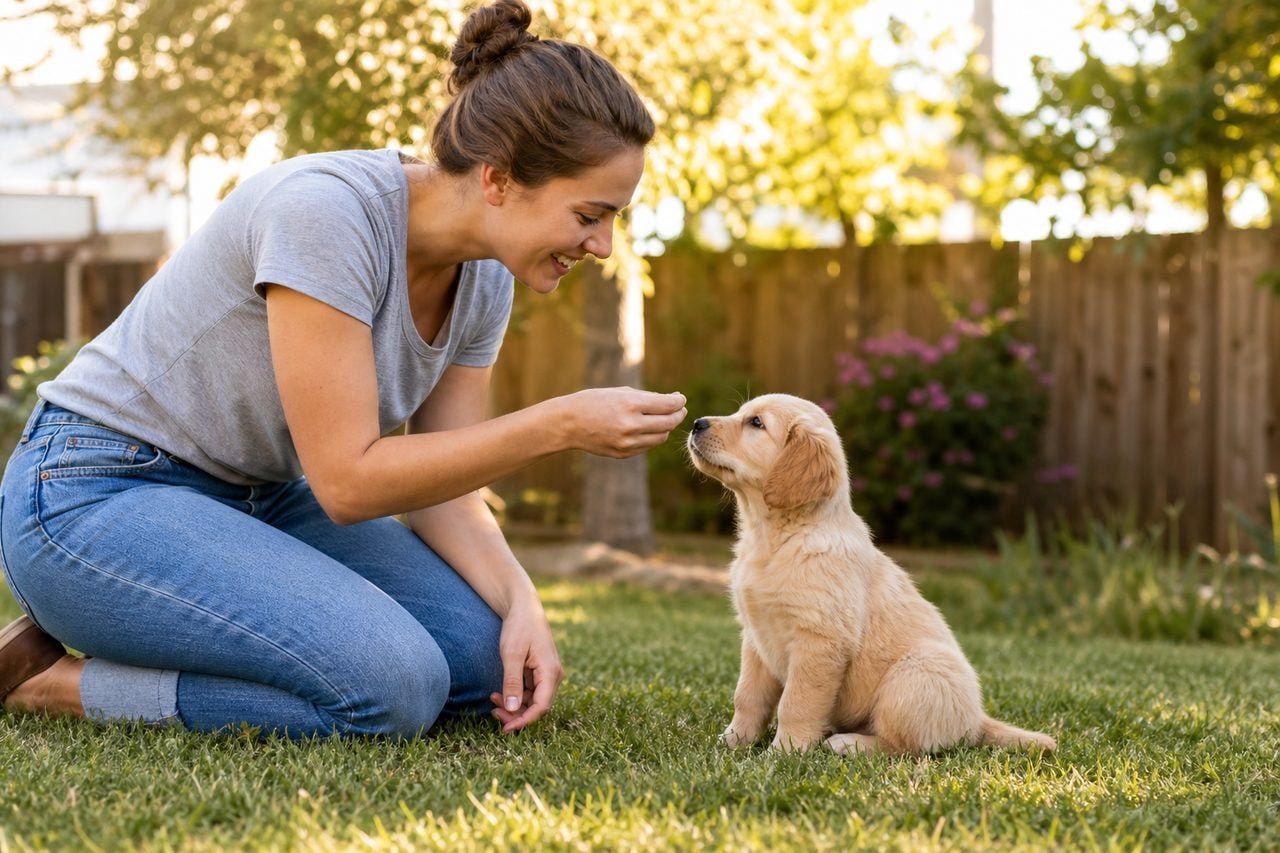
Bringing a puppy home in Terre Haute starts a clock that most owners do not realize is running. The weeks between roughly eight and sixteen weeks of age shape an adult dog’s temperament more than any amount of training that comes afterward, and they pass whether or not you use them. Families across Vigo County who wait until the chewing gets expensive or the leash-pulling gets embarrassing have not started late by a little — they have started after the easiest window has already closed behind them.
- When to Start: The Window Is Narrower Than Most Owners Expect
- House-Training and Crate Work Through a Wabash Valley Year
- Leash Manners for Parks, Trails and Campus Sidewalks
- Biting, Chewing and Surviving Adolescence
- Where Terre Haute Owners Actually Take a Puppy
- Choosing Between Group Class, Private Lessons and Board-and-Train
- Building a First-Year Plan — and When to Look Toward Indianapolis
- Reviewed trainers
- FAQ
The encouraging part is that the Wabash Valley is better equipped for early puppy work than a metro this size usually is. Terre Haute sits on the east bank of the Wabash River at the Illinois line, with Indiana State University downtown and Rose-Hulman Institute of Technology on the north side, which means a steady population of students, faculty and young renters raising dogs in apartments alongside long-settled families in the older industrial neighborhoods. That mix has supported a handful of genuinely capable trainers, several of them with decades of experience, plus a park system — Deming Park, Dobbs Park & Nature Center, Fowler Park, Hawthorn Park and the paved National Road Heritage Trail — that gives you real places to practice instead of one fenced patch of grass.
This guide walks through what to teach and when, how to use the metro’s public spaces without overwhelming a young dog, which Terre Haute trainers actually run puppy programs, and the honest cases where an owner here is better off driving the seventy-five minutes east on I-70 to Indianapolis for a niche specialist.
When to Start: The Window Is Narrower Than Most Owners Expect
Puppy training does not begin with a class. It begins the hour your puppy walks through the door, because everything that happens from that point forward is teaching something — whether jumping gets attention, whether crying in the crate gets the door opened, whether the kitchen counter is worth investigating. A puppy is learning continuously at eight weeks. The only question is whether the lessons are the ones you chose.
The developmental period that matters most runs from roughly three weeks to sixteen weeks, and you typically get your puppy partway through it, around eight weeks. That leaves about two months of prime learning time. During this stretch a puppy forms lasting impressions about what is normal and safe: vacuum cleaners, men in work boots, the hiss of air brakes on US-40, kids on scooters along the National Road Heritage Trail, the elevator in a downtown apartment building near Indiana State. Experiences banked now cost you almost nothing. The same experiences introduced at ten months, after the dog has already decided the world is unpredictable, can take months of careful counter-conditioning to undo.
Practically, that means enrolling in or booking something before the puppy is twelve weeks old, not after. Terre Haute trainers who run puppy programs generally take dogs well before the full vaccination series is finished, because the behavioral cost of waiting is understood to outweigh the controlled, sanitized risk of a well-run indoor class. Talk to your veterinarian about your specific puppy, but do not accept a blanket "wait until sixteen weeks for everything" without asking what the plan is for socialization in the meantime.
If your puppy is already past that window, none of this is wasted. Older puppies and adolescents learn perfectly well — they simply need more repetition, more management and more patience from you, and the local trainers here handle that work routinely.
House-Training and Crate Work Through a Wabash Valley Year
House-training is a schedule problem far more than a training problem. Puppies eliminate on a predictable rhythm — after waking, after eating, after play, and roughly every hour or two in between when very young — and the owners who succeed quickly are the ones who get the puppy outside before the accident rather than reacting after it. Pick one door, one route, one patch of yard, and take the puppy there on leash so the trip is about business rather than an unsupervised expedition into the mulch.
West-central Indiana weather makes this harder than the textbooks suggest. A January morning in Terre Haute can be genuinely unpleasant, and the honest failure mode is the owner who opens the back door, stands inside where it is warm, and assumes the puppy did something. It did not. It stood on the step, got cold, came back in and emptied itself on the rug ten minutes later. Put a coat on, go out with the dog, mark the moment it finishes and reward it right there. Summer brings the opposite problem: humidity in the river valley means puppies drink more and need more frequent trips, and hot pavement on afternoon walks is a real hazard for soft young pads.
The crate is the other half of the system. A crate is not a punishment and it is not a storage container — it is the tool that makes house-training possible, protects your puppy from swallowing something that requires surgery, and gives an overtired dog a place to shut down. Feed meals in it, leave the door open between sessions, and build duration in small increments rather than closing the door for four hours on night one and hoping.
For students and young renters near Indiana State, crate training also solves the apartment problem: a puppy that settles quietly in a crate is a puppy that does not become a noise complaint while you are in class.
Leash Manners for Parks, Trails and Campus Sidewalks
Leash pulling is the single most common complaint that brings Terre Haute owners to a trainer, and it is almost always the result of a simple pattern established early: the puppy pulled, and the walk continued. Pulling worked. Every repetition since has strengthened it. The fix is unglamorous and effective — forward motion happens only when the leash is slack, and stops the instant it tightens.
Start indoors, then in your own driveway, then somewhere quiet. Do not start on a Saturday afternoon at Deming Park with squirrels, children and other dogs in every direction; that is an examination, not a lesson. Build the behavior where your puppy can actually think, and add difficulty deliberately. The paved National Road Heritage Trail is genuinely useful here because it gives you a predictable surface, a straight sightline and the option to turn around long before your dog is overwhelmed. Fowler Park and Hawthorn Park offer quieter, more rural-feeling practice; Dobbs Park & Nature Center adds wildlife scent, which is a harder distraction than most owners expect.
Equipment matters less than technique but it is not irrelevant. A well-fitted flat collar or a front-clip harness gives most puppies enough control without teaching them to lean into pressure. Retractable leads teach the opposite of what you want — they reward pulling with more distance — and they are a poor choice anywhere near traffic on US-40 or the busier campus sidewalks.
Add one more layer that Terre Haute owners tend to skip: teach your puppy to be neutral around other dogs rather than thrilled by them. A puppy that drags you toward every dog it sees is on its way to becoming a leash-reactive adolescent, because eventually one of those dogs will react badly and the frustration will curdle into something worse. Reward the puppy for looking at another dog and then looking back at you. That single habit prevents an enormous amount of later trouble.
Biting, Chewing and Surviving Adolescence
Needle-sharp puppy teeth on human skin alarm new owners more than almost anything else, and the alarm is usually misplaced. Mouthing is normal, developmentally necessary behavior, and the goal in the first months is not to eliminate it instantly but to teach the puppy how much pressure a human can tolerate. Play, and when teeth land hard, the game stops — briefly, calmly, without drama — then resumes. Over weeks the puppy learns to soften. That learned softness is the safety margin that matters for the rest of the dog’s life, because a dog that has learned to modulate its jaw is far less likely to do damage if it is ever startled or hurt.
Chewing is a management problem. Puppies chew because they are teething, bored, or under-exercised, and the answer is a combination of appropriate outlets and a house that has been puppy-proofed honestly. Cords, shoes, drywall corners and children’s toys all disappear behind closed doors or into bins. A chewing puppy that is never given the chance to practice on your furniture does not develop a furniture habit.
Then, somewhere between six and eighteen months, the adolescent slump arrives and the owner’s confidence takes a hit. Recall that worked perfectly at fourteen weeks evaporates. The dog that ignored other dogs starts barking at them. This is not the training failing — it is a normal hormonal and neurological reorganization, and the dogs that come through it best are the ones whose owners keep training through it rather than giving up and hoping.
Adolescence is also when Terre Haute trainers see the most new clients, and it is a perfectly reasonable time to get help. A few private sessions during this stage often prevent a genuine behavior case a year later.
Where Terre Haute Owners Actually Take a Puppy
The metro has a small but real set of trainers, and the puppy-specific options are concentrated in a couple of places.
Unlimited Pawsibilities, at 1209 N Fruitridge Ave, runs the broadest menu in the Terre Haute area and is the most obvious starting point for a puppy. Alongside group obedience it offers a dedicated puppy program, private and in-home training, and the full AKC ladder — Canine Good Citizen, Community Canine, AKC Urban CGC, Trick Dog and Rally — which gives a young dog a structured path to follow for a year or more rather than a single six-week class and a dead end. It also covers behavior modification for aggression, reactivity, anxiety and fear, K-9 nose work, canine agility and fitness, therapy dog training, and service dog evaluation and training, plus virtual home-manners evaluations for owners who want an assessment before committing. The trainer goes by Mariah; she is a certified trainer and an AKC Evaluator, with ten years as a veterinary assistant and more than nine years training. One thing to know upfront: this is not a board-and-train facility.
K9.5 Training Academy at 3475 Erie Canal Road operates a 10,000 square foot purpose-built facility and takes a different approach — two structured obedience packages, one a six-day program the owner attends alongside the dog, and one a twelve-day board-and-train. The facility also offers boarding, day play, grooming and vaccine clinics, which makes it convenient for owners who want several services under one roof. Owner Larry Hopper is the K9 Commander of the Vigo County Sheriff’s Office K9 Unit, a Master Trainer with DLE and a former IPWDA trainer.
VonBernd K9 Training Center at 11750 S US Hwy 41 is run by John Holcomb, who has forty-seven years in the field and a background as a full-time law-enforcement K9 handler, trainer and supervisor. He is an AKC Canine Good Citizen Evaluator and offers basic and advanced obedience, behavior and aggression work, tracking and man-trailing, service dogs and boarding. For a puppy this is a foundation-obedience option with an unusually experienced set of hands behind it.
Top Dog Training LLC, owned by Nicole Thraen, runs in-home board-and-train on an eight-acre property where dogs live in the trainer’s home, plus weekly group classes reserved for board-and-train clients. Availability has not always been open to new clients, so treat it as worth a phone call rather than a certainty. Cultivate K9 Training offers dog training as a secondary service of a working family farm and publishes no program details. Several other names circulate locally — CABP Canine Training Academy, K9 812 Terre Haute, M&B Dog Training — without published program information; a phone call is the only reliable way to learn what they currently offer.
Choosing Between Group Class, Private Lessons and Board-and-Train
For a healthy, reasonably confident puppy, a group class is usually the right first purchase. The value is not only the curriculum — sit, down, come, loose leash, settle — but the controlled exposure to other dogs, other people and a novel environment while an instructor watches your handling and corrects it in real time. You cannot get that from a video, and most owners cannot see their own timing errors without someone pointing them out.
Private and in-home lessons make sense when the problem is specific to your house, when your schedule cannot accommodate a fixed weekly class, or when your puppy is fearful enough that a room full of other dogs would do more harm than good. In-home work is particularly effective for house-training, crate issues, door-dashing and resource guarding, because the trainer sees the actual environment where the behavior happens rather than a description of it. Unlimited Pawsibilities offers both private and in-home options, and its virtual home-manners evaluations are a low-commitment way to get a professional read before you choose a format.
Board-and-train is the most intensive and most misunderstood option. A skilled trainer can put reliable obedience on a dog in a couple of weeks, and K9.5 Training Academy’s twelve-day program and Top Dog Training’s in-home model both do that kind of work. What board-and-train cannot do is train the owner, and dogs return to the household that produced the original behavior. The programs that hold up are the ones with a genuine handover — sessions where you learn to run the cues yourself, plus follow-up. K9.5’s six-day owner-attended package exists precisely because owner involvement is the variable that determines whether the results last. For a very young puppy, most trainers would steer you toward classes and private work first; board-and-train tends to fit better once a dog is a bit older.
Building a First-Year Plan — and When to Look Toward Indianapolis
The most useful thing you can do is stop thinking of training as one class and start thinking of it as a year. A workable Terre Haute plan looks roughly like this: eight to sixteen weeks, aggressive but careful socialization plus house-training, crate work and the first cues at home; four to six months, a structured puppy or beginner group class and consistent short outings to the National Road Heritage Trail, Deming Park and quieter spots like Fowler or Hawthorn; six to twelve months, keep training through adolescence and add a goal — Canine Good Citizen is the natural one, and it is available locally through AKC Evaluators at Unlimited Pawsibilities and VonBernd; twelve months onward, pick an activity that suits the dog, whether that is nose work, rally, trick training, agility or simply a very reliable off-leash recall in safe places.
Having a goal matters more than the specific goal. Owners who finish one six-week class and stop tend to watch the behavior erode over the following year. Owners who always have the next thing booked keep the dog in practice and, more importantly, keep themselves in practice.
Be honest about the metro’s limits, too. Terre Haute is strong on obedience and board-and-train, and it has genuinely experienced trainers — more than a city this size usually supports. Where the pool thins is deep, niche behavior work: severe separation anxiety, complex multi-dog aggression, veterinary behavior cases that need medication alongside a behavior plan. For those, the specialist depth is in Indianapolis, about an hour and fifteen minutes east on I-70, and that drive is a reasonable price for the right professional. Start local — the local trainers here handle a great deal, including reactivity and fear work — but do not let geography talk you out of a specialist when your dog needs one.
Owners in West Terre Haute, Brazil, Rockville, Clinton and Sullivan are generally within a comfortable drive of the Terre Haute trainers, which makes the local option the practical default for everything short of a genuine specialist case.
Reviewed Puppy Training Trainers in Terre Haute
These reviewed Terre Haute-area trainers from our directory are the local options for puppy training. Each links to a full profile with specialties, certified credentials, reviews, and contact info:
- Unlimited Pawsibilities — 4.8★ (79 reviews)
- M&B Dog Training — 5.0★ (3 reviews)
- K9 812 Terre Haute — 5.0★ (3 reviews)
- K9.5 Training Academy — 4.9★ (73 reviews)
- Top Dog Training LLC — 4.9★ (27 reviews)
- Vonbernd K9 Training Ctr LLC — 4.4★ (47 reviews)
- Cultivate K9 Training
- CABP Canine Training Acadamy
See all Terre Haute puppy training trainers →
Frequently Asked Questions
How old should my puppy be before starting training in Terre Haute?
Training starts the day you bring the puppy home, usually around eight weeks, because everything that happens is teaching something either way. For formal classes, most Terre Haute trainers will take puppies before the vaccination series is complete, since the behavioral cost of waiting outweighs the controlled risk of a well-run indoor class. Aim to have something booked before twelve weeks. Ask your veterinarian about your specific puppy, but push back on a blanket instruction to wait until sixteen weeks with no socialization plan in the meantime.
Which Terre Haute trainer runs an actual puppy program?
Unlimited Pawsibilities at 1209 N Fruitridge Ave offers a dedicated puppy program alongside group obedience, private and in-home training, and the full AKC ladder. The trainer, Mariah, is a certified trainer and AKC Evaluator with ten years as a veterinary assistant and more than nine years training. K9.5 Training Academy and VonBernd K9 Training Center both run obedience programs that suit young dogs as well, though their structures are different. Call to confirm current schedules before you plan around a start date.
Is board-and-train a good idea for a young puppy?
Usually not as a first step. Board-and-train is most effective on slightly older dogs with established habits, and very young puppies generally benefit more from group classes and in-home work where the owner is learning at the same time. K9.5 Training Academy offers a twelve-day board-and-train and a six-day program the owner attends, and Top Dog Training runs an in-home board-and-train model. If you do choose board-and-train, the handover sessions matter more than the training days.
Where can I safely socialize a puppy around Terre Haute?
Deming Park, Dobbs Park & Nature Center, Fowler Park, Hawthorn Park and the paved National Road Heritage Trail all work well, provided you go at quiet times and keep sessions short. Sidewalk work near the Indiana State campus is useful for exposure to foot traffic, skateboards and bicycles. Avoid dog parks and heavily used areas until your veterinarian clears your puppy, and prioritize calm observation from a distance over close contact with unknown dogs.
My puppy bites hard. Is something wrong?
Almost certainly not. Mouthing is normal, developmentally necessary behavior in young puppies, and the goal is to teach pressure control rather than eliminate it overnight. When teeth land hard, the game stops briefly and calmly, then resumes — over weeks the puppy learns to soften. If the biting is accompanied by stiffness, growling over food or resources, or genuine intent rather than play, that is worth a professional evaluation sooner rather than later.
When should I look outside Terre Haute for help?
Local trainers handle a great deal, including reactivity, fear and aggression work — Unlimited Pawsibilities and VonBernd K9 Training Center both take behavior cases. Where the metro thins out is deep specialist work: severe separation anxiety, complicated multi-dog aggression, or cases that need veterinary behavior medicine alongside a training plan. Indianapolis is about an hour and fifteen minutes east on I-70 and has a much deeper specialist pool. Start local, and escalate when the case genuinely calls for it.
Related: read our complete puppy training guide or the full Terre Haute dog training overview.
Ready to find the right puppy training pro in Terre Haute?