
Board & Train in Jackson, MI
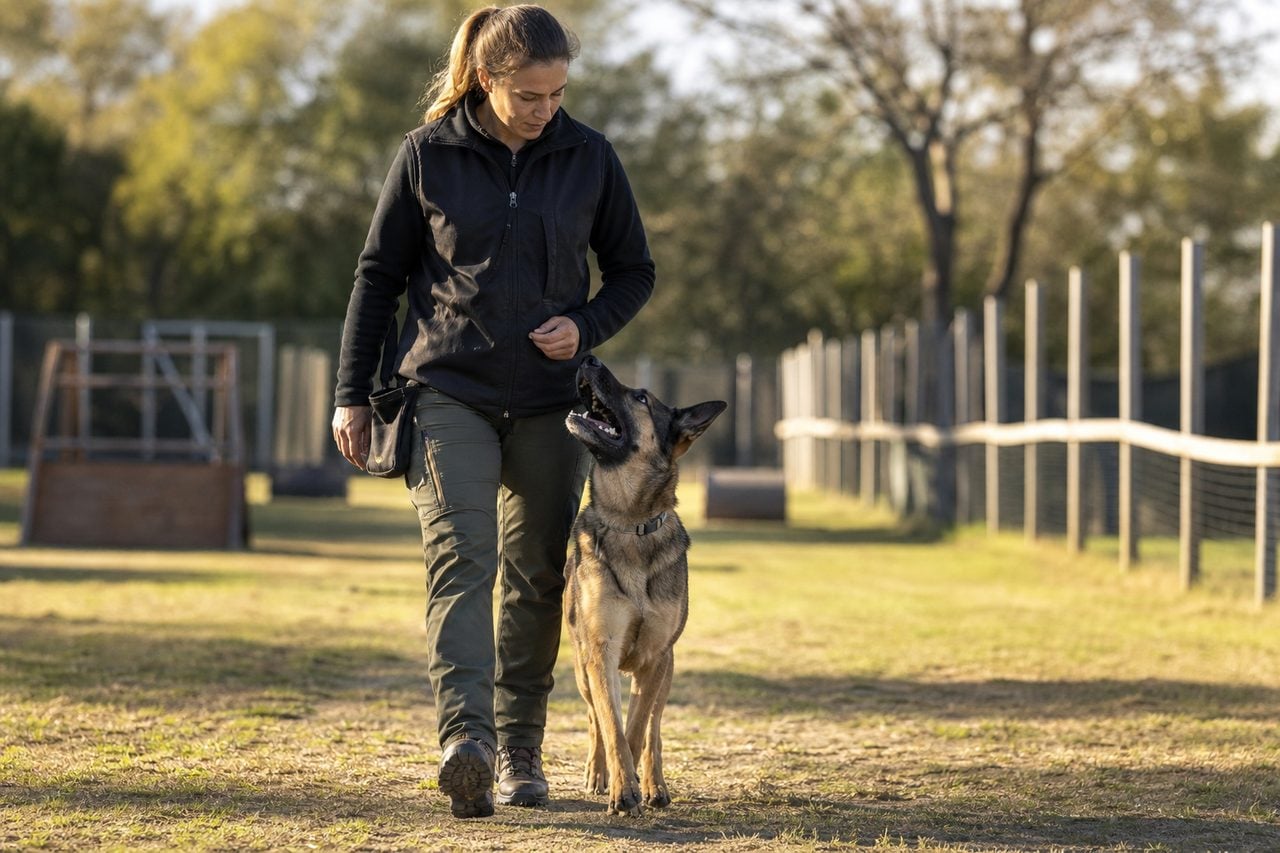
Board and train programs ask a lot of a Jackson family. You hand your dog to a professional for a stretch of days or weeks, the dog lives on-site, and the training happens without you in the room. For the right household and the right dog, that trade can be worth it: an intensive, distraction-controlled block of work often moves faster than a once-a-week group class squeezed between school pickups and shifts at the plant. For the wrong situation, it can be an expensive way to postpone the real work, which is you learning to handle the dog you get back.
- What board and train actually means
- When a board and train is the right call in the Jackson area
- How to vet a facility before you hand over your dog
- What a fair program includes
- Methods, tools, and asking the right questions
- Bringing the training home to Jackson
- Costs, timelines, and setting honest expectations
- Reviewed trainers
- FAQ
This guide is written for owners in Jackson, Spring Arbor, Michigan Center, Napoleon, Brooklyn, Grass Lake, and the smaller towns across Jackson County who are weighing an in-kennel program. It covers what board and train actually is, when it fits, how to vet a facility, what a fair program includes, and how to protect the results once your dog is home walking the Falling Waters Trail with you again. Local supply for true board and train is thin in the immediate Jackson area, so the honest picture includes the reality that some owners look east toward the larger Ann Arbor and Detroit specialist pool, roughly forty minutes down I-94, for certain programs.
The goal here is a clear-eyed decision, not a sales pitch. A good board and train can be transformative. A poorly chosen one can set a dog back. Knowing the difference is most of the battle.
What board and train actually means
Board and train, sometimes called in-kennel or immersion training, means your dog stays at a trainer’s facility or home for a defined period while the trainer works the dog daily. The length varies widely. Some programs run two weeks, others three or four, and specialized behavior programs can run longer. The dog eats, sleeps, and trains in the same environment, which lets the trainer control the variables that a weekly class never can.
The appeal is concentration. Instead of twenty minutes of practice on a good day at home, the dog gets multiple structured sessions daily, plus the incidental learning that comes from living under clear rules. A skilled trainer uses that time to build reliable responses to core cues, reduce problem behaviors, and expose the dog to controlled distractions in a deliberate order.
What board and train is not is a repair shop. You do not drop off a broken dog and collect a fixed one. Dogs are not appliances, and behavior is contextual. A dog that heels beautifully on a trainer’s property in Concord still has to learn that the same rules apply in your kitchen, on your street, and at Ella Sharp Park with kids and other dogs around. That transfer is the owner’s job, and it is why the handoff at the end matters as much as the training in the middle.
There is also a range in philosophy. Some programs lean heavily on food, markers, and reward-based methods. Others incorporate correction tools. The label board and train tells you the format, not the methods, so you have to ask specifically what happens when the dog gets it right and what happens when the dog gets it wrong.
When a board and train is the right call in the Jackson area
Board and train earns its cost in a few clear situations. The first is a genuine time crunch. If your work and family schedule realistically cannot support daily practice for the next couple of months, and you would rather invest money than time, an immersion program can front-load the work. This is common for households with long commutes toward Ann Arbor or Lansing, shift workers, and families in the middle of a move or a new baby.
The second is a specific, defined skill goal. Owners who want a solid recall for off-leash hikes on the Falling Waters Trail, reliable leash manners for busy sidewalks, or a dependable place and stay for a dog that mobs guests are good candidates. These are trainable behaviors with a clear finish line, and a focused block of daily work suits them well.
The third is early intervention on a young dog headed the wrong direction. A juvenile that is starting to pull hard, ignore cues, and test boundaries can benefit from an intensive reset before the habits set, provided the program includes real owner coaching afterward.
A fourth situation worth naming is the multi-dog or multi-goal household that has simply fallen behind. When life gets busy and a dog’s training slips across the board, trying to fix everything at once at home can feel impossible. An immersion program resets the baseline and gives you a single coherent system to maintain, rather than a patchwork of half-learned cues. That fresh, consistent foundation is sometimes worth more than the specific behaviors themselves.
Board and train is a weaker fit for serious behavior problems rooted in fear or aggression. Those cases need a behavior-focused approach, careful assessment, and often a veterinary component, and they do not reliably resolve in a fixed two-week package. If a facility promises to cure aggression or severe anxiety in a short residential stay, treat that as a warning sign rather than a solution. For those cases, read our companion guidance on behaviorists, and be prepared to travel east for specialist help.
How to vet a facility before you hand over your dog
Vetting is where owners either protect their dog or get burned. Start by visiting in person. A trustworthy operator will let you see where dogs are housed, how they are exercised, and how they are handled. Be cautious of any program that keeps the kennel area off-limits or gives vague answers about daily routine.
Ask direct questions and expect direct answers. What methods and tools do you use, and why. What does a typical training day look like. How many dogs are on-site at once, and how much individual attention will mine get. Who handles my dog if you are away. What is your plan if my dog stops eating, gets sick, or is injured. A confident professional welcomes these questions.
Ask about credentials and continuing education. Certifications from recognized organizations, membership in professional bodies, and a habit of ongoing learning are all positive signs. None of these guarantee skill, but a total absence of them, paired with grand promises, is a red flag.
Request references and, ideally, video of the specific behaviors they train. Watch how the dogs in those videos look. Are they engaged and relaxed, or shut down and stiff. A dog that is compliant but visibly stressed is not a training win.
Finally, understand the contract. Know the total cost, what is and is not included, the vaccination and health requirements, the policy on injuries or illness, and exactly what follow-up support you receive after pickup. Because true board and train options are limited close to Jackson, some owners widen the search toward the Ann Arbor and Detroit corridor to find a facility whose methods and housing they are comfortable with. Traveling forty minutes for the right fit beats settling for the wrong one nearby.
What a fair program includes
A well-run board and train is more than daily drills. Look for structure across the whole engagement, not just the dog’s stay.
- An honest intake assessment. The trainer should evaluate your dog and your goals before quoting a program, and should be willing to say if board and train is not the right tool for your situation.
- A clear training plan. You should know which behaviors will be worked, roughly in what order, and how progress will be measured.
- Regular updates. Photos, short videos, or written notes during the stay keep you connected and let you see the methods in action rather than only the finished result.
- Proofing against real distractions. Behaviors trained only in a quiet kennel yard rarely survive contact with a busy Jackson sidewalk. Good programs deliberately add difficulty.
- Owner transfer sessions. This is non-negotiable. Before or at pickup, the trainer teaches you to give the cues, hold the standard, and troubleshoot. Without this, the results decay fast.
- Follow-up support. Included follow-up lessons, a support window, or a go-home plan help you carry the training into daily life at home and on local trails.
Be wary of programs that are all board and no train in practice, where dogs spend most of the day in a kennel with a couple of short sessions tacked on. Ask concretely how many minutes of active training and enrichment your dog gets per day, and how the rest of the day is structured. Rest matters, but you are paying for skilled work, not just boarding. A vague answer here, or a reluctance to put numbers to the daily routine, usually means there is less training in the day than the marketing implies.
Methods, tools, and asking the right questions
The training world contains a genuine spectrum of methods, and reasonable professionals disagree. As an owner, your job is not to become an expert in learning theory but to understand what will be done to your dog and to make an informed choice you can live with.
Ask what the trainer does to mark and reward correct behavior. Food, toys, praise, and marker words or clickers are common and effective. Then ask what happens when the dog makes a mistake or refuses. Some trainers rely on withholding reward and resetting. Others use leash corrections, prong collars, or electronic collars. Each of these has advocates and critics, and the way a tool is used matters more than the tool itself. A prong collar in skilled, humane hands is a different thing than the same tool used to punish a confused dog.
Watch for two extremes. One is the trainer who promises fast, dramatic obedience and is vague about how they get it. The other is the trainer who is dogmatic to the point of refusing to adapt to your dog. What you want is someone who explains their approach clearly, adjusts to the individual animal, prioritizes the dog’s welfare, and can show you calm, willing dogs as evidence.
It is also fair to ask how the trainer will keep you informed and how they measure whether your dog is enjoying the work. A dog that trains willingly, with a loose body and genuine engagement, learns faster and retains more than one that complies out of pressure. Ask the trainer to describe what a happy, working dog looks like to them. The answer reveals a great deal about their priorities and whether welfare sits at the center of their program or on the margins.
If a facility will not let you see a tool used, will not explain corrections plainly, or bristles at questions, that tells you something. You are entrusting a living animal to this person for weeks. Clarity is the minimum you should accept.
Bringing the training home to Jackson
The most common way board and train fails is not in the kennel. It fails in the weeks after pickup, when a trained dog lands back in an untrained routine. The dog learned that structure produces good outcomes; if home has no structure, the dog reasonably concludes the old rules are back.
Protect your investment by treating the first weeks home as a continuation of the program, not a graduation party. Keep sessions short and frequent. Practice the cues in the exact places you struggle: your entryway when guests arrive, the driveway, the sidewalk, the parking lot at a local park. Add distraction gradually rather than testing everything at the busiest corner on day one.
Hold the standard consistently across everyone in the house. If one person lets the dog blow off a cue, the dog learns that the cue is optional. Agree as a family on the rules and the words before the dog comes home.
Use Jackson’s outdoor spaces as your training gym once the basics are solid. A calm loop of the Falling Waters Trail, a controlled walk near Cascades Falls at a quiet hour, or practice sessions at Ella Sharp Park give you graduated real-world difficulty close to home. Keep the leash on and expectations realistic until the dog proves reliable in each new setting.
Plan the first day home deliberately rather than letting it become a chaotic reunion. Bring the dog back to a calm house, reintroduce the routine the trainer used, and resist the urge to immediately invite friends and family over to see the new well-behaved dog. That excitement floods a freshly trained dog and teaches it that the rules relax at home. Give the dog a few low-key days to settle into the new normal before adding social pressure.
It also helps to keep a short written log for the first couple of weeks: which cues held, where the dog struggled, and what triggered any slips. Patterns emerge quickly, and a log turns a vague sense that things are sliding into a specific, fixable list. When you use your follow-up lesson, that record lets the trainer target the exact gaps instead of guessing.
If you hit a wall, use the follow-up support you paid for. A short tune-up lesson early beats letting a small slip become a re-entrenched habit. Across the Jackson area, local ordinances govern leashing and dog control, so keep your dog leashed where required and treat every public outing as both a walk and a rehearsal.
Costs, timelines, and setting honest expectations
Board and train is usually one of the more expensive training options because you are paying for daily professional labor plus housing and care over a continuous period. Rather than fixate on a single number, evaluate value: what is included, how much individual work the dog gets, and what support carries you afterward. Two programs at similar prices can differ enormously in what your dog actually receives.
On timelines, be realistic. A two-week program can build a strong foundation and noticeably change a dog’s manners, but it will not erase years of practiced behavior or resolve deep fear. Longer programs do more, but even the best residential work needs weeks of owner follow-through to become durable. Anyone guaranteeing a permanent fix in a short stay is overselling.
Set your expectations around a partnership. The trainer builds the skills and shows you the mechanics; you maintain and generalize them at home. Measured that way, board and train is not a shortcut around your involvement. It is a way to compress the hardest early phase into a focused block, so that your ongoing work starts from a much better place.
Because dedicated in-kennel programs are limited immediately around Jackson, factor travel into your planning. If the strongest fit for your dog and your comfort with methods sits in the Ann Arbor or Detroit area, the drive is a one-time cost against weeks of daily professional work. Choose the program on quality, methods, and follow-up first, and let location be a secondary factor rather than the deciding one.
Board & Train in Jackson: Local Options & Nearest Specialists
A few Jackson-area trainers can help with milder board & train needs:
- Divinity K9 — 4.9★ (136 reviews)
Nearest board & train specialists — Ann Arbor
For complex cases, some families travel to the larger pool of specialists in the Ann Arbor area for an assessment or a board-and-train stay. Top-reviewed options:
- The Dog Wizard Ann Arbor — 5.0★ (152 reviews)
- Szegi Haus K9 Solutions — 4.7★ (75 reviews)
See all Ann Arbor board & train trainers →
Frequently Asked Questions
How long should a board and train program last?
It depends on the goals and the dog. Foundation obedience programs commonly run two to three weeks, while more involved work can run longer. Shorter is not automatically worse, but be skeptical of very short stays that promise dramatic, permanent change. Whatever the length, the durable results come from the owner follow-through in the weeks after pickup, so judge a program partly by how much it invests in teaching you.
Will my dog forget me or bond to the trainer instead?
No. Dogs form lasting attachments to their families and readily re-engage with owners after a residential stay. A good trainer actually wants your dog bonded to you, since you are the one who has to handle the dog for years. The transfer sessions at the end are designed to shift the working relationship back to you, which is exactly why an included owner handoff is so important.
Is board and train a good option for aggression or severe anxiety?
Usually not as a standalone fix. Serious fear and aggression are behavior problems that need careful assessment, often a veterinary workup, and a plan built around the individual dog rather than a fixed residential package. Be very cautious of any facility promising to cure aggression in a short stay. For those cases, a qualified behaviorist is the better starting point, and some Jackson owners travel toward Ann Arbor or Detroit for that level of specialist help.
What should I ask before choosing a facility near Jackson?
Ask to visit in person and see where dogs are housed and worked. Ask what methods and tools are used and what happens when the dog makes a mistake. Ask how many dogs are on-site, how much individual attention yours will get, and what the health and emergency plan is. Request references and video of the specific behaviors they train, and confirm exactly what owner coaching and follow-up support are included.
How do I keep the training from fading once my dog is home?
Treat the first weeks home as part of the program. Practice the cues in the specific places you struggle, add distraction gradually, and keep every member of the household holding the same standard. Use local spots like the Falling Waters Trail or Ella Sharp Park as graduated real-world practice once the basics are solid, and book a follow-up tune-up early if something starts to slip rather than waiting.
Are there board and train options right in Jackson, or do I need to travel?
Dedicated in-kennel programs are relatively thin in the immediate Jackson area, so options may be limited close to home. Many owners widen the search east along I-94 toward the larger Ann Arbor and Detroit specialist pool, roughly forty minutes away, to find a facility whose methods, housing, and follow-up they are comfortable with. Choose on quality and approach first, and treat a one-time drive as a reasonable trade for the right program.
Related: read our complete board & train guide or the full Jackson dog training overview.
Ready to find the right board & train pro in Jackson?