
Puppy Training in Columbus, IN
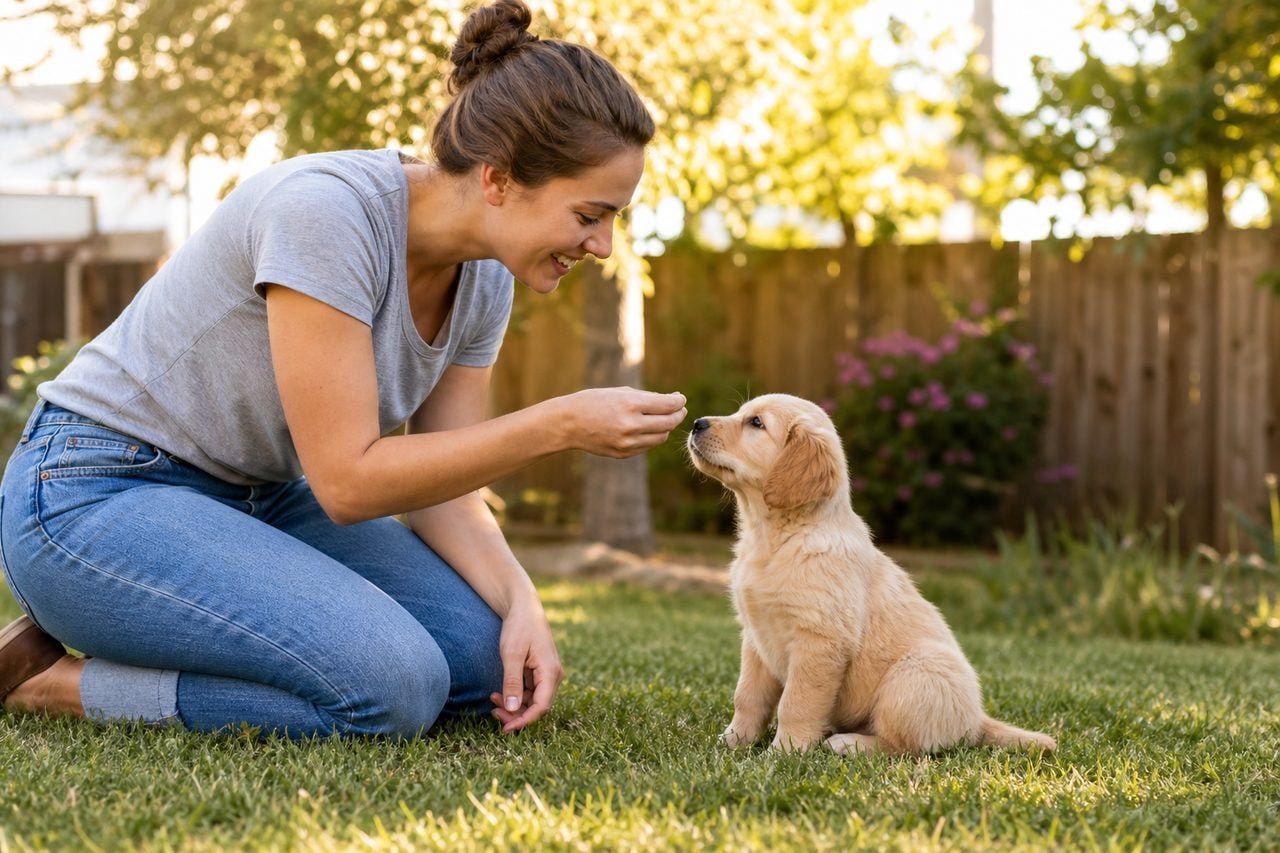
A new puppy in Columbus, Indiana lands in a town that is unusually easy to raise a dog in — and unusually easy to get wrong. Bartholomew County is compact enough that a fifteen-minute drive covers most of it, the Columbus People Trails run paved and connected through much of the city, and Mill Race Park sits right where the Flatrock and Driftwood rivers meet to form the East Fork White River. Add a downtown full of Saarinen-era modernist buildings that draws visitors year-round, and your puppy is going to meet the world early and often whether or not you planned for it. Training is how you decide what those first meetings teach him.
- What puppy training in Columbus actually covers
- When to start — the socialization window versus the vaccination worry
- Group class, private lessons or day school: picking a format
- House-training that survives an Indiana winter
- Leash manners for the People Trails and Mill Race Park
- Building a puppy who can be left alone
- What to ask a Columbus puppy trainer before you enrol
- Reviewed trainers
- FAQ
The professional training market here is small but real. Columbus has a certified behavior-focused trainer, a pet resort running a structured in-house school, and an obedience club-style program; Seymour, about twenty-five minutes south where I-65 crosses US-50, adds a full-service school with board-and-train and AKC testing; Greensburg has a store-based beginner class. That is enough choice to be picky — but not so much that you can wait. Class sections in a metro this size fill from a handful of seats, and the eight weeks that matter most for a puppy do not pause while you shop around.
This guide covers what puppy training actually looks like in the Columbus–Seymour area: when to start, which format fits which household, how to handle house-training and leash manners in local conditions, and what to ask a trainer before you hand over a deposit.
What puppy training in Columbus actually covers
Most people book a puppy class expecting to teach sit, down and stay. Those are in there, and they are the easiest part. What a good puppy program in Columbus is really doing is spending six to eight weeks building three things that are much harder to install later: a dog who can be handled, a dog who can be interrupted, and a dog who thinks people are worth paying attention to when something more interesting is happening.
Handling means the puppy tolerates having his feet touched, his ears looked in, his collar grabbed, his mouth opened. Every vet visit and every nail trim for the next decade runs on this. Interruptibility means he can be called off a squirrel on the trail, dropped a chicken bone he found in a parking lot, or moved away from a toddler he is getting too rowdy with. Attention means the default when he is unsure is to look at you rather than to bark, bolt or freeze. Sit is a party trick next to those three.
Local programs organise this differently. Hot Diggity Dog in Columbus runs drop-in group classes on basic manners, which suits owners who cannot commit to the same weeknight for two months. Barkefellers in Columbus folds training into its Day School and Stay School programs at a puppy level plus level one and level two, so the puppy learns while boarding or in daycare. Guardian-K9 in Columbus runs puppy and obedience courses alongside its AKC Canine Good Citizen and therapy dog work. Dog Training With Monica in Seymour offers group classes, private lessons, in-home sessions and day school, and tests for AKC CGC and trick titles. Feeders Pet Supply in Greensburg runs a single six-week beginner class on Sundays that combines puppies and adults.
They differ in structure, not really in goal. Ask any of them what the puppy will be able to do at graduation and you should hear some version of the same answer: walk on a loose leash past a distraction, settle when asked, come when called in a low-stakes environment, and be handled by a stranger without panic.
When to start — the socialization window versus the vaccination worry
The single most common mistake Columbus owners make is waiting. A puppy’s critical socialization period runs roughly from three to sixteen weeks, and most puppies come home at eight or nine. That leaves about two months of the most important developmental window a dog will ever have — and it closes on schedule regardless of what your vaccination series is doing.
The tension is genuine. Puppies are not fully vaccinated until around sixteen weeks, and parvovirus is not a hypothetical in rural Indiana. But the veterinary behavior consensus for years now has been that behavioral problems, not infectious disease, are the leading cause of death in dogs under three years old, because unsocialized dogs get surrendered. The resolution is not to choose one risk over the other; it is to socialize in controlled places rather than uncontrolled ones.
In practice, for a Columbus puppy that means: yes to a structured puppy class where every attendee has to show vaccination records and the floor gets disinfected between sessions. Yes to a friend’s fenced yard in Hope or Taylorsville where the resident dogs are vaccinated and calm. Yes to sitting on a bench on a quiet stretch of the People Trails watching cyclists go past with the puppy on your lap rather than sniffing the ground. Yes to carrying the puppy through downtown on a Saturday so he hears traffic and voices and the odd tour group. No to the dog park. No to letting him sniff around the grass strip outside a busy pet store entrance. No to Mill Race Park during an event, where you have no idea what has been on the ground.
If you are reading this with a fourteen-week-old and no class booked, call today rather than tomorrow. If your puppy is already six months old, the window has narrowed but nothing is lost — the work simply becomes more deliberate and takes longer per behaviour.
Group class, private lessons or day school: picking a format
The Columbus metro offers all three main formats, and the right one depends far more on your household than on your puppy.
Group classes are the default for a reason. A room with six other puppies in it is a training environment you cannot recreate at home: it teaches your dog to work while other dogs exist, which is the entire skill most owners actually want. They are also the cheapest format per hour of instruction, and they give you a weekly deadline that makes you practice. The trade-off is that a group class runs at the pace of the group, and a puppy who is genuinely frightened of other dogs can spend six weeks rehearsing fear instead of learning. Hot Diggity Dog’s drop-in structure is useful here because you are not locked into a fixed course; Monica’s group classes in Seymour and the Feeders Pet Supply six-week Sunday class in Greensburg follow the more traditional fixed-cohort model.
Private lessons are the answer when the problem is specific, the schedule is impossible, or the puppy needs to be met where he is. Hot Diggity Dog offers private consultations, and Monica offers private and in-home sessions. In-home is particularly worth paying for when the issue is context-bound — house-training that only fails in the back hallway, door-dashing, crate screaming, resource guarding around the kitchen. A trainer standing in your actual doorway sees things you will never successfully describe over the phone.
Day training and day school sit in between: the puppy goes somewhere for the day, a professional does the repetitions, and you get handover sessions to learn what was taught. Hot Diggity Dog, Guardian-K9, Monica and Barkefellers all run some version of this. It suits households where the adults work full-time at Cummins or the hospital and genuinely cannot do three short sessions a day. The caveat is universal and worth taking seriously: a dog trained by someone else still has to be handled by you, so the transfer sessions are not an optional extra, they are the product.
House-training that survives an Indiana winter
House-training is a scheduling problem dressed up as a behaviour problem. The puppy is not confused about where to go; he is unable to hold it as long as you would like, and he has not yet learned that outside is the only option that pays.
The mechanics are the same everywhere: take the puppy out on a fixed interval rather than waiting for a signal, go to the same spot, wait, pay immediately and generously the second he finishes, and bring him back in. Feed on a schedule so that elimination happens on a schedule. Crate or tether when you cannot supervise, because a free-roaming unsupervised puppy is simply practising the wrong habit somewhere you are not looking. Clean accidents with an enzymatic cleaner, not a household one — ammonia-based products smell like a toilet to a dog.
What is local is the weather. A Columbus January will hand you a puppy who steps onto frozen concrete, refuses, and holds it until he gets back inside where it is warm. This is the most common cause of a house-training regression around here, and it is almost always misdiagnosed as stubbornness. The fixes are practical: shovel and keep clear one small designated patch so the surface is consistent, go out with him rather than putting him out, keep the trip short and high-value so the reward comes fast, and consider booties or a covered spot for a small-breed puppy. Summer has the mirror problem — a puppy who will not settle to eliminate on hot afternoon pavement, and who should not be on it anyway.
Expect it to take longer than the internet says. A reliably clean dog at four months is a lucky owner, not a normal one. Most puppies are dependable somewhere between five and seven months, and night-time dryness usually arrives before daytime reliability does.
Leash manners for the People Trails and Mill Race Park
Columbus is a walking town by Midwestern standards. The People Trails network links neighbourhoods on paved paths, Mill Race Park gives you open ground at the river confluence, and Ceraland Park east of town adds space with fewer bikes. All of that is a gift and all of it is a distraction gauntlet for an untrained puppy.
The core problem with loose-leash walking is that pulling works. The puppy pulls, he gets closer to the interesting thing, the behaviour is reinforced several hundred times before you get around to addressing it. Everything effective is a variation on making pulling stop working: stop moving when the leash tightens, reverse direction, reward the position you want rather than correcting the one you do not. Do it in your driveway before you do it on the trail, because a puppy who cannot hold position on a quiet street has no chance next to a passing cyclist.
Two trail-specific skills are worth training deliberately here. The first is a “to me” or side-change cue so that when a bike calls out behind you, you can move the dog to the far side and hold him there without a scramble. The People Trails carry a lot of cyclists and the paths are not wide. The second is a reliable disengage — look at the thing, then look back at you — because the trails run past water, waterfowl and other dogs, and a puppy who can only be physically restrained is a puppy who will be walked less and less as he gets heavier.
Equipment helps but does not substitute. A well-fitted front-clip harness gives you steering while the training takes hold; a six-foot fixed leash gives you consistent information that a retractable never will. Save the long line for open ground at Ceraland or a field, where a fifteen-foot line lets a young dog explore and still be reeled in, which is the best recall practice available to a puppy who is not yet safe off-leash anywhere.
Building a puppy who can be left alone
Separation is the training goal that people skip and then pay for. Puppies who spend their first months never alone learn that alone is an emergency, and the resulting distress is genuinely difficult and expensive to treat later.
The protocol is unglamorous. Start with the puppy in a crate or pen while you are in the room, feed him something good in there, let him out before he complains. Extend the duration, then add distance, then add door closures, then add short absences. The rule that governs the whole thing is that you come back before he panics, not after — every rehearsal of panic makes the next one arrive faster. If he is screaming, you have moved too fast; drop back a step rather than waiting him out.
Two Columbus-specific realities affect this. First, a lot of local households have someone home irregularly — shift patterns at the plants, hybrid schedules — which sounds like an advantage and often is not, because the puppy never gets a predictable pattern to learn from. Deliberately practise absences even on days when you are home. Second, daycare is available here and is not a substitute for alone-training; a dog who spends every workday at Barkefellers or in day training is still a dog who has never learned to be by himself when you take a Tuesday off.
If you already have a puppy who screams, self-injures, eliminates or destroys doorframes specifically when left, that has crossed from a training gap into a behaviour case. Hot Diggity Dog in Columbus explicitly takes separation anxiety cases — owner Lisa Korf holds CPDT-KA and IAABC-CDBC credentials — and that is the appropriate place to start locally rather than a general obedience course.
What to ask a Columbus puppy trainer before you enrol
There is no licensing requirement to call yourself a dog trainer in Indiana or anywhere else in the United States. That makes the vetting conversation your only quality control, and it does not need to be adversarial — good trainers enjoy these questions.
Ask what happens when the puppy gets something wrong. This is the question that tells you the most, because it reveals the actual method rather than the marketing language. You want a concrete answer about managing the environment, resetting, lowering criteria or removing the reward — not a vague reassurance. Ask what equipment is required and what is prohibited; a program that requires a specific tool on a twelve-week-old should explain why. Ask about class size and how many puppies share the floor at once. Ask whether vaccination records are required for every dog in the room, and what they do with a puppy who is frightened rather than excited.
Ask about credentials specifically rather than generally. Certifications exist — CPDT-KA from the Certification Council for Professional Dog Trainers, IAABC credentials for behaviour consultants — and a trainer who holds them will tell you exactly which ones and can explain what they required. Absence of letters does not make someone bad; vagueness about them is the warning sign.
Finally, ask about scope, because in this metro scope varies sharply and honestly. Dog Training With Monica in Seymour is clear that she does not take aggression or reactivity behaviour cases; Hot Diggity Dog in Columbus states that she does, including reactivity, aggression and resource guarding. A trainer telling you what they do not do is showing you professional judgement, not a limitation. If your puppy is showing early warning signs — stiffening over a food bowl, growling when approached on furniture, panicking at other dogs rather than bouncing at them — route to a behaviour-qualified professional first and take the manners class afterwards.
Reviewed Puppy Training Trainers in Columbus
These reviewed Columbus-area trainers from our directory handle puppy training. Each links to a full profile with specialties, certified credentials, reviews, and contact info:
- Dog Training With Monica — 4.8★ (110 reviews)
- Guardian-K9 — 4.7★ (103 reviews)
- Barkefellers – Columbus — 4.6★ (202 reviews)
- Feeders Pet Supply Obedience & Training
- Hot Diggity Dog — 5.0★ (14 reviews)
See all Columbus puppy training trainers →
Frequently Asked Questions
How old should my puppy be before starting training in Columbus?
Training starts the day the puppy comes home, usually at eight or nine weeks — you are teaching name response, house-training and handling from hour one. For a formal class, most Columbus-area programs take puppies from around eight to ten weeks with a first vaccination round on record. Do not wait for the full vaccine series to finish at sixteen weeks, because the critical socialization window is closing at the same time.
Is a group class or a private lesson better for a first-time puppy owner?
For most first-time owners a group class is the better starting point, because learning to work around other dogs is the skill that actually transfers to daily life, and the weekly session forces you to practise. Switch to private lessons if your schedule cannot hold a fixed weeknight, if the issue is location-specific like door-dashing or house-training, or if your puppy is fearful rather than social. Several Columbus and Seymour trainers offer both, so you can combine them.
How long does it take to house-train a puppy?
Most puppies become reliable somewhere between five and seven months old, with night-time dryness usually arriving before full daytime reliability. Consistency matters more than technique — fixed feeding times, fixed outdoor intervals and constant supervision or confinement in between. Expect a temporary regression during the first hard Indiana freeze, when a puppy refuses to eliminate on cold ground; clearing one small consistent patch and going outside with him usually resolves it.
Can I socialize my puppy at Mill Race Park before he is fully vaccinated?
You can use the environment without using the ground. Carrying a young puppy or sitting with him on a blanket or your lap lets him hear traffic, see cyclists and watch people at a distance with essentially no exposure risk. What you should avoid until the vaccine series is complete is letting him sniff, walk on or eliminate in high-traffic communal grass, and any unstructured contact with dogs whose vaccination status you do not know.
My puppy bites hard during play. Is that aggression?
Almost always no — mouthing and hard puppy biting are normal developmental behaviour, and the puppy is learning bite inhibition through feedback. The standard approach is to make the fun stop the instant teeth land too hard, redirect to an appropriate item, and make sure the puppy is not chronically overtired, since most of the worst biting happens when a puppy needs a nap. If the biting is accompanied by freezing, stiffening or growling over food, toys or resting spots, that is a different category and worth a behaviour consultation.
What should I bring to a puppy class in the Columbus area?
Bring vaccination records, a flat collar or well-fitted harness, a six-foot non-retractable leash, and a large quantity of soft, small, high-value treats — more than you think, cut smaller than you think. A mat or towel for settling work and a chew for downtime are useful. Feed a lighter meal beforehand so the puppy is hungry enough to work, and check with the specific trainer, since programs differ on equipment they prefer or prohibit.
Related: read our complete puppy training guide or the full Columbus dog training overview.
Ready to find the right puppy training pro in Columbus?