
Puppy Socialization in Columbus, IN
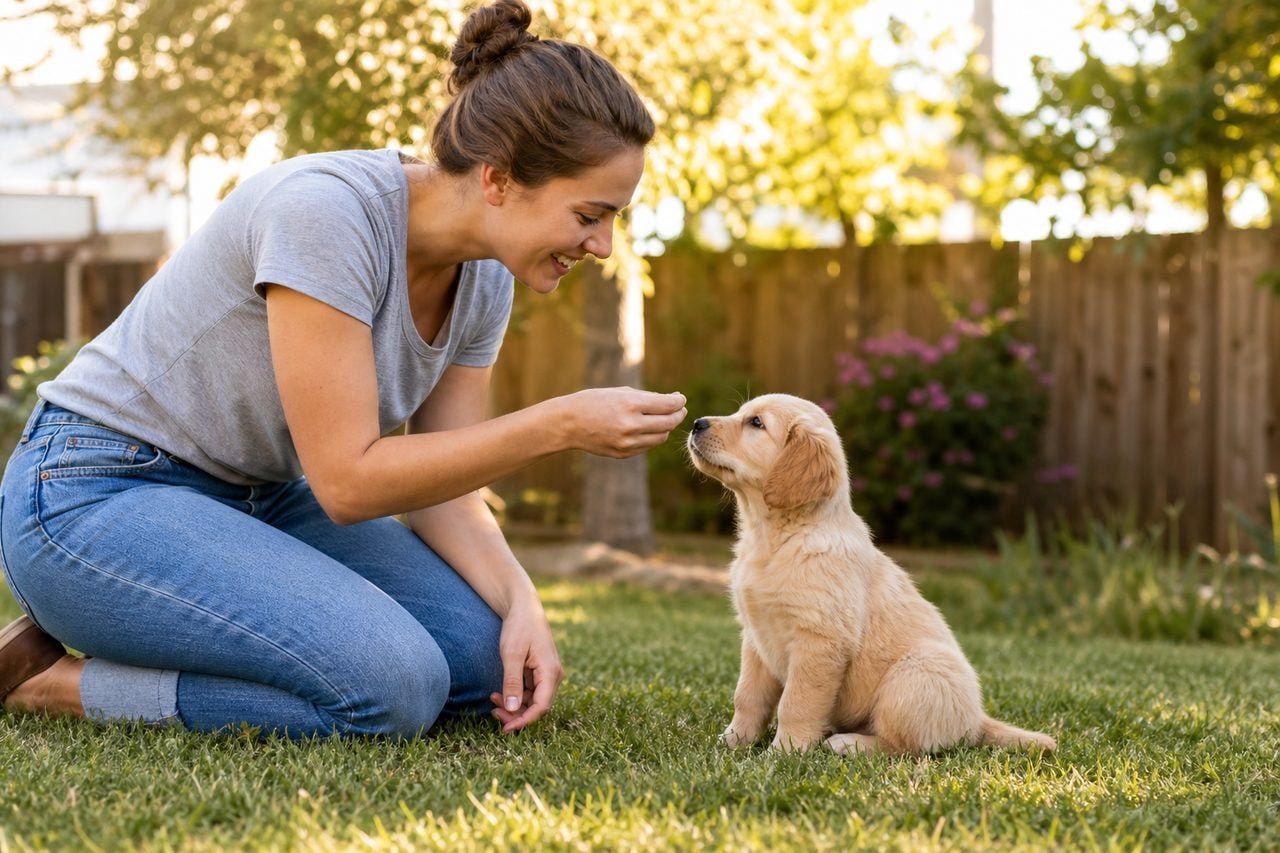
Socialization is the piece of puppy raising with the shortest deadline and the longest consequences. The window in which a puppy’s brain treats novelty as interesting rather than threatening runs roughly from three weeks to sixteen weeks of age, and most Columbus families do not meet their puppy until week eight or nine. That leaves about two months to introduce a dog to the world he is going to live in for the next twelve to fifteen years — and the clock does not stop for vaccination schedules, work travel, or a bad February.
- What socialization actually means — and what it is not
- The window: three to sixteen weeks, and what happens after
- A Columbus socialization checklist: people, surfaces and sounds
- Safe places to socialize a puppy in and around Columbus
- Dog-to-dog introductions and why puppy class beats the dog park
- Reading your puppy: stress signals and the three-second rule
- When socialization is not enough: fear, reactivity and who to call locally
- Reviewed trainers
- FAQ
The good news is that Columbus, Indiana is an unusually workable place to do it. Bartholomew County packs a lot of variety into a small radius: a downtown of internationally known modernist architecture that brings steady foot traffic and visitors, the Columbus People Trails threading paved paths through neighbourhoods, Mill Race Park at the confluence of the Flatrock and Driftwood rivers, Ceraland Park east of town, and within a half hour’s drive the railroad streets of Seymour, the courthouse square in Greensburg with its famous tower tree, and the wetlands and woods of Muscatatuck National Wildlife Refuge. A puppy can bank an enormous amount of experience here without ever sitting in traffic for an hour.
The bad news is that most owners socialize by accident and hope. This guide is about doing it on purpose: what socialization actually is, where to do it locally, how to read whether it is working, and when to stop and call a professional instead.
What socialization actually means — and what it is not
The word has been mangled. Most people hear “socialization” and picture a puppy playing with other dogs. Playing with other dogs is a small and optional part of it, and done badly it is actively harmful.
Socialization is the deliberate process of giving a puppy positive or neutral experiences with the range of people, animals, environments, surfaces, sounds, handling and events he will encounter as an adult, at an age when his nervous system is still deciding what counts as normal. The operative word is positive-or-neutral. A puppy who is frightened by an experience has not been socialized to it; he has been sensitized to it, and you now have more work than you started with.
That reframing changes what a good outing looks like. The goal is not maximum exposure, it is maximum good exposure. Ten calm minutes watching skateboarders from forty feet away while eating chicken beats two minutes in the middle of them. A puppy who observes a garbage truck from across the street and then gets fed has learned that loud trucks predict good things. A puppy who is dragged up to the truck to “get used to it” has learned that you cannot be trusted to keep him safe.
It also changes what counts as a socialization target. The list people forget is the boring one: nail clippers, a towel rubbed over the body, being lifted, being held still, a stranger looking directly at him, a hat, a beard, a walking stick, a wheelchair, a wheelie bin, a hardwood floor, a metal grate, a wobbly surface, a vacuum, a doorbell, a thunderstorm recording, a car ride that does not end at the vet. Those categories cause far more adult problems in this metro than dog-to-dog play ever does, and almost all of them can be done in your own house in five-minute sessions.
The window: three to sixteen weeks, and what happens after
Developmental windows are not switches, they are slopes. Around three weeks a puppy’s senses come online and curiosity outweighs caution. Somewhere between eight and eleven weeks most puppies pass through a fear period during which a single bad experience can leave a durable impression — which, awkwardly, is exactly when they move to a new home. By twelve to sixteen weeks caution is climbing steadily, and by sixteen weeks the default response to genuine novelty has shifted from “what is that” to “should I be worried about that.” A second, milder fear period often shows up somewhere in adolescence, between roughly six and fourteen months, and it surprises owners who thought the job was finished.
Practically, that means the eight weeks between homecoming and four months old are the highest-leverage training time you will ever have with this dog. Effort spent there is worth several times the same effort spent at eight months. This is why local trainers push people to book early and why waiting for the vaccine series to complete is a false economy.
It also means that missing the window is not a life sentence. Older puppies and adult dogs absolutely can learn that new things are safe — it just stops being casual exposure and becomes structured counter-conditioning: controlled distance, controlled duration, high-value food, and a deliberate progression. That work is slower, more technical, and much more likely to need professional help. The honest framing is that socialization before sixteen weeks is prevention and it is cheap; the same outcome after sixteen weeks is treatment and it is not.
If your puppy is already past the window, do not panic and do not flood him. The temptation to make up for lost time by taking a shy five-month-old to a busy event is the single most reliable way to make a shy dog into a reactive one.
A Columbus socialization checklist: people, surfaces and sounds
Work from a written list. Memory will quietly steer you toward the categories that are easy and away from the ones that matter.
People: men with deep voices, people in hats and hoods, sunglasses, high-visibility work clothing, people carrying boxes, someone jogging past, a child moving unpredictably, an older person moving slowly with a stick, someone in a wheelchair, a person on a bicycle, a person in a uniform. Bartholomew County gives you all of these downtown on a weekday lunch hour without any special effort.
Surfaces: grass, gravel, mulch, sand, wet concrete, metal grate, a manhole cover, a wooden deck, a rubber mat, stairs with open risers, a slick tile or vinyl floor, a swaying dock or bridge. The Columbus People Trails supply several of these in a single half-mile, and the downtown plazas add smooth stone and metal. Slick floors deserve specific attention — a dog who has never walked on polished vinyl as a puppy will remember that at the vet clinic for years.
Sounds: traffic, a train horn, a motorbike, a leaf blower, a lawnmower, sirens, fireworks, thunder, a dropped pan, a smoke alarm chirp. Seymour’s railroad heritage means real train noise is easy to find at a safe distance, and the surrounding county gives you agricultural machinery. For fireworks and thunder, recordings played at low volume during meals work well and cost nothing.
Handling and events: collar grabs, harness on and off, feet held, ears checked, teeth looked at, being brushed, being towel-dried, being weighed, standing on a raised surface, being lifted, riding in the car to somewhere pleasant, waiting calmly in a parked car for two minutes, a happy visit to the vet clinic lobby where nothing medical happens. Aim to cover a handful of items every week and tick them off; ten deliberate minutes a day comfortably clears the list before sixteen weeks.
Safe places to socialize a puppy in and around Columbus
Location choice is mostly a risk-management exercise: you want rich sensory input and low contact with unknown dogs’ waste until the vaccine series is finished.
Downtown Columbus is the best value in the metro. The architecture draws visitors, so there are people of all descriptions, but the sidewalks and plazas are hard surfaces that are far lower-risk than communal grass. A puppy sitting on a bench or in your arms for fifteen minutes near a busy corner gets more useful exposure than an hour in an empty field. The People Trails are the second workhorse — paved, connected, and full of the exact moving objects a dog needs to learn to ignore. Stay to the edge, keep the puppy off the verge until fully vaccinated, and treat every passing bike as a paid opportunity rather than a problem.
Mill Race Park and Ceraland Park are excellent later, once vaccination is complete, for open-space work and long-line recall. Before that, use their parking lots and paved paths rather than their lawns. Muscatatuck National Wildlife Refuge east of Seymour, and Jackson-Washington State Forest with Starve Hollow south of Brownstown, are worth building toward for an older puppy: they add wildlife scent, water, uneven ground and quiet, which is a completely different curriculum from a busy street. Check current leash and access rules before you go, and remember that wildlife areas mean ticks, so plan prevention with your vet.
Smaller towns are underrated. The historic square in Hope, the courthouse square in Greensburg, the outlet area at Edinburgh and the streets of Seymour and North Vernon each give you a slightly different mix of foot traffic, surfaces and noise. Rotating locations matters more than repeating one, because generalisation is the actual skill you are building.
What to avoid before sixteen weeks: dog parks, communal grass at pet store entrances, busy event days, and anywhere with visible waste. What to avoid at every age: forcing an interaction the puppy is backing away from.
Dog-to-dog introductions and why puppy class beats the dog park
Puppies do need to learn to be around other dogs. They do not need to wrestle with every dog they see, and the belief that they do is responsible for a large share of adolescent leash reactivity.
A dog park is an uncontrolled group of unknown dogs of unknown vaccination status, unknown social skill and unknown owner attentiveness. For a confident adult dog with good social skills that can be fine. For a puppy it is a lottery in which one bad ticket — a rude adult dog who pins him, a chaotic scrum he cannot escape — can produce a fear response that takes months of professional work to undo. It also teaches an expensive lesson: that seeing another dog means going to play with it immediately, which is precisely the belief behind a dog who screams and lunges on a leash at eleven months.
A structured puppy class solves the same problem with the variables controlled. Vaccination is verified, the other dogs are the same age and size range, play is supervised and interrupted before it escalates, and — the important bit — most of the session is spent teaching the puppy to work calmly while other dogs are present rather than to play with them. That is the behaviour you actually want at two years old. Group classes in this metro run through Hot Diggity Dog in Columbus on a drop-in basis, Dog Training With Monica in Seymour, Guardian-K9 in Columbus, Barkefellers’ puppy-level Day School program, and a six-week Sunday beginner class at Feeders Pet Supply in Greensburg.
Outside class, the best dog-to-dog socialization is a small number of known, vaccinated, well-mannered adult dogs who will tolerate a puppy and correct him fairly. One patient six-year-old neighbour dog teaches better manners in three sessions than a month of dog-park free-for-all. Keep sessions short, end while it is still going well, and step in before the puppy gets frantic rather than after.
Reading your puppy: stress signals and the three-second rule
Socialization only works if you can tell the difference between a puppy who is coping and a puppy who is enduring. Dogs signal discomfort clearly, but the signals are quiet and most people miss them until they escalate into something loud.
Early signs of stress: lip licking when there is no food, yawning when not tired, turning the head away, a sudden intense sniff of the ground, whale eye where the whites show, ears back and low, a tightly closed or tightly panting mouth, a lowered body, a tucked tail, shaking off as if wet when dry, sudden scratching, or refusing food he would normally take. That last one is the most useful single indicator in the field: a puppy who will not eat a piece of chicken is over threshold, full stop. Louder signs — freezing, growling, barking, lunging, snapping — mean the quiet ones were already ignored.
The practical tool is distance. If the puppy shows early signals, increase distance from whatever is causing them until he can eat, then work there. Distance is free and it is the most underused piece of training equipment in existence. Duration is the second dial: leave while it is still going well, not when he is done.
The three-second rule is worth adopting for greetings with strangers or other dogs. Allow the interaction for about three seconds, then move the puppy away and see what he does. If he strains to go back, the interaction was wanted and you can allow more. If he stays with you, sniffs the ground, or leans away, he was tolerating rather than enjoying it, and you have just spared him. This single habit prevents more damage than any other, because it moves the decision from the stranger who wants to pet the puppy to the puppy himself.
When socialization is not enough: fear, reactivity and who to call locally
Some puppies need more than a good exposure plan. Genetics, early experience before you got him, a poor start in a shelter or a hoarding situation, or a single bad event during a fear period can produce a dog whose baseline is anxious. Recognising that early and routing to the right professional is the highest-value decision an owner in this metro can make.
Signs that you are past general socialization and into behaviour territory: the puppy cannot eat in the presence of the trigger even at a large distance; he barks or lunges at other dogs or people rather than approaching or avoiding; he freezes and shuts down rather than exploring; he growls or stiffens over food, chews or resting spots; he panics rather than protests when left alone; he escalates instead of habituating over repeated calm exposures. Any of those means an ordinary manners class is the wrong tool — not because the class is bad, but because a group room full of puppies is above his working threshold, and six weeks in it will rehearse the problem.
Locally the scopes are usefully complementary and both trainers are clear about them. Hot Diggity Dog in Columbus explicitly takes behaviour cases including reactivity, separation anxiety, aggression and resource guarding; owner Lisa Korf holds CPDT-KA certification from the Certification Council for Professional Dog Trainers and the IAABC-CDBC behaviour consultant credential. Dog Training With Monica in Seymour is equally explicit that she does not take aggression or reactivity cases, focusing instead on group classes, private and in-home lessons, day school, board-and-train and AKC Canine Good Citizen and trick testing. That is not a ranking — it is a map. Take a behaviour case to the behaviour consultant and a manners goal to whichever program fits your schedule.
Involve your veterinarian too. Pain, gastrointestinal discomfort and thyroid issues all present as behaviour change, and a fearful puppy who is also physically uncomfortable will not respond to a behaviour plan alone. Rule out the body before you spend months working on the mind.
Reviewed Puppy Socialization Trainers in Columbus
These reviewed Columbus-area trainers from our directory handle puppy socialization. Each links to a full profile with specialties, certified credentials, reviews, and contact info:
- Dog Training With Monica — 4.8★ (110 reviews)
- Guardian-K9 — 4.7★ (103 reviews)
- Barkefellers – Columbus — 4.6★ (202 reviews)
- Feeders Pet Supply Obedience & Training
- Hot Diggity Dog — 5.0★ (14 reviews)
See all Columbus puppy socialization trainers →
Frequently Asked Questions
When does the puppy socialization window close?
The critical period runs from roughly three weeks to sixteen weeks of age, with caution rising steadily from around twelve weeks. Since most puppies come home at eight or nine weeks, you typically have about two months of prime time. Socialization after sixteen weeks still works, but it shifts from casual exposure to structured counter-conditioning and takes considerably longer.
Can I socialize my puppy before he is fully vaccinated?
Yes, and you should — you simply control where. Carrying the puppy, sitting with him on a blanket, and using hard surfaces like downtown Columbus sidewalks and paved People Trails gives you rich exposure with minimal disease risk. Avoid communal grass, dog parks and any area with visible waste until your veterinarian confirms the vaccine series is complete.
Is the dog park a good place to socialize a puppy?
No. Dog parks put an unvaccinated or partly vaccinated puppy in an uncontrolled group of unknown dogs, where one rough encounter during a fear period can create a lasting problem. They also teach the puppy that every dog he sees is a play opportunity, which is the root of a lot of adolescent leash reactivity. A supervised puppy class or a few known, vaccinated, well-mannered adult dogs is a far better use of the window.
How much socialization does a puppy need each day?
Quality beats volume. Ten to fifteen focused minutes a day, split into short sessions and rotated across different categories — people, surfaces, sounds, handling, environments — is plenty for most puppies. Watch for tiredness and stress signals; an overtired puppy stops learning and starts biting, and a session that ends badly does more harm than a session skipped.
My puppy hides behind me when strangers approach. What should I do?
Respect it and add distance. Do not let people reach for a puppy who is retreating, and do not hold him still to be petted — both teach him that hiding does not work and that you will not protect him. Instead have strangers ignore him while you feed him at whatever distance he can still eat, and let him choose to approach. If he consistently cannot eat near people, or if hiding turns into growling or barking, book a behaviour consultation rather than pushing on.
Where are good places near Columbus to take a young puppy?
Downtown Columbus sidewalks and plazas give the best mix of people and hard surfaces, and the Columbus People Trails add bikes, joggers and strollers on paved ground. Once vaccination is complete, Mill Race Park at the river confluence and Ceraland Park east of town offer open space, and Muscatatuck National Wildlife Refuge near Seymour or Jackson-Washington State Forest south of Brownstown add a completely different set of scents, terrain and quiet. Rotating locations matters more than repeating one, and you should check current leash and access rules before visiting public land.
Related: read our complete puppy socialization guide or the full Columbus dog training overview.
Ready to find the right puppy socialization pro in Columbus?