
Puppy Socialization in Richmond, IN
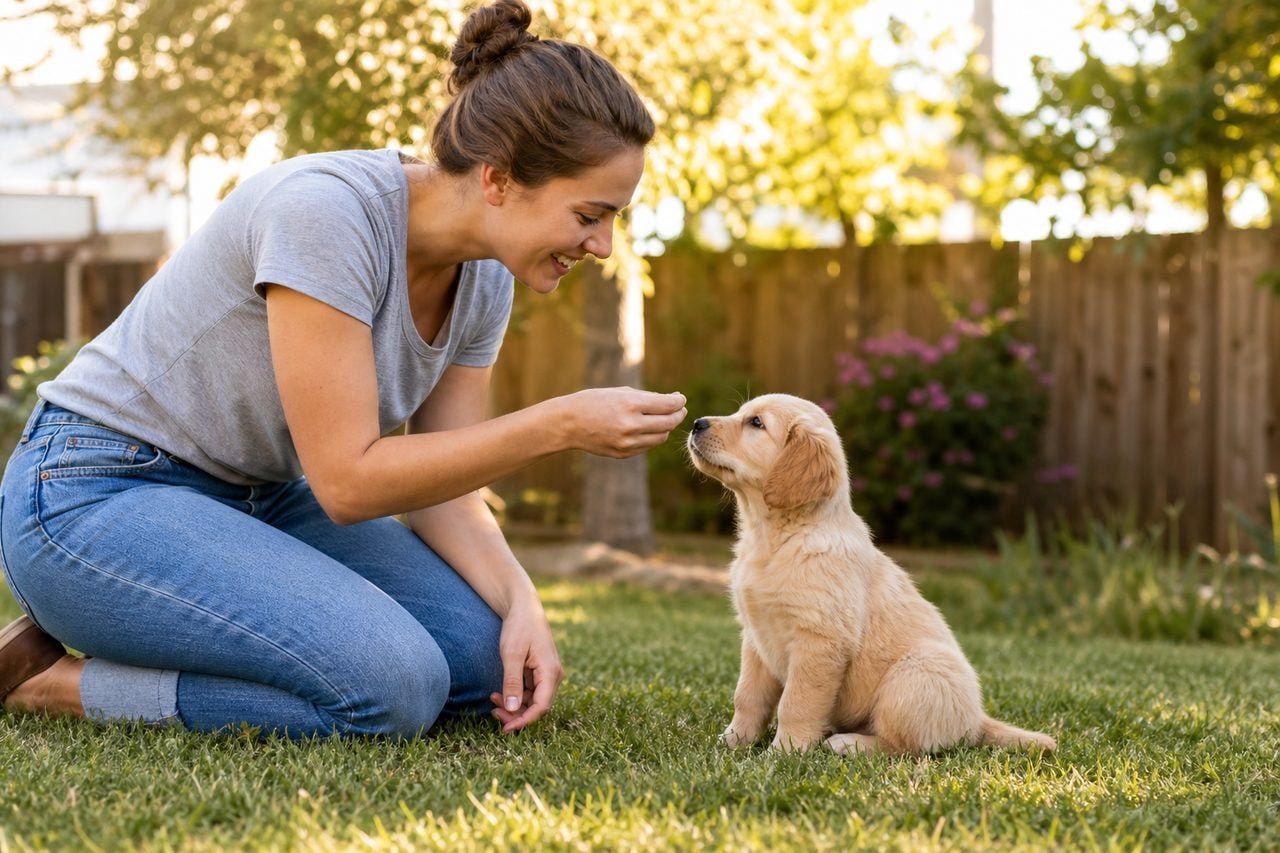
Socialization is the most misunderstood word in dog training. Most people hear it and picture puppies playing together, which is roughly ten per cent of what the term actually means and the part that goes wrong most often. What it really describes is a systematic project: teaching a young dog, during a short developmental window, that the ordinary world is safe and boring.
- Socialization is not playtime, and the difference matters
- Quality, distance and the puppy's own opinion
- A Richmond exposure list you can actually work through
- People are the exposure most puppies are short of
- The vaccination window, honestly handled
- Winter, distance and the two local constraints
- How to tell whether it is working, and what to do if it is not
- Reviewed trainers
- FAQ
In Richmond that project has a specific shape, because the world a Wayne County puppy has to learn is a particular one. It is a small city with a busy National Road corridor running through the middle of it, two college campuses that empty and fill on an academic calendar, a river gorge with echoing acoustics, farm country on three sides with livestock and machinery, and an Ohio state line six miles east that means a fair number of local dogs will spend their lives crossing between two states’ worth of vet clinics, parks and traffic. This page is about building that exposure list deliberately rather than hoping the dog picks it up.
Socialization is not playtime, and the difference matters
The single most common mistake is to equate socialization with dog-to-dog play. Owners set out to socialize a puppy and interpret that as arranging as much contact with other dogs as possible, ideally at a dog park.
The problem is that unstructured play with unknown dogs teaches a puppy two lessons you do not want: that every dog it sees is a play opportunity, and — if a rough encounter happens — that other dogs are frightening. The first produces the adolescent that screams and lunges on leash out of pure frustration, which owners then describe as aggression. The second produces genuine fear.
What socialization actually means is neutral exposure to the full range of things a dog will meet in its life, at an intensity the puppy can handle, paired with good outcomes. Sounds, surfaces, sights, people of different sizes and appearances, vehicles, handling, being alone, and yes, other dogs — but calm, known, appropriate ones, and often at a distance rather than nose to nose.
The goal is a dog that notices a thing and does not care. Boredom is the target emotion. A puppy that can lie down on a sidewalk while the world goes past has been socialized far better than one that has body-slammed forty strangers’ dogs at a park.
Quality, distance and the puppy's own opinion
The mechanics are simpler than they sound and they revolve around three things: distance, duration and the puppy’s body language.
Distance is the dial you turn. If a puppy is worried about a passing truck, you do not move closer to prove it is fine; you move further away until the puppy can watch and eat, then close the gap over sessions. Every exposure should happen at a distance where the puppy can still take food and still choose to look at you.
Duration is shorter than owners think. Two or three minutes of good exposure beats twenty minutes of overwhelm. A puppy that has stopped taking treats, gone still, started panting oddly, tucked its tail, yawned repeatedly or tried to leave is telling you the session ended a while ago.
Consent is the third piece. Let the puppy approach things rather than carrying it into them. A puppy that walks toward a strange man in a hat under its own power learns something completely different from a puppy that is handed to him.
Pair, do not flood. A new thing appears, food happens. The new thing goes away, food stops. Done a few dozen times, this builds a dog that sees novelty and looks at you expectantly instead of bracing.
And if a puppy is genuinely frightened, retreat is not spoiling it. You cannot reinforce fear by adding distance; you can absolutely deepen it by holding a puppy in place until it stops struggling.
A Richmond exposure list you can actually work through
Generic checklists tell you to expose a puppy to “traffic” and “crowds.” Here is what that means concretely in Wayne County, ordered roughly from easy to hard.
- Quiet residential streets in the county towns — Centerville, Cambridge City, Hagerstown — where a puppy can walk a whole block with nothing happening.
- A parked car near a busy road. Windows cracked, engine off, puppy on a lap or in a crate, watching National Road traffic go past for five minutes with food raining down.
- Hard and strange surfaces. Metal grates, gravel, wet grass, a boardwalk, the ramp of a trailer. Farm-country dogs meet all of these.
- Rural sound and smell. Livestock at a distance, grain equipment, a tractor on a section road, gunshots in hunting season. These are unavoidable in this county and much easier introduced deliberately.
- The Cardinal Greenway on a quiet morning. Bicycles approaching from behind is a specific skill; the Greenway lets you practice it with predictable geometry and easy escape distance.
- Glen Miller Park from the edge. Sit on the perimeter and watch the disc golf, the dogs and the kids from fifty yards before ever going into the middle.
- The Whitewater Gorge trail. Uneven rock, water noise, wildlife scent, echo under the trees — a genuinely different sensory environment ten minutes from downtown.
- College-adjacent sidewalks. Skateboards, backpacks, groups of young adults, doors opening — and a term-time schedule that means the same street is a different place in August than in July.
- Vet and grooming visits with no procedure. Walk in, get weighed, eat something good, leave.
People are the exposure most puppies are short of
Ask a puppy owner whether their dog is socialized to people and they will usually say yes, because the puppy has met the family and the neighbors. That is a narrow sample, and dogs generalize far worse than we assume.
Puppies raised in a household of adults commonly grow into dogs that are frightened of children, not through any bad experience but through absence. The same happens with men in hats, people with beards, wheelchairs and walkers, high-visibility jackets, umbrellas, hoods up in winter, and anyone moving unpredictably. Uniforms are their own category, and the delivery driver is the single most common trigger of front-door reactivity.
The fix is to make a list of human categories rather than a list of individuals, and to tick them off. In a small city this takes deliberate effort — you have to go where the people are rather than waiting for variety to arrive at your door.
How the meeting happens matters as much as whether it happens. Ask strangers not to loom, reach over the head or make direct eye contact. Have them stand side-on and let the puppy come to them. A puppy that is passed around a circle of enthusiastic strangers is not being socialized; it is being endured.
Children need particular care. Supervised, short, calm sessions with sensible children beat one chaotic party. Feed the puppy while children exist nearby and stop the moment the puppy is uncomfortable.
The vaccination window, honestly handled
The tension is real and pretending otherwise helps nobody. The socialization window is closing while the vaccination course is still finishing, and the two facts are simply in conflict.
The resolution the veterinary behavior field settled on is risk management, not avoidance. Puppies are far more likely to lose their homes over behavior problems than to die of infectious disease, so the correct plan is early exposure with the disease risk deliberately engineered downward.
In practice that means: no dog parks, no ground at high-traffic public parks, and no contact with dogs whose vaccination status and health you do not know. It means carrying a young puppy where you would otherwise walk it. It means choosing controlled environments — a friend’s vaccinated adult dog, a clean class floor, your own car in a busy parking lot, hard surfaces you can see and that get rained on.
A well-run local puppy class is a good bet precisely because it controls all the variables you cannot control on a walk: vaccination proof at the door, a cleaned floor, matched puppies, and an instructor watching the play rather than letting it run.
Your veterinarian is the right person to calibrate this for Wayne County specifically. What matters is that the conversation is about how to socialize safely, not about whether to socialize at all.
Winter, distance and the two local constraints
Two things make socialization harder here than the average checklist assumes, and both have workarounds.
Winter compresses the whole project. A puppy that comes home in November has its window running through the darkest, coldest, least sociable months of the year in east-central Indiana. Outdoor sessions get short and infrequent exactly when they should be ramping up.
The answer is to move the work indoors and into the car. Build a novelty course in the house — cardboard, a laundry basket, a wobble cushion, an umbrella opening across the room, a vacuum at a distance. Use recorded sound at low volume paired with food. Drive somewhere and simply park. Visit stores that permit dogs, and carry the puppy. Invite the varied humans you cannot meet outdoors into the living room instead.
Distance is the other constraint. A family in Liberty, Connersville or Fountain City is twenty-five to thirty-five minutes from Richmond, which turns a weekly class into a real logistical commitment and makes spontaneous exposure trips rare. For those households, front-loading the home curriculum matters more, and an in-home trainer who already covers the outlying counties is often the more realistic professional support.
Neither constraint is an excuse; both are reasons to plan the exposure work deliberately instead of assuming it will happen incidentally on walks.
How to tell whether it is working, and what to do if it is not
You do not measure socialization by counting encounters. You measure it by watching how the dog recovers.
A well-socialized four-month-old is not a puppy that has never been startled. It is one that startles, orients, and then re-engages with you within a few seconds. The recovery is the whole metric. A puppy that jumps at a dropped bucket and is fine ten seconds later is on track. One that jumps and is still worried five minutes later, or that avoids that corner of the room for days, needs the intensity turned down and more repetition at lower levels.
Warning signs worth acting on quickly: freezing rather than fleeing, refusing food that the puppy would normally take, hiding behind you consistently in one category of situation, or a startle that generalizes to a whole location. Early fear is far more tractable than established fear, and this is exactly the point at which a professional session is worth its cost.
Equally, do not manufacture problems. Some puppies are naturally cautious and simply need more time and more distance. Cautious is not broken.
If the window has already closed — if you have inherited an eight-month-old or a rescue with obvious gaps — the work does not stop, it changes name. It becomes counter-conditioning and desensitization, it is slower, and it benefits from professional guidance from the start. Richmond has local behavior-modification capacity for exactly that kind of case; the deeper specialist bench is an hour west in Indianapolis.
Reviewed Puppy Socialization Trainers in Richmond
These reviewed Richmond-area trainers from our directory are the local options for puppy socialization. Each links to a full profile with specialties, certified credentials, reviews, and contact info:
- Whitewater Valley Dog Training Club
- Charlie’s Dog Obedience Training — 5.0★ (183 reviews)
- Peak Dog Training — 5.0★ (25 reviews)
- Dog Doz it Training — 4.5★ (2 reviews)
- All Aboard Dog Training
See all Richmond puppy socialization trainers →
Frequently Asked Questions
How many new things should my puppy meet each week?
Quality beats volume. A commonly used target is a handful of genuinely new experiences per week, each one short and each one ending while the puppy is still comfortable. Three good exposures where the puppy stays relaxed and eats are worth more than twenty rushed ones. Track categories rather than counts: surfaces, sounds, people types, vehicles, handling, other animals, and being alone. If any category is empty after a month, that is the gap to fill next.
Is the dog park a good place to socialize a Richmond puppy?
No, and this is the clearest advice in this whole area. Dog parks combine unknown vaccination status, unsupervised play, mismatched sizes and energy levels, and owners who are not watching. A single bad encounter during the sensitive period can produce lasting fear or defensive reactivity. Controlled play with a known, vaccinated, appropriate adult dog teaches far better dog-to-dog manners, and a supervised puppy class does it better still.
Where can I take a puppy near Richmond that is not overwhelming?
Start where you control the variables. A parked car near National Road traffic, a quiet street in Centerville or Hagerstown, the edge of Glen Miller Park rather than the middle, and the Cardinal Greenway on a weekday morning all give real exposure with easy escape distance. The Whitewater Gorge trail adds uneven ground, water noise and wildlife scent once the puppy is coping elsewhere. Build up to the busy places rather than starting there.
My puppy is scared of men. Did I do something wrong?
Usually it is absence rather than a bad experience, which is good news because gaps fill more easily than trauma. Work at distance with food, have men ignore the puppy entirely at first, get them side-on and crouched rather than looming, and let the puppy make the approach. Never have someone hold food out to lure a frightened puppy into range. If the fear is not softening within a couple of weeks of consistent work, get professional eyes on it while the dog is still young.
It is winter and my puppy is only twelve weeks old. Have I missed the window?
No, but you need to change tactics rather than wait for spring. Move the work indoors and into the car: novel surfaces and objects in the house, recorded sounds at low volume paired with food, visitors of varied appearance invited in, dog-friendly stores where the puppy can be carried, and time simply parked somewhere busy. An indoor evening group class becomes disproportionately valuable in winter, so take a spot even if the timing is awkward.
What is the difference between socialization and obedience training?
Socialization changes how a dog feels about the world; obedience changes what it does on cue. They are separate projects and neither substitutes for the other. A dog with flawless obedience can still be terrified of children, and a well-socialized dog can still pull on the leash. Socialization is time-limited and mostly finishes by around four months; obedience can be built at any age. In a puppy’s first months, socialization is the more urgent of the two.
Related: read our complete puppy socialization guide or the full Richmond dog training overview.
Ready to find the right puppy socialization pro in Richmond?