
Board & Train in Columbus, IN
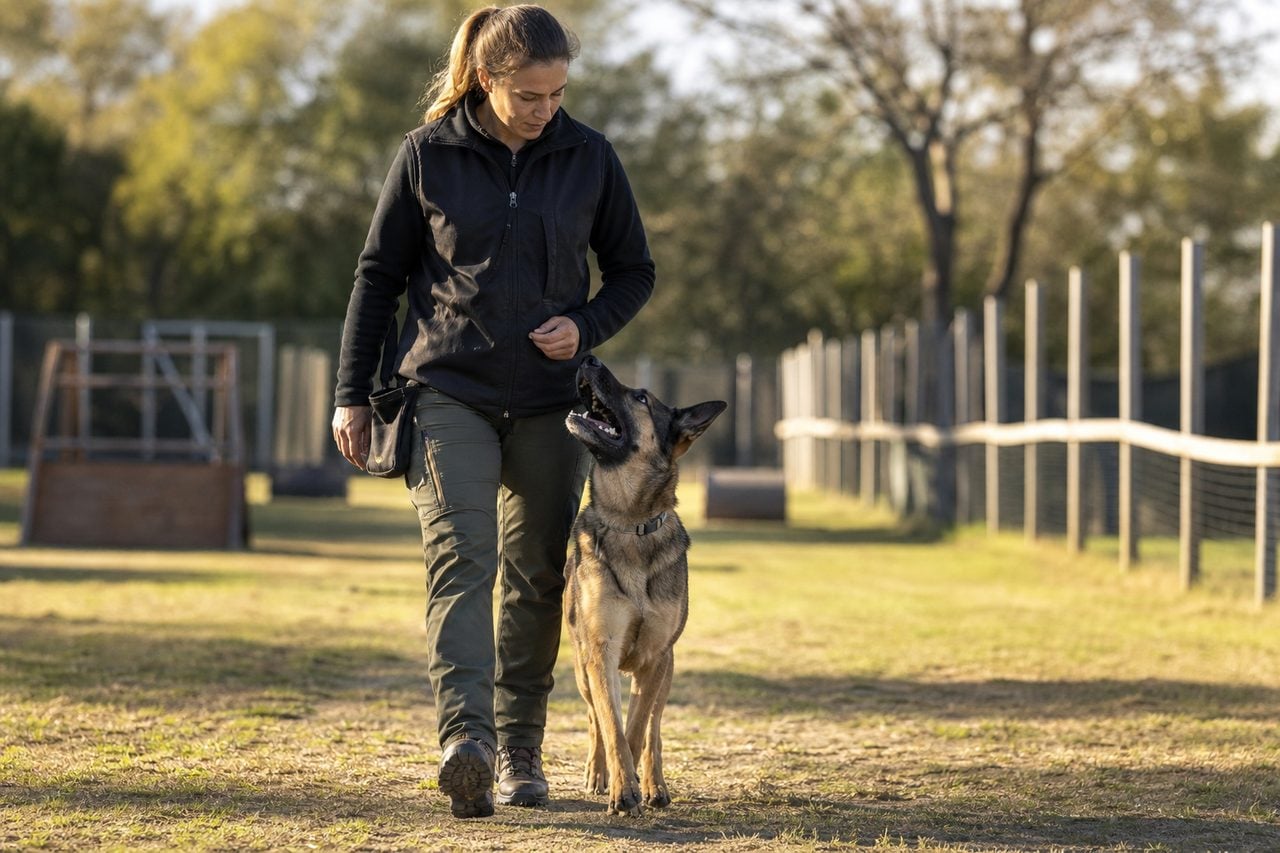
Board-and-train is the option owners in Bartholomew County reach for when the ordinary approach has stalled — the once-a-week group class that keeps getting missed because of a shift at Cummins, the puppy who is charming at home and unmanageable on a walk downtown, the adolescent dog whose recall evaporated somewhere around eight months old. The pitch is simple and appealing: your dog lives with a trainer for a set stretch of time, gets worked every day by someone who does this professionally, and comes home further along than you could have gotten alone in the same period.
- What board-and-train actually is
- What is actually available around Columbus and Seymour
- What board-and-train does well — and what it cannot do
- The transfer problem: why the go-home lessons matter most
- How to vet a board-and-train facility
- Cheaper alternatives worth pricing before you book
- When the drive to Indianapolis is worth it
- Reviewed trainers
- FAQ
That pitch is partly true and partly oversold, and the difference matters a great deal when you are handing over your dog and a significant amount of money. Columbus, Seymour and the surrounding towns — Hope, Taylorsville, Edinburgh, North Vernon, Brownstown, Greensburg — do have real local board-and-train options, which is more than can be said for several other specialty niches in this metro. But the range is narrow. Once you start looking for a specific methodology, a specific problem focus, or a facility whose schedule matches yours, you are often looking at the hour’s drive north on I-65 to the Indianapolis area, where the trainer pool is simply deeper.
This guide covers what board-and-train genuinely accomplishes, what it structurally cannot fix, how to evaluate a program before you book it, what exists locally, and when the drive to Indianapolis is the honest answer.
What board-and-train actually is
Board-and-train — sometimes marketed as a residency program, immersion training, or a “stay school” — means your dog lives at a trainer’s facility or in a trainer’s home for a defined period while receiving structured daily training sessions. Programs commonly run somewhere between two and six weeks, though the range is wide and depends entirely on the provider and the goals, so treat any specific number you see advertised as that program’s number rather than an industry standard.
The value proposition is frequency and consistency. A dog in a well-run residency gets multiple short sessions per day from a handler who never has an off night, never skips because of weather, and never accidentally rewards the wrong thing out of fatigue. Skills that take an owner three months of inconsistent evening practice can genuinely consolidate faster under that regime. Repetition density is the real mechanism, not magic.
What varies enormously between programs is everything else: how the dog is housed between sessions, whether it gets enrichment and decompression time or sits in a kennel for twenty-two hours a day, what training methods are used, how many dogs a single trainer is running at once, and how the skills get handed back to you. Two facilities charging similar money can deliver radically different experiences. That is why the vetting section below matters more than the price comparison.
It is also worth understanding what board-and-train is not. It is not boarding with training thrown in, though some kennels market it that way — ask how many minutes of actual structured training your dog receives per day, because “training while boarding” can mean twenty minutes and a lot of kennel time. It is not a behavior treatment programme, and it is not a substitute for veterinary care when something physical is driving the behavior. Read the description of the service carefully rather than the name of the package, and if the written description is vague about daily structure, ask for the schedule in writing before you put down a deposit.
What is actually available around Columbus and Seymour
Being honest about local supply: this metro is thin on dog-training specialists generally, but board-and-train is one of the few categories where genuine local options do exist. Dog Training With Monica, based in Seymour, runs multi-week board-and-train programs. Barkefellers in Columbus operates a board-and-train offering it calls Stay School, alongside a Day School format where the dog comes in for the day and goes home at night. Guardian-K9 in Columbus offers day training and boarding services.
That is a real set of choices, and for a mainstream goal — a young dog who needs foundation obedience, leash manners, house structure, impulse control around doors and food — there is a reasonable chance one of them fits what you need without leaving Bartholomew or Jackson County. Start there. Local means you can visit before booking, drop in during the stay if the facility permits it, and get to go-home lessons without blocking out half a Saturday for driving.
Where the local pool runs out is specialisation. If your dog’s problem is serious aggression, severe separation distress, complex fear, or something needing a specific methodology or a veterinary-behavior tie-in, the number of nearby programs equipped for it drops toward zero. That is not a knock on anyone local — a small market cannot support a dozen niches. It is just the reality of a county-seat metro of this size, and it is why the Indianapolis corridor keeps coming up.
We do not publish prices for these programs, and you should be sceptical of any directory that does. Rates change, they vary by dog and by goal, and a stale number helps nobody. Call and ask.
What board-and-train does well — and what it cannot do
Board-and-train is strongest on skills that are essentially mechanical and that a dog can learn in a controlled environment: sit, down, place, loose-leash walking, recall foundations, crate comfort, door manners, waiting for food, settling on cue. These are behaviors where clear repetition and clean timing do most of the work, and a professional handler beats a beginner owner on both counts. Owners routinely get a dog back that genuinely knows more than it did.
It is much weaker on anything that is fundamentally about the relationship between the dog and your specific household, or about emotion rather than skill. A dog who guards the couch from your teenager, panics when your car leaves the driveway, or reacts to the neighbour’s dog through your particular fence line is responding to a context the trainer’s facility cannot fully reproduce. Improvement often happens, but it does not automatically travel home with the dog.
The honest framing is that board-and-train buys you a head start and a trained set of behaviors, not a finished dog and not a changed household. Any program that promises your dog will come back “fixed” is selling you something the format cannot deliver. The good programs say this out loud in the sales conversation, which is itself a useful screening signal — a trainer who front-loads the limitations is usually the one who understands the work.
There is a second, quieter benefit that often justifies the cost even when the behavior gains are modest: the reset. Households that have been fighting with a dog for months are usually running on frustration, inconsistent rules and a lot of shouting. A few weeks of separation gives everyone a break, ends the daily rehearsal of the bad pattern, and lets the family return to the dog with a fresh set of rules that everyone agrees on. That reset is real value, but you should be clear-eyed that you are partly buying it — and that it evaporates fast if the household falls straight back into the old habits at pickup.
The transfer problem: why the go-home lessons matter most
The single most common way board-and-train money gets wasted is the transfer failure. The dog performs beautifully for the trainer and then, within two or three weeks at home, drifts back toward the old patterns. This is not fraud and it is usually not incompetence. It is how learning works: dogs bind behavior tightly to context, and the context includes the handler, the environment, the cues, and the consequences. Change all four at once and performance degrades.
The fix is structured handover, and it should be built into the program rather than bolted on. Look for a package that includes multiple go-home sessions — not one twenty-minute demo at pickup — ideally with at least one session in your own home or on your own street. You should be taught the exact verbal cues and hand signals, shown the reward mechanics, and drilled until your timing is passable. Then you should have follow-up contact for at least a few weeks after the dog is back.
Ask directly: how many owner sessions are included, who runs them, do they happen at my house, and what happens if I am struggling a month later? A program that treats the handover as an afterthought is charging residency prices for a result that will not survive the trip home. Ask, too, what the trainer expects of you daily once the dog is back — if the honest answer is fifteen minutes a day for six months, you want to know that before you book.
How to vet a board-and-train facility
Visit in person before you commit, and insist on seeing where the dogs actually sleep — not just the lobby and the training floor. You are looking for clean, temperature-controlled housing, separation between dogs who should not interact, and evidence that dogs get meaningful time out of the kennel. Ask how many hours a day your dog will be out and what happens during those hours. “Training, rest and enrichment” is a real answer; vagueness is not.
Ask what happens when your dog gets something wrong, and listen to the specific answer rather than the label. Every trainer will say they are “balanced” or “positive” because those words have become marketing. The useful question is mechanical: what tools do you use, in what circumstances, and what does a correction look like? If tools like prong or electronic collars are part of the program, you are entitled to know before drop-off, to see them used, and to say no. A trainer who becomes defensive about a straightforward equipment question is telling you something.
Cover the practical items too: staff-to-dog ratio, whether the trainer working your dog is the one you met, vaccination and intake requirements, what the veterinary emergency plan is and which clinic they use, whether you can get video updates or visit mid-stay, and what the policy is if the dog turns out to be a poor fit for residency. Get the whole thing in writing. Finally, ask for references from clients with a similar dog and a similar problem, and actually call one.
Cheaper alternatives worth pricing before you book
Board-and-train is the most expensive way to buy dog training, and for a meaningful share of the dogs it gets sold to, it is not the most effective. Before you book weeks of residency, price the alternatives honestly against your actual problem.
Day training — the dog goes to the trainer for the day and comes home at night — captures most of the repetition benefit while keeping the dog in your household every evening, which softens the transfer problem considerably. Barkefellers’ Day School format and Guardian-K9’s day training are local versions of this shape. Private in-home lessons are the right tool when the problem is contextual: the trainer sees your doorway, your fence, your family’s habits, and coaches you in the environment where the behavior actually happens. Group classes remain the cheapest structured option and are genuinely good for a normal young dog who needs socialisation, distraction work, and an owner who needs accountability.
A reasonable rule of thumb: if the problem is “my dog does not know how to do X,” residency or day training is efficient. If the problem is “my dog does X in my house, with my people, in a specific situation,” start with in-home private work. If the problem is fear, panic, or aggression, see the behavior escalation path — residency is rarely the right first move for those, and sending a fearful dog away from home can make things worse.
When the drive to Indianapolis is worth it
Columbus sits roughly an hour south of the Indianapolis metro on I-65, and Seymour adds about twenty minutes to that. It is a genuinely manageable drive for a service you use a handful of times, which is exactly what board-and-train is: a drop-off, possibly a mid-stay visit, a pickup, and a few follow-up sessions. Unlike weekly group class, the mileage is not a recurring tax.
Go north when the local pool does not match your specific need. That includes: programs specialising in a methodology you have deliberately chosen, trainers with a documented track record on your particular problem, facilities with in-house behavior expertise, and any situation where you want to interview three or four providers rather than take the one that has an opening. Depth of choice is the actual product Indianapolis offers.
Practical logistics: schedule drop-off and pickup outside Indianapolis rush windows, since I-65 north of Franklin and the south-side interchanges can add half an hour easily. If go-home lessons are part of the package, ask whether the trainer will travel to Bartholomew or Jackson County for at least one of them, and what that costs — some will, and an in-home session in your actual environment is worth more than a repeat session on their training floor. And ask about mid-stay visitation before you book, because an hour each way is a different proposition than a fifteen-minute hop across town.
One more consideration that argues for staying local when you can: relationships. A trainer twenty minutes away is someone you can call in eight months when adolescence throws up a new problem, drop in on for a tune-up session, or use for boarding with someone who already knows your dog. That continuity has real value over a dog’s life, and it is the main reason to exhaust the Columbus and Seymour options before defaulting to the drive. Use Indianapolis when the need is genuinely specialist — not simply because a bigger city sounds like it must be better.
Reviewed Board & Train Trainers in Columbus
These reviewed Columbus-area trainers from our directory handle board & train. Each links to a full profile with specialties, certified credentials, reviews, and contact info:
- Dog Training With Monica — 4.8★ (110 reviews)
- Guardian-K9 — 4.7★ (103 reviews)
- Barkefellers – Columbus — 4.6★ (202 reviews)
See all Columbus board & train trainers →
Frequently Asked Questions
Is board-and-train available in Columbus, Indiana, or do I have to travel?
There are local options. Dog Training With Monica in Seymour runs multi-week board-and-train, Barkefellers in Columbus offers a Stay School board-and-train plus a Day School day-training format, and Guardian-K9 in Columbus provides day training and boarding. For mainstream obedience and manners goals, one of those may well fit. The reason owners still drive to Indianapolis is breadth — if you want a specific methodology, a specialist in a particular behavior problem, or several providers to compare, the metro an hour north on I-65 has a much deeper pool.
How long should a board-and-train program be?
It depends on the goal and the dog, and programs in the market range from short two-week stays to multi-week residencies. Rather than picking a length, pick an outcome: ask the trainer what specific, observable behaviors your dog will reliably perform at the end, under what level of distraction, and how they will demonstrate it at pickup. A program that can answer that precisely is selling a plan; one that only sells a duration is selling time. Longer is not automatically better, and a dog who is stressed in kennel housing may do worse in an extended stay.
Will my dog come home fully trained?
No, and any program that says otherwise is overselling the format. Your dog will come home knowing behaviors and having practiced them heavily with a skilled handler. Whether those behaviors survive in your house depends almost entirely on the handover: how well you are taught the cues and mechanics, how much follow-up support you get, and how consistently you maintain the work. Plan for daily practice for months after pickup. The residency is the head start, not the finish line.
Does board-and-train work for aggression or severe anxiety?
It is usually the wrong first tool. Aggression, panic and severe fear are emotional problems tied to specific contexts, and removing the dog to an unfamiliar facility can add stress rather than resolve it. The better sequence is an assessment with a qualified behavior professional and a veterinary check to rule out pain or a medical driver. Locally, Hot Diggity Dog in Columbus takes reactivity, separation anxiety, aggression and resource-guarding cases. For cases needing medication or a veterinary behavior diagnosis, Indianapolis or Purdue’s veterinary behavior service in West Lafayette is the escalation path.
What should I ask before leaving my dog somewhere for weeks?
Ask to see the kennel area, not just the lobby. Ask how many hours a day the dog is out of the kennel and what it does during that time. Ask exactly what tools are used and what a correction looks like, in mechanical terms rather than labels. Ask the staff-to-dog ratio, whether the trainer you met is the one handling your dog, what the veterinary emergency plan is, and how many owner handover sessions are included. Get the answers in writing, and call a reference with a dog similar to yours.
Is day training a better option than a full residency?
For many dogs, yes. Day training gives you most of the repetition advantage — a professional working the dog in structured sessions — while the dog sleeps at home every night, which reduces the stress of relocation and makes the skills easier to transfer into your household. It also lets you absorb the coaching in smaller doses instead of one firehose session at pickup. Residency makes more sense when your schedule genuinely cannot support daily transport, or when the program you want is far enough away that a daily round trip is unrealistic.
Related: read our complete board & train guide or the full Columbus dog training overview.
Ready to find the right board & train pro in Columbus?