
Board & Train in Fort Wayne, IN
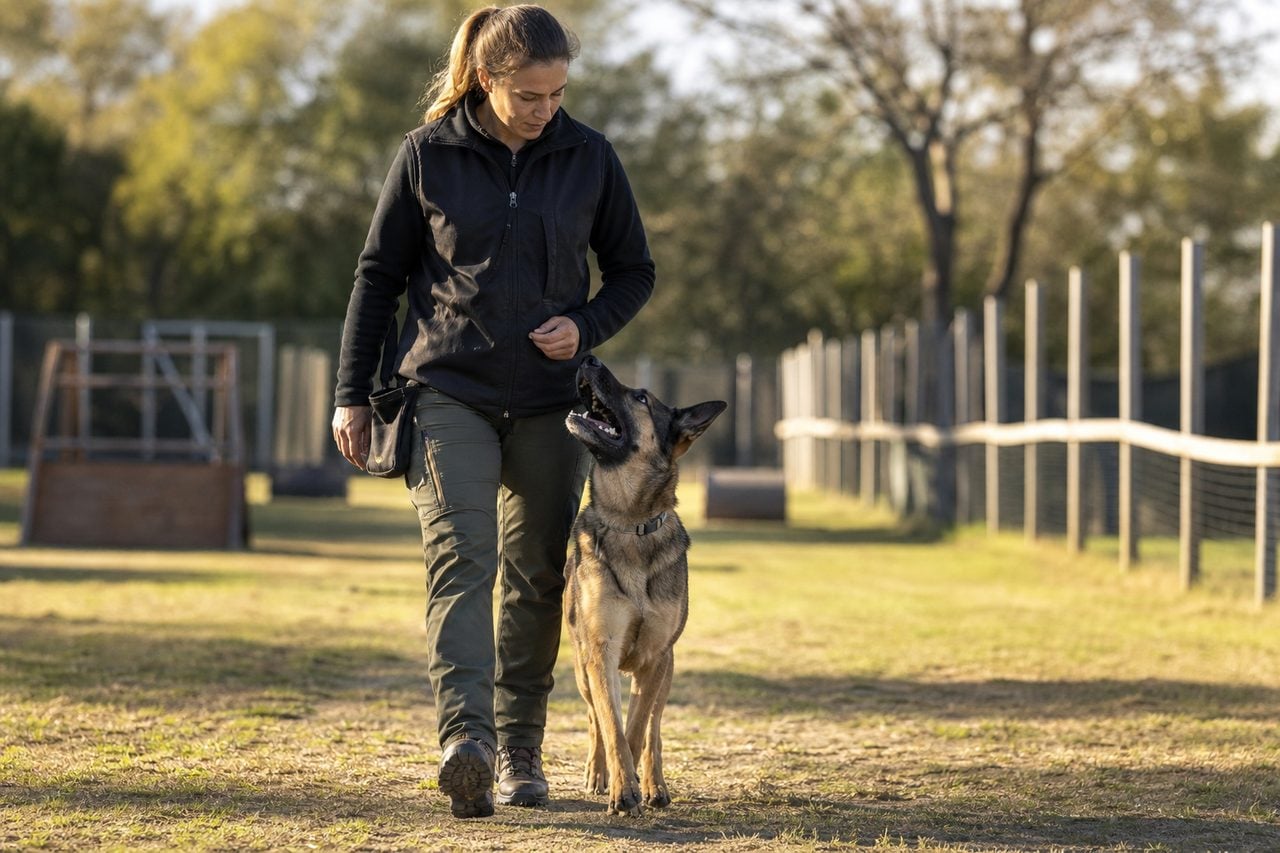
Board & train programs send a dog to live with a professional trainer for a set stretch of time — usually two to four weeks — so the daily obedience work happens in the hands of an expert instead of squeezed into a busy family schedule. For Fort Wayne owners juggling work downtown, kids in New Haven or Huntertown schools, and a dog who pulls, bolts, or ignores every recall, the appeal is obvious: hand off the heavy lifting, get back a dog who already knows the job.
- What a board & train program actually is
- Who a board & train is a good fit for
- What happens during an in-kennel program
- Choosing a facility in Allen County and northeast Indiana
- The go-home transfer — where programs succeed or fail
- Costs, contracts, and the questions to ask
- Setting your dog up to keep the training in Fort Wayne
- Reviewed trainers
- FAQ
The reality is more nuanced. A good board & train can compress months of foundation work into a focused window, but it is not a car wash for behavior. The dog learns the skills; the family still has to learn how to hold them. This guide walks through how in-kennel programs actually work, who they suit, what to look for in an Allen County or northeast Indiana facility, and the questions that separate a genuine professional from a kennel with a shock collar and a sales pitch.
Everything below is written for the Summit City and its surrounding towns — Leo-Cedarville, Grabill, Auburn, Columbia City, Bluffton, Angola and the lake country beyond — where trail access, weather swings, and a mix of rural and suburban settings all shape how a trained dog needs to behave.
What a board & train program actually is
A board & train is a residential training program. The dog boards at a trainer’s facility or home kennel and receives daily, structured instruction — typically several short sessions a day rather than one marathon lesson — over a contracted number of weeks. The model exists because repetition and consistency are what build reliable behavior, and most owners simply cannot deliver that volume of clean, well-timed practice while holding down a job and a household.
Programs generally fall into a few tiers. A basic obedience board & train covers the core cues: sit, down, place, recall, loose-leash walking, and a solid stay. A more advanced program layers in off-leash reliability, distraction-proofing, and duration — holding a down-stay while people come and go. Some facilities offer puppy-focused stays that emphasize socialization, house manners, and crate comfort rather than precision obedience.
The critical distinction is that a board & train trains the dog, not the household. The best facilities in the Fort Wayne area build owner transfer directly into the program — go-home lessons, follow-up sessions, and written protocols — because a dog that performs flawlessly for the trainer but reverts at home has not actually solved anything. When you evaluate a program, weigh the transfer component as heavily as the in-kennel curriculum.
Who a board & train is a good fit for
Board & train earns its keep for specific situations. It suits owners who are time-poor but committed — people who will absolutely maintain the training once it is installed but cannot build it from scratch. It suits dogs with a stubborn, well-established habit (pulling like a freight train, door-dashing, no recall) where the owner’s own attempts have plateaued. And it suits adolescent dogs, roughly six to eighteen months, who have the drive and energy that overwhelm a first-time handler.
It is a weaker fit in a few cases. Dogs with serious aggression or deep fear-based reactivity are usually better served by a behavior-focused program with a credentialed specialist, not a general obedience board & train — the underlying emotion has to be addressed, not just the surface behavior. Very young puppies may get more from an owner-involved program where the family learns alongside the dog during the critical socialization window. And any owner who wants the dog trained but is unwilling to do the follow-through will be disappointed regardless of how good the facility is.
Consider your own honesty here. A Fort Wayne family that walks the Rivergreenway daily and will practice recall at Franke Park every weekend gets far more out of a board & train than one who expects the dog to arrive home finished. The program is a jump-start, not a finish line.
What happens during an in-kennel program
A well-run in-kennel day is structured. Most trainers run several short teaching sessions spaced through the day — foundation cues in the morning, proofing and distraction work midday, and calmer place or duration work in the evening — interleaved with rest, potty breaks, and decompression. Dogs learn faster in short, frequent bursts than in long grinding sessions, and rest is where the learning consolidates.
Early in the stay the trainer establishes clear communication: a reward marker, a consistent release word, and a reliable way to show the dog what pays off. As cues become fluent, the trainer raises difficulty — adding duration, distance, and distraction. This is where a quality facility shines, because proofing against real-world distraction is the hardest part to replicate at home. A dog that holds a down-stay while another dog walks past, or recalls off a squirrel, has been deliberately exposed to those triggers in a controlled way.
Ask how the facility handles socialization and enrichment during downtime, and what the housing looks like. A dog spending three weeks in a kennel should still get decompression time, mental enrichment, and humane rest. Ask, too, about their methods. Many Fort Wayne-area trainers use reward-based systems, some layer in an e-collar for off-leash reliability; either can be done well or badly. What matters is that the trainer can explain their approach clearly, shows you the dog is worked fairly, and does not rely on intimidation.
Choosing a facility in Allen County and northeast Indiana
The Fort Wayne metro and the towns around it give you real choice — facilities range from suburban training centers to rural kennels out toward Grabill, Auburn, and the lake country near Angola. Distance matters more than owners expect, because board & train works best with go-home lessons and follow-up, and you will be driving back for those. A facility twenty minutes away in New Haven or Huntertown is far more practical for ongoing support than one two hours off.
Vet the trainer, not just the marketing. Look for verifiable experience, a clear methodology they will explain without dodging, and references or reviews from actual local clients. Ask to tour the facility before you book — a professional will welcome it. You want to see clean, safe housing, secure fencing (important for any off-leash proofing), and dogs that look comfortable rather than shut down.
Credentials add confidence. Certifications such as CPDT-KA through the Certification Council for Professional Dog Trainers, or a Fear Free designation, signal a trainer who has invested in the craft, though experience and transparency matter as much as letters after a name. Be wary of any program that guarantees a fully finished dog, refuses to let you observe, or leans on fear as a selling point (do this or your dog will end up in a shelter). The right facility talks about the dog’s welfare and your long-term success, not just a fast fix.
The go-home transfer — where programs succeed or fail
The single biggest predictor of whether a board & train sticks is the transfer. Dogs are contextual learners; a dog that performs perfectly at the trainer’s facility does not automatically generalize to your kitchen, your fenced yard in Leo-Cedarville, or a busy trailhead at Fox Island. The handoff is where the family learns to speak the dog’s new language.
Good programs build in one or more go-home sessions where the trainer works the dog in front of you, then coaches you through the same cues until you can reproduce them. You should leave with written protocols — the exact words, hand signals, reward timing, and rules the dog has learned — so the whole household stays consistent. A dog told place by the trainer and go lie down by dad and get in your bed by the kids will lose the behavior fast.
Follow-up support separates serious facilities from drop-and-pray operations. Ask what is included after pickup: additional lessons, phone or text access, a group class to practice around distraction, or a check-in schedule. The first few weeks home are when habits either lock in or erode, and a trainer who is available during that window is worth more than one who disappears the moment you drive off with your dog.
Costs, contracts, and the questions to ask
Board & train is among the more expensive training options because you are paying for boarding, individualized daily instruction, and the trainer’s expertise over weeks. Pricing varies widely by program length, the skills covered, and the facility, so avoid anyone quoting a number sight-unseen as gospel — get a written scope. What matters is understanding exactly what the fee includes and what it does not.
Before you sign, get clear answers on the essentials:
- Program length, daily session structure, and the specific skills your dog will leave knowing
- Training methods and tools used, and whether you are comfortable with them
- How many go-home lessons and follow-up sessions are included in the price
- Vaccination and health requirements, and how illness or injury is handled
- Housing and daily routine — where the dog sleeps, rests, and decompresses
- What happens if the dog is not progressing, and the refund or make-good policy
- Whether you can observe or visit, and how you will receive updates during the stay
Put realistic expectations on the outcome. A three-week program can install solid, reliable obedience; it cannot rewire a lifetime of anxiety or turn a dog into a machine. If a facility over-promises, that is a signal to keep looking. The best Fort Wayne-area trainers are candid about what your specific dog can achieve in the time booked.
Setting your dog up to keep the training in Fort Wayne
The work that keeps a board & train alive happens after pickup, and northeast Indiana gives you plenty of places to practice. Proofing obedience means practicing in gradually harder environments, and the region’s parks and trails are an ideal ladder. Start in your own yard or a quiet stretch of the Rivergreenway, then progress to busier settings — Franke Park, Foster Park, or the trails at Metea County Park — where other dogs, walkers, and wildlife raise the difficulty.
Build short, consistent daily practice into your routine rather than occasional long sessions. Ten focused minutes a day beats an hour once a week. Keep the household on the same page — same cues, same rules — and honor the boundaries the dog learned, like a place command or a threshold wait at the door, because inconsistency is what erodes trained behavior fastest.
Mind the local realities, too. Fort Wayne winters bring ice and short daylight, so plan indoor practice and enrichment for the cold stretches. Summer heat and river-trail crowds add their own distractions worth proofing against. And remember that Indiana has no statewide leash law — leash and control rules come from local ordinances across the Fort Wayne area, so a reliable recall and steady leash manners are genuinely useful on shared trails and in town, not just nice-to-haves. Maintained well, the foundation a board & train builds becomes the dog you live with for the next decade.
Reviewed Board & Train Trainers in Fort Wayne
These reviewed Fort Wayne-area trainers from our directory handle board & train. Each links to a full profile with specialties, certified credentials, reviews, and contact info:
- Dog Training Elite Northeast Indiana — 5.0★ (170 reviews)
- Off Leash K9 Training of Fort Wayne LLC — 5.0★ (120 reviews)
- Perfect Pup LLC — 5.0★ (46 reviews)
- Solid Foundation Dog Training — 5.0★ (18 reviews)
- Lee’s Dog Training — 4.6★ (86 reviews)
- Dog Psychology and Training Center – Fort Wayne — 4.6★ (14 reviews)
- animal training & development — 4.5★ (14 reviews)
- Northeastern Indiana Kennel Club Training Classes
See all Fort Wayne board & train trainers →
Frequently Asked Questions
How long does a board & train program usually last?
Most residential programs run two to four weeks, though some basic packages are shorter and advanced off-leash programs can run longer. Length depends on the skills you want and your dog’s starting point and temperament. A young dog learning foundation obedience needs less time than one working through an entrenched habit or building reliable off-leash recall. Ask the trainer to match the program length to your specific goals rather than buying a one-size package.
Will my dog forget everything once it comes home?
Not if the transfer is done properly and you keep up the practice. Dogs are contextual learners, so a dog can perform perfectly at the facility and struggle at first in a new environment — that is normal and expected. The go-home lessons, written protocols, and follow-up support exist precisely to bridge that gap. Households that stay consistent with cues and practice a little each day keep the training; those who expect a finished dog and stop practicing tend to see it erode.
Is board & train right for an aggressive or very fearful dog?
Often it is not the best first step. Serious aggression and deep fear-based reactivity are emotional problems, not just obedience gaps, and they usually call for a behavior-focused approach with a credentialed specialist — sometimes alongside a veterinary workup. A general obedience board & train can teach cues, but it may not address the underlying emotion, and the wrong methods can make fear worse. If your dog has bitten or shows intense fear, look for a trainer or behavior professional who specifically handles those cases and start with an assessment.
What should I look for when touring a facility?
Clean, safe, secure housing; comfortable-looking dogs rather than shut-down ones; and secure fencing if any off-leash work is done. Ask to see where dogs sleep, rest, and decompress. Just as important is the trainer’s willingness to explain their methods and tools clearly without dodging, and to let you observe. A professional welcomes questions and a tour. Guarantees of a perfectly finished dog, refusal to let you visit, or fear-based sales pressure are all reasons to keep looking.
Do trainers in the Fort Wayne area use e-collars or shock collars?
Some do, particularly for off-leash reliability, while others work entirely reward-based. Either approach can be done humanely and skillfully or poorly. What matters is that the trainer can explain how and why they use a given tool, shows you the dog is worked fairly rather than intimidated, and respects your comfort level. If you are not comfortable with a particular tool, say so up front and find a trainer whose methods align with your values — the region has options across the spectrum.
How much does a board & train cost in northeast Indiana?
It is one of the pricier training options because you are paying for boarding plus individualized daily instruction over weeks, and rates vary considerably by program length, skills, and facility. Rather than anchoring on a single number, ask each trainer for a written scope of exactly what is included — number of go-home lessons, follow-up support, housing, and the specific skills your dog will leave with. Comparing what you get for the fee is far more useful than comparing headline prices alone.
Related: read our complete board & train guide or the full Fort Wayne dog training overview.
Ready to find the right board & train pro in Fort Wayne?