
Board & Train in Indianapolis, IN
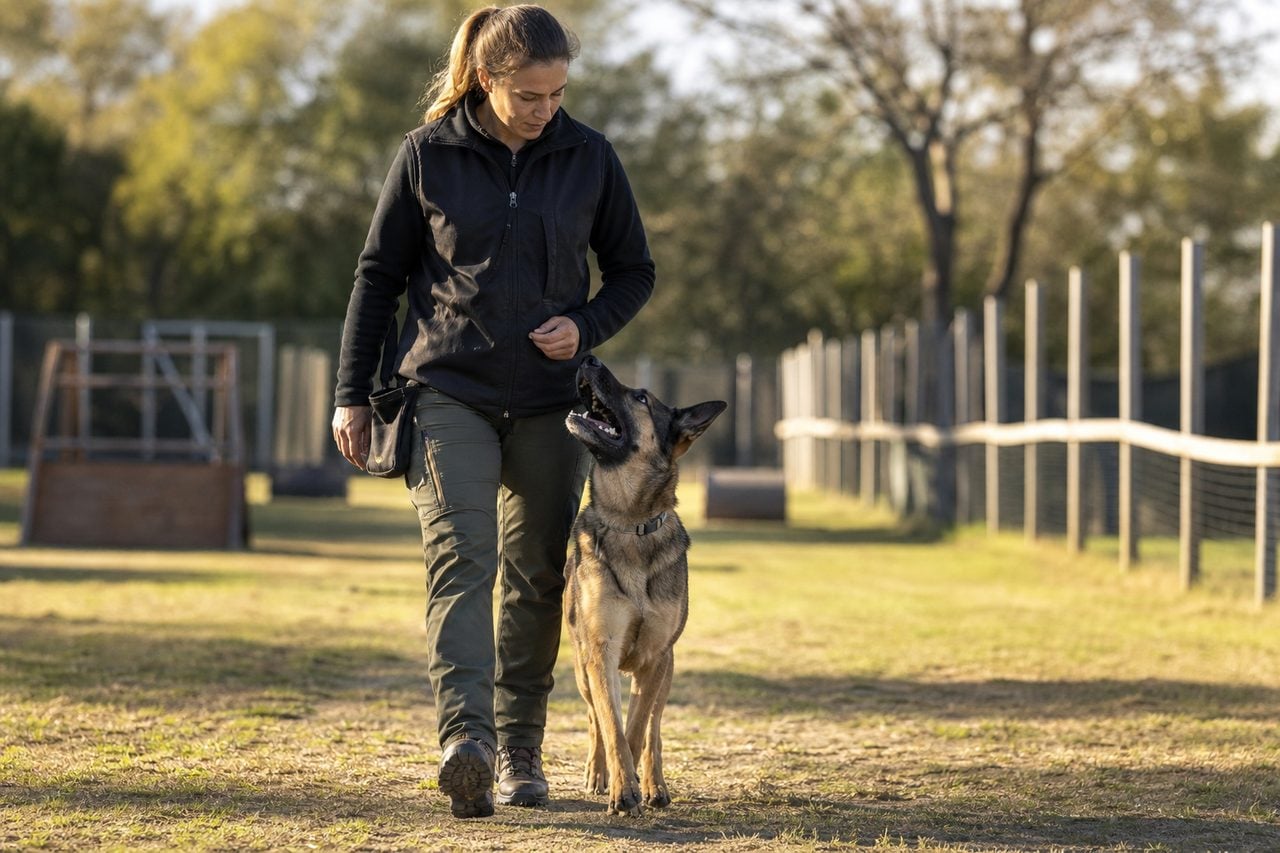
Board-and-train is the option Indianapolis owners reach for when they want a serious behavior reset and don’t have weeks of evenings to commit to it themselves. Your dog moves into a professional trainer’s facility — typically for two to four weeks — and spends every day in structured, repeated training sessions while living in a kennel or home-style environment. When the program ends, you get a dog who has already done the hard repetition, plus a handoff process that teaches you how to keep the results going.
- What board-and-train actually means
- Common program lengths and what each covers
- What a week inside the facility looks like
- The go-home transfer protocol — the part that makes it stick
- Pricing tiers in the Indianapolis market
- Is your dog a good candidate?
- Questions to ask before you book
- Choosing a board-and-train provider near you
- Reviewed trainers
- FAQ
Across Indy and its suburbs — from the near-north side and Broad Ripple to Carmel, Fishers, Greenwood, Avon, and Zionsville — local trainers run residential programs that range from foundational obedience to focused behavior rehabilitation. The model is popular here precisely because so many households juggle long commutes up and down I-465 and simply can’t deliver the daily consistency a young or reactive dog needs.
This page explains how board-and-train actually works, what the weeks look like, how the go-home transfer protocol protects your investment, and the realistic price tiers you’ll encounter in the central Indiana market.
What board-and-train actually means
In a board-and-train program, your dog lives at the trainer’s facility for the duration of the course. Instead of one weekly group class, your dog gets multiple short training sessions every single day, woven into a predictable routine of rest, exercise, feeding, and skill work. That density of repetition is the entire point: behaviors that might take an owner three months of inconsistent practice can be installed and proofed far faster when a professional controls the environment all day long.
The format suits a specific kind of owner. If you travel for work, have a demanding schedule, are physically unable to do the early heavy lifting, or simply feel out of your depth with a strong-willed adolescent dog, handing the foundation-building to a pro can be the difference between progress and a year of frustration. It’s also common for Indianapolis families with new rescues who arrive with no manners at all.
What board-and-train is not is a magic black box. A dog returns trained to a person and a system; the long-term outcome depends heavily on the go-home handoff and your willingness to maintain the routine. Reputable Indy trainers are upfront about this.
Common program lengths and what each covers
Central Indiana programs generally cluster into a few durations, each aimed at a different goal:
- Two weeks — foundation / puppy fast-start. Best for younger dogs or those needing core obedience: name response, sit, down, place, loose-leash walking, and basic impulse control. Two weeks installs the skills; you do the proofing at home.
- Three to four weeks — comprehensive obedience. The most common tier. Adds reliable recall, duration on commands, off-leash work where appropriate, and real-world proofing around distractions.
- Four-plus weeks — behavior modification. Reserved for leash reactivity, fear, resource guarding, or serious manners problems. These programs move slower on purpose because behavior change can’t be rushed.
A good trainer will tell you honestly which tier your dog needs rather than upselling you into the longest one. If a program promises to cure deep aggression in a flat two weeks, treat that as a red flag.
What a week inside the facility looks like
Days are built around structure. A typical residential day mixes several focused training blocks — usually short, because dogs learn best in concentrated bursts — with decompression, enrichment, supervised play or rest, and controlled exposure to the distractions your dog will face back home.
The best programs deliberately train in varied settings rather than only a quiet training room. Expect exposure to parking lots, sidewalks, other dogs at a distance, and everyday noise so the skills generalize. Indianapolis trainers often work sessions outdoors when the weather cooperates, then shift to indoor facilities during the region’s hot, humid July afternoons or the icy stretches of January and February when sidewalks are treacherous.
Look for trainers who send regular updates — photos, short videos, or progress notes. Transparency during the stay is one of the clearest signals of a quality operation, and it lets you see the methods being used on your dog.
The go-home transfer protocol — the part that makes it stick
The single biggest predictor of long-term success isn’t what happens at the facility — it’s the handoff. A dog learns to respond to the trainer in the trainer’s environment; the transfer protocol moves that reliability to you and your home.
Strong programs build in:
- Go-home lessons where the trainer coaches you, in person, on timing, commands, leash handling, and how to reward and correct consistently.
- Written or video instructions documenting every cue your dog now knows and exactly how to use it.
- Follow-up sessions — often one to several over the following weeks — sometimes at your home so the skills hold in the real environment.
When you compare Indianapolis providers, weigh the transfer package as heavily as the in-facility curriculum. A two-week stay with three thorough go-home sessions usually beats a four-week stay with a rushed thirty-minute handoff.
Pricing tiers in the Indianapolis market
Board-and-train is the most expensive training format because you’re paying for room, board, and many hours of one-on-one professional time. In central Indiana, expect tiers roughly along these lines (always confirm directly, since scope varies widely):
- Two-week foundation programs sit at the lower end of the residential range.
- Three-to-four-week comprehensive obedience occupies the broad middle and is where most Indy families land.
- Extended behavior-modification programs command the highest rates because of the specialized skill and longer timeline involved.
When evaluating a quote, ask what’s actually included: How many daily sessions? Are go-home lessons and follow-ups part of the price or add-ons? Is there any guarantee or refresher policy? A higher sticker price with included follow-up support is frequently the better value than a cheaper headline number with everything billed separately.
Is your dog a good candidate?
Board-and-train isn’t the right tool for every dog or every owner, and the best Indianapolis trainers will tell you so during an intake call. The format pays off most when the obstacle to progress is consistency — you know roughly what your dog needs, but your schedule or energy can’t deliver the daily repetition. In those cases, handing the foundation to a professional who controls the whole environment is a force multiplier.
Strong candidates include adolescent dogs in the ‘teenage’ phase who have outpaced their owners’ ability to keep up, new rescues that arrived with no manners or house rules, large or powerful breeds whose pulling and jumping have become genuinely difficult to manage, and households facing a deadline — a move, a baby, a wedding — where slow weekly progress won’t get there in time. Dogs with leash reactivity or resource guarding can also be good fits for a longer behavior-modification program run by an experienced professional.
It’s a weaker fit when the core issue is owner follow-through that won’t change after the program, since a returned dog still needs a maintained routine. It’s also not a substitute for veterinary care — behavior changes that come on suddenly, or signs of pain or anxiety, deserve a vet check first. A reputable trainer will flag this rather than enroll a dog whose problem may be medical.
If you’re unsure, start with an honest assessment. Many Indy providers offer an evaluation that tells you whether board-and-train, a day program, or in-home work is the most efficient path for your particular dog — and the right answer isn’t always the most expensive one.
Questions to ask before you book
Because board-and-train is a significant investment and your dog will be in someone else’s care for weeks, the questions you ask up front are your best protection. Before committing to any central Indiana provider, get clear answers on the following:
- How many training sessions per day, and how is the rest of the day structured between work, rest, and enrichment?
- What methods do you use, and how do you handle mistakes? You should get a plain-language answer you understand.
- How are dogs housed overnight, and how is exercise and decompression handled?
- What communication will I get during the stay — photos, videos, written updates, and how often?
- What does the go-home handoff include — how many owner lessons, written instructions, and follow-up sessions, and are they part of the price?
- What happens if my dog gets sick or injured, and is there a vet relationship in place?
- Is there any guarantee, refresher policy, or recourse if results don’t hold despite my follow-through?
A confident, experienced trainer welcomes these questions and answers them specifically. Vague responses, pressure to book immediately, or unwillingness to let you tour the facility are all reasons to keep looking.
Choosing a board-and-train provider near you
Indianapolis is spread across a wide metro, so location and convenience matter. Owners on the near-north side, Broad Ripple, and the mid-north neighborhoods often have the most facilities within a short drive, while families in the north suburbs — Carmel, Fishers, and Noblesville tend to choose from a strong cluster of suburban programs. To the south, Greenwood and Franklin owners have their own options, as do those out west in Avon, Plainfield, Brownsburg, and Speedway, and in the northwest around Zionsville and Westfield. The east side and Irvington round out the metro coverage.
Wherever you are, prioritize trainers who let you tour the facility before booking, explain their methods clearly, and are willing to say no to a program that isn’t right for your dog. Ask how dogs are housed, how rest and play are balanced, and what happens if your dog gets sick during the stay.
Browse the board-and-train providers listed below for your area of the metro, then reach out to two or three to compare programs and transfer support before committing.
Reviewed Board & Train Trainers in Indianapolis
These reviewed Indianapolis-area trainers from our directory handle board & train. Each links to a full profile with specialties, certified credentials, reviews, and contact info:
- Nate Schoemer Dog Training — 5.0★ (188 reviews)
- Good Bones K9 Training — 5.0★ (31 reviews)
- Pup Club — 5.0★ (20 reviews)
- Steven’s Bootcamp Dog Training Indianapolis — 5.0★ (9 reviews)
- Lead & Learn Canine Solutions — 5.0★ (7 reviews)
- Paws a Moment Dog Training LLC — 5.0★ (1 reviews)
- Brooks Canine Training Services — 5.0★ (1 reviews)
- Ultimate Canine — 4.9★ (435 reviews)
- Club Canine — 4.9★ (233 reviews)
- Indy K-9 — 4.9★ (123 reviews)
See all Indianapolis board & train trainers →
Frequently Asked Questions
How long does a board-and-train program take?
Most central Indiana programs run two to four weeks. Two weeks covers a puppy foundation or basic obedience reset; three to four weeks is the common comprehensive-obedience tier; serious behavior modification can run four weeks or longer. The right length depends on your dog’s age, temperament, and goals.
Will my dog forget the training once it's home?
Not if you maintain the routine. A trained dog comes home with skills, but those skills transfer to you through the go-home protocol. Owners who follow through on the coaching, written instructions, and follow-up sessions keep the results; owners who let the structure lapse usually see backsliding within weeks.
How much does board-and-train cost in Indianapolis?
It’s the priciest training format because you’re paying for boarding plus many hours of professional one-on-one work. Two-week foundation programs sit at the lower end, three-to-four-week obedience in the middle, and extended behavior-modification at the top. Always confirm what’s included — daily session count, go-home lessons, and follow-ups vary a lot between providers.
Is board-and-train better than group classes?
It’s different, not universally better. Board-and-train shines for busy owners, strong-willed adolescents, new rescues with no foundation, or specific behavior problems — situations where daily consistency is hard to deliver at home. Group classes are excellent for socialization and motivated owners with time to practice. Many Indy dogs benefit from a board-and-train foundation followed by ongoing group work.
Can I visit my dog during the program?
Policies vary by trainer. Some allow scheduled visits, others limit them early on so the dog can settle into the training routine without resetting emotionally. What you should always get is regular communication — photos, videos, or progress updates. Ask about both visit and update policies before you book.
What kinds of problems is board-and-train best for?
It’s well suited to foundational obedience, manners, leash skills, recall, and impulse control, plus structured behavior modification for issues like leash reactivity or resource guarding when run by an experienced trainer. It’s also a strong fit for owners whose schedules make daily at-home training unrealistic.
Related: read our complete board & train guide or the full Indianapolis dog training overview.
Ready to find the right board & train pro in Indianapolis?