
Board & Train in Kokomo, IN
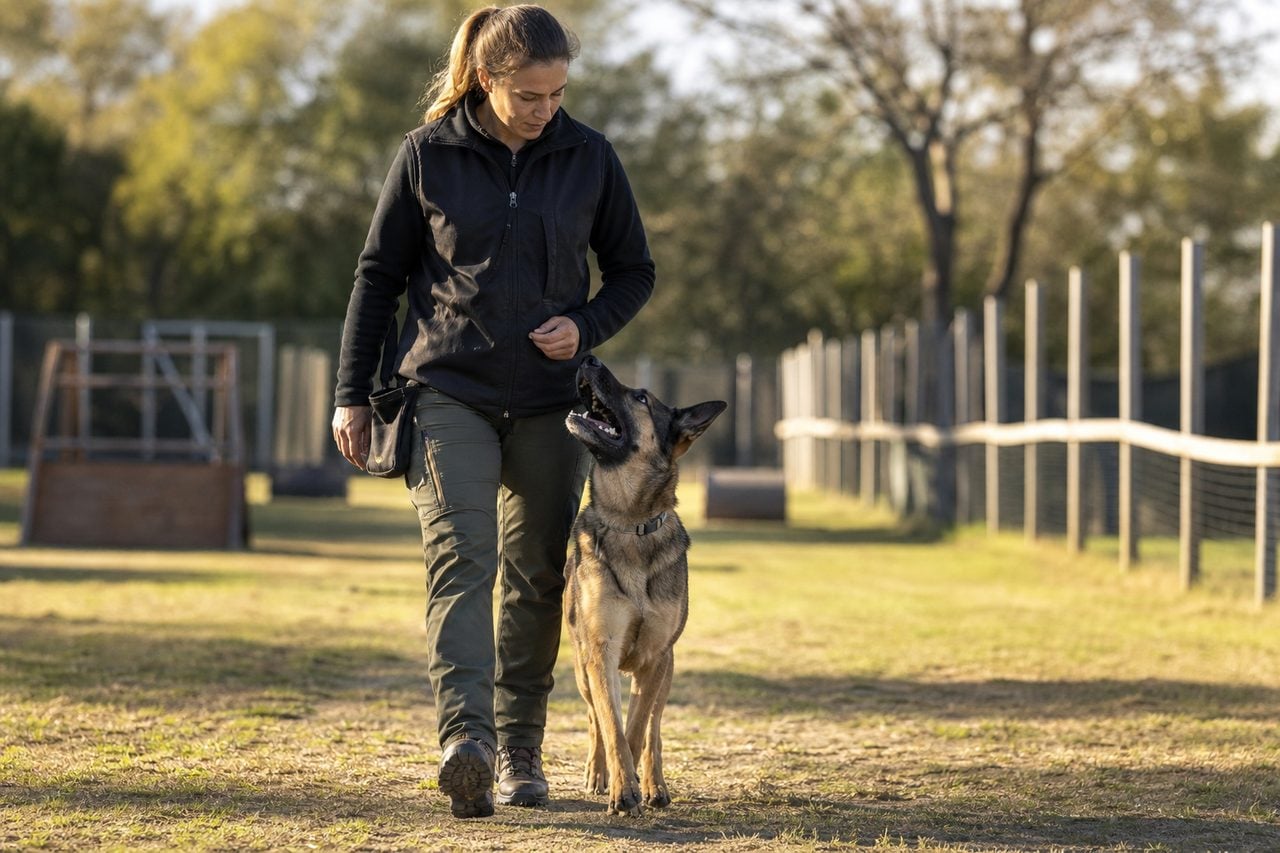
Board-and-train programs, sometimes called in-kennel or stay-and-train programs, place your dog with a professional trainer for a set stretch of days or weeks so that daily, structured practice happens under expert supervision. For families across the Kokomo area, from Howard County out to Grant, Wabash, and Miami counties, this format has become a practical answer to a common problem: the will to train is there, but the consistent hours are not. Between commutes down US-31 toward Indianapolis, shift work at local plants, and the ordinary chaos of a household, the twenty minutes a day that obedience really needs can be hard to protect.
- What a Board-and-Train Program Actually Is
- Signs a Board-and-Train Might Be the Right Fit
- How Local Programs Structure the Stay
- Methods, Tools, and Asking the Right Questions
- The Handoff: Why the Go-Home Lessons Matter Most
- Costs, Contracts, and Setting Fair Expectations
- Preparing Your Dog and Choosing Locally
- Reviewed trainers
- FAQ
The appeal of a board-and-train is concentrated repetition. Instead of a single group class once a week, a dog in a residential program gets multiple short sessions every day, woven into feeding, walking, and rest. Skills compound quickly because the environment is controlled and the reinforcement is timely. When the dog comes home, the trainer transfers those skills to the owner through handoff lessons so the results stick in the real world of Wildcat Creek walks and backyard fence lines.
This guide explains how board-and-train works in north-central Indiana, what kinds of dogs and problems it suits, how to vet a program responsibly, and what to expect before, during, and after the stay. It focuses on setting realistic expectations so that owners in Kokomo, Marion, Peru, Wabash, Logansport, and the surrounding farm towns can decide whether a residential program is the right investment.
What a Board-and-Train Program Actually Is
A board-and-train is a residential arrangement where your dog lives with a trainer or at a training facility for an agreed period, typically two to six weeks, while receiving daily instruction. The trainer manages the whole learning environment: when the dog eats, where it sleeps, how it is exercised, and, critically, how every interaction is used as a teaching moment. Because the professional controls the variables, unwanted behaviors get fewer chances to rehearse and desired behaviors get many chances to be rewarded.
Programs vary in intensity and focus. A foundational obedience board-and-train concentrates on the everyday commands most families want: reliable recall, loose-leash walking, sit and down with duration, place or bed command, and polite greetings instead of jumping. More advanced programs layer in off-leash reliability, distraction-proofing, or specific problem-solving for reactivity and door-dashing. The common thread is immersion. The dog is not practicing for an hour a week and forgetting in between; it is living inside a consistent set of rules.
It helps to understand what a board-and-train is not. It is not a magic reset that erases a dog’s temperament, and it is not a substitute for the owner’s ongoing involvement. The most successful programs treat the boarding phase as the beginning of a partnership. The dog learns the skills, and then the humans learn to maintain them. A trainer who promises a permanently ‘fixed’ dog with no follow-up from the family is overselling what any program can deliver.
The learning-theory reason board-and-train works so well is repetition density combined with reduced interference. In a normal home, a dog might practice a command a handful of times a day and rehearse an unwanted behavior dozens of times, so the bad habit wins the numbers game. A residential program flips that ratio. Every meal becomes a chance to reinforce impulse control, every doorway a chance to practice waiting, every walk a chance to build focus. Over two or three weeks the sheer volume of correct repetitions, delivered with precise timing that most owners have not yet learned, turns shaky behaviors into dependable ones. That is why a professional can accomplish in a compressed window what a busy household struggles to achieve over months.
Signs a Board-and-Train Might Be the Right Fit
Residential training is not the only path, and it is not always the best one. It tends to shine in specific situations. Owners who travel frequently, work long or irregular hours, or have physical limitations that make hands-on leash work difficult often benefit because the heavy lifting happens without them needing daily availability. Households juggling young children and a boisterous adolescent dog sometimes find that a few weeks of professional structure resets the whole dynamic.
The format also suits dogs that have plateaued in group classes. Some dogs are too distracted, too anxious, or too far ahead of a beginner class to make progress in a weekly-lesson format. Concentrated one-on-one work can break through where a crowded room could not. Puppies raised in a program during the crucial early months can build a strong obedience and manners foundation, though good breeders and reputable trainers will stress that owner involvement during socialization windows still matters enormously.
There are also cases where a board-and-train is the wrong first move. Serious aggression, severe separation anxiety, or sudden behavior changes deserve a different pathway that starts with a veterinary exam and, potentially, a qualified behavior professional rather than a general obedience stay. Pain, thyroid issues, and neurological problems can masquerade as training problems. A responsible trainer will decline a case that belongs in a veterinary or behavior consult first and will tell you so plainly.
How Local Programs Structure the Stay
Across the Kokomo region, board-and-train setups fall into a few broad models. Some trainers run small in-home or ranch-style programs on rural acreage outside town, where a handful of dogs live in a home-like environment with plenty of space for real-world practice. Others operate from a dedicated facility with kennels, indoor training floors, and fenced outdoor areas. Neither model is automatically better; what matters is cleanliness, safety, the ratio of dogs to trainers, and how much genuine one-on-one work each dog receives per day.
A typical day in a well-run program is not the dog sitting in a kennel between two short lessons. It is a rhythm of structured training blocks, decompression walks, enrichment, rest, and controlled socialization when appropriate. The rural setting of much of Miami, Wabash, and Grant county actually helps here: open ground, quiet gravel roads, and low-distraction fields give trainers a graduated way to build focus before testing skills in busier places like a Kokomo park or a Marion sidewalk.
Ask any prospective program to walk you through a representative day, hour by hour. How many training sessions? How long is each? What does downtime look like? Where do the dogs sleep, and how are they separated? A trainer who can describe this concretely, and who invites you to see the space, is signaling transparency. Vagueness about the daily routine is a reason to keep looking.
The number of dogs a program takes at once also shapes the experience. A trainer juggling many boarders at the same time simply has fewer minutes to give each dog, no matter how skilled they are. Small-group programs, or those with additional qualified staff, can protect the one-on-one time that drives results. Ask directly how many dogs are typically in residence and how many hands are available to work them, then do the arithmetic yourself. The regional geography works in your favor here: because the Kokomo area spans quiet farm country in Miami and Wabash counties as well as busier streets in Kokomo and Marion, a good local trainer can deliberately sequence a dog through easier and harder environments without ever leaving the region, which is exactly the kind of graduated exposure that builds reliability.
Methods, Tools, and Asking the Right Questions
Training philosophy varies, and owners should understand a program’s approach before committing. Many modern trainers lean heavily on reward-based, positive-reinforcement methods, building behaviors with food, play, and praise. Some also incorporate corrective tools such as prong collars or remote e-collars, particularly for off-leash reliability work. There is legitimate professional debate about tools, and thoughtful trainers on multiple sides of it exist in north-central Indiana. What matters most is that the trainer can explain, in plain language, why they use what they use, how they introduce it humanely, and how they measure the dog’s emotional state throughout.
Good questions cut through marketing. Ask what happens when the dog gets something right and what happens when it gets something wrong. Ask how the trainer would handle a dog that shuts down or becomes fearful. Ask for the specifics of how skills are proofed against distractions and generalized to new places. Ask whether you can observe a session or see video of dogs currently in the program. A confident professional welcomes these questions rather than deflecting them.
Be wary of absolute guarantees and one-size-fits-all pitches. Dogs are individuals, and a trainer who claims identical results for every dog regardless of temperament is not being straight with you. Certifications and continuing education are worth asking about, but experience, references, and the ability to explain their reasoning often tell you more than a single credential. Request contact information for a few recent clients in the area and actually call them.
The Handoff: Why the Go-Home Lessons Matter Most
The single biggest predictor of whether board-and-train results last is the quality of the transfer back to the owner. A dog can learn beautiful obedience with a professional handler and then fall apart at home if the family does not know how to give cues, reward correctly, and enforce the same rules. The handoff phase, often called turnover or go-home lessons, is where the program either pays off or unravels.
Strong programs build in several owner lessons, sometimes spread over the weeks following the dog’s return. During these, the trainer coaches you through the exact commands and mechanics the dog now knows, watches you practice, and corrects your timing. The goal is to make you as consistent as the trainer was. Expect homework: daily practice sessions, rules about furniture or doorways, and structured walks. Skills fade without maintenance, just like anything else a dog learns.
When comparing programs, weigh the follow-up support heavily. How many owner sessions are included? Is there phone or text support afterward for troubleshooting? Will the trainer come to your home in Kokomo, Greentown, or Windfall to see how the dog behaves in its real environment, or are all lessons at the facility? A program with a thin or nonexistent handoff is selling you a temporary result. The best ones treat your education as part of the service, not an afterthought.
Costs, Contracts, and Setting Fair Expectations
Board-and-train is generally the most expensive training format because it bundles boarding, feeding, and many hours of professional labor over multiple weeks. Pricing across the region depends on program length, the intensity of the work, the trainer’s experience, and what is included afterward. Rather than chasing the lowest number, evaluate what you are actually buying: how many daily sessions, what skills are targeted, how much follow-up support, and what happens if progress stalls. A slightly higher investment with strong turnover lessons often delivers far more lasting value than a cheap stay with no follow-through.
Read the agreement carefully before signing. A clear contract should spell out the program length, the specific goals, vaccination and health requirements, what happens if your dog gets sick or injured, and the refund or continuation policy if results do not meet the stated goals. Reputable local programs require proof of core vaccinations and may ask for a temperament assessment before accepting a dog, which protects every animal in their care.
Set expectations around outcomes honestly. A few weeks of skilled work can produce a dramatically more manageable dog, but no program overrides genetics, resolves deep anxiety overnight, or removes the need for ongoing practice. The realistic promise is a well-started or substantially improved dog plus the knowledge to keep it there. If a trainer’s marketing sounds too good to be true, treat that as information. Measured, specific claims are the mark of a professional who intends to keep their word.
It is also fair to ask about progress reporting during the stay. Good programs keep owners in the loop with updates, photos, or short videos showing what the dog is working on and how it is responding. This transparency does more than reassure an anxious owner; it primes the family for the handoff by showing them the commands and mechanics in action before the dog even comes home. A program that goes silent for weeks and then presents a finished dog gives you no window into the process and no head start on maintenance, so treat regular communication as part of what a quality program provides.
Preparing Your Dog and Choosing Locally
Once you have selected a program, a little preparation smooths the transition. Make sure vaccinations are current well ahead of the start date, since many facilities require documentation and a buffer before intake. Bring the dog’s regular food to avoid stomach upset from an abrupt diet change, along with any medications and clear instructions. Share honest, detailed history with the trainer, including any bite history, fears, or medical issues. Holding back information does not protect your dog; it puts the trainer and the process at a disadvantage.
Choosing locally has real advantages beyond convenience. A trainer based in Howard, Grant, Wabash, or Miami county understands the environments your dog will actually navigate: the foot traffic near Highland Park, the open trails of the Nickel Plate corridor, the farm-dog realities of properties around Russiaville or Tipton, and the wildlife and livestock a rural recall has to hold up against. Proximity also makes the all-important follow-up lessons easier to attend, which directly improves how well the training lasts.
It is also worth thinking about timing. Adolescent dogs, roughly six months to two years old, often get the most out of a residential program because they are past the fragile early puppy stage but still forming lifelong habits. If your household has a big change on the horizon, such as a move, a new baby, or a long stretch of travel, scheduling the program before that upheaval rather than during it gives everyone a calmer runway to practice the go-home lessons. A dog returning to a chaotic home right after a program has a harder time holding onto new skills.
Use the directory to shortlist a few programs, then vet them the same way you would any professional you trust with a family member. Visit in person, observe the space and the dogs already there, ask the hard questions about methods and follow-up, and speak with past clients. The right board-and-train is a partnership, and the effort you put into choosing it is repaid every day your dog lives calmly and reliably in your home.
Reviewed Board & Train Trainers in Kokomo
These reviewed Kokomo-area trainers from our directory handle board & train. Each links to a full profile with specialties, certified credentials, reviews, and contact info:
- Perspective K9 Training — 5.0★ (44 reviews)
- Canine Connoisseur Relationship-based Dog Training — 5.0★ (39 reviews)
- Country Road Boarding & Obedience — 5.0★ (10 reviews)
- Vohne Liche Kennels — 4.6★ (99 reviews)
See all Kokomo board & train trainers →
Frequently Asked Questions
How long does a board-and-train program usually last?
Most residential programs run somewhere between two and six weeks, depending on the goals and the dog. Foundational obedience often fits in a shorter window, while off-leash reliability, distraction-proofing, or working through established habits typically needs more time. A trainer should recommend a length based on your specific dog after assessing it, rather than quoting a fixed duration for every case. Remember that the weeks in the program are only part of the timeline; the maintenance work at home determines how well the results hold.
Will my dog forget me or bond only with the trainer?
No. Dogs form strong, lasting attachments to their families and readily reconnect after a residential stay. A few weeks apart does not erase your relationship. What the dog learns is a clearer set of rules and better skills, and a good program transfers those to you through go-home lessons so the dog responds to you the way it learned to respond to the trainer. If anything, many owners report a stronger relationship afterward because daily life becomes less frustrating for both sides.
Is a board-and-train appropriate for aggression or severe anxiety?
Serious aggression, severe separation anxiety, or a sudden change in behavior should start with a veterinary examination to rule out pain or medical causes, and often a qualified behavior professional rather than a general obedience stay. Some experienced trainers do take on behavior cases, but a responsible one will screen carefully and refer out when a case belongs elsewhere. For owners in the Kokomo area facing these issues, the safest first step is a vet visit, then a discussion about whether behavior-focused help or a specialist in the larger Indianapolis market is warranted.
What should I look for when touring a facility?
Look for cleanliness, secure fencing and kennels, safe separation between dogs, and calm, well-cared-for animals currently in the program. Ask to see where dogs sleep, eat, and train, and ask how many dogs each trainer works with. Pay attention to whether the trainer welcomes your questions and can describe a typical day in concrete detail. Transparency about methods, daily routine, and follow-up support is a strong positive sign; vagueness or reluctance to let you see the space is a reason to keep looking.
How much owner involvement is required afterward?
Quite a bit, and that is a good thing. The results of a board-and-train last only if the family maintains the skills with consistent daily practice and the same rules the dog learned. Expect go-home lessons where the trainer coaches your timing and mechanics, plus homework such as short daily sessions and structured walks. Programs that include multiple owner lessons and ongoing support tend to produce far more durable outcomes than those that simply hand the dog back with no follow-through.
How do I compare programs across the Kokomo region fairly?
Compare what is actually included rather than just the headline price. Weigh the number of daily training sessions, the specific skills targeted, the dog-to-trainer ratio, the quality and quantity of go-home lessons, and the after-program support. Visit in person, ask the same detailed questions of each program, and call past clients. A local trainer in Howard, Grant, Wabash, or Miami county also makes follow-up lessons easier to attend, which meaningfully improves how well the training holds up in your everyday environment.
Related: read our complete board & train guide or the full Kokomo dog training overview.
Ready to find the right board & train pro in Kokomo?