
Dog Boot Camp in Bloomington, IN
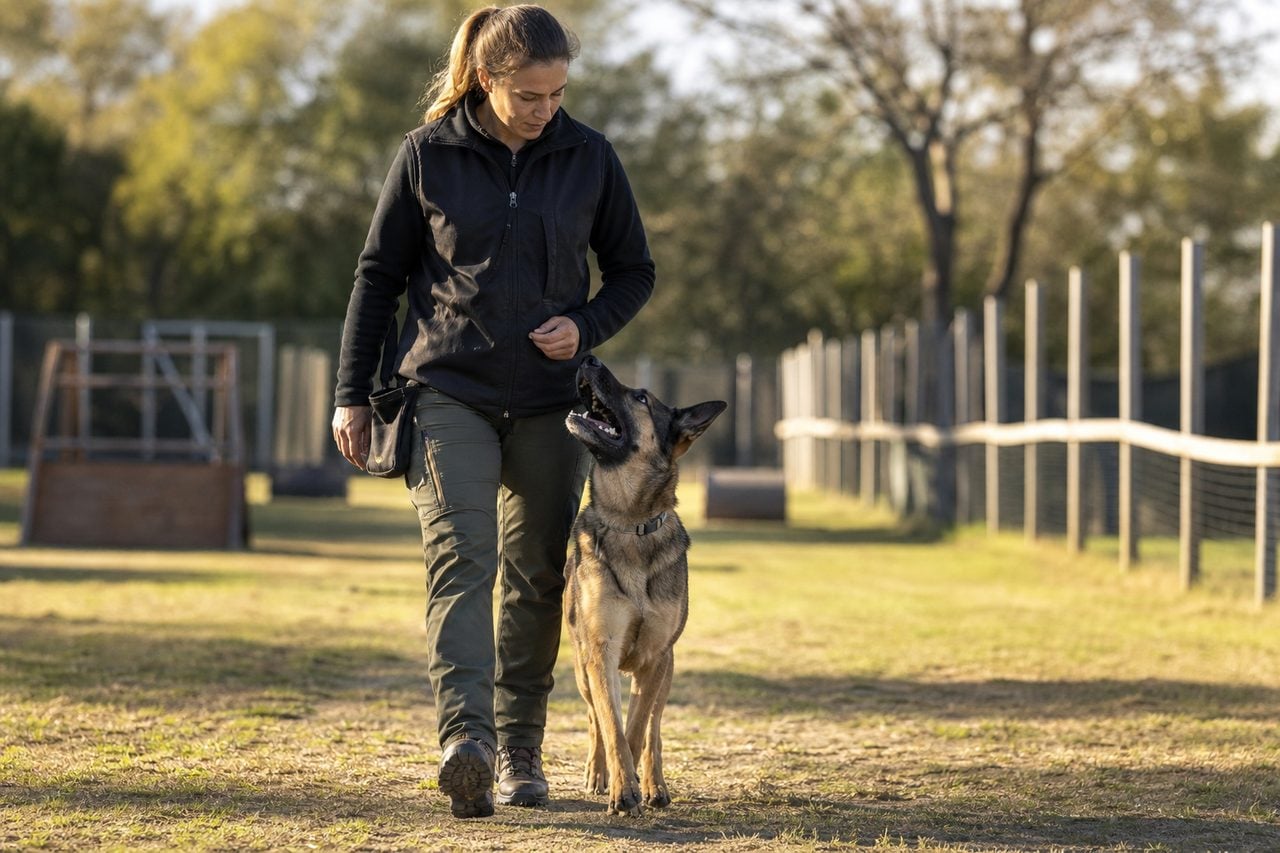
The phrase dog boot camp conjures an image of an intensive, no-nonsense program that turns an unruly dog around fast. For many owners across Monroe County — the ones whose dog pulls like a freight train on the B-Line Trail, ignores every recall at Griffy Lake, or bounces off the walls at home — that intensity is exactly the appeal. A boot camp compresses weeks of scattered practice into a concentrated stretch of daily, structured work.
But boot camp is a marketing term, not a regulated one. What sits behind the label ranges from thoughtful, immersive obedience programs to high-pressure operations that value speed over the dog’s wellbeing. Understanding what the words actually mean, and how to tell a good program from a bad one, is the difference between a dog that comes home genuinely improved and one that simply learned to shut down.
This guide explains what dog boot camps involve, how intensive obedience training works, what the Bloomington area offers, and how to choose a program that gets fast results through clear structure and cooperation rather than force. The aim is a dog that is more responsive and easier to live with — and an owner equipped to keep it that way.
What Dog Boot Camp Really Means
Boot camp is an umbrella term for intensive obedience training delivered over a short, concentrated period. In practice, most boot camps are a form of board and train — the dog stays at a facility and receives many training sessions per day — though some trainers offer day-boot-camp formats where the dog attends during the day and goes home at night. The common thread is density: instead of one class a week, the dog trains multiple times a day, every day, for a defined stretch.
The word boot camp can imply harshness, and some programs lean into that image. It is worth separating the marketing from the method. Intensity refers to how often and how thoroughly the dog trains — not to how harshly it is treated. The best intensive programs are demanding in structure and repetition while remaining humane and reward-based. A program that equates intensity with punishment is selling toughness, not results.
Typical boot camp goals include reliable obedience — sit, down, stay, place, recall, and loose-leash walking — along with impulse control and better manners around distractions. Some programs push toward off-leash reliability. Because the format is immersive, dogs that respond well to consistency and clear rules often make quick, visible progress.
It is worth being precise about where the speed in a boot camp comes from, because misunderstanding it leads to disappointment. The acceleration is not the result of a secret technique; it comes from frequency and consistency. A dog that practices a skill six times a day, every day, with correct timing and no confusing mixed messages, simply learns faster than a dog that practices once a week with an owner who is still figuring out the mechanics. That is genuinely valuable — but it also means the ceiling on results is set by how well the behaviors then transfer to your slower, less consistent home practice. Understanding that keeps expectations grounded and puts the focus where it belongs: on the handoff and your follow-through.
Who Boot Camp Is For — and Who It Is Not
Intensive obedience training suits some dogs and situations far better than others. It tends to work well for physically healthy, emotionally stable dogs whose problems are essentially training gaps: a young dog with boundless energy and no manners, a rescue that never learned the basics, or a dog whose owners simply have not had time to be consistent.
Good candidates
- Adolescent and adult dogs with obedience gaps but sound temperament.
- Dogs whose owners struggle to maintain daily consistency on their own.
- Households wanting to accelerate foundation training before it becomes ingrained bad habit.
- Dogs that need reliable recall and leash manners for an active Bloomington lifestyle — trails, lakes, and busy sidewalks near campus.
Poor candidates
- Dogs whose core issue is fear, anxiety, or aggression driven by an emotional state.
- Dogs with untreated pain or medical problems that may be driving behavior.
- Very young puppies, who generally do better with gentle socialization and short home-based sessions.
The distinction matters because an intensive obedience program applied to an anxious or aggressive dog can make things worse. Piling structure and pressure onto a dog whose real problem is emotional can suppress warning signals without resolving the underlying state. If aggression or serious fear is in the picture, the right first step is usually a behavior-focused professional and often a veterinary evaluation — not a boot camp.
A useful way to self-assess is to ask what the behavior is really about. If your dog knows how to sit but chooses not to when excited, or has simply never been taught to walk on a loose leash, that is an obedience gap — exactly what intensive training addresses. If your dog freezes, cowers, snaps when approached, or panics when you leave, the behavior is being driven by an emotion, and no amount of obedience drilling changes how the dog feels. Owners frequently blur these two, hoping a boot camp will resolve an emotional problem through structure alone. A trustworthy trainer will make this distinction for you during the intake conversation and redirect you if a boot camp is the wrong tool. That honesty, rather than a willingness to take every dog, is one of the clearest markers of a good program.
Inside an Intensive Obedience Program
A well-designed boot camp is not a marathon of nonstop drilling. Dogs learn in short bursts, and rest is part of the curriculum. Expect a daily rhythm of multiple brief training sessions separated by decompression, enrichment, and structured downtime that itself teaches the dog to settle.
The training usually progresses through stages. Early on, the trainer establishes clear communication — marker signals, reward timing, and the basic command vocabulary in a quiet setting. As the dog gains fluency, sessions add duration and difficulty: longer stays, recall from farther away, and walking past mild distractions. Finally comes proofing, where the dog practices in progressively harder real-world environments so the behaviors hold up outside the training yard.
That last stage is where the Bloomington area shines. A dog that can hold a stay in a quiet room has not really learned it until it can do so near other dogs, in a parking lot, or along a busy stretch of the B-Line Trail. A serious program deliberately exposes the dog to the kinds of distractions it will face in real life — campus foot traffic, other dogs at Griffy Lake, the bustle of a store entrance.
Ask any program to describe this arc concretely. Trainers who document progress with notes and video, and who can explain how they build from foundation to proofing, are demonstrating a real methodology rather than a slogan.
Rest deserves a closer look, because it is the part owners most often underrate. A dog that is aroused and tired does not consolidate learning well, and chronic stress undermines everything a program is trying to build. Good trainers treat structured downtime — calm settling in a crate or kennel run — as an active skill, not merely a break between the real work. For many boot camp dogs, learning to be quiet and relaxed on cue is one of the most life-changing outcomes of the stay, because an over-aroused dog that cannot switch off is often the root of the behaviors that drove the owner to seek help in the first place. When you tour a facility, notice whether the dogs are frantic or settled. A yard full of calm, resting dogs between sessions is a better sign than constant activity, and it tells you the program understands that a settled nervous system is the platform every trained behavior is built on.
Red Flags: Separating Real Training From Tough Talk
Because boot camp markets itself on toughness, it attracts some operators who deliver intimidation dressed up as discipline. Knowing the warning signs protects your dog and your money.
Warning signs to take seriously
- Guaranteed results or miracle timelines. Living creatures do not come with guarantees. Honest trainers describe likely outcomes and limits, not certainties.
- Refusal to let you observe. If you cannot watch a session or see video of dogs mid-program, ask why. Transparency is a hallmark of good trainers.
- Heavy reliance on harsh corrections as the default. Prong and electronic collars used as a first resort, or intimidation-based control, should give you pause. Ask what happens when a dog makes a mistake.
- No owner instruction. A program that hands back a dog with no coaching for you is setting you up to lose the results.
- Vague or defensive answers. A professional welcomes hard questions about method, housing, and safety.
Positive indicators run the other way: clear explanations of method, willingness to show you the operation, credentials such as CPDT-KA, realistic promises, and a genuine emphasis on teaching you to maintain the training. A dog that behaves for the trainer but not for you is a failed program, no matter how impressive the demo looks.
Dog Boot Camp Options Around Monroe County
Bloomington and the surrounding area support a range of trainers, from campus-adjacent obedience specialists to rural facilities with the space for an immersive program. As a university town roughly an hour south of Indianapolis via SR-37 and I-69, Bloomington gives owners a genuine local choice rather than forcing a drive to the metro for intensive training.
The surrounding communities widen the options. Trainers work in and around Ellettsville, Spencer near McCormick’s Creek State Park, Bedford to the south, Nashville by Brown County State Park, and the smaller towns of Bloomfield and Martinsville. Rural settings can be an asset for a boot camp — more room to work, quieter surroundings for foundation learning, and easy access to varied environments for proofing once the dog is ready.
An active local lifestyle raises the bar for what obedience training needs to accomplish. Owners here want dogs that can handle Lake Monroe outings, hikes in Brown County State Park, walks on the B-Line Trail, and the everyday distractions of a busy college town. When you evaluate a program, ask specifically how it prepares dogs for those real-world settings rather than just the training yard. And because Indiana has no statewide leash law, you will be relying on your dog’s reliability and on the local ordinances across the Bloomington area — another reason solid, proofed recall and leash manners are worth the investment.
There is also the question of proximity versus specialty. Because a boot camp is a multi-day commitment, a program close to home makes it far easier to attend transfer lessons, drop in if the trainer offers it, and handle pickup without a long haul. For the great majority of obedience goals, a local Monroe County program covers everything an owner needs. The metro up SR-37 and I-69 is worth the drive only when you are after a genuine specialty that is not available nearby. Weigh convenience honestly — the easier it is to stay involved during and after the stay, the more likely the results are to last.
Making the Results Last After Boot Camp
The hardest truth about any intensive program is that the finish line at pickup is really a starting line. Your dog learned to respond to a trainer in a controlled setting. Bringing those behaviors home, into a house full of old habits and handled by someone still learning the new system, requires deliberate follow-through.
This is why owner instruction is non-negotiable. A quality boot camp builds in transfer lessons — hands-on coaching where you practice the commands, reward correctly, and learn to read your dog — plus written home protocols and ideally a window of follow-up support. Budget real time for this. The programs that fail are rarely the ones with bad training; they are the ones where the owner treated pickup as the end.
Keeping the gains
- Practice the commands daily at first, in short sessions, in real settings.
- Keep the whole household on the same commands, rules, and rewards.
- Maintain the structure the trainer recommends — crate use, feeding routine, clear boundaries.
- Expect a brief regression in the first weeks and stay consistent through it.
- Use follow-up lessons if offered; a check-in a few weeks out catches drift early.
A boot camp can genuinely accelerate a dog’s obedience, but it accelerates a process — it does not replace it. The owners who get lasting value are the ones who see the intensive stay as a powerful jump-start that they then protect through consistency at home.
How to Choose the Right Program
With the marketing stripped away, choosing a boot camp comes down to a handful of practical steps. Start by getting clear on your goals. A dog that just needs leash manners and a reliable recall has different needs than one you want fully off-leash reliable, and a good trainer will tailor the plan accordingly rather than selling a one-size package.
Then vet the trainer directly. Tour the facility and inspect where your dog will live. Ask about method, tools, daily routine, rest, and safety. Request to observe a session or see video. Confirm vaccination requirements and emergency protocols. Ask about the transfer process and what support you get after pickup. Talk to past clients — in a community the size of Bloomington, honest word of mouth travels.
Finally, trust your read of the person. The individual who will actually handle your dog matters more than the brochure. A trainer who is transparent, realistic, and clearly humane in their approach is worth more than a slicker operation that dodges your questions, and the way a program answers hard questions during your first conversation is often the truest preview of how it will treat your dog when you are not there to watch. Intensity delivered with skill and care produces a better dog; intensity delivered through pressure produces a quieter one that is not actually better off. Choose the former.
It also pays to think past pickup before you ever enroll. Ask what maintenance the program expects of you, what happens if a behavior slips a month later, and whether follow-up sessions or refreshers are available. A boot camp is a concentrated push, but living with a well-behaved dog is an ongoing practice, and the trainers worth choosing frame it that way rather than implying the job is finished when you drive off. If a program cannot describe what your role looks like in the weeks and months after the stay, it has not thought through the part that actually determines whether your money was well spent.
Finally, keep perspective on what a boot camp can and cannot deliver. It can give a healthy, stable dog a strong obedience foundation faster than you could alone, resolve nuisance habits, and hand you a trained animal plus the coaching to maintain it. It cannot rewrite a dog’s temperament, cure fear or aggression through drilling, or substitute for the daily relationship you build at home. Matched to the right dog and the right goals, and backed by your follow-through, intensive obedience training is one of the more powerful tools available to an owner around Monroe County. Matched to the wrong problem, it is an expensive way to postpone getting the help your dog actually needs.
Reviewed Dog Boot Camp Trainers in Bloomington
These reviewed Bloomington-area trainers from our directory handle dog boot camp. Each links to a full profile with specialties, certified credentials, reviews, and contact info:
- Hackers Creek Kennel — 5.0★ (21 reviews)
- Havenquest Kennels — 5.0★ (2 reviews)
- Hoosier Country Canine — 5.0★ (1 review)
- Scout’s Honor — 4.9★ (248 reviews)
- Mannered Mutts Training LLC — 4.8★ (103 reviews)
- Hillside Boarding and Kennel — 4.7★ (119 reviews)
See all Bloomington dog boot camp trainers →
Frequently Asked Questions
Is dog boot camp the same as board and train?
Mostly, yes — most boot camps are a form of board and train, where your dog stays at a facility and trains intensively each day. Some trainers offer a day format where the dog comes home at night. Boot camp is a marketing term that emphasizes intensity; the substance is the same immersive, high-frequency obedience training. What matters is the method and the transfer back to you, not the label.
Does boot camp use harsh methods?
It depends entirely on the trainer. The name implies toughness, but intensity should mean frequent, thorough training — not harsh handling. The best intensive programs are demanding in structure while remaining reward-based and humane. Ask directly what tools are used, when, and why, and request to observe a session. If a program equates being tough with punishing dogs, keep looking.
How fast will I see results?
Because training is concentrated, many dogs show visible progress within the first couple of weeks, and foundation obedience can be well established in two to three. That said, be skeptical of guaranteed timelines. Results also depend on your follow-through at home — the speed of a boot camp is real, but it jump-starts a process you then have to maintain.
Is boot camp right for an aggressive or anxious dog?
Usually not as a first step. Aggression and serious anxiety are emotional, and sometimes medical, issues rather than simple obedience gaps. Adding pressure and structure can suppress warning signs without fixing the underlying state, and may make things worse. These cases generally need a behavior-focused professional and often a veterinary workup first. A responsible trainer will say so instead of taking the case anyway.
Will the training transfer to me, or only work for the trainer?
Transfer only happens if the program builds it in. Dogs generalize poorly, so behaviors learned with a trainer need to be re-taught to you through hands-on coaching, written protocols, and ideally follow-up support. A boot camp with no owner instruction will leave you with a dog that behaves for the trainer and not at home. Insist on real transfer lessons before you commit.
What should my dog already know before boot camp?
Nothing formal is required — many dogs enter with no training at all — but your dog should be healthy and current on vaccinations, and you should disclose any history of fear, guarding, or biting so the trainer can plan safely. If pain or a medical issue might be driving the behavior, have your veterinarian rule that out first. Honesty up front protects your dog, the staff, and the results.
Related: read our complete dog boot camp guide or the full Bloomington dog training overview.
Ready to find the right dog boot camp pro in Bloomington?