
Dog Boot Camp in Columbus, IN
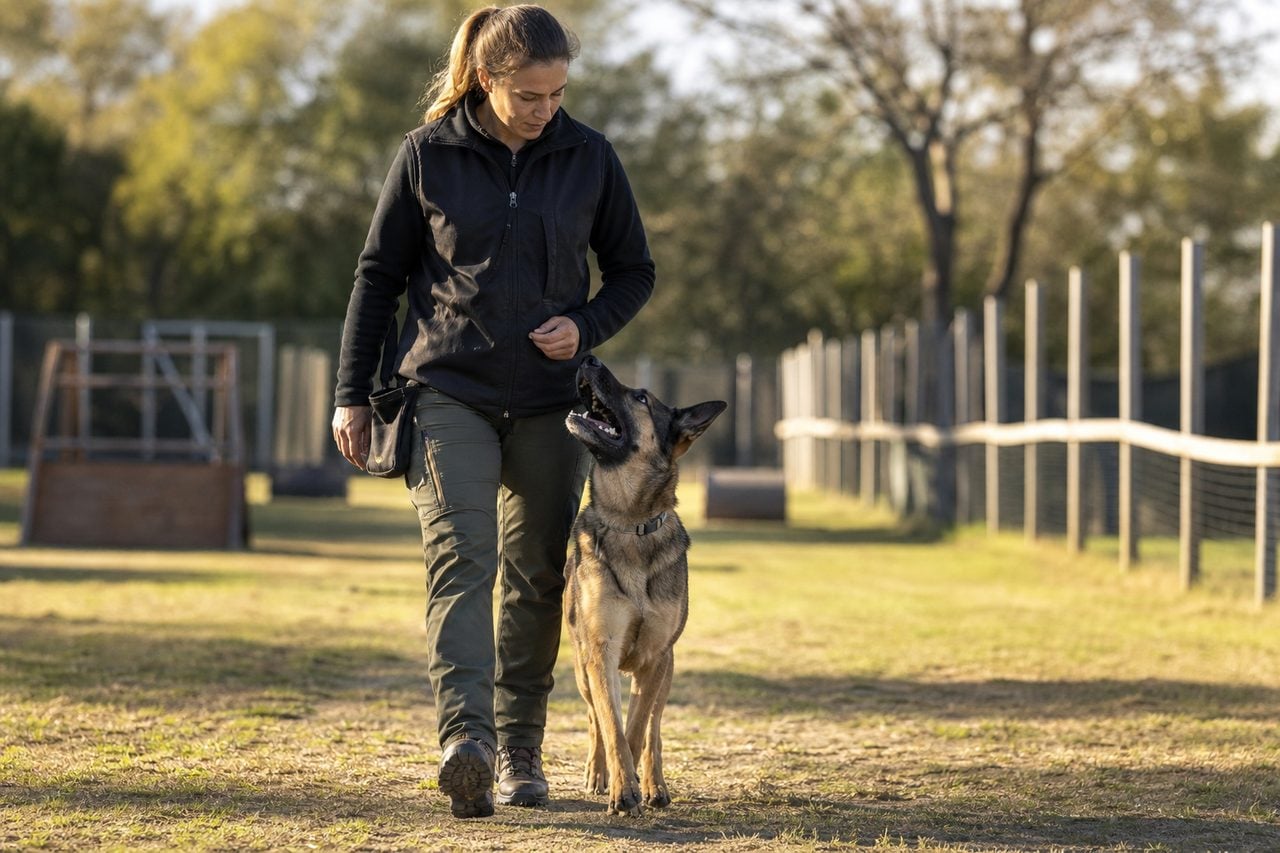
“Dog boot camp” is what people in Columbus and Seymour type into a search bar at the end of a bad week. The dog has bolted out the front door again, or dragged someone down the sidewalk, or eaten something off the counter for the third time, and the phrase that comes to mind is the one that promises discipline delivered fast by somebody else. It is an emotionally accurate search term. It is also, as a description of a service, almost entirely a marketing label rather than a defined category of training.
- What people actually mean by “dog boot camp”
- Sorting the labels: boot camp, board-and-train, day camp, daycare
- Who actually benefits: the adolescent dog problem
- What exists around Columbus, Seymour and the county towns
- Red flags in boot-camp marketing
- What a well-run intensive looks like day to day
- Preparing for drop-off — and when to look north to Indianapolis
- Reviewed trainers
- FAQ
That matters, because the word carries baggage. To some providers, “boot camp” simply means an intensive residential program — the same thing another facility calls board-and-train or a stay school, sold with a punchier name. To others, the military framing is the product: strict, correction-heavy, obedience-first. Two facilities can advertise a boot camp and run programs with almost nothing in common. Since you are handing over your dog for weeks, knowing which one you are actually buying is the whole job.
This guide unpacks what the term covers, which dogs genuinely benefit from an intensive format, what exists locally around Bartholomew and Jackson counties, the red flags that should end a sales conversation, and when the deeper trainer pool an hour north on I-65 in Indianapolis is the sensible call. It is written for owners who are frustrated but still want to make a good decision rather than a fast one.
What people actually mean by “dog boot camp”
There is no professional body that defines a dog boot camp, no certification attached to the phrase, and no standard curriculum behind it. It is a consumer-facing name, and the honest translation is usually “an intensive training program where the dog stays with the trainer.” In most cases that is functionally the same product as board-and-train, dressed in language that appeals to an owner who feels they have lost control.
Where the label does carry information is in what it signals about the provider’s framing. A trainer who leans hard on military and discipline imagery is telling you something about their emphasis: structure, compliance, obedience under pressure. A trainer who avoids the term entirely is usually signalling a different emphasis, often on emotional state, motivation and reinforcement. Neither signal tells you whether the training is good. Plenty of excellent trainers use blunt language, and plenty of poor ones use gentle language.
So treat the phrase as a search term, not a specification. When you call, stop using the word and ask concrete questions instead: where does the dog sleep, how many sessions per day, what tools are used, what happens when the dog gets it wrong, what does the dog know at the end, and how does that knowledge get handed to me. The answers to those six questions describe the actual product. The name on the website describes the ad.
It is also worth noticing what the search term reveals about your own state of mind. Owners who type “boot camp” are usually past the point of patience, and that is precisely the moment when people overpay for the wrong service. The frustration is legitimate — living with a dog who cannot be walked or trusted in the house is genuinely exhausting — but the decision made in that state is often the one regretted later. Give yourself a week, call three providers rather than one, and treat the phone conversations as interviews rather than as a purchase you have already decided on.
Sorting the labels: boot camp, board-and-train, day camp, daycare
Four terms get used loosely in this market and mean very different things for your dog and your wallet. Boot camp and board-and-train usually describe the same structure: the dog lives at the facility or in a trainer’s home for a defined number of weeks and receives daily structured sessions. Day training or day school means the dog is dropped off in the morning, trained during the day by staff, and goes home at night — the training content can be nearly identical, but the dog sleeps in your house.
Doggy daycare is not training at all. It is supervised group play and containment, and while a good daycare enforces some manners and gives an under-exercised dog an outlet, nobody is running structured sessions with your dog’s specific goals in mind. Some facilities sell daycare and training under one roof, which is fine, but you should know which product you are paying for and how many minutes a day of actual training your dog receives.
The practical ranking for most owners: day training first if logistics allow, because it preserves the home context and spreads the coaching over time; residency when your schedule genuinely cannot support daily transport or when the program you want is too far for a daily round trip; daycare as supplemental exercise, never as a substitute for either. Group class and private in-home lessons sit alongside all of this and are frequently the better value for the specific problem you are trying to solve.
Who actually benefits: the adolescent dog problem
An enormous share of boot-camp inquiries involve a dog between roughly seven and eighteen months old. This is not a coincidence. Adolescence in dogs brings a predictable cluster of changes: the recall that worked at four months stops working, the world becomes more interesting than the owner, hormonal and developmental shifts alter tolerance and impulse control, and physical size finally makes bad leash habits genuinely unmanageable. Owners describe it as the dog “going backwards” or “forgetting everything.”
Adolescent dogs are often excellent candidates for an intensive format, because what they mostly need is high-frequency, well-timed repetition in the presence of distraction — exactly what a competent full-time handler delivers better than a tired owner at 9pm. Foundation obedience, impulse control, leash mechanics, settling on cue and recall all respond well to concentrated work at this age.
The dogs who benefit least are at the two extremes. A young puppy under about five months usually needs socialisation, exposure and gentle habituation delivered by its own family, not a residency; sending a puppy away during a critical developmental window can cost more than it buys. At the other end, a dog with a real behavior problem — bites, panic, entrenched fear, resource guarding with a history — needs assessment and a behavior plan, not an obedience intensive. Obedience does not treat emotion. A dog can hold a flawless down-stay and still be terrified or still bite.
There is also a category of dog for whom the intensive format is a poor fit regardless of the problem: dogs who do badly in kennel environments. Some dogs shut down, stop eating, or spiral into stress behaviors when housed away from home, and a stressed dog learns poorly. If your dog has struggled with boarding before, say so up front and ask how the facility handles it — whether the dog can be housed in a trainer’s home rather than a kennel run, or whether day training would be the safer choice. A good provider will steer you away from residency in those cases rather than take the booking.
What exists around Columbus, Seymour and the county towns
Straight answer on local supply: nobody in this metro is marketing a distinct product called a dog boot camp, but the underlying service — an intensive residential or day-based training program — does exist locally, which puts it ahead of several other specialty niches around here. Dog Training With Monica in Seymour runs multi-week board-and-train. Barkefellers in Columbus runs a board-and-train it calls Stay School plus a Day School day-training option. Guardian-K9 in Columbus offers day training and boarding.
For the classic case — a big, rude, under-trained adolescent who needs structure and a lot of repetition — those are real options inside Bartholomew and Jackson counties, and being able to visit the facility, meet the person handling your dog, and get to follow-up sessions without an hour on the interstate has genuine value. Owners in Hope, Taylorsville, Edinburgh, North Vernon, Brownstown, Crothersville, Austin and Greensburg are all within a reasonable drive of Columbus or Seymour.
What this metro does not have is choice within the category. If the first facility you call is booked out, or their methods do not match what you want, or your dog needs something outside mainstream obedience, the local list is short enough that you will run out of it quickly. That is a population-size problem, not a quality problem. We do not list prices or program lengths here because those change and vary by dog — call and ask each provider directly, and get their answer in writing before you book.
Red flags in boot-camp marketing
The first red flag is a guarantee. Living creatures do not come with guaranteed outcomes, and a trainer promising a specific behavioral result in a specific number of days is either exaggerating or planning to define success loosely. Related: any claim that your dog will come home “fixed,” “bulletproof,” or “never do that again.” Good trainers describe outcomes in terms of skills, reliability levels and distraction thresholds, with conditions attached.
The second is opacity. If you cannot see the kennel area, cannot get a straight answer about what equipment is used, cannot visit or receive video during the stay, or find that the person who sold you the program is not the person training your dog, treat all of that as a single compound warning. You do not need constant access, but you need the option and you need honesty about who does what.
The third is pressure. Deposits demanded on the first call, urgency framing about a spot that is about to be lost, or discomfort when you say you want to look at two other providers first — none of that belongs in a decision this size. The fourth is a refusal to discuss what happens if the dog does not do well: every honest program has had a dog that struggled in residency, and they should be able to describe how they handled it and what the refund or early-exit policy is. Finally, be wary of anyone who diagnoses your dog’s problem over the phone without seeing it, especially if the diagnosis conveniently matches the most expensive package.
What a well-run intensive looks like day to day
Ask a provider to walk you through a typical day and you learn more than any brochure will tell you. A good answer has shape: several short training sessions rather than one long one, because dogs learn better in brief blocks; sessions in varied locations and with increasing distraction as the weeks progress, not just repetition on the same training floor; deliberate rest, because consolidation happens during downtime and a chronically over-aroused dog learns poorly; and enrichment — sniffing, chewing, problem-solving — that keeps a kennelled dog mentally intact.
You should also hear about generalisation. Skills learned in one room with one handler do not automatically appear in a parking lot with a stranger. A serious program deliberately moves the work outdoors, into public spaces, around other dogs and people, and gets a second handler involved before the dog goes home. Ask specifically where they take dogs to proof behavior, and whether your dog will work anywhere other than the facility.
Progress reporting is the third marker. Regular updates with video, describing what is going well and what is not, tell you the trainer is tracking your dog as an individual rather than running a conveyor belt. And the schedule should end with owner transfer sessions built into the program, ideally more than one, ideally with at least one in your own home. If the day-to-day description you get is vague, generic or purely about obedience commands with no mention of rest, enrichment or generalisation, keep calling.
Preparing for drop-off — and when to look north to Indianapolis
Before drop-off, get the paperwork and health side clean: current vaccinations to the facility’s standard, parasite prevention, and a vet visit if there is any chance pain is driving the behavior. Orthopedic pain, ear infections, gut problems and thyroid issues all show up as behavior, and an intensive program cannot train away a physical problem. Bring the dog’s normal food to avoid a diet change on top of an environment change. Write down, honestly, what your dog actually does — including the embarrassing parts and any bite history — because a trainer who is surprised on day three is a trainer who cannot keep everyone safe.
Set your own expectations too. Decide in advance what daily maintenance you can realistically commit to when the dog comes back, and tell the trainer the truth about it, so the program can be built around a household that exists rather than an ideal one. Fifteen honest minutes a day beats a plan for an hour that never happens.
Then the geography. Columbus is about an hour south of Indianapolis on I-65 and Seymour roughly twenty minutes further; that is an easy drive for a service you use a handful of times. Go north when you want real choice — several programs to interview, a specific methodology, a trainer with a documented history on your dog’s particular problem, or a facility with behavior expertise on staff. If the problem is emotional rather than obedience-shaped, start with a behavior professional instead: Hot Diggity Dog in Columbus takes reactivity, separation anxiety, aggression and resource-guarding cases locally, and the escalation path beyond that runs to veterinary behavior support in Indianapolis or Purdue’s veterinary behavior service in West Lafayette, about two hours northwest.
Whichever direction you go, write down what success looks like before you hand over money — three or four specific, observable things your dog will be doing differently in eight weeks. “Walks on a loose leash past another dog at ten feet,” “stays on a mat while we eat dinner,” “comes when called in the yard with the neighbour’s dog barking.” Concrete criteria let you evaluate the program honestly instead of relying on a general feeling that things are better or worse. They also make the conversation with the trainer sharper from the first phone call, and any provider worth hiring will engage with that list rather than deflect it.
Reviewed Dog Boot Camp Trainers in Columbus
These reviewed Columbus-area trainers from our directory handle dog boot camp. Each links to a full profile with specialties, certified credentials, reviews, and contact info:
- Dog Training With Monica — 4.8★ (110 reviews)
- Guardian-K9 — 4.7★ (103 reviews)
- Barkefellers – Columbus — 4.6★ (202 reviews)
See all Columbus dog boot camp trainers →
Frequently Asked Questions
Is dog boot camp the same thing as board-and-train?
In practice, usually yes. “Boot camp” is a marketing name rather than a defined service category, and most programs sold under it are residential intensives — the dog lives with the trainer and works daily. The label sometimes hints at a more discipline-focused style, but it guarantees nothing. Ignore the name and ask the concrete questions: where the dog sleeps, how many sessions a day, what tools are used, what happens when the dog is wrong, and how the skills get handed back to you.
Can I find an intensive training program in Columbus, Indiana?
Yes, within limits. Dog Training With Monica in Seymour runs multi-week board-and-train, Barkefellers in Columbus offers a Stay School board-and-train plus a Day School day-training option, and Guardian-K9 in Columbus provides day training and boarding. For mainstream obedience and manners work, those are genuine local choices. The constraint is breadth: if you want several providers to compare, a particular methodology, or a specialist in a specific behavior problem, the Indianapolis pool an hour north on I-65 is deeper.
How old should my dog be for an intensive program?
Adolescents, roughly seven to eighteen months, are the classic fit — that is when foundation skills break down and concentrated repetition helps most. Young puppies under about five months are generally better served at home, where the family can handle socialisation and habituation during a critical developmental window. Older dogs can absolutely learn in an intensive format, though longstanding habits take longer to shift and any sudden behavior change in an older dog warrants a veterinary check first.
Are boot camps harsh or punishment-based?
Some are, some are not, and the name does not tell you which. What tells you is the equipment and the correction protocol, so ask mechanically: what tools do you use, in what circumstances, what does a correction look like, and may I watch one. You are entitled to know before drop-off and entitled to decline any tool you are not comfortable with. A trainer who answers plainly and lets you observe is giving you the information you need; a defensive or evasive answer to a simple equipment question is itself the answer.
What if my dog is aggressive — will a boot camp fix it?
An obedience intensive is the wrong first tool for aggression. Aggression is an emotional and contextual problem, and a dog can perform obedience perfectly while still being dangerous in the situation that triggers it. Start with a veterinary exam to rule out pain, then a qualified behavior professional. Hot Diggity Dog in Columbus, whose owner holds CPDT-KA and IAABC-CDBC credentials, takes aggression and resource-guarding cases locally. If medication or a formal diagnosis is needed, escalate to veterinary behavior support in Indianapolis or Purdue in West Lafayette.
How much daily work will I have to do after the program ends?
Expect real ongoing effort — most trainers will tell you to plan on short, consistent daily practice for months, plus permanent changes to household routines and management. That is not a failure of the program; it is how behavior maintenance works. The most useful question to ask before booking is what the trainer expects of you specifically once the dog is home, in minutes per day and in concrete habits. If the answer is more than your life can absorb, say so, and build a smaller plan that you will actually follow.
Related: read our complete dog boot camp guide or the full Columbus dog training overview.
Ready to find the right dog boot camp pro in Columbus?