
Dog Boot Camp in Orland Park, IL
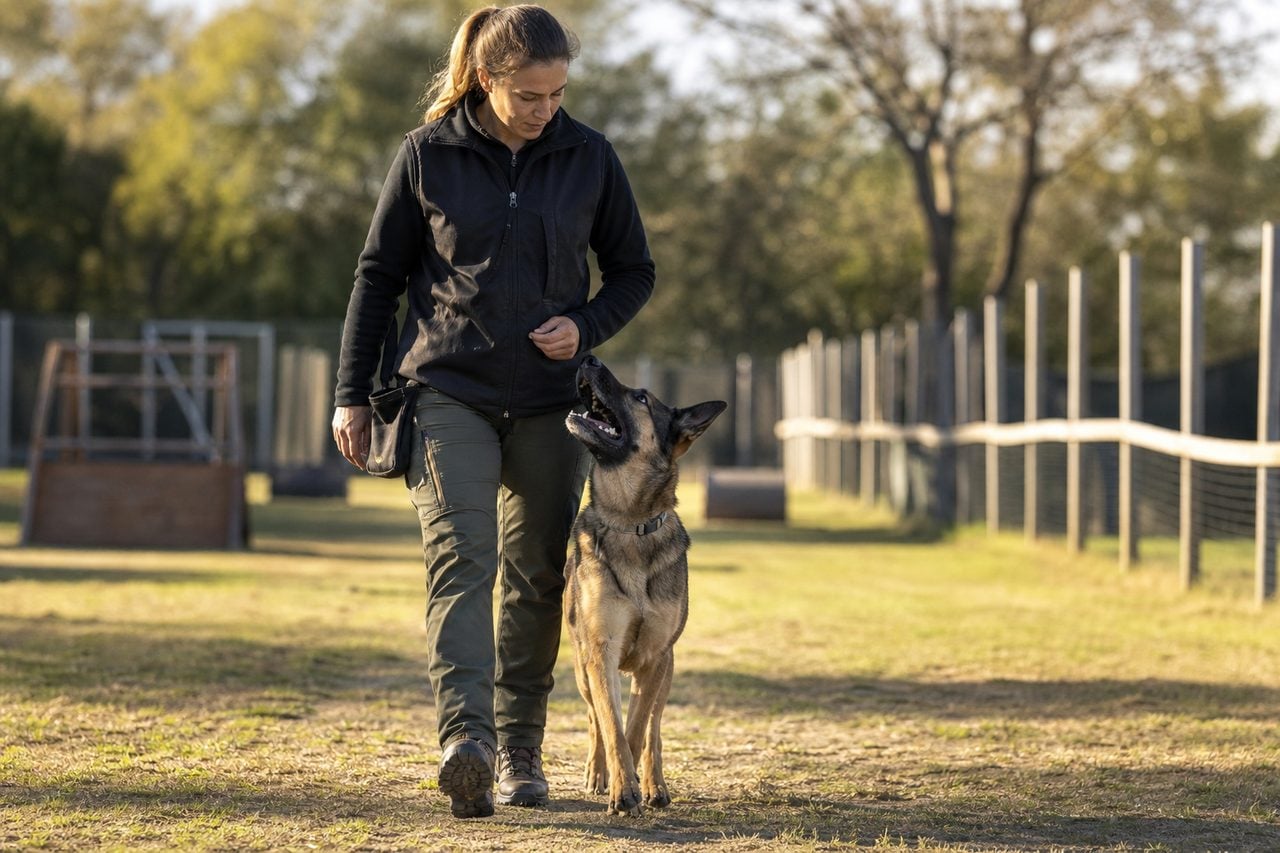
“Boot camp” is a marketing phrase rather than a technical one, and in this metro it is used for two quite different things. Most often it means the same residential program described as board-and-train: the dog lives with the trainer for a period and is worked daily. Sometimes it means an intensive non-residential course — a run of daily or near-daily sessions compressed into a week or two, with the dog going home each night. The two are priced differently and suit different households, and the word on the website will not tell you which you are being offered.
The appeal in the south suburbs is obvious and it is about time rather than about discipline. A household commuting out of Tinley Park or Orland Park at six-thirty in the morning cannot deliver a training program in twenty-minute daily instalments over three months. Compressing the work into a defined block, done by someone else, is a rational response to a real constraint. What matters is knowing exactly what is inside the block, and what happens on the far side of it.
Ask what the words mean before you compare prices
The first question to any provider advertising a boot camp is simply: does my dog sleep at your place or at mine? That single answer separates two products with entirely different cost structures. A residential program is paying for boarding as well as training. An intensive day program is not, which is why it is usually cheaper — but it requires you to transport the dog every day, which in this metro can mean forty minutes each way if the provider is in Frankfort and you are in Park Forest.
The second question is how many training sessions the dog actually receives per day, and who delivers them. There is a large difference between a dog receiving three structured sessions a day from a qualified trainer and a dog boarding in a facility where someone does some training when there is time. Both may be described in similar language on a website. Only one is worth residential prices.
The third question is what is included after the block ends. This is the same point as on the board-and-train page and it is repeated deliberately, because it is where most of the local disappointment with intensive formats originates. A compressed program concentrates the teaching and therefore concentrates the risk that nothing transfers to you.
What compression is good at
Intensity genuinely helps with some things. Behaviors that need many correctly-timed repetitions in a short window — a reliable recall, a solid place or settle, loose-lead walking rebuilt from scratch after years of pulling — benefit from being worked several times a day by someone with consistent timing. Progress that would take three months of once-weekly practice can be made in a fortnight, simply because the dog is not forgetting between sessions.
Compression also helps households whose real problem is inconsistency rather than knowledge. If you know exactly what to do and you keep not doing it because Tuesday was awful and Wednesday was worse, an intensive block delivered by someone else breaks the cycle. That is not a failure on your part; it is an accurate reading of a week that does not have the space in it.
What compression cannot accelerate is emotional change. A frightened dog, a dog with genuine anxiety, a dog whose reactivity is rooted in fear — these change on their own timetable, and pushing them faster generally produces suppression rather than improvement. A dog that has stopped reacting because it has learned that reacting is punished is not a dog that has stopped being afraid, and the difference tends to reveal itself later and worse. Be suspicious of any intensive program that promises a fast fix for fear.
Day-camp and daycare-plus-training in this belt
A distinctly local variant is worth naming because several businesses across this metro offer it. A number of facilities in the southwest corridor and in Frankfort and Homer Glen combine daycare or boarding with training, and sell a package where the dog attends during the day and receives training sessions as part of the stay. For a commuting household this can be an efficient arrangement: the dog is supervised while you are at work, it gets structured work rather than eight hours of unstructured play, and you collect a tired, worked dog rather than an over-aroused one.
The thing to establish is the ratio. Ask how many minutes of actual one-to-one training the dog receives per day, and what it does for the rest of the time. Structured daycare with two short training sessions is a good product and should be priced as daycare plus a little. A full day-training program where the dog is worked repeatedly and rested deliberately between sessions is a different and more expensive product. Both are legitimate; conflating them is how people end up disappointed.
Be aware too that a busy daycare floor is a high-arousal environment. For a dog that is already over-excited around other dogs, spending forty hours a week practicing exactly that, with a little training layered on, can work against the training. Ask how your specific dog will be grouped and rested.
Method matters more when it is compressed
Any method looks better when applied consistently, which is precisely why intensive formats produce impressive short-term results across the whole methodological spectrum. It is also why the method question deserves a clearer answer here than in a weekly class where you are watching every session.
Ask directly what equipment will be used on your dog, what happens when it gets something right, and what happens when it gets something wrong. Ask whether you will see video of real sessions during the block — not a highlight reel at the end, but a mid-week clip of ordinary work. Ask whether you can watch a session in person. Providers across this metro sit at different points on the reward-based to balanced spectrum and many state their position openly on their own websites, which makes them easy to shortlist by preference before you ever pick up the phone.
If a provider is uncomfortable with any of those questions, that is information. It does not automatically mean the method is harsh — some facilities genuinely cannot accommodate observers on the floor — but the reason should make practical sense to you, and an alternative form of visibility should be offered.
The two weeks after are the two weeks that count
The pattern of failure with intensive formats is consistent enough to predict. The dog comes back visibly better. The household relaxes, because the problem appears solved. Nothing is practiced. Old patterns re-emerge over four to eight weeks — the fence line, the doorbell, the pull toward the corner where the other dog lives — and the household concludes that the money was wasted.
The counter is to treat collection day as the start rather than the finish. Keep the dog on a lead indoors for the first few days if that is what the trainer recommends. Do short sessions every day in the specific places you care about: your hallway, your driveway, the sidewalk outside your house, the parking lot at the shops. Then take it somewhere deliberately harder once a week — the long open sightlines of the Orland Grassland loop, the steady predictable traffic of cyclists and walkers on the Old Plank Road Trail, or a busy Saturday at the edge of Centennial Park — and see whether the behavior holds under real conditions rather than assuming it does.
Book the follow-up sessions in advance, on dates, before you leave the facility. A follow-up you intend to arrange when there is a problem happens after the problem has been rehearsed for a month. A follow-up in the diary for a fortnight’s time happens.
Who should not book one
Three households should choose something else. First, anyone hoping to hand the dog over and receive it back finished; that product does not exist at any price, and a provider who implies otherwise is selling the wrong story. Second, households with a dog whose problem is specifically about your absence — separation distress is treated by systematic, graduated absence work at home, and a residential block addresses the wrong variable entirely. Third, puppies, for whom household routine and bonding are the actual curriculum.
There is a fourth group worth naming honestly: households for whom the cost would be a genuine strain. An intensive program is the most expensive way to buy training in this metro, and a well-chosen six-week group course plus five minutes a day of homework produces a better result for most normal family dogs at a fraction of the price. The intensive formats earn their cost for defined problems and for households whose weeks genuinely cannot carry the alternative. If a class would work for you, do the class.
Dog Boot Camp in Orland Park: Local Options & Nearest Specialists
Right now there are no listed Orland Park trainers focused specifically on dog boot camp. Many general Orland Park dog trainers can help you get started, and the nearest specialists for this focus are below.
Nearest dog boot camp specialists — Chicago
For complex cases, some families travel to the larger pool of specialists in the Chicago area for an assessment or a board-and-train stay. Top-reviewed options:
- Suburban K9 Dog Training — 5.0★ (592 reviews)
See all Chicago dog boot camp trainers →
Frequently Asked Questions
Is a boot camp the same as board-and-train?
Often, but not always, and you must ask. Most providers in this metro use the two terms interchangeably for a residential program where the dog lives with the trainer. Some use boot camp for an intensive non-residential course — daily sessions with the dog going home each night. The cost structures are quite different because one includes boarding and the other does not, so establish which you are being quoted for before comparing any prices.
How fast will I see results?
Visible change inside a fortnight is normal for obedience-type behaviors, because the dog is getting many correctly-timed repetitions with consistent handling. Emotional change — fear, anxiety, genuine reactivity rooted in worry — does not compress the same way, and a program promising it quickly is promising suppression rather than change. Ask what specifically will be different at the end, in behaviors you can observe, and be sceptical of answers phrased as personality transformation.
Can I combine daycare with training?
Yes, and several facilities across the southwest corridor, Frankfort and Homer Glen offer exactly that. It suits a commuting household well. The question to pin down is the ratio: how many minutes of genuine one-to-one training per day, and what the dog does for the rest of the time. Structured daycare with two short sessions is a good product at a daycare price; a full day-training program is a different and dearer one. Also ask how an over-excitable dog will be grouped and rested, because a busy floor can undo the training.
What should I ask before booking an intensive program?
Five things. Does my dog sleep at your place or mine? How many training sessions per day and who delivers them? What equipment is used and what happens when my dog gets it wrong? How many follow-up sessions are included and is one of them at my home? And what is the policy if my dog does not settle in the first few days? Providers who have thought about their program answer all five without hesitation.
Is an intensive program worth it for an ordinary family dog?
For most, no. A well-chosen group course, a provider whose method you have actually watched, and five minutes of practice twice a day will get a normal family dog where you want it for a small fraction of the cost. Intensive formats earn their price for defined, stubborn problems, for households in a genuine time crisis, and for owners who know from experience that a weekly slot will not happen. Those are real situations — but they are not most households.
Related: read our complete dog boot camp guide or the full Orland Park dog training overview.
Ready to find the right dog boot camp pro in Orland Park?