
Dog Boot Camp in Schaumburg, IL
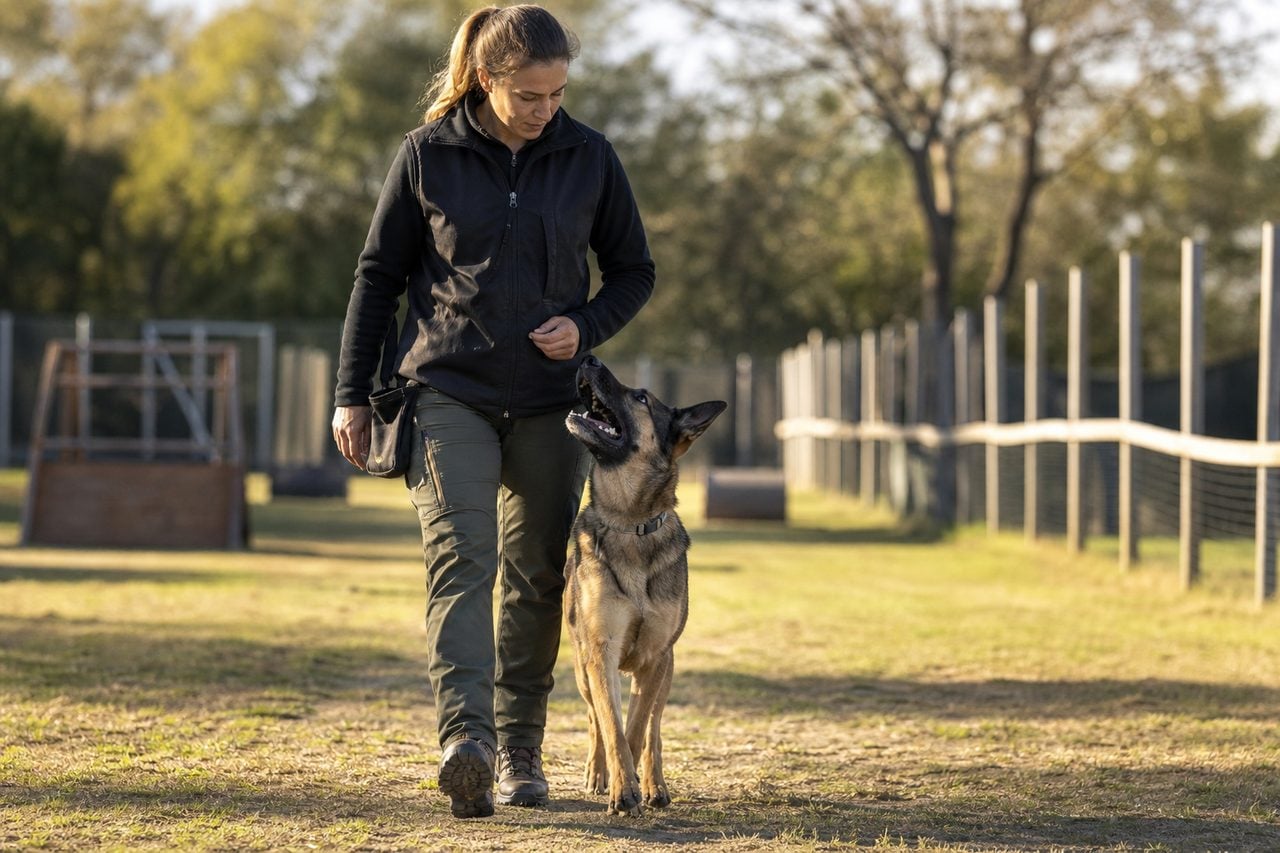
Dog boot camp is a marketing name rather than a training method, and in the northwest suburbs it is applied to at least three different products. Some local programs use it for a residential stay where the dog lives with the trainer for two to four weeks. Some use it for an intensive day program — drop-off in the morning, home at night, run over one or two weeks. And some use it for a compressed private course, several sessions crammed into a fortnight instead of spread over two months. The word tells you the intensity is high. It does not tell you where your dog sleeps, who handles it, or what happens when it gets something wrong.
That ambiguity matters because it is the first thing a buyer needs resolved. Two local programs both called a boot camp can differ by three thousand dollars and by whether your dog is home each evening. Before comparing prices, establish which product each quote actually describes.
This page unpicks the label, explains what an intensive format genuinely does well, sets out honest local pricing for each version, and lists the questions that reveal whether a given boot camp is a serious training program or an expensive kennel stay.
Three products, one name
Residential boot camp. The dog lives with the trainer, typically two to four weeks. This is board and train under a more energetic name. Highest cost, highest repetition density, and the version where the handover back to the family matters most because the dog has learned everything in someone else’s building.
Day boot camp. The dog is dropped off in the morning and collected in the evening, usually five days a week for one to three weeks. Sometimes branded as a day academy, day camp or day training intensive; several centers in the sector run something of this shape. You get most of the repetition benefit, the dog sleeps at home so generalization to your house happens continuously rather than in one handover, and the price sits well below the residential version. For a commuting northwest-suburb household this is frequently the best-value serious option available.
Compressed private boot camp. A private package delivered fast — six sessions in three weeks rather than six sessions in three months. The dog never leaves home, the family does the daily work, and the intensity comes from the pace of the coaching rather than from professional handling hours. Cheapest of the three and the one that most depends on the household actually doing the homework.
Establish which one you are being quoted before anything else. The single most useful question on a first phone call is simply: where does my dog sleep, and how many hours a day is a professional actually handling it?
What intensity is genuinely good at
Compressed formats are not merely a faster version of a weekly class. They are better than a weekly class at some things and worse at others, and knowing which is which prevents an expensive mismatch.
They are good at breaking a rehearsed habit. A behavior practiced daily for a year — bolting the front door, lunging at the window, dragging on the lead down your driveway — is maintained by rehearsal. A weekly class gives the dog six days to keep rehearsing between lessons. An intensive interrupts the loop.
They are good at behaviors that need volume. Duration on a place bed, a settled down-stay, a heel that holds past a distraction, an off-lead recall — these need hundreds of correct repetitions. Thirty a day for fourteen days is four hundred; three a day for fourteen weeks is a different curve entirely.
They are good at households in genuine crisis, where the dog’s size or behavior has made daily life unsafe now and a three-month plan is not a viable answer.
They are poor at emotional problems. Fear, anxiety, separation distress and true reactivity change on a biological clock, not a commercial one. You cannot compress the schedule on which a dog’s emotional response to a trigger changes, and a program that claims to is either doing something you would not want to watch or is suppressing behavior rather than changing feeling.
They are also poor at teaching the family, unless the program is explicitly built to. Intensity concentrates the professional’s hours, which by definition means fewer of the household’s hours.
Local prices for each version
Because the label spans three products, so does the price. Realistic northwest-suburb bands:
Residential boot camp: about $1,500 for a short stay, $2,000 to $3,500 for a typical two-week program, and $3,500 to $6,000-plus for three to four weeks or for off-lead and behavior-focused work.
Day boot camp: commonly a few hundred dollars a week, with one- to three-week blocks landing somewhere between roughly $800 and $2,500 depending on the number of sessions per day and the facility. Meaningfully cheaper than residential for a large share of the same benefit.
Compressed private boot camp: priced off the private rate of roughly $100 to $200 a session, so six sessions delivered over three weeks lands around $600 to $1,200.
When comparing quotes, normalize them. Ask each provider for two numbers: how many hours a professional will personally handle your dog, and how many hours of in-person coaching you will receive. A $3,000 residential program with twenty handling hours and one handover session is a different purchase from a $1,800 day program with forty handling hours and four coaching sessions, even though the first looks more serious. The northwest-suburb market is competitive enough that you can genuinely shop this.
The handover problem, and why day formats dodge it
Every residential format faces the same structural obstacle. Dogs learn contextually. A dog that has spent three weeks being brilliant in a training hall in an Elk Grove Village industrial unit has learned to be brilliant there, with that handler, on that floor, with those cues. Your kitchen has none of those features.
Good residential programs solve this deliberately: multiple in-person handover sessions, at least one at your house, written cue and equipment documentation, and follow-up included in the price. Weak ones hand you a lead in the parking lot and a printed sheet.
Day formats sidestep the problem structurally. The dog goes home every evening, so it is generalizing the new behavior to your house continuously, in small increments, for the entire duration of the program — and you are present for the transfer every single day rather than in one concentrated debrief. Many trainers who run both formats will say privately that day training produces better retention in ordinary family households, and that residential’s real advantage is for dogs whose home environment is actively undermining the training or where the household simply cannot be present.
If you are choosing between two local programs at similar prices and one is residential while the other is day-based, the day-based one starts with a genuine structural advantage on retention. That is not the same as being better — but it should be weighed.
Warning signs specific to intensive programs
The compressed formats attract the strongest marketing claims in the industry, and the northwest suburbs are no exception. A few things should give you pause.
A guaranteed outcome. No trainer controls what happens in your house after the dog comes home, so no honest guarantee can promise a behavioral result independent of the household. A guarantee of further free sessions is reasonable; a guarantee of a fixed outcome is a sales instrument.
Vagueness about consequences. You are entitled to a concrete answer to what happens when the dog gets it wrong, in plain language. A trainer who will not describe it, or who answers only with a philosophy label, has told you something.
Refusal to show the space. Decisive, every time. If the dog will be housed anywhere you may not see, do not book.
No video updates. Regular video is standard among the better local residential programs and is nearly the only window a client has. Its absence in a residential program is a meaningful gap.
Aggression and anxiety promised in two weeks. These do not run on a fortnight’s schedule. A program that markets a two-week fix for aggression is either suppressing the behavior — which removes the warning signals while leaving the underlying emotion intact, a genuinely dangerous outcome — or is overselling.
No assessment before the quote. A price quoted over the phone without anyone having met your dog is a product being sold, not a program being designed.
Choosing between formats: a practical decision path
Start with the problem, not the product.
If the issue is obedience and manners on a normal dog — pulling, jumping, ignoring recall, no impulse control — and the household has any capacity at all, start with a group obedience course at $150 to $300 or a private package. This is the cheapest intervention in the market and it resolves a large majority of ordinary cases. Escalate only if it does not.
If the issue is the same, but the household genuinely cannot supply daily repetitions — two long commutes, small children, no time — then a day boot camp is the best fit. Professional repetitions during the day, the dog home each evening, and a price well under residential.
If the dog’s size or strength has made the situation unsafe now, or if the home environment is actively reinforcing the problem faster than any program can undo it, a residential boot camp earns its premium. Buy it with the handover quantified in writing.
If the issue is fear, anxiety, separation distress or reactivity, skip the intensive formats and engage a behavior-focused trainer for graduated in-home work. Several trainers across the sector publish behavior modification and reactivity as named services. This is a different discipline on a different timescale, and buying intensity here mostly buys disappointment.
And in every case, ask for an assessment before a price. The trainer’s willingness to recommend the cheaper product when it is the right one is the most reliable signal you will get.
Making it stick once the program ends
Whatever format you buy, the fortnight after it ends decides what you kept.
Keep the structure for at least a month. Whatever rules the program installed — a place command before meals, a wait at the door, no furniture, lead on in the house — hold them longer than feels necessary. The commonest way northwest-suburb families lose a boot-camp result is by relaxing everything the weekend the dog gets home, because the dog is behaving well and the rules feel unnecessary. They feel unnecessary precisely because they are working.
Use the cues daily in ordinary life rather than in dedicated practice sessions. A sit before the food bowl, a place command when the doorbell goes, a recall from the garden before you let the dog back in. Five bolted-on repetitions a day survive a commuting household; a fifteen-minute training slot does not.
Book the follow-ups and actually attend them. Sessions included in the fee are routinely skipped because the dog seems fine, and they are skipped at exactly the point where a small drift is cheap to correct.
Finally, join something. A follow-on group class, a Canine Good Citizen preparation course or a sport class — agility, rally, nose work — gives the household a reason to keep handling the dog every week. The sector has plenty of all of these. A dog with an ongoing weekly commitment holds its training; a dog whose training ended on collection day starts drifting the following month.
Dog Boot Camp in Schaumburg: Local Options & Nearest Specialists
Right now there are no listed Schaumburg trainers focused specifically on dog boot camp. Many general Schaumburg dog trainers can help you get started, and the nearest specialists for this focus are below.
Nearest dog boot camp specialists — Chicago
For complex cases, some families travel to the larger pool of specialists in the Chicago area for an assessment or a board-and-train stay. Top-reviewed options:
- Suburban K9 Dog Training — 5.0★ (592 reviews)
See all Chicago dog boot camp trainers →
Frequently Asked Questions
What is the difference between dog boot camp and board and train?
Often nothing — boot camp is a marketing name, and locally it is applied to residential programs, to day programs where the dog goes home each night, and to compressed private courses. Before comparing quotes, ask where the dog sleeps and how many hours a day a professional will actually handle it. Those two answers identify the product; the name does not.
How much does a dog boot camp cost in the Schaumburg area?
It depends entirely which version you are buying. A residential program runs roughly $1,500 to $6,000-plus depending on length and content. A day-based program is typically a few hundred dollars per week, so a one- to three-week block lands around $800 to $2,500. A compressed private package of six sessions at the local rate of $100 to $200 each lands around $600 to $1,200.
Is a two-week boot camp long enough?
For obedience foundations on a normal dog, usually yes — two weeks of several daily sessions is a large number of repetitions. For off-lead reliability, three to four weeks is more realistic. For fear, anxiety or true reactivity, no length of intensive program is the right tool; those change on a biological timescale and need graduated work in the dog’s own environment.
Is day boot camp better than residential?
For many ordinary family households, yes, on retention. The dog goes home every evening, so the new behavior is generalizing to your house continuously and you are part of the transfer daily instead of in one handover session. Residential earns its premium when the home environment is actively undermining training or when nobody can be present at all.
What should make me walk away from a boot camp program?
A refusal to show you where the dog will be housed. A guaranteed behavioral outcome. Vagueness about what happens when the dog gets something wrong. No video updates on a residential program. A price quoted before anyone has assessed your dog. And any claim to fix aggression in two weeks — suppressed aggression removes the warning signals while leaving the underlying emotion intact, which is worse than where you started.
What should I do the week my dog comes home?
Hold every rule the program installed for at least a month, even though the dog is behaving well — it is behaving well because the structure is working. Use the cues in ordinary daily events rather than in dedicated practice slots. Attend the follow-up sessions you have already paid for. And book an ongoing weekly commitment, whether a follow-on class or a sport class, so there is a reason to keep handling the dog after the program ends.
Related: read our complete dog boot camp guide or the full Schaumburg dog training overview.
Ready to find the right dog boot camp pro in Schaumburg?