
Dog Boot Camp in Staunton, VA
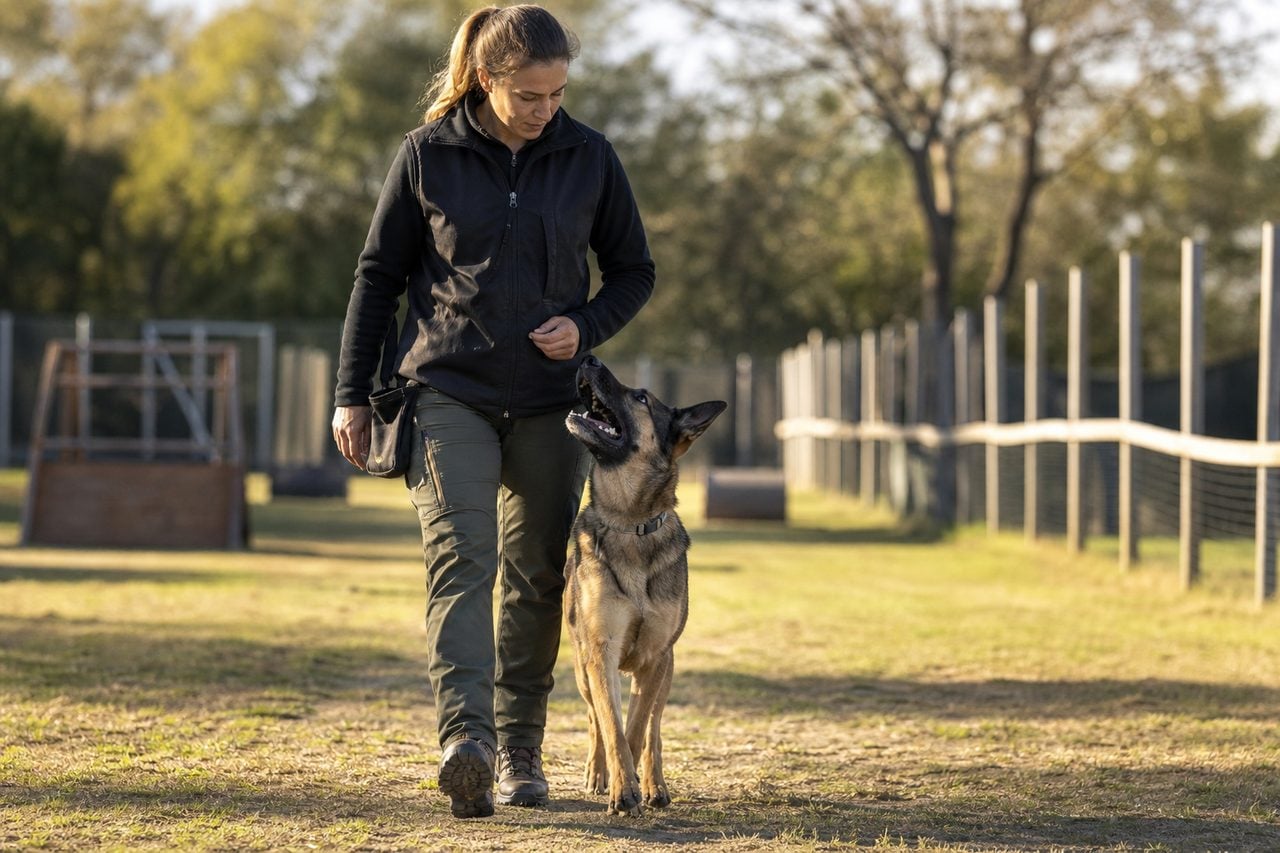
“Boot camp” is a search term rather than a service, and in this catchment that is unusually literal. Of the seventeen trainers serving the Staunton–Waynesboro corridor, the phrase appears on the published menu of exactly one operation — which markets a “puppy boot camp” and a “doggie bootcamp” board-and-train program — and nowhere else. The market here is not short of intensive training. It is short of the label.
- The four things people mean by 'boot camp'
- What intensive formats can and cannot buy
- The name is a red flag only when the content matches it
- What this catchment actually supplies, honestly
- A cheaper route that usually works better
- If you do book an intensive program
- Where the search term takes people wrong
- Reviewed trainers
- FAQ
That matters because the word carries connotations that do not match what is actually for sale. People searching for a boot camp are usually in one of four different situations, and three of them are better served by something that is not called a boot camp at all. Sorting out which one you are in is most of the work, and it is the difference between spending a few hundred dollars usefully and several thousand on the wrong product.
This page maps the four requests onto what this valley actually offers, with the published local prices where they exist, and says plainly where the supply is thin.
The four things people mean by 'boot camp'
“My adolescent dog is out of control and I need someone to fix it.” Usually a large dog between eight and eighteen months, pulling, jumping, ignoring recall. This is the request an intensive format genuinely serves well, because the problem is a shortage of consistent repetitions and a professional can supply those. Locally this resolves to day-training at about $150 a day, or to a two- or three-week residential program quoted after a consultation.
“My dog is aggressive or reactive and I am frightened.” A different problem in similar clothing. This needs behavior work rather than obedience volume. Locally it resolves to behavior-modification sessions published around $80, or to one of the two operations here that advertise aggression rehabilitation — and the honest answer is that specialist supply for this is thin in the valley.
“My puppy is a nightmare and I want a head start.” Locally this is the one request that is literally sold as a boot camp: a puppy head-start program, typically two weeks residential, or puppy day-training published around $100 a day.
“I want a dog that is obedient off lead.” A specific, teachable outcome, usually involving remote-collar work at the advanced stage, published locally around $75 a session or $150 a day. It is not a discipline problem and it does not need a camp.
What intensive formats can and cannot buy
They buy repetitions. That is the whole mechanism, and it is a real one. Thirty clean repetitions a day for fourteen days is four hundred more than a working owner will manage in the same fortnight, and reliability is built out of repetitions more than out of insight.
They cannot buy a changed household. The dog returns to the same door, the same visitors, the same lead that goes slack when it pulls hard enough. The programs here that publish go-home lessons, a directional video and discounted follow-up sessions are pricing in the part that actually determines the outcome; the ones that do not are selling you the easier half.
They also cannot buy emotional change quickly. Fear, anxiety and reactivity move on their own timetable, and intensity does not accelerate them — it frequently sets them back. This is the single most important line on this page, because “boot camp” markets itself on intensity and intensity is exactly wrong for the second of the four requests above.
The name is a red flag only when the content matches it
There is nothing wrong with the word itself. One local operation uses it plainly for a residential obedience program and a puppy head-start, and the published content is ordinary, sensible training: obedience, manners, socialization, house-training.
What deserves scrutiny is any program where the military framing describes the method rather than the format — language about dominance, breaking a dog, or establishing who is in charge. That vocabulary tends to travel with confrontational handling, and confrontational handling with a frightened or defensive dog is how bite histories get started rather than finished.
The useful test is mechanical, not rhetorical. Ask what happens when the dog gets it right, what happens when it gets it wrong, and what happens when it is frightened. Three specific answers mean you are talking to someone who has thought about it. Three answers about attitude and leadership mean you are not.
What this catchment actually supplies, honestly
Intensive training is the second-strongest lane here after in-home work: five of the seventeen local trainers publish a residential or day-based program, clustered along the US-250 and US-340 corridor between Fishersville and Stuarts Draft and on properties towards Crimora and Afton.
The specialist end is thinner. Two operations publish aggression or behavior rehabilitation. Two publish protection or security work. Two publish separation or anxiety rehabilitation. Nobody in the catchment publishes work as a behaviorist, and nobody publishes a dedicated leash-reactivity program. If your “boot camp” search is really the second request — fear and aggression — you should know before you start that local specialist depth is limited and that Harrisonburg, twenty-five minutes north, and Charlottesville, thirty-five minutes east over Afton Mountain, are realistic extensions of your search area.
On the other hand, for the first and third requests — the unruly adolescent and the wild puppy — this is a well-supplied market with published prices and real choice, and there is no reason to drive out of the valley.
A cheaper route that usually works better
Before committing to a multi-thousand-dollar residency, consider the format that most owners here underuse: a block of private sessions, at your own address, mixed with day-training days.
The published local packages are built exactly this way — around $675 for roughly ten to fifteen private sessions plus day-training blocks, or around $450 for a fifteen-session package aimed at enrichment, scent and trick work. Compare that to a residency and the arithmetic is often favourable, because the private sessions train the household at the same time as the dog.
The reason this works better for most ordinary cases is simple: the dog’s problems live at your door, in your kitchen and on your fence line, and a trainer standing there can see the thing that is actually maintaining the behavior. A residential program trains the dog somewhere the problem does not occur and then asks you to transfer it. Sometimes that is the right trade. For the standard unruly adolescent with a co-operative owner, it usually is not.
If you do book an intensive program
Set the success criterion in writing before the dog leaves. Three things, at your house, in eight weeks. Vague goals produce vague outcomes and unhappy owners.
Insist on the handover. At least one long session with you and the dog, filmed or written instructions, and a support window. If it is not in the quote, ask for it in the quote.
Ask what the dog will be able to do and in what conditions — off lead in open ground, or on a long line with a handler paying attention. These are different products at similar prices.
Check the small print on expiry and consent. Local training agreements commonly set a twelve-month expiry on unused sessions and include standing permission to photograph your dog for promotion. Neither is unusual; both are easier to vary before you sign.
And plan the fortnight after. The dog comes home able to do things it could not do before, in a house that has not practiced any of them. That fortnight is where your money either compounds or evaporates.
Where the search term takes people wrong
Two failure modes recur. The first is the frightened dog put through an intensive program because the owner searched for intensity. The dog comes back quieter, the owner reports improvement, and six months later the behavior returns with less warning than before, because suppression is not the same as change. If your dog’s problem involves fear, growling or a bite, do not let the search term choose the format.
The second is the owner who buys volume when they needed a diagnosis. A dog that will not settle, wakes at night, and cannot be left may have a medical problem, a pain problem or a sleep deficit rather than a training problem. Almost nothing on this page helps with any of those, and a vet conversation costs less than a residency.
Get those two sorted first. If what is left is an untrained dog with a busy owner, the intensive formats in this valley are genuinely good and reasonably priced, and there is no reason to be sniffy about the name on the tin.
Reviewed Dog Boot Camp Trainers in Staunton
These reviewed Staunton-area trainers from our directory handle dog boot camp. Each links to a full profile with specialties, certified credentials, reviews, and contact info:
- Auburn Leach K9 Academy — 4.3★ (87 reviews)
See all Staunton dog boot camp trainers →
Frequently Asked Questions
Is there a dog boot camp in Staunton or Waynesboro?
Under that exact name, barely. One local operation publishes a ‘puppy boot camp’ and a ‘doggie bootcamp’ board-and-train program; no other trainer in the catchment markets the term. What does exist, in quantity, is the same thing under plainer names: day-training at roughly $100 to $150 a day, two- and three-week residential programs quoted after consultation, and packaged programs at about $450 to $675.
Is a boot camp the right choice for an aggressive dog?
Usually not. Aggression and fear need behavior work at a distance the dog can cope with, and intensity tends to suppress the signs rather than change the emotion — which makes the eventual relapse less predictable. Two local operations publish aggression rehabilitation, nobody in the catchment publishes behaviorist services, and Harrisonburg and Charlottesville are realistic extensions of the search for a severe case.
How long does an intensive program run?
Locally, two weeks for basic obedience or a puppy head-start and three weeks where off-lead and remote-collar work is included. Day-training alternatives run as blocks of individual days rather than a continuous stay, which suits owners who do not want their dog kennelled overnight.
Is day training a good alternative?
For most ordinary cases in this area, yes. The dog trains during the day and sleeps at home, which avoids the two biggest residential risks — kennel stress and a poor handover. Published local day rates are about $100 for puppy work and about $150 for obedience or remote-collar work, and several local packages deliberately mix day-training days with private lessons.
What will it cost?
Convert everything to total cost plus total trainer contact hours before comparing, because local programs are priced in at least four different shapes: per day, per night, per session and per package. As a reference, published figures in this catchment include $100 to $150 per day, about $80 a night for a dog in training, about $200 for a ninety-minute private lesson, and $450 to $675 for packages.
My dog comes back trained and then regresses. Why?
Because the training transferred and the household did not. The behaviors were learned in a place where the old contingencies did not exist; at home the door still opens when the dog barks and the walk still continues when the lead is tight. This is why go-home lessons, a directional video and follow-up sessions — all of which local programs do publish — are the part of the package worth paying for.
Related: read our complete dog boot camp guide or the full Staunton dog training overview.
Ready to find the right dog boot camp pro in Staunton?