Dog Trainers in Martinsburg, WV
Martinsburg anchors West Virginia’s Eastern Panhandle, and the Panhandle does not behave like the rest of the state. It is the corner of West Virginia that reaches east past the mountains into the Washington–Baltimore commuter belt: Maryland is a few minutes north across the Potomac, Virginia a few minutes south past Inwood, and the MARC train out of Martinsburg and Duffields runs into Washington every weekday morning. That single fact shapes the dog-training market here more than anything else. A large share of households in Berkeley and Jefferson Counties keep a commuting schedule — out before seven, back after six — and the training formats that actually sell in this metro reflect it. Day training, where the trainer works the dog while the owner is at work and hands it back the same evening, and multi-week board-and-train are unusually well represented for a metro of this size, and they are priced accordingly. Weekly evening group classes exist, but they are the minority format rather than the default. The metro’s geography is a wide limestone valley rather than a hollow. I-81 runs the length of Berkeley County with Martinsburg in the middle of it and the warehouse and distribution corridor strung along it from Spring Mills down to Tabler Station; WV 9 runs east from Martinsburg through Kearneysville into Jefferson County, where Charles Town, Ranson, Shepherdstown and Harpers Ferry sit close together in the fork of the Potomac and the Shenandoah; and Morgan County climbs west into Berkeley Springs, Great Cacapon and Sleepy Creek. Those three settings produce three different dogs. Subdivisions in Spring Mills, Hedgesville and around Ranson — new builds, small fenced yards, dogs behind fences on both sides — generate fence-line reactivity, barrier frustration and dogs that come apart at the doorbell. Downtown Martinsburg and Shepherdstown, where the streets are narrow and the sidewalks are genuinely used, generate leash pulling and dog-to-dog reactivity at close quarters. Out toward Back Creek Valley, Gerrardstown, Middleway and the Morgan County ridges, where the lot is an acre or five and the fence is a line on the deed, the complaint is almost always recall — deer, groundhogs, livestock, and a dog that will not turn around on a ridge. Supply here is small but genuinely varied, and it is not concentrated in Martinsburg itself. Berkeley County holds the larger facility-based operators; Jefferson County, and Kearneysville in particular, holds an unusual density of specialists — detection and scent work, protection and IGP sport, structured life-stage class programs — for a county of its size. Expect to drive fifteen to thirty minutes for the right format. In a metro this shape, that is normal, and it is worth doing.
- Top-Rated Dog Trainers in Martinsburg
- What Kind of Training Does Your Dog Need?
- Training Formats and Typical US Dog-Training Prices
- Dog Training Schools & Classes in Martinsburg
- How to Pick the Right Trainer
- Dog Training by Martinsburg Neighborhood
- Martinsburg Dog Training Resources
- Common Questions About Dog Training in Martinsburg
- Start Here
This page is your starting point. Whether you need puppy socialization, basic obedience, off-leash training, or help with a serious behavior problem, we’ll help you understand your options, what to expect, and how to connect with the right professional in Martinsburg.
Top-Rated Dog Trainers in Martinsburg
Compare Martinsburg’s top-rated dog trainers below — each listing shows real Google reviews and, where we’ve checked them, certified credentials, so you can reach out with confidence.

What Kind of Training Does Your Dog Need?
Before you start comparing trainers, figure out which category your dog falls into. This determines the type of training, the format, and the realistic timeline.
Puppy (8 weeks to 5 months)
Priority: socialization and foundation habits. This is the most time-sensitive stage — the critical socialization window closes around 16 weeks, and what your puppy is exposed to during this period shapes their temperament permanently. Group puppy classes are ideal. Read our full guide: Puppy Training in Martinsburg.
Adolescent dog (5 to 18 months)
Priority: obedience and impulse control. This is the stage where most owners hit the wall — the cute puppy has turned into a teenager who jumps on guests, pulls on the leash, and has developed selective hearing. Group obedience classes or private lessons work well here. Consistency is everything.
Adult dog — new to training
Priority: basic obedience and household manners. It’s never too late. Adult dogs are often faster learners than puppies because they have longer attention spans.
Adult dog — specific behavior issue
Priority: targeted behavior modification. Reactivity, aggression, separation anxiety, resource guarding, excessive barking. These issues need a qualified trainer or behaviorist — not a group class. Start with a behavior consultation.
Any dog — intensive training needed fast
Priority: results on a compressed timeline. Board-and-train programs offer intensive daily training over 2 to 6 weeks — the fastest path to results when done right. Read our full guide: Board and Train in Martinsburg.
Training Formats and Typical US Dog-Training Prices
The formats below are the same everywhere; the figures are national ranges, not Martinsburg rates. Prices vary by city and by trainer — confirm directly with the trainer before you book.
Group classes
Best for socialization and foundation obedience. Meet once a week for 5 to 6 weeks with other dogs. Most affordable option. Typical US range: $150 to $300 for a full course.
Private lessons
One-on-one with a trainer at their facility or your home. Best for specific goals, reactive dogs, or customized plans. Typical US range: $100 to $175 per session (facility) or $125 to $200 (in-home).
Day training
Your dog goes to the trainer during the day and comes home at night. Great for working professionals. Typical US range: $75 to $125 per day.
Board and train
Your dog stays with the trainer for 2 to 6 weeks. Most intensive option. Typical US range: $1,500 to $6,000+ depending on length and complexity.
Behavior consultation
A diagnostic assessment for serious behavioral issues — a professional evaluation that produces a treatment plan. Typical US range: $200 to $400 for the initial assessment.
Dog Training Schools & Classes in Martinsburg
Looking for a dog training school or group obedience classes in Martinsburg? Plenty of local trainers and facilities run weekly group classes — a structured, affordable way to cover socialization and basic obedience alongside other dogs. Browse dog obedience classes in Martinsburg, or use the trainer directory above to compare every dog school and trainer in the Martinsburg area by specialty, reviews and price.
How to Pick the Right Trainer
Choosing a dog trainer is a lot like choosing a doctor — credentials matter, but so does communication style, philosophy, and whether you trust them with someone you care about.
Training methodology
This is the most important factor and the one most people skip. Dog training ranges from purely positive reinforcement (rewards only) to balanced training (rewards plus corrections). There is no single “right” approach — but there IS a right approach for your dog. A fearful rescue needs a different approach than a confident, drive-y working breed. Ask every trainer what tools and methods they use, and don’t commit until you understand and agree with their philosophy.
Credentials
Look for recognized certifications — CPDT-KA (Certified Professional Dog Trainer), KPA-CTP (Karen Pryor Academy), IACP, AKC CGC Evaluator, or for complex behavior, a CAAB or veterinary behaviorist. Credentials aren’t everything — some of the best trainers built their skills through decades of hands-on experience — but a trainer with no credentials AND no verifiable track record is a risk.
Transparency — red flags and green flags
Red flags: won’t let you observe a class or tour the facility, gets defensive about methodology, guarantees specific results, pressures you to sign up immediately, or trash-talks every other trainer. Green flags: welcomes questions, offers to let you observe a class first, gives references, is honest about what training can and cannot achieve, and tells you upfront if your dog’s issue is outside their expertise.
Dog Training by Martinsburg Neighborhood
The Martinsburg metro is large, and driving 45 minutes for a weekly class isn’t sustainable for most people. Here’s a quick overview of training availability by area:
Downtown Martinsburg & the North End
The old railroad and mill core — Queen and King Streets, the B&O Roundhouse complex, and the tight grid of nineteenth-century houses running north off it. Lots are narrow, parking is on-street, yards are small or non-existent, and the sidewalks carry real foot traffic. Dogs here live almost entirely on a leash, so this is where loose-leash walking, door manners and dog-to-dog reactivity at six feet show up first — and where a fenced back yard is rarely part of the answer.
Spring Mills, Marlowe & the northern I-81 corridor
The fastest-growing part of Berkeley County: newer subdivisions north of Martinsburg toward Falling Waters and the Potomac, built at density, with young families, small fenced back yards and a dog on the other side of most fences. The signature problem here is not a lack of space but too much stimulus at the boundary — fence-line running, barrier frustration, and a dog that has learned barking makes the trigger go away. It is also the part of the metro with the longest commutes, which pushes owners toward day training and board-and-train.
Inwood, Bunker Hill, Gerrardstown & southern Berkeley County
The stretch of US 11 and I-81 running south toward the Virginia line, mixing older village centers with newer builds and working acreage. Households here are commonly a few minutes from open ground and the dogs get more off-property exercise than their Martinsburg counterparts, which changes the brief: less leash management, more recall, more livestock and wildlife proofing, and more owners who want a dog reliable off lead on their own land.
Hedgesville, Back Creek Valley & the western ridges
West of Martinsburg the valley narrows into ridge-and-hollow country running up toward Sleepy Creek and the Morgan County line. Properties are large, gravel lanes are common, and neighbors are far apart. Dogs here are rarely socially pressured and often badly under-proofed — perfectly calm at home, useless in a parking lot. Recall against deer and turkey is the recurring job, and so is building enough neutral exposure that the dog can cope with a town center when it finally goes to one.
Kearneysville, Shenandoah Junction & the WV 9 corridor
The rural belt between Martinsburg and Charles Town, and the densest concentration of dog-training specialists in the metro. Several of the area’s facility-based operators sit within a few miles of each other here on acreage well off the main road — detection and scent work, protection and IGP sport, structured class programs, residency training. If a Panhandle owner needs a discipline rather than a general obedience course, this is usually where the drive ends.
Charles Town & Ranson
Jefferson County’s built-up center: the historic Charles Town grid around the courthouse, the racetrack and casino complex on the east side, and Ranson’s newer residential blocks running north. Denser than anywhere in the metro outside Martinsburg, with sidewalks, foot traffic and a lot of dogs in a small area. It produces the classic town-dog list — pulling, greeting, over-arousal at the door — and it is close enough to Loudoun County that some owners here arrive having compared prices against Northern Virginia.
Shepherdstown, Harpers Ferry & the river towns
The oldest corner of the state, wedged into the Potomac and the Shenandoah. Shepherdstown is a small university town with a walkable center and constant pedestrian traffic; Harpers Ferry and Bolivar sit on steep streets inside and beside a national park where dogs must be leashed at all times and trail traffic is heavy year-round. Both are excellent proofing environments and difficult daily environments, which is exactly the combination that sends owners looking for help with reactivity rather than obedience.
Berkeley Springs & Morgan County
The western end of the metro, roughly an hour from Martinsburg by road and a different world from the I-81 corridor: a small spa town, state parks, forest and very low density. There is effectively no local training supply here, so households either drive east into Berkeley County or work with a trainer who travels. The brief is the rural one — recall, wildlife, road safety on lanes with no shoulder — with the added complication that a dog raised here may meet almost no strangers or strange dogs before its first vet visit.
Martinsburg Dog Training Resources
Beyond professional training, Martinsburg has some excellent resources for dog owners.
Parks and off-leash areas
- Poor House Farm Park, Martinsburg — A 137-acre Berkeley County park west of town with about five miles of trail through meadow and woodland, a stocked pond and a restored farm complex. Dogs must be on a leash throughout, and you bring your own water and waste bags. The mix of open meadow and enclosed woodland track over that distance makes it the best place in the metro to build a genuinely long loose-leash walk — enough space to get distance from a trigger, and enough trail traffic that the distance actually has to be managed.
- Sam Michaels Dog Park, Shenandoah Junction — Jefferson County’s off-leash park, opened in 2018 on the Sam Michaels Park grounds: roughly two acres of enclosed grass for dogs of all sizes, with a perimeter walking path and benches. Free, open dawn to dusk, with the enclosure opening at noon on Wednesdays through spring, summer and autumn because the crews service it that morning. It is the only free public off-leash enclosure in the metro, which makes it both valuable and busy — use the perimeter path with a reactive dog and save the enclosure for a dog whose recall already works.
- War Memorial Park, Martinsburg — A twenty-acre city park inside Martinsburg with a pool, mini-golf and sports facilities. Leashed dogs only, and you bring your own water and bags. Its value in a training plan is not exercise — it is the concentration of ordinary chaos: children, bicycles, ball games and picnic noise, all inside a short walk, with an easy exit. It is the metro’s most convenient place to do fifteen focused minutes of proofing rather than an hour of walking.
- Wurzburg Dog Park & Goldie Gibbons Dog Park, Berkeley County — The two off-leash dog parks run by Martinsburg–Berkeley County Parks and Recreation. Both are membership-based rather than walk-in, so access has to be arranged through the parks office first. The membership requirement filters the user base, which many owners of nervous or slow-to-warm dogs prefer to an open enclosure — but it does mean the nearest free off-leash ground is over in Jefferson County.
- Harpers Ferry National Historical Park — The park at the confluence of the Potomac and the Shenandoah, with the Appalachian Trail running through it and heavy visitor traffic on the lower town streets and the river crossings. Pets must be leashed and under control throughout. Nowhere else in the metro concentrates this much unpredictable distraction — crowds, steps, bridges, trains, other dogs on a narrow trail — which makes it the honest final exam for a dog that has been working well in quieter places, and completely the wrong place to start.
- Sleepy Creek Wildlife Management Area, Berkeley & Morgan Counties — Thousands of acres of forest and mountain lake straddling the county line west of Hedgesville, with rough access roads and long, quiet trails. It is a wildlife management area rather than a park, so it is used for hunting in season and the ground is genuinely wild — deer, turkey and bear are all real. That is the point for training purposes: a dog whose recall holds here holds anywhere, and a dog whose recall does not hold here belongs on a long line until it does.
- Berkeley Springs State Park & Cacapon Resort State Park, Morgan County — The small spa park in the middle of Berkeley Springs and the much larger resort park just south of it, with trails running up Cacapon Mountain. State park rules apply to dogs — leashed and under control, with tighter lead-length limits around lodging areas. For Morgan County households these are effectively the only structured public ground available, and the pairing is useful: a short, busy town walk in Berkeley Springs and a long, quiet climb ten minutes away.
These parks are great for socialization practice AFTER your dog has a foundation of training. Taking an untrained dog to an off-leash park is asking for trouble.
Veterinary behaviorists
For complex behavior cases that may require medication alongside training, ask your primary vet for a referral to a veterinary behaviorist serving the Martinsburg area.
Dog Trainers by Community in the Martinsburg Area
Looking for a trainer in a specific Martinsburg-area community? Here are the local options town by town.
Dog Trainers in Kearneysville, WV
- Metropolitan Executive Dogs — 4.6★ (9)
- Causey Labradors And Training, LLC — 3.4★ (5)
- Canine Corner Activity Center, LLC
- Critical K-9 Detection
Dog Trainers in Charles Town, WV
- Red Barn Ranch and Labradors, LLC — 5.0★ (16)
- Country Roads Canine Training Center — 5.0★ (13)
Dog Trainers in Inwood, WV
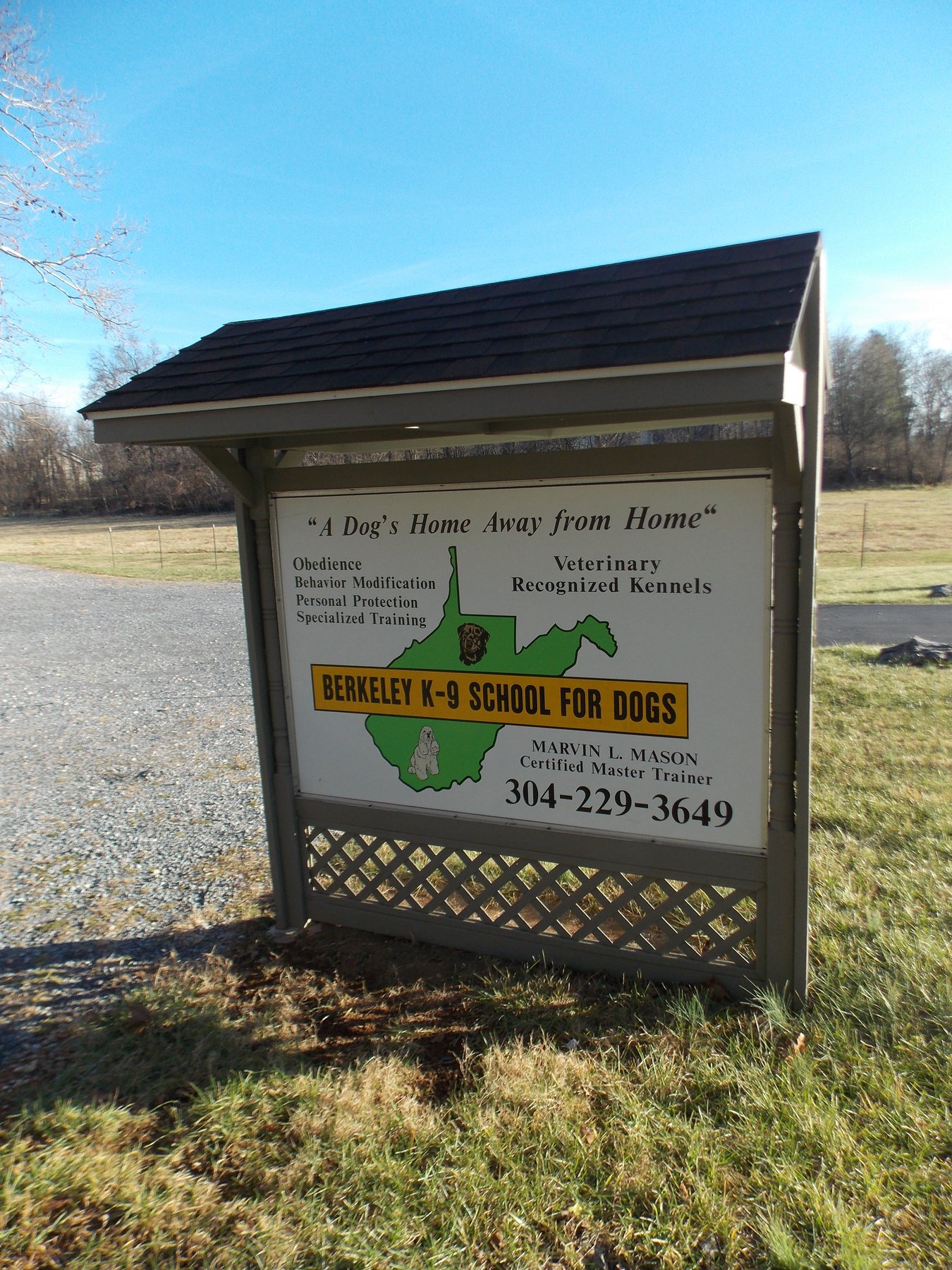
- Berkeley K-9 School For Dogs — 4.7★ (49)
Dog Trainers in Gerrardstown, WV
- Puppy Love Dog Training, LLC. — 5.0★ (34)
Dog Trainers in Falling Waters, WV
- Weaver Dog Services — 5.0★ (5)
Dog Trainers in Harpers Ferry, WV
- Debby Kay’s Super Sniffer Program — 5.0★ (5)
Dog Trainers in Slanesville, WV
- Paw Paws Canine College — 4.6★ (22)
Also in Martinsburg: Panhandle Paws LLC, Good Sport Dog Training, Independent K-9 L.L.C., Dog’s Got Talent Dog Training
Dog Training by Specialty in Martinsburg
Martinsburg-specific guides for each type of training:
- Puppy Training
- Puppy Socialization
- Dog Obedience Classes
- Aggressive Dog Training
- Protection & K9 Training
- Service Dog Training
- Therapy Dog Training
Also live across West Virginia: Beckley · Charleston · Clarksburg · Huntington · Morgantown.
Common Questions About Dog Training in Martinsburg
How many dog trainers are there around Martinsburg?
Fewer than the population would suggest, and they are spread across three counties rather than clustered in Martinsburg. Berkeley County holds the larger facility-based operators, in and immediately around Martinsburg and out toward Inwood and Falling Waters. Jefferson County — Kearneysville, Charles Town, Harpers Ferry — holds a disproportionate share of the specialists. Morgan County has effectively none of its own. In practice that means the nearest trainer is often not the one running the format you need, and a fifteen-to-thirty-minute drive is a normal part of choosing here rather than a sign you have looked in the wrong place.
What does dog training cost in the Eastern Panhandle?
The figures trainers in this metro publish on their own sites cluster fairly tightly. Single private lessons run around $125, dropping to roughly $100–$115 a lesson when bought in a package of three or five. Day training — the trainer works your dog during the working day and you collect it in the evening — is published at about $75 a day, or nearer $70 in a multi-day block, with a structured three-day program including owner coaching advertised at $1,300. Two-week board-and-train is published at around $2,500. Plain boarding, where a trainer offers it alongside, runs about $55–$59 a night. Always confirm what a package includes; some quote the owner-handover lesson separately and some fold it in.
Day training, board-and-train or weekly classes — which fits this area?
The commute usually decides it. A household running the MARC train or the I-81 drive into Maryland or Northern Virginia often cannot make a fixed 6pm class four weeks running, which is why day training and board-and-train are better represented here than in comparable metros and why several local trainers lead with them. If you can genuinely commit to a weekly class the classes exist and they are the cheapest route, particularly for a young dog that mainly needs structure and exposure. If you cannot, do not sign up to fail — day training keeps the dog at home overnight and puts the training work on someone whose schedule is not the problem.
I live in Maryland or Virginia — will Panhandle trainers take me?
Generally yes, and a good many of them say so explicitly. The Eastern Panhandle sits inside a metro area that crosses three state lines within a half-hour drive, so trainers here routinely list Hagerstown, Winchester, Frederick and Northern Virginia among the areas they serve, and plenty of their clients cross a state line to reach them. The practical questions are the same as anywhere: whether the format needs you on site weekly, and whether the drive is one you will still be making in week five.
My dog is fine at home and impossible in town. Why?
Because in this metro those are genuinely different environments and most dogs here only ever practice one of them. A dog raised on an acre in Back Creek Valley or on the Morgan County ridges may go weeks without meeting a stranger, a bicycle or another dog at close range, so its calm at home is not trained composure — it is the absence of anything to react to. Take that dog to Shepherdstown’s main street or the lower town at Harpers Ferry and it meets a year’s worth of novelty in twenty minutes. The fix is not more obedience; it is graded exposure, starting somewhere like the edge of War Memorial Park and working up, which is precisely what a local trainer who knows these places will build for you.
Are there off-leash dog parks near Martinsburg?
Not many, and the nearest one may not be the obvious one. Berkeley County’s two off-leash parks — Wurzburg and Goldie Gibbons — are membership-based through Martinsburg–Berkeley County Parks and Recreation rather than open access. The nearest free public enclosure is Sam Michaels Dog Park at Shenandoah Junction in Jefferson County, about two acres, open dawn to dusk with a Wednesday-morning closure for maintenance. Everywhere else — Poor House Farm, War Memorial Park, the state parks, Harpers Ferry — is leash-only. It is worth being honest about what a dog park is for: it is a place to practice a recall that already works, not a place to build one.
What should I ask a trainer here before booking?
Three things, in this order. Where does the training actually happen — their facility, your house, or public places — because in a metro this spread out that determines your real weekly time cost. What is included in the price, specifically whether owner coaching and follow-up sit inside the quoted figure or are billed on top. And what happens after the program ends, because the failure mode on board-and-train and day training is not that the dog does not learn, it is that the handover is thin and the behavior drifts back within a month. A trainer who answers the third question well is worth a longer drive than one who does not.
Start Here
The best time to start training is today. Whether your puppy needs socialization, your adolescent dog needs impulse control, or your adult dog has a behavior issue that’s been building for years — the sooner you start, the faster things improve.
Browse dog trainers in Martinsburg on GetDogSchool.com. Compare programs, read reviews, and connect with professionals who fit your dog’s needs and your budget.
Find Dog Trainers in Martinsburg →
Ready to find the right trainer for your dog in Martinsburg?
Get matched with a trainer in Martinsburg →