
Dog Training Prices in Columbus, IN
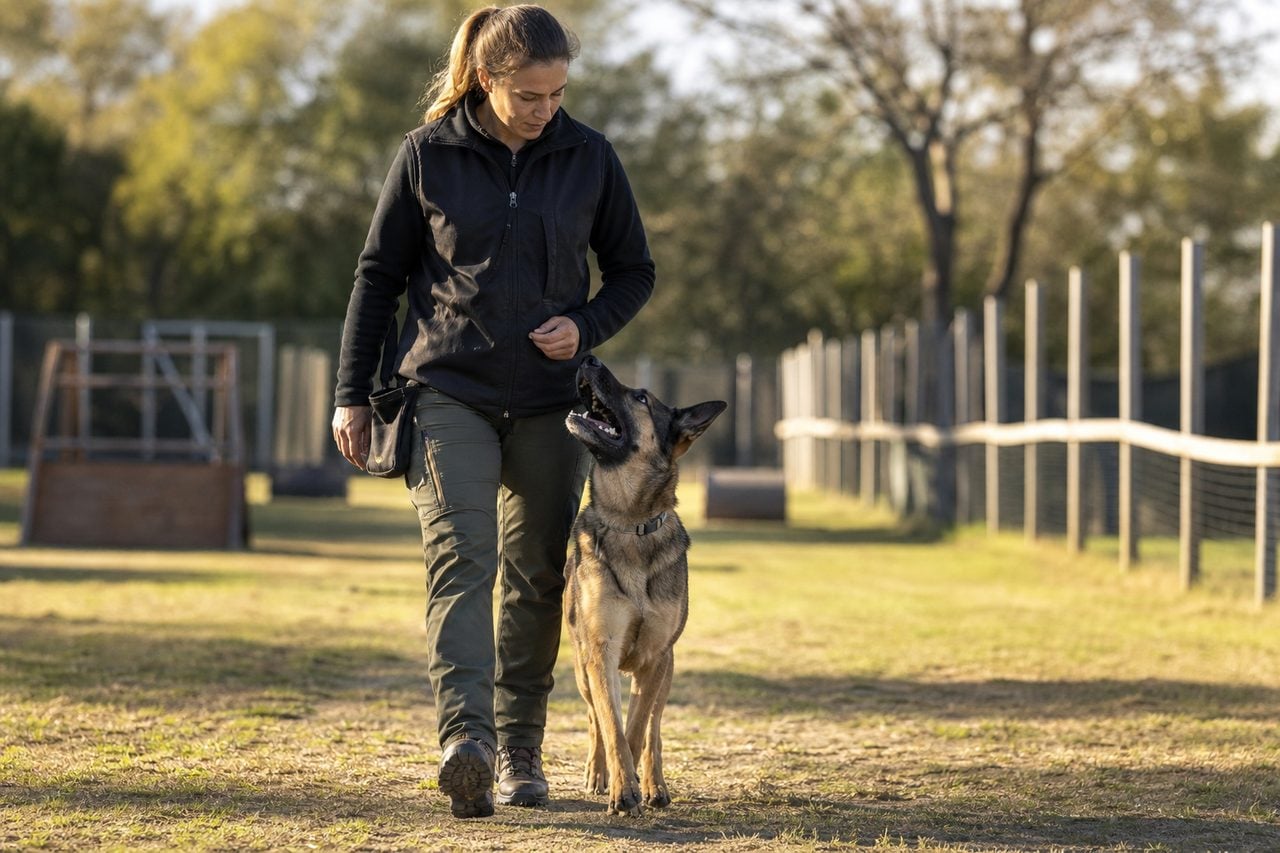
Almost everyone researching dog training in Columbus, Indiana starts with the same question — what does it cost — and almost every honest answer starts the same way: it depends, and any site quoting you a firm local figure is guessing. Training is not a commodity with a market rate. The same dog, the same goal and the same town can produce wildly different totals depending on whether you buy a weekly group class, a handful of private lessons, several weeks of day training, or a residential board-and-train, and depending on whether the problem is a puppy who jumps or an adult dog with a bite history.
- Why nobody can quote you a price over the phone — and what to ask instead
- The four main formats and what drives each one’s cost
- Group classes: the lowest cost per hour of instruction
- Private lessons and in-home training
- Day training and board-and-train: the premium tier
- Behaviour cases: why reactivity, aggression and anxiety cost more
- Getting value: what actually determines your return on training spend
- Reviewed trainers
- FAQ
What is genuinely useful is understanding the cost structure — what you are actually paying for in each format, which variables move the number most, and where the money is well spent versus wasted. That is knowledge you can carry into a phone call with any trainer in Bartholomew, Jackson, Jennings or Decatur County and use to get an accurate quote in five minutes instead of three conversations.
This guide breaks down the formats available in the Columbus–Seymour metro, the drivers that push a quote up or down, why behaviour cases sit in a different pricing category from obedience, and how to judge value rather than sticker price. Every local program mentioned — in Columbus, Seymour and Greensburg — sets its own rates and changes them over time, so treat the trainers named here as a map of what exists and get current pricing directly from them.
Why nobody can quote you a price over the phone — and what to ask instead
When a trainer hesitates to give you a number in the first thirty seconds of a call, that is usually competence rather than evasion. A quote depends on information they do not have yet: what the dog actually does, how long it has been doing it, how many people in the household are involved, what the goal is, and whether the presenting problem is a training gap or an emotional one. A dog who pulls on the leash and a dog who lunges at other dogs look identical in a one-line enquiry and require completely different amounts of professional time.
The productive move is to give them the information that lets them quote accurately. Describe the dog: breed or best guess, age, how long you have had him, where he came from. Describe the behaviour in observable terms rather than labels — not “he is dominant,” but “when someone reaches for his bowl he freezes and his lip lifts.” Say how often it happens, how long it has been happening, and what you have already tried. State your goal concretely: walk on the trails without pulling, be safe around visiting grandchildren, pass the AKC Canine Good Citizen test, be able to be left alone for four hours.
Then ask price questions that produce comparable answers. How many sessions are included and how long is each. Is follow-up support included or extra. What equipment do I need to buy separately. Are make-up sessions available if I miss a week. Is there a package rate versus a per-session rate. What happens if my dog turns out to need a different service than the one I booked. Two programs with the same headline number can differ enormously once you account for included sessions, support and travel.
Finally, ask what is not included. Vaccination requirements, veterinary clearance, gear, and any prerequisite class are common add-ons that owners discover late. None of that is a red flag on its own; being surprised by it in week two is what turns a fair price into a bad experience.
The four main formats and what drives each one’s cost
Everything on the local market is a variation on four delivery models, and their cost structures are different in kind, not just in degree.
Group classes spread one trainer’s time across a room of dogs. That shared cost is why they are always the cheapest instruction per hour, and why they are usually sold as a fixed course — the Feeders Pet Supply beginner class in Greensburg runs six weeks on Sundays, for example — or, in the drop-in model used by Hot Diggity Dog in Columbus, as individual attendances. The main cost drivers are the number of weeks and the class size.
Private lessons buy a trainer’s undivided attention, so you pay the full hourly rate. In-home lessons add travel, which is a real factor in a metro where a trainer might be driving from Columbus to Crothersville or North Vernon. Hot Diggity Dog offers private consultations and Dog Training With Monica in Seymour offers private and in-home sessions; the drivers here are session length, number of sessions, travel distance and whether follow-up contact between sessions is included.
Day training and day school have the trainer doing the repetitions with your dog for part or all of a day, then teaching you the handover. You are buying professional labour by the day plus facility time, so it sits above private lessons in total outlay while often being better value per unit of progress. Hot Diggity Dog, Guardian-K9, Dog Training With Monica and Barkefellers all run some version of this; Barkefellers structures it as Day School at puppy, level one and level two.
Board-and-train and residential programs are the top of the range because you are paying for boarding, care, facility overhead and multiple daily training sessions simultaneously, usually across one to several weeks. Dog Training With Monica offers board-and-train and Barkefellers runs a Stay School version. The drivers are the length of stay, the number of sessions per day, and how much go-home instruction is bundled. That last item is the one to interrogate hardest, because it is what determines whether the results survive contact with your household.
Group classes: the lowest cost per hour of instruction
For most Columbus-area owners with an ordinary dog and ordinary goals, a group class is the highest-value purchase available, and it is not close. You get a professional’s eyes on your handling weekly, a curriculum that has been refined across hundreds of dogs, and the one thing you cannot buy any other way at that price: a room full of distractions to prove the training against.
Cost within the group category varies on a few axes. Course length is the obvious one — a six-week course costs more in total than a four-week one, though often less per session. Class size affects both price and value in opposite directions: smaller classes cost more per head and are usually worth it, because a room of five gets meaningfully more individual correction than a room of twelve. Level matters too; specialist or advanced classes and sport classes such as the just-for-fun agility offered by Hot Diggity Dog or the agility at Guardian-K9 typically price differently from a beginner manners course because of equipment and space requirements.
Structure affects your real cost as much as the rate does. A fixed six-week cohort is cheaper per session but only if you attend; miss two weeks to a work trip and your effective cost per session jumps by half. A drop-in model, like the basic manners group classes at Hot Diggity Dog, generally costs more per attendance but wastes nothing when life interferes, which for shift workers and families with irregular schedules can be the cheaper option in practice. Ask about make-up policies before assuming the fixed course is the bargain.
The hidden costs in group classes are small but real: a suitable leash and harness, a mat for settling work, and a genuinely large volume of treats. Budget for good food rewards rather than economising on them — low-value treats are the single most common reason a group class underperforms, because a dog who will not work for what you brought cannot compete with a room full of other dogs.
Private lessons and in-home training
Private instruction costs more per hour than any group format, and for the right problem it is the cheapest thing you can buy, because it removes the wasted weeks.
You are paying for three things. First, undivided attention: the trainer is watching your timing, your leash handling, your body position and your criteria, and correcting them in real time. Second, customisation: the plan is built for your dog rather than for a curriculum. Third, context, if the lesson is in your home — and context is frequently the entire problem. Door-charging, counter-surfing, crate distress, barking at the window, guarding a particular chair, and house-training failures in one specific room are all environment-bound behaviours. A trainer who watches your actual doorway on your actual street sees the antecedents you have stopped noticing.
Cost drivers are straightforward. Session length is usually the base unit. Travel distance matters for in-home work across a spread-out metro — a trainer based in Columbus travelling to Austin or Brownstown is spending an hour on the road, and it is reasonable for that to be reflected. The number of sessions is the largest variable of all, and it is worth asking for an honest estimate up front: a simple, well-defined issue caught early may resolve in a small number of sessions, while a long-established pattern in a busy household is a longer engagement. Some programs price in packages, which typically lowers the per-session cost and has the side benefit of committing you to finishing.
Between-session support is the item most often overlooked when comparing quotes. A program that includes messaging or check-ins between sessions is meaningfully different from one that does not, because most of the actual training happens in your week rather than in the hour with the trainer. Ask whether it is included, capped or billed.
Day training and board-and-train: the premium tier
These formats occupy the top of the price range for a simple reason: you are buying a professional’s hands-on labour with your dog, plus facility time, rather than buying instruction for yourself.
Day training and day school — offered in various forms by Hot Diggity Dog, Guardian-K9 and Dog Training With Monica, and structured as levelled Day School at Barkefellers in Columbus — means the dog attends for the day and a trainer works him. The economics are worth understanding: a skilled professional will get more clean, well-timed repetitions into a day than most owners manage in a fortnight, so the progress per calendar week is high. For a household where every adult works full time, that speed can make it cheaper overall than a slow-burning package of private lessons that never gets practised between visits. The cost drivers are the number of days, the hours per day, and how much of the day is training versus daycare.
Board-and-train, offered by Dog Training With Monica in Seymour and as Stay School at Barkefellers, adds overnight care, feeding, exercise and supervision to the training. You are effectively buying boarding and training simultaneously, so the daily rate is high and the total scales with the length of stay. The variables that move the price are duration, sessions per day, whether the dog is in a home environment or a kennel, and the amount of included follow-up.
The value question with both formats is transfer. The training was installed by someone else, in someone else’s environment, with someone else’s timing. Whether it survives depends almost entirely on the handover, so treat go-home sessions as the core of what you are buying rather than as a courtesy. When comparing two programs, count the included owner sessions, ask whether they are scheduled or left to you to arrange, and ask what support exists a month later when the first regression appears. A cheaper program with one rushed handover is usually more expensive in the end than a costlier one with three proper ones.
Behaviour cases: why reactivity, aggression and anxiety cost more
Behaviour consulting is priced differently from obedience instruction, and owners are sometimes startled by the gap. The reasons are structural rather than opportunistic.
A behaviour case begins with a long intake — history, environment, household composition, medical background, a detailed picture of when the behaviour does and does not occur — that can take as long as several ordinary lessons. It often requires coordination with your veterinarian, because pain and illness are common contributors and some cases benefit from medication alongside behaviour modification. The work itself is slower by nature: counter-conditioning and desensitisation progress in small increments at controlled distances, and you cannot compress them by working harder, because pushing past threshold undoes progress. Sessions are also frequently one-to-one by necessity, since the dog cannot yet be in a group environment.
There is a liability and expertise dimension too. Aggression cases carry real risk, require a professional qualified to assess it, and demand detailed management plans and written protocols. That is why credentials matter here in a way they matter less for a puppy manners class, and why practitioners with behaviour-specific qualifications price accordingly.
In this metro the scopes are clearly drawn and it saves everyone time. Hot Diggity Dog in Columbus explicitly takes behaviour cases including reactivity, separation anxiety, aggression and resource guarding, and owner Lisa Korf holds CPDT-KA certification and the IAABC-CDBC behaviour consultant credential. Dog Training With Monica in Seymour states plainly that she does not take aggression or reactivity behaviour cases and concentrates on group classes, private and in-home lessons, day school, board-and-train, and AKC Canine Good Citizen and trick testing. Booking a behaviour case into a general obedience course is the most expensive mistake available in this market, because you pay for the course, get no result, and arrive at the behaviour consultation later with the problem better rehearsed.
Getting value: what actually determines your return on training spend
The cheapest training is the training that works, and price is a weak predictor of that. Four things matter more.
The first is fit between format and problem. Money spent on the wrong format is entirely wasted regardless of how competitively it was priced. A reactive dog in a group class, a time-poor family in a homework-heavy private package, a fearful puppy in a busy room — each of those is a full-price purchase with close to zero return. Spend ten minutes on triage before you spend anything else.
The second is what you do between sessions. Training is a practice activity, and the professional hour is the smallest part of it. Five focused minutes three times a day beats one heroic hour on Sunday, and a household that agrees on the rules will outperform a household where one person enforces them and another does not. This is free and it is the largest single multiplier on whatever you pay.
The third is timing. Behaviour is cheapest to change early, before it has been practised into a habit and before the emotional response has consolidated. A puppy socialization plan costs a fraction of treating an adult dog’s fear of strangers, and a leash-manners class before a dog reaches full size costs a fraction of managing a strong adult who has been pulling for two years. Almost every expensive training case in this metro started as a cheap one that waited.
The fourth is honesty about scope. Ask a trainer for a realistic estimate of sessions and a realistic description of the outcome. Good trainers will tell you when something will take months, when management rather than resolution is the sensible goal, and when your dog needs a different professional. Beware anything sold with a guarantee of a specific behavioural outcome — living creatures do not come with those, and the promise usually costs more than the honest quote next to it. Finally, get current prices directly from the programs themselves: Hot Diggity Dog, Guardian-K9 and Barkefellers in Columbus, Dog Training With Monica in Seymour, and Feeders Pet Supply in Greensburg all set and revise their own rates, and a figure published anywhere else is out of date the moment they change it.
Reviewed Dog Trainers in Columbus
These reviewed Columbus-area trainers from our directory can walk you through pricing for their programs. Each links to a full profile with specialties, certified credentials, reviews, and contact info:
- Hot Diggity Dog — 5.0★ (14 reviews)
- Dog Training With Monica — 4.8★ (110 reviews)
- Guardian-K9 — 4.7★ (103 reviews)
- Barkefellers – Columbus — 4.6★ (202 reviews)
- Feeders Pet Supply Obedience & Training
See all Columbus dog training prices trainers →
Frequently Asked Questions
How much does dog training cost in Columbus, Indiana?
There is no single local rate, and any published figure would be out of date quickly, so the reliable answer is to get quotes directly from the programs you are considering. What you can rely on is the ordering: group classes cost the least per hour of instruction, private and in-home lessons cost more because you have the trainer to yourself, day training costs more again, and board-and-train sits at the top because it bundles boarding with multiple daily sessions. Behaviour consulting for reactivity or aggression is priced separately from ordinary obedience.
Why is board-and-train so much more expensive than a group class?
Because you are buying several things at once — boarding, daily care, facility overhead and multiple training sessions a day — whereas a group class splits one trainer’s hour across a room of dogs. The total scales with the length of stay and the number of sessions per day. When comparing programs, count the included go-home sessions, since those determine whether the results transfer to your household.
Is a cheaper trainer a worse trainer?
Not necessarily — price reflects format, overhead and specialisation at least as much as skill. A store-based group class is cheap because the format is cheap, not because the instruction is poor. The more useful filters are what happens when your dog makes a mistake, what certifications the trainer actually holds and can verify, and whether you may observe a class before enrolling.
How many sessions will my dog need?
It depends on the goal, the dog’s age, how long the behaviour has been practised and how consistently your household follows through. Basic manners for a young dog with no complications typically fits inside a standard course of around six weeks; long-established habits and behaviour cases take considerably longer, and some are managed rather than fully resolved. Ask any trainer for an honest estimate at intake, and treat a confident promise of a fast fix for a serious problem with caution.
Are there extra costs beyond the class fee?
Usually some. Common ones are equipment such as a properly fitted harness and a six-foot non-retractable leash, a mat for settling work, a substantial supply of high-value treats, and any vaccination or veterinary requirements the program sets. In-home training may reflect travel distance, and package versus per-session pricing can change the total significantly. Ask what is not included before you book rather than after.
Does pet insurance or anything else cover dog training?
Standard pet insurance policies generally cover illness and injury rather than training, though some plans include limited behavioural coverage — check your specific policy wording rather than assuming either way. Where a veterinarian is treating a diagnosed behavioural condition, portions of that veterinary care may be treated differently from training fees. Many training programs offer package pricing that lowers the per-session cost, which is usually the more practical route to reducing the total.
Related: read our complete dog training prices guide or the full Columbus dog training overview.
Ready to find the right dog training prices pro in Columbus?