
Puppy Socialization in Fort Wayne, IN
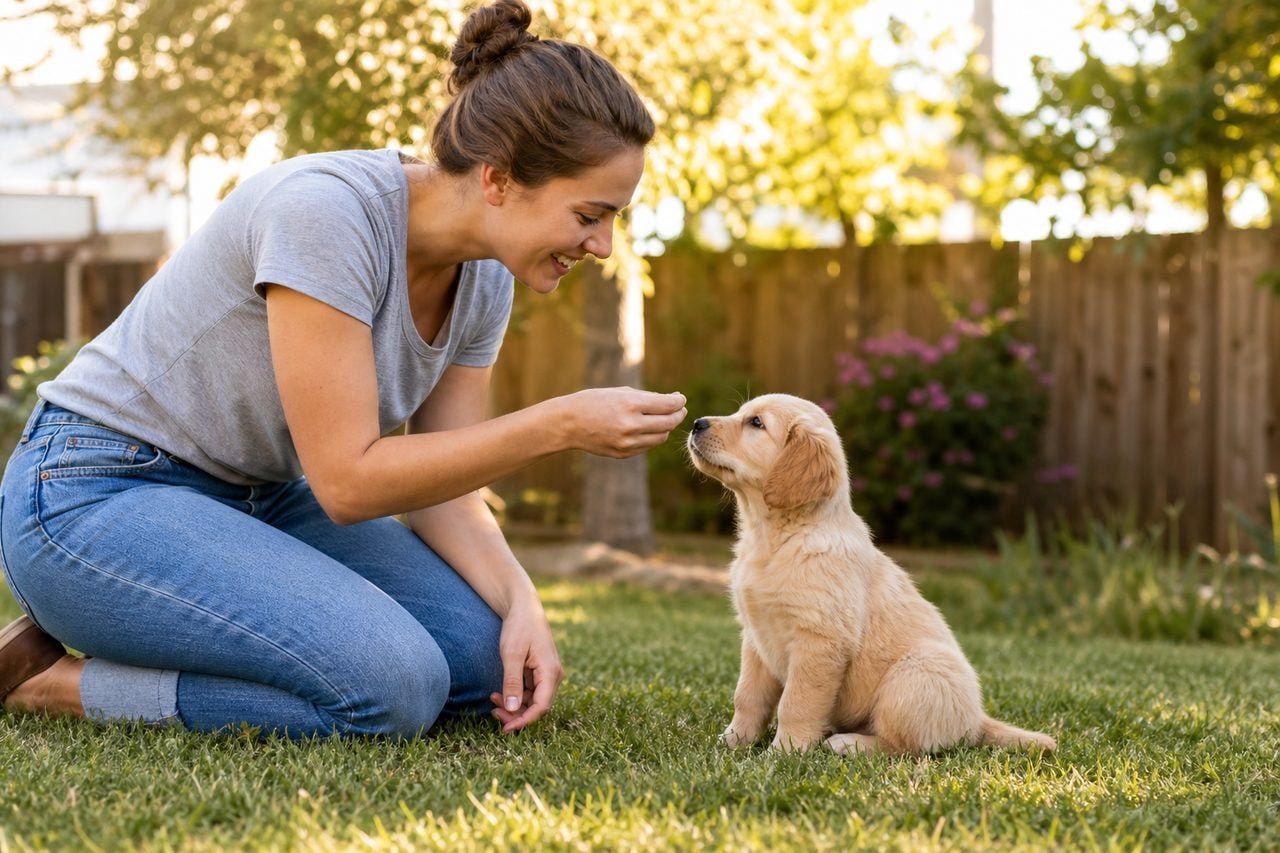
Socialization is the quiet foundation of a confident, easygoing dog, and it is one of the most time-sensitive things you will do as a new owner in the Fort Wayne area. A well-socialized puppy grows into an adult that takes the world in stride — the clatter of a farmers market, a stranger’s outstretched hand, a bicycle whirring past on the Rivergreenway, the rumble of a summer thunderstorm. A poorly socialized puppy, by contrast, may spend its life anxious or reactive, and undoing that is far harder than preventing it. The good news is that early, thoughtful socialization is well within reach for any committed owner.
- What Socialization Really Means
- The Critical Socialization Window
- Socializing Your Puppy to People and Other Dogs
- Local Places to Socialize in the Fort Wayne Area
- Socialization Beyond Living Things: Sounds, Surfaces, and Situations
- Reading Your Puppy and Avoiding Common Mistakes
- Keeping Socialization Going Through Adolescence
- Reviewed trainers
- FAQ
The concept is often misunderstood. Socialization is not simply playing with other dogs, and it is certainly not throwing a puppy into overwhelming situations to toughen it up. It is the careful, positive introduction of a young dog to the enormous variety of sights, sounds, surfaces, people, and animals it will encounter in life — always at a pace the puppy can handle. Done well, it builds resilience. Done carelessly, it can create the very fears it was meant to prevent.
Fort Wayne and the surrounding communities of Allen County and Northeast Indiana offer a rich menu of experiences for this work, from the trails and parks of the Summit City to the quieter roads around Grabill and Leo-Cedarville. This guide explains what socialization really means, why the timing is urgent, and how to do it well in this region across all four seasons.
What Socialization Really Means
Socialization is the process by which a young dog learns that the ordinary features of human life are normal and safe. It covers far more than meeting other dogs, though that is part of it. A properly socialized puppy has had positive, low-pressure exposure to a wide range of categories: different kinds of people, including children, older adults, and people wearing hats, uniforms, or carrying umbrellas; other animals; a variety of surfaces from grass to metal grates to slick tile; everyday sounds like traffic, vacuum cleaners, and thunder; and novel environments beyond the home.
The word positive is doing a lot of work in that description. Exposure alone is not socialization — the emotional experience is what counts. A puppy that encounters a skateboard and has a pleasant experience learns that skateboards are fine. A puppy that is frightened by the same skateboard, or forced toward it despite obvious fear, may learn the opposite lesson, and that impression can stick. The aim is always to keep the puppy under its stress threshold, letting it observe and approach at its own pace while good things — treats, praise, gentle play — happen.
This is why more is not automatically better. A common misconception is that a socialized puppy should be able to handle any chaotic situation. In reality, quality matters more than quantity. Ten calm, positive encounters with new things teach far more than one overwhelming outing to a crowded, noisy event where the puppy shuts down. Reading your puppy’s body language — loose and curious versus tense, tucked, or trying to retreat — is the core skill. When you see stress, you have gone too far, too fast, and it is time to add distance or take a break.
The Critical Socialization Window
Timing is what makes socialization urgent rather than optional. Puppies pass through a sensitive period, roughly between three and sixteen weeks of age, during which their brains are unusually receptive to forming positive associations with new experiences. Things a puppy meets pleasantly during this window are likely to be accepted for life. After it closes, dogs become naturally more cautious about novelty, and teaching them to accept new things becomes slower and harder.
Because puppies typically go to their new homes around eight weeks, owners have only a short stretch of this precious window to work with — often just eight weeks or so. That is why waiting until a puppy is older, or until it has finished every vaccination, can be a costly mistake. A dog that misses early socialization may be perfectly healthy but struggle for years with fear or reactivity that gentle early exposure would have prevented.
This creates a genuine tension with disease prevention, since young puppies are not yet fully protected. The widely accepted resolution among veterinary and behavior professionals is to socialize carefully rather than not at all. That means choosing lower-risk environments — clean indoor settings, well-run puppy classes that require vaccination of participants, friends’ healthy vaccinated dogs, and your own arms for carrying the puppy to observe the world — rather than high-risk places like dog parks or areas of heavy unknown dog traffic. Talk with your veterinarian about how to balance the two, because the behavioral cost of doing nothing is real. The window does not reopen.
Socializing Your Puppy to People and Other Dogs
People and other dogs are two of the most important categories, and each deserves a deliberate approach.
For people, the goal is variety and good experiences. Puppies can form narrow impressions — a dog that only ever meets its own family may grow wary of strangers, and one that never meets children may find them alarming later. Introduce your puppy to as many different kinds of people as you reasonably can: men and women, children under supervision, older adults, people of different appearances and dress. Let the puppy approach rather than being approached, keep greetings calm, and have visitors offer treats. Teach children to be gentle and to let the puppy come to them. A confident, people-friendly dog is a pleasure to have on the Rivergreenway or at a family gathering in Huntertown.
For other dogs, quality and safety are paramount. The aim is positive interactions with appropriate, healthy, vaccinated dogs — not a free-for-all. A well-run puppy class is one of the best venues, because interactions are supervised and matched by size and temperament. Playdates with a friend’s known, gentle adult dog also work well. What to avoid, especially with a young puppy, is the open dog park, where you cannot vet the other dogs’ health or behavior and a single frightening encounter can set your puppy back significantly. One bad experience can teach fear far faster than many good ones teach confidence, so err toward controlled introductions.
Watch the interactions and intervene if play becomes one-sided or if your puppy looks overwhelmed. Good dog-dog socialization is about learning appropriate manners and body language, not simply burning energy. Healthy play tends to be loose, bouncy, and self-interrupting, with the dogs taking turns and pausing on their own; play that is stiff, one-directional, or in which one dog cannot get away is a cue to step in and give your puppy a break. A puppy that learns to read and respond to other dogs calmly becomes an adult that navigates the neighborhood and the trails with ease.
It also helps to remember that not every dog needs to be a social butterfly. The realistic goal for most puppies is neutrality and good manners around other dogs — the ability to pass another dog on the Rivergreenway calmly — rather than an eagerness to greet every dog it meets. A dog that is comfortable and polite in the presence of others, without demanding interaction, is easier to live with than one that pulls toward every dog in sight. Building that calm neutrality is a perfectly good socialization outcome, and often a more practical one for daily life in a busy river city.
Local Places to Socialize in the Fort Wayne Area
The Fort Wayne region offers plenty of settings for graduated, positive exposure once you have matched the environment to your puppy’s age and vaccination status. Early on, favor lower-risk, controllable places; as your puppy matures and is fully protected, expand the range.
The Rivergreenway is excellent for calm observation. Its length lets you sit on a bench at a comfortable distance and let your puppy watch joggers, cyclists, and other dogs go by while good things happen — a low-pressure introduction to the bustle of the wider world. Parks such as Lakeside Park, Salomon Farm Park, and Metea County Park in Huntertown add open spaces, varied surfaces, and gentle activity. Salomon Farm, with its rural character, is a good place to introduce a puppy to the sights and sounds of a farm setting, which connects naturally to the agricultural landscape around Grabill and the countryside of outer Allen County.
Town environments matter too. A quiet stroll through a small downtown — the calmer streets of New Haven, Auburn, or Columbia City, for instance — exposes a puppy to sidewalks, doorways, parked cars, and passersby at a manageable pace. Some pet-friendly stores allow leashed dogs and provide indoor exposure to smooth floors, carts, and strangers, which is especially handy during a Northeast Indiana winter when outdoor time is limited.
A few cautions apply. Skip open dog parks and areas of heavy unknown dog traffic while your puppy is young and not fully vaccinated. Always follow the leash and cleanup expectations set by local ordinances across the Fort Wayne area, which differ by park and municipality. And never mistake a busy, overwhelming event for good socialization — the goal is positive, and a frightened puppy in a chaotic setting is learning the wrong lesson.
Socialization Beyond Living Things: Sounds, Surfaces, and Situations
Many owners focus entirely on people and dogs and overlook a whole category of experiences that can trip up an adult dog: the non-living features of the world. A puppy that is comfortable with strangers but terrified of thunder, slick floors, or the vacuum has gaps in its socialization that will affect daily life.
Sounds. Everyday and startling noises deserve deliberate, gentle exposure. Traffic, doorbells, household appliances, fireworks, and thunder are all worth pairing with calm and treats before they become a problem. In the Fort Wayne area, summer thunderstorms are a regular feature, and noise sensitivity is one of the most common adult-dog anxieties. Early, low-volume, positive exposure to storm sounds and other loud noises can head off a lifetime of distress.
Surfaces. Dogs form preferences about what they will walk on. Expose your puppy to grass, gravel, tile, hardwood, metal grates, wobbly surfaces, and stairs while young, so none of them become obstacles. This pays off everywhere from a veterinary clinic’s slick floor to a metal ramp.
Situations and handling. Car rides, crate time, grooming, nail trims, and veterinary handling all go far more smoothly if introduced gently and early. Practice touching ears, paws, and mouth paired with treats. Take short, pleasant car trips so the car does not only ever mean the vet. Introduce grooming tools calmly.
Winter-specific exposures. Northeast Indiana’s seasons create their own socialization tasks. A puppy raised in summer may never have seen snow, felt ice underfoot, or worn boots until winter arrives. Introduce snow, cold, and any winter gear gradually and positively so the change of seasons is an adventure rather than a shock.
Reading Your Puppy and Avoiding Common Mistakes
The difference between socialization that builds confidence and socialization that creates fear usually comes down to reading the puppy and respecting its limits. Learning basic canine body language is the most important skill an owner can develop here.
Signs that a puppy is comfortable include a loose, wiggly body, a curious approach, soft eyes, and a willingness to take treats. Signs of stress include a tucked tail, flattened ears, a lowered body, lip licking, yawning out of context, freezing, trying to retreat, or refusing food it would normally take. When you see stress signals, the answer is to create distance and lower the intensity, not to push through. Forcing a frightened puppy toward the thing it fears — a technique sometimes called flooding — commonly makes fear worse, not better.
Several mistakes recur often enough to name:
- Doing too much too fast. Overwhelming a puppy with intense experiences backfires. Favor short, positive, frequent outings over rare, chaotic ones.
- Waiting too long. Delaying socialization until vaccinations are fully complete can mean missing the window. Socialize carefully in lower-risk settings in the meantime.
- Comforting fear the wrong way. If your puppy is scared, calmly increase distance and let it recover rather than encouraging it to confront the trigger.
- Assuming friendliness is guaranteed. Socialization is ongoing. Continue positive exposure well past sixteen weeks to maintain and generalize what your puppy has learned.
- Relying on dog parks. They are not a substitute for controlled socialization and carry real risks for young dogs.
If your puppy shows persistent fear or reactivity despite careful effort, seek professional help early. A qualified trainer or behavior professional in the Fort Wayne area can assess the situation and guide you before an early worry hardens into an established pattern.
Keeping Socialization Going Through Adolescence
A frequent and disappointing surprise for owners is the dog that was beautifully socialized as a puppy but grows uncertain or reactive as an adolescent. This is normal and predictable. Dogs go through a second sensitive period during adolescence, roughly between five and eighteen months depending on the individual and breed, when previously accepted things can suddenly seem worrisome and new fears can emerge. Early socialization is not a vaccination that lasts forever — it is a foundation that needs maintenance.
The remedy is to keep going. Continue exposing your growing dog to varied people, dogs, places, sounds, and situations, always keeping the experiences positive. If your adolescent dog becomes wary of something it used to accept, back off the intensity and rebuild the positive association gradually rather than forcing it. Ongoing training classes are a good structure for this stage, providing both continued socialization and a way to work through the behavioral ups and downs of adolescence with guidance.
Seasonal rhythms in Northeast Indiana can affect this too. Long winters often mean less outing time, and a dog that spends months mostly indoors may seem to lose ground with the outside world by spring. Plan indoor enrichment and safe outings through the cold season, and re-expand experiences deliberately as the weather warms so your dog stays comfortable rather than rusty.
Viewed over the whole first year and a half, socialization is a continuous project, not a box to check in the first few weeks. The households that end up with steady, confident adult dogs are the ones that started early, read their puppies carefully, and kept up the positive exposure through adolescence — producing a dog that is at home anywhere from a quiet country road near Leo-Cedarville to a busy stretch of the Rivergreenway on a summer afternoon.
Reviewed Puppy Socialization Trainers in Fort Wayne
These reviewed Fort Wayne-area trainers from our directory handle puppy socialization. Each links to a full profile with specialties, certified credentials, reviews, and contact info:
- Dog Training Elite Northeast Indiana — 5.0★ (170 reviews)
- Off Leash K9 Training of Fort Wayne LLC — 5.0★ (120 reviews)
- The Well Mannered Dog — 5.0★ (115 reviews)
- Perfect Pup LLC — 5.0★ (46 reviews)
- Solid Foundation Dog Training — 5.0★ (18 reviews)
- Trevor’s Dog Training, VSA-CDT, FFCP — 5.0★ (7 reviews)
- The Canine Coach — 5.0★ (3 reviews)
- Polite Paws — 4.9★ (8 reviews)
- Flying Colors Canine Academy Inc. — 4.8★ (112 reviews)
- Riju Dawg Skool — 4.7★ (9 reviews)
See all Fort Wayne puppy socialization trainers →
Frequently Asked Questions
What is the ideal age for puppy socialization?
The critical socialization window runs roughly from three to sixteen weeks of age, when a puppy’s brain is unusually receptive to forming positive associations with new experiences. Since puppies usually go home around eight weeks, owners have only a short stretch to work with, which is why starting immediately matters. Socialization should continue well beyond sixteen weeks and through adolescence to maintain and build on that early foundation, but the early window is the most important and does not reopen.
Can I socialize my puppy before all its vaccinations are complete?
Yes, and most veterinary and behavior professionals recommend it, because the behavioral cost of waiting is significant. The key is to choose lower-risk settings: clean indoor environments, well-run puppy classes that require participants to be vaccinated, healthy vaccinated dogs you know, and carrying your puppy to observe the world. Avoid higher-risk places like open dog parks and areas of heavy unknown dog traffic until your puppy is fully protected. Discuss the balance with your veterinarian for guidance specific to your puppy.
Are dog parks good for socializing a puppy?
Open dog parks are generally not recommended for young puppies. You cannot verify the health or temperament of the other dogs, and a single frightening or rough encounter can create lasting fear that undoes a lot of good work. Controlled introductions are far better: a well-run puppy class, supervised playdates with a friend’s known and gentle vaccinated dog, or matched interactions where you can manage the environment. Quality and safety of interactions matter much more than quantity.
Where are good places to socialize a puppy in Fort Wayne?
The Rivergreenway is excellent for calm observation from a comfortable distance. Parks such as Lakeside Park, Salomon Farm Park, and Metea County Park in Huntertown offer varied surfaces and gentle activity, and Salomon Farm adds a farm-country setting. Quiet strolls through the calmer streets of New Haven, Auburn, or Columbia City provide town exposure, and some pet-friendly stores allow indoor socialization during winter. Match the setting to your puppy’s age and vaccination status, and follow the leash and cleanup rules set by local ordinances for each location.
What are signs my puppy is stressed during socialization?
Watch for a tucked tail, flattened ears, a lowered or crouched body, lip licking, yawning out of context, freezing, trying to retreat, or refusing treats it would normally take. These signal that the experience is too intense or too close. The correct response is to create distance and lower the intensity so your puppy can observe and recover, not to push it toward the trigger. Keeping your puppy under its stress threshold is what turns exposure into confidence rather than fear.
Does socialization stop after the puppy stage?
No. Early socialization builds a foundation, but it needs maintenance. Dogs go through a second sensitive period during adolescence, roughly five to eighteen months, when previously accepted things can suddenly seem worrisome and new fears can appear. Continue positive exposure to people, dogs, places, and sounds through adolescence, and back off the intensity if your dog becomes wary of something rather than forcing it. In Northeast Indiana, plan for long winters that reduce outings by adding indoor enrichment so your dog does not lose ground by spring.
Related: read our complete puppy socialization guide or the full Fort Wayne dog training overview.
Ready to find the right puppy socialization pro in Fort Wayne?