
Puppy Socialization in Terre Haute, IN
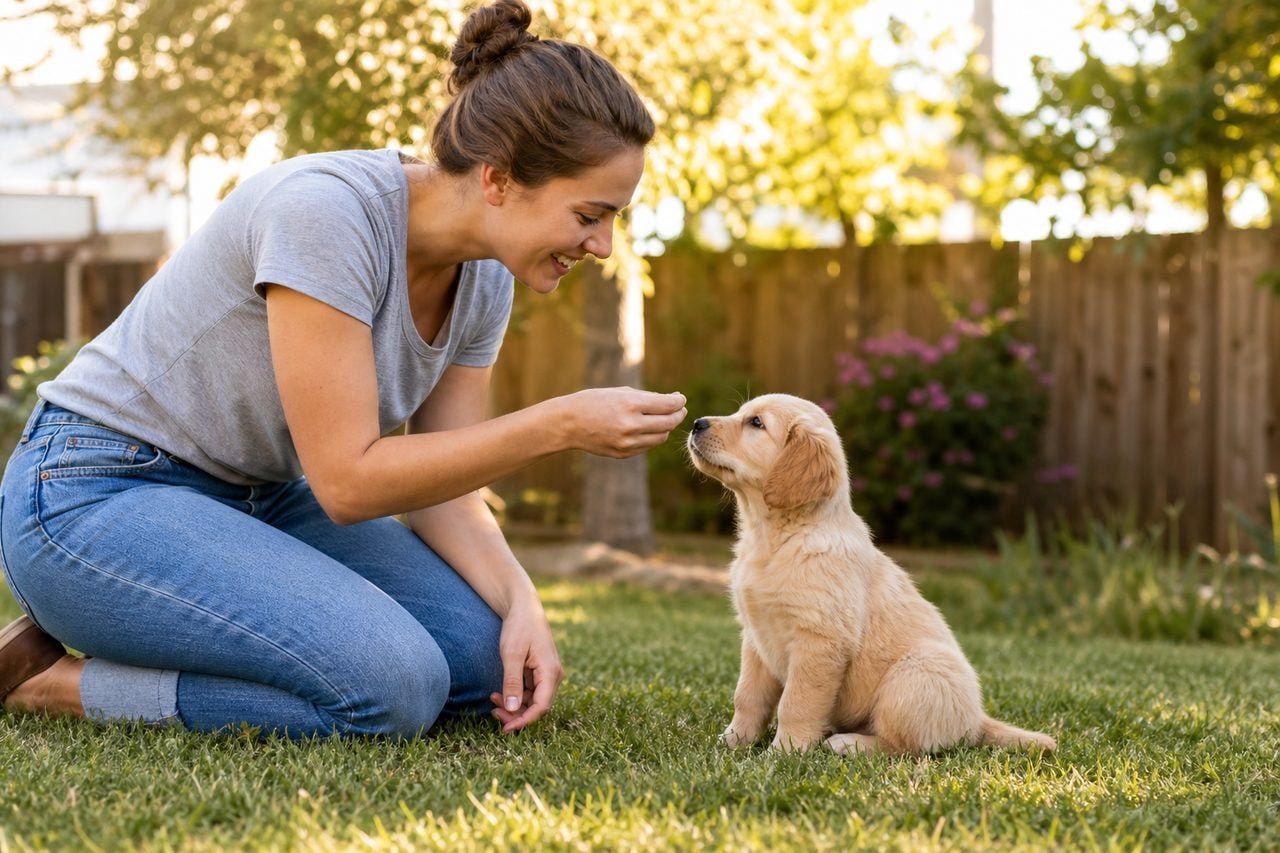
Socialization is the single highest-leverage thing you will ever do with a dog, and it is also the thing most owners get wrong — not through neglect, but through a misunderstanding of what the word means. It is not a supply of playdates. It is not turning a puppy loose in a dog park and hoping the experience is positive. Socialization is the deliberate, carefully paced process of teaching a young dog that the ordinary world is safe and unremarkable, and it has a deadline.
- What Socialization Actually Means — and What It Isn't
- The Vaccination Question, Handled Honestly
- A Terre Haute Socialization Checklist
- Places to Practice Around the Wabash Valley
- Dog-to-Dog Introductions and the Dog Park Problem
- Local Help: Who Runs Socialization Work in Terre Haute
- After Sixteen Weeks: Maintenance, Adolescence and Specialist Help
- Reviewed trainers
- FAQ
That deadline is biological. The window in which a puppy forms lasting, low-effort impressions about what is normal runs from roughly three weeks to sixteen weeks of age. You typically take possession around eight weeks, which leaves about two months of the most valuable learning time a dog will ever have. Experiences banked inside that window cost you almost nothing. The same experiences introduced at ten months, once the dog has already concluded the world is unpredictable, may take months of careful work to reframe — and some of it never fully reverses.
Terre Haute is a workable place to do this properly. Sitting on the east bank of the Wabash River at the Illinois line, with Indiana State University downtown and Rose-Hulman Institute of Technology to the north, the metro offers a genuinely varied environment: quiet residential streets, busy campus sidewalks, the traffic noise of US-40 and I-70, the paved National Road Heritage Trail, and a park system running from the classic bustle of Deming Park to the quieter ground at Fowler and Hawthorn. This guide covers the checklist, the safety math, the local places to practice, and who in the Wabash Valley can help.
What Socialization Actually Means — and What It Isn't
The most damaging myth about socialization is that it is primarily about meeting other dogs. It is not. Dog-to-dog interaction is one item on a long list, and it is not even the most important one. The bulk of the work is exposure to the non-dog world: surfaces, sounds, objects, movement, people of different ages and appearances, handling, vehicles, weather, and being calm in the presence of activity that has nothing to do with the puppy.
The second myth is that more exposure is automatically better. It is not. What builds a confident adult dog is exposure at an intensity the puppy can process without becoming frightened. A puppy that watches three children play on the far side of Deming Park from a comfortable distance and eats treats while doing it has had a genuinely useful session. A puppy that is carried into the middle of those children and mobbed has had a bad one, and the fact that the children were friendly and the puppy did not bite anyone does not make it a success. Fear learned during this window is durable.
The right mental model is a bank account. Each calm, positive, low-stress exposure is a deposit. Each frightening or overwhelming one is a substantial withdrawal — larger than a single deposit, which is why pushing too hard is worse than doing slightly too little. Your job during these weeks is to run up a large balance of ordinary, unremarkable experiences.
Read your puppy rather than the plan. Ears back, tail tucked, freezing, lip-licking, yawning out of context, refusing food it would normally take, trying to move away — these all mean the same thing: too much, too close, too fast. Increase distance, let the puppy watch, and let it approach on its own terms or not at all.
The Vaccination Question, Handled Honestly
Every new owner runs into the same apparent contradiction. The socialization window closes around sixteen weeks. The vaccination series is not usually complete until around then. So does the puppy stay home?
No — but the exposure has to be chosen intelligently. The risk of infectious disease is real and depends heavily on where the puppy’s feet go and who those feet have been near. The risk of behavioral damage from an under-socialized adolescence is also real, and in aggregate it does far more harm across the dog population than parvovirus does. The professional consensus for decades has been that socialization should proceed during the vaccination series, with sensible precautions.
In practice that means favoring controlled environments over uncontrolled ones. A well-run indoor puppy class where every attendee is vaccinated to schedule and the floor is sanitized is a low-risk, high-value setting — which is why Terre Haute trainers who run puppy programs generally accept dogs before the series finishes. Friends’ homes with known, healthy, vaccinated adult dogs are low risk. Carrying your puppy in your arms through a hardware store or along a quiet stretch of the National Road Heritage Trail gets you enormous exposure to sights and sounds with the paws never touching shared ground.
What to avoid until your veterinarian clears you: dog parks, the busiest areas of Deming Park on a warm weekend, pet-store floors, and anywhere large numbers of unknown dogs of unknown status have eliminated. Those are the genuinely higher-risk settings, and skipping them costs you very little because none of them is necessary for good socialization. Talk to your own veterinarian about your specific puppy and your specific area — that conversation should produce a plan, not a blanket ban on leaving the house.
A Terre Haute Socialization Checklist
Vague intentions produce vague results. Write a list, work through it, and track what you have covered, because human memory reliably overestimates how much variety a puppy has actually seen.
People. Men and women, children of different ages, teenagers, older adults, people in hats, hoods, high-visibility vests and heavy work boots, people with beards, people using canes, walkers or wheelchairs, people carrying boxes, people jogging past. Around Indiana State and Rose-Hulman you will find backpacks, bicycles, skateboards and large groups moving quickly — excellent material, best observed from a comfortable distance at first.
Sounds. Traffic on US-40, air brakes, motorcycles, sirens, trains, lawn mowers, leaf blowers, basketballs, the vacuum, the doorbell, thunderstorms, fireworks around the Fourth. Wabash Valley summers deliver storms reliably, and a puppy that learns early that thunder predicts a treat rather than a catastrophe saves you years of trouble.
Surfaces. Grass, gravel, mulch, wet pavement, metal grates, wooden bridges and boardwalks, tile, slick vinyl floors, stairs of different kinds, the ramp of a car boot. Dobbs Park & Nature Center and the trails at Fowler and Hawthorn offer natural surface variety that a suburban sidewalk cannot.
Handling. Ears, paws, tail, mouth, collar grabs, being lifted, being brushed, having nails touched with clippers even if you do not cut. A puppy that accepts handling calmly is a puppy your veterinarian and groomer can work with for the next fifteen years, and this is the item owners skip most often.
Situations. Car rides that end somewhere pleasant rather than only at the vet, being left alone for short periods, waiting calmly while you talk to someone, and being ignored in a busy place. That last one is underrated: neutrality in public is a trained skill, and it is more useful than any trick.
Places to Practice Around the Wabash Valley
Terre Haute’s advantage is that you can find almost any difficulty level within a fifteen-minute drive, which lets you build up in deliberate steps rather than jumping from a silent living room to chaos.
Start easy. Your own street at a quiet hour. A parking lot on a weekday morning where you can sit in the open boot of your car and let the puppy watch the world from a safe perch. Fowler Park and Hawthorn Park on a weekday tend to be calm, with natural surfaces, open ground and enough space to keep whatever distance your puppy needs.
Step up. The National Road Heritage Trail is close to ideal for graded exposure — a paved rail-trail with predictable users, long sightlines so you can see a jogger or cyclist coming and create distance in advance, and the option to turn around at any point. Dobbs Park & Nature Center adds wildlife scent and quieter natural surroundings, which is a different and slightly harder kind of distraction.
Step up again. Deming Park is Terre Haute’s classic busy park and works as a genuine test once your puppy is handling the trail comfortably: families, other dogs, playgrounds, noise. Go to the edges first, not the center. The downtown area around Indiana State gives you foot traffic, doorways, outdoor seating and street noise. If your puppy can sit calmly on a sidewalk near campus while students stream past, you have a well-socialized dog.
Vary the map. Take the occasional trip beyond the city — West Terre Haute across the river, Brazil to the east, Rockville up in Parke County covered-bridge country, or Clinton and Sullivan along US-41. Different towns, different smells, different surfaces, different car journeys. Generalization is the point: a dog that has only ever been calm in one park has learned about that park, not about the world.
Dog-to-Dog Introductions and the Dog Park Problem
Meeting other dogs matters, but the quality of those meetings matters far more than the quantity, and the default local venue — an open dog park — is the worst possible classroom for a puppy.
The problem is not that dog parks are inherently evil. It is that they are uncontrolled. You cannot vet the other dogs, their vaccination status, their social skills or their owners’ attentiveness. A single overwhelming encounter with a rude adolescent that body-slams your twelve-week-old puppy can produce leash reactivity that takes a year of professional work to unwind. The odds of that happening on any given visit are not high, but the downside is severe and the upside is easily obtained elsewhere.
What works better: arranged play with a known, healthy, vaccinated, socially appropriate adult dog. Adults are the best teachers a puppy can have, because a well-adjusted grown dog will correct a pushy puppy fairly and proportionately — a lesson the puppy needs and that you cannot teach. Two or three reliable canine friends beat twenty strangers.
Structured puppy classes are the other good answer, because the play is supervised, the participants are size- and temperament-matched, and an instructor interrupts before an interaction goes sour. That supervision is most of the value.
Finally, teach neutrality alongside play. A puppy learning that every dog it sees means play is a puppy building enormous leash frustration, which is one of the most common routes into adolescent reactivity. Practice walking past other dogs at a distance while your puppy notices them and then checks in with you. Most of the dogs your dog encounters for the rest of its life will be dogs it does not get to greet. Teach that now.
Local Help: Who Runs Socialization Work in Terre Haute
A structured class is the most efficient socialization tool available, and the Terre Haute metro has real options despite its size.
Unlimited Pawsibilities, 1209 N Fruitridge Ave, is the most complete provider locally. It runs a puppy program plus group obedience, private and in-home training, and the full AKC ladder — Canine Good Citizen, Community Canine, AKC Urban CGC, Trick Dog and Rally. The AKC Urban CGC and Community Canine titles are worth noting for socialization specifically, because they test a dog’s composure in real public environments rather than a training room. It also handles behavior modification for aggression, reactivity, anxiety and fear, which is the right resource if your puppy is showing early fear signs, and offers K-9 nose work, agility and fitness, therapy dog training, service dog evaluation and training, and virtual home-manners evaluations. The trainer goes by Mariah — a certified trainer and AKC Evaluator with ten years as a veterinary assistant and over nine years training. There is no board-and-train here.
K9.5 Training Academy, 3475 Erie Canal Road, works out of a 10,000 square foot purpose-built facility with two obedience packages: a six-day program the owner attends, and a twelve-day board-and-train. It also runs boarding, day play, grooming and vaccine clinics. Day play in a supervised setting can be a useful socialization outlet for an older puppy once vaccination is complete. Owner Larry Hopper is K9 Commander of the Vigo County Sheriff’s Office K9 Unit, a Master Trainer with DLE and a former IPWDA trainer.
VonBernd K9 Training Center, 11750 S US Hwy 41, is run by John Holcomb — forty-seven years in the field, former full-time law-enforcement K9 handler, trainer and supervisor, and an AKC Canine Good Citizen Evaluator. Basic and advanced obedience, behavior and aggression work, tracking and man-trailing, service dogs and boarding.
Top Dog Training LLC (owner Nicole Thraen) runs in-home board-and-train on an eight-acre property with weekly group classes exclusive to those clients; intake has not always been open, so call before counting on it. Cultivate K9 Training offers training as a secondary service of a working family farm with no published program details. CABP Canine Training Academy, K9 812 Terre Haute and M&B Dog Training are further local names without published details — the metro has several smaller trainers best reached by phone.
After Sixteen Weeks: Maintenance, Adolescence and Specialist Help
The critical window closing does not mean the work is finished. It means the cheap phase is over and the maintenance phase has begun. Socialization that is not maintained decays, and it decays fastest during adolescence — roughly six to eighteen months — when many well-socialized puppies go through a period of renewed caution and start barking at things they previously ignored.
This is normal and it is temporary in dogs whose owners keep working through it. The mistake is interpreting the wobble as a personality change and withdrawing the dog from the world, which guarantees the fear consolidates. Keep going out, keep the sessions positive, increase your distance from whatever spooks the dog rather than forcing proximity, and keep food in your pocket. Most adolescent caution resolves with steady, unremarkable exposure.
If your puppy is genuinely fearful rather than briefly startled — consistently refusing food outdoors, shutting down, panicking at ordinary sounds, or showing defensive aggression — get professional help early rather than waiting to see if it improves. Fear cases respond far better at six months than at two years. Unlimited Pawsibilities and VonBernd both take behavior work, and both are reasonable first calls.
Be realistic about where the metro’s depth ends. Terre Haute is well served for obedience, board-and-train and general behavior work, and it has one genuine personal and home protection provider in VonBernd for owners whose needs run that direction. What the Wabash Valley does not have is a deep bench of niche specialists — veterinary behaviorists, severe separation anxiety specialists, complex multi-dog aggression cases. That depth is in Indianapolis, roughly an hour and fifteen minutes east on I-70. For most puppies you will never need it. For the ones that do, the drive is worth it, and starting with a local trainer who will tell you honestly when a case is beyond the local scope is the best position to be in.
Reviewed Puppy Socialization Trainers in Terre Haute
These reviewed Terre Haute-area trainers from our directory are the local options for puppy socialization. Each links to a full profile with specialties, certified credentials, reviews, and contact info:
- Unlimited Pawsibilities — 4.8★ (79 reviews)
- M&B Dog Training — 5.0★ (3 reviews)
- K9 812 Terre Haute — 5.0★ (3 reviews)
- K9.5 Training Academy — 4.9★ (73 reviews)
- Top Dog Training LLC — 4.9★ (27 reviews)
- Vonbernd K9 Training Ctr LLC — 4.4★ (47 reviews)
- Cultivate K9 Training
- CABP Canine Training Acadamy
See all Terre Haute puppy socialization trainers →
Frequently Asked Questions
Can I socialize my puppy before the vaccination series is finished?
Yes, and you should — with sensible precautions. Favor controlled settings: well-run indoor puppy classes with vaccinated attendees, homes with known healthy dogs, and carrying your puppy through busy places so its paws stay off shared ground. Avoid dog parks, pet-store floors and the busiest areas of public parks until your veterinarian clears you. The behavioral cost of waiting until sixteen weeks with no exposure at all is generally worse than the managed infectious risk.
How much socialization is enough?
There is no fixed number, and quality beats quantity every time. Aim for varied, short, positive exposures most days rather than one long overwhelming outing a week. Track categories — people, sounds, surfaces, handling, situations — rather than counting hours. If your puppy is eating treats, moving freely and choosing to investigate, the session is working. If it is freezing, tucking or refusing food, you have gone too far and should increase distance.
Are dog parks in the Terre Haute area good for puppies?
Generally no, at least not during the puppy stage. Dog parks are uncontrolled environments where you cannot vet the other dogs’ health, social skills or their owners’ attention, and one bad encounter can create leash reactivity that takes months to undo. Arranged play with known, vaccinated, well-mannered adult dogs and supervised puppy classes give you the same benefit with far less risk.
Which local places are best for practicing?
Start quiet: your own street, a weekday parking lot, or Fowler Park and Hawthorn Park on an off-peak day. Move up to the National Road Heritage Trail, which offers long sightlines so you can create distance before a cyclist or jogger reaches you, and Dobbs Park & Nature Center for natural surfaces and scent. Deming Park and the sidewalks around Indiana State are the advanced level — work the edges before the center.
Is it too late if my dog is already six months old?
Not too late, just harder and slower. After roughly sixteen weeks, new experiences require more repetition and more care to land as positive rather than alarming, but adolescent and adult dogs change constantly with good work. The approach shifts from broad exposure to targeted, distance-managed counter-conditioning. If your dog is showing genuine fear or reactivity rather than just inexperience, bring in a trainer who handles behavior work rather than proceeding alone.
Who in Terre Haute handles puppy socialization and early fear issues?
Unlimited Pawsibilities on N Fruitridge Ave runs a puppy program and also handles behavior modification for anxiety, fear and reactivity, which makes it a sensible first call for both. VonBernd K9 Training Center on S US Hwy 41 takes behavior and aggression work with a very experienced trainer behind it. For severe or complex cases — veterinary behavior medicine, serious separation anxiety — the deeper specialist pool is in Indianapolis, about an hour and fifteen minutes east on I-70.
Related: read our complete puppy socialization guide or the full Terre Haute dog training overview.
Ready to find the right puppy socialization pro in Terre Haute?