
Puppy Training in Lafayette, IN
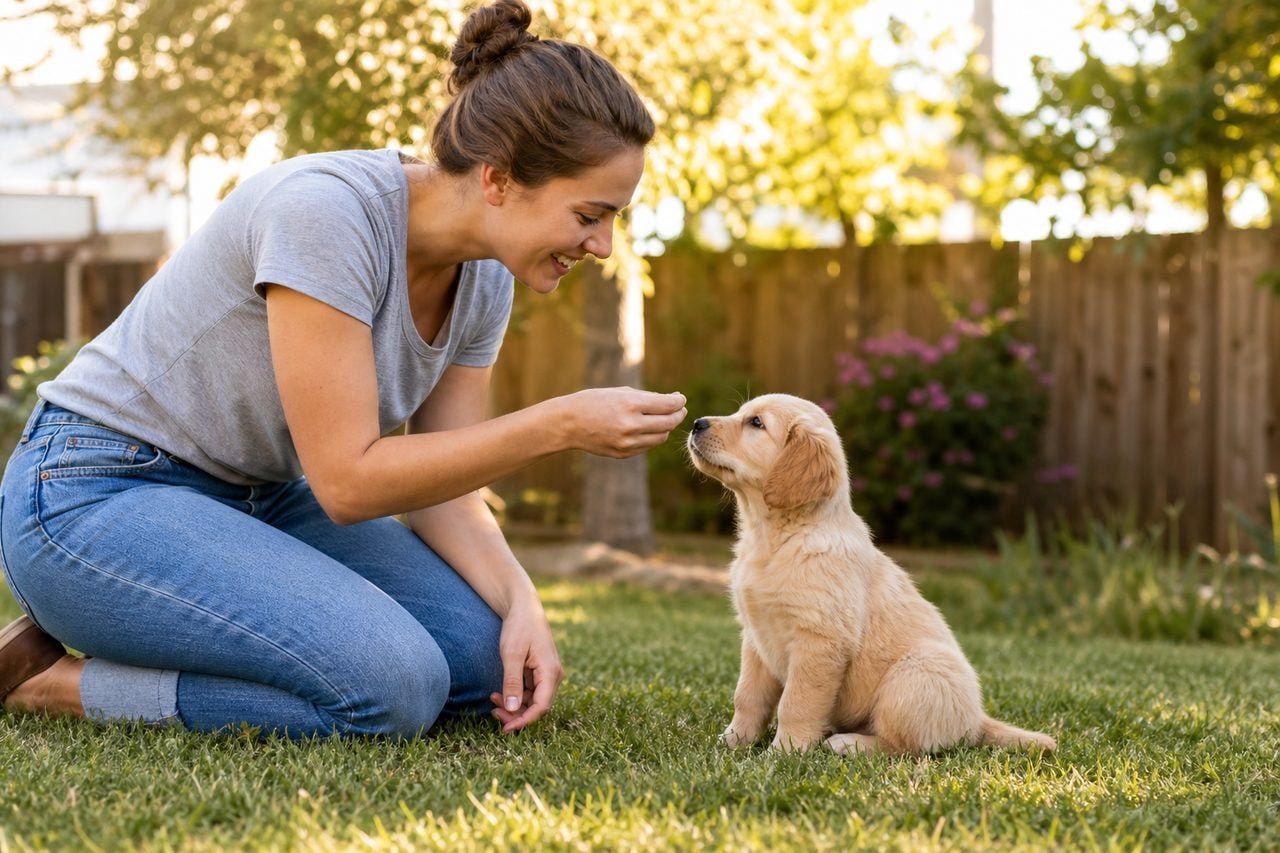
Bringing a new puppy home in Greater Lafayette is exciting, but the first few months set the tone for the rest of your dog’s life. Whether you live in a student rental near Purdue, a family home in the Wea Ridge area, or a farmhouse out toward Battle Ground, the fundamentals of raising a well-mannered dog are the same. What changes from place to place is the environment your puppy grows up in, and Tippecanoe County offers a rich mix of quiet neighborhoods, busy campus sidewalks, riverside trails, and open state parks that can either help or overwhelm a young dog depending on how you introduce them.
- The First Two Weeks: Setting a Foundation Before Any Commands
- House-Training Through an Indiana Year
- Teaching the Core Cues That Actually Matter
- Using Local Spaces to Proof Your Training
- Bite Inhibition, Chewing, and the Adolescent Challenge
- Socialization Runs Parallel to Training
- When to Bring in Professional Help
- Reviewed trainers
- FAQ
This guide walks through what puppy training actually looks like in the Lafayette and West Lafayette area, from the very first week at home through the adolescent months when many owners feel like their once-perfect puppy has forgotten everything. The goal is practical, local, and honest advice you can start using today, along with a clear sense of when a group class or a private trainer is worth the investment.
None of this requires expensive equipment or hours of free time. It requires consistency, a little patience, and a willingness to practice in the ordinary moments of daily life across the places you already go.
The First Two Weeks: Setting a Foundation Before Any Commands
Most new owners want to jump straight to sit, down, and shake. Those are fine, but the real work of the first two weeks is helping your puppy feel safe and predictable in a brand-new world. A puppy that trusts you and understands the rhythm of the day learns commands far faster than one that is anxious or overstimulated.
Start by deciding, before the puppy arrives, where it will sleep, where it will eat, and where it will go to the bathroom. Consistency in these three areas prevents most early problems. In a smaller West Lafayette apartment, a crate or pen in a corner away from foot traffic gives the puppy a den it can retreat to. In a larger home, resist the urge to give a young puppy the run of the house; a confined, supervised space reduces accidents and chewing while it learns the rules.
Use these first weeks to build a positive association with the crate, gentle handling of paws and ears, and short periods of being alone. Puppies that never learn to settle by themselves often develop separation anxiety later, which is a particular risk for Purdue students whose class and work schedules mean the dog will regularly be home alone. Practicing calm departures and returns from day one is far easier than fixing panic months down the road.
What to prioritize early
- A predictable feeding and potty schedule tied to the clock, not to whining
- Positive, low-pressure crate and confinement time
- Gentle body handling so vet and grooming visits go smoothly
- Short, frequent naps, because an overtired puppy behaves like an overtired toddler
It also pays to slow down socially in these first days. Many owners are so thrilled with a new puppy that they invite every friend and neighbor over at once, which can flood a young dog before it has found its footing. A calmer first week, with the household itself becoming familiar before the wider world arrives, gives the puppy a stable base to explore from. There is plenty of time for the busy campus sidewalks and packed weekend trails once the puppy trusts that home is predictable.
Keep in mind that a puppy is learning constantly, whether or not you are formally training. Every time it whines and gets attention, jumps up and gets petted, or barks and gets let out of the crate, it is learning what works. In these first weeks, simply being thoughtful about what behaviors you reward, even accidentally, prevents many of the problems owners later pay trainers to fix.
House-Training Through an Indiana Year
House-training is the number one frustration for new owners, and the Greater Lafayette climate adds its own wrinkles. Summers along the Wabash are hot and humid, winters bring snow and biting wind, and spring turns yards to mud. Each season tests a puppy’s routine in a different way.
The core method does not change: take the puppy out frequently, reward it heavily the instant it finishes outside, supervise closely indoors, and clean accidents with an enzymatic cleaner so no scent marker remains. Puppies generally need to go out after waking, after eating, after play, and roughly every hour or two otherwise when very young.
Winter is where many Lafayette owners struggle. A small puppy may refuse to potty in deep snow or on frozen ground, and the temptation to cut the trip short is strong when the wind is howling. Shoveling a small clear patch in the yard gives the puppy a reliable spot, and going out with the puppy rather than sending it out alone lets you reward the right behavior immediately. In summer, early-morning and evening trips avoid the worst heat, which matters because hot pavement on Lafayette sidewalks can burn sensitive paw pads.
Crate training and house-training reinforce each other. A puppy that is comfortable in an appropriately sized crate is unlikely to soil it, because dogs naturally avoid eliminating where they sleep. That makes the crate a useful tool for the stretches when you cannot supervise directly, provided the crate is never used as punishment and the puppy is not confined longer than it can reasonably hold. A rough guideline is that a puppy can hold its bladder for about one hour per month of age, so an eight-week-old should not be crated for hours on end.
Apartment dwellers near campus face a particular challenge, because reaching grass may mean a flight of stairs and a walk to a common area rather than a quick trip to a private yard. Building in extra time for these trips, and rewarding the puppy the moment it finishes rather than waiting until you are back inside, keeps the lesson clear. Some apartment owners use an indoor potty option as a temporary bridge for a very young puppy, then transition fully outdoors as the puppy matures and can hold longer.
Expect setbacks. A puppy that seemed fully trained at four months may backslide during adolescence or after a change in routine. This is normal. Return to closer supervision and a tighter schedule for a week or two and the habit usually reasserts itself. Sudden, repeated accidents in a previously trained dog can also signal a medical issue such as a urinary tract infection, so a check with your veterinarian is worthwhile if the regression seems out of character.
Teaching the Core Cues That Actually Matter
Once your puppy is settling in, a handful of cues will carry you through daily life. Rather than collecting tricks, focus on the behaviors that keep a dog safe and pleasant to live with: name recognition, sit, a reliable recall, loose-leash walking, and a solid leave-it.
Keep sessions short, ideally two to five minutes, several times a day. Puppies have limited attention spans and learn best in brief, upbeat bursts. Use small, soft treats the puppy can eat quickly so momentum is not lost. Mark the exact moment the puppy does the right thing, either with a clicker or a consistent word like yes, then deliver the reward.
Recall deserves special attention
A dog that comes when called can be trusted with far more freedom, and in an area with as much open space as Tippecanoe County, that freedom is worth building carefully. Start indoors with no distractions, calling the puppy in a happy voice and paying generously every single time. Gradually add mild distractions, then move to a securely fenced yard, then to a long training line in a quieter corner of a park. Never call your puppy to you for something it dislikes, such as ending playtime or getting a bath, or the word will start to predict bad news.
Loose-leash walking is the other high-value skill, especially if you plan to walk the Wabash Heritage Trail or the busy sidewalks around campus. Reward the puppy for staying near you, stop moving when it pulls, and reverse direction so the puppy learns that a tight leash never gets it where it wants to go. Progress is slow at first and then suddenly clicks. A properly fitted harness can make these early walks easier on both of you by taking pressure off a puppy’s neck, though the harness itself does not teach the dog not to pull; that still comes from consistent rewards for a loose leash.
Two more cues deserve a place in your daily practice. Leave-it teaches a puppy to turn away from something it wants, which is genuinely a safety skill given how much a curious dog will try to eat off the ground on a riverside trail or a downtown sidewalk. Build it by rewarding the puppy for choosing you over a treat on the floor, gradually raising the temptation. A settle or place cue, where the puppy learns to lie calmly on a mat, is equally valuable for a young dog that struggles to switch off, and it translates directly to calm behavior in a cafe patio or a friend’s living room.
Throughout, keep your criteria realistic and celebrate small wins. A puppy will not hold a stay for a minute in week one, and it does not need to. Reward duration and difficulty in tiny increments, always setting the puppy up to succeed more often than it fails. Training built on a long string of small successes produces a confident dog that enjoys working with you, which is the real engine behind everything else.
Using Local Spaces to Proof Your Training
A puppy that behaves perfectly in your living room but falls apart at the park has not truly learned the behavior; it has only learned it in one context. Proofing means practicing the same cues in gradually more challenging environments, and Greater Lafayette offers a natural ladder of difficulty.
Begin in your home and yard, the easiest settings. Once cues are solid there, move to a quiet residential street, then to a moderately busy area, and finally to genuinely distracting places. The Celery Bog Nature Area in West Lafayette offers wildlife smells and other walkers, a good middle step. Prophetstown State Park and the trails around the Tippecanoe Battlefield in Battle Ground provide open space with new sights and scents. Columbian Park in Lafayette adds people, playground noise, and other dogs at a distance.
Only advance when your puppy is succeeding at the current level. If it stops responding, you have moved up too fast; drop back to an easier setting, rebuild confidence, and try again. Always confirm leash rules and keep your dog leashed unless you are in a clearly designated off-leash space, since ordinances vary across the Lafayette area and open land does not automatically mean off-leash is allowed.
For students, campus itself is an excellent, if demanding, training environment. Skateboards, bicycles, crowds, and squirrels around the Purdue mall test a young dog thoroughly. Keep early campus outings short, bring high-value treats, and give the puppy plenty of room to observe from a comfortable distance before asking for focus.
Bite Inhibition, Chewing, and the Adolescent Challenge
Puppy teeth are needle-sharp, and mouthing is completely normal. The goal is not to eliminate mouthing overnight but to teach the puppy to control the force of its jaws, a skill called bite inhibition. When a puppy bites too hard during play, a brief pause in the fun teaches it that gentle mouths keep the game going and hard ones end it. Redirecting to an appropriate chew toy gives those needs a legal outlet.
Teething, which peaks in the middle months, drives a strong urge to chew. Provide a rotation of safe chew items and keep tempting household objects out of reach rather than relying on the puppy to resist them. A frozen wet washcloth or a puppy-safe frozen chew can soothe sore gums during the worst of it.
Then comes adolescence, roughly five to eighteen months, when many owners feel blindsided. A previously cooperative puppy may ignore known cues, test boundaries, and act as if training never happened. This is a developmental stage, not defiance, and it is the most common point at which dogs are surrendered. The answer is not to give up but to keep expectations realistic, maintain structure, continue rewarding good choices, and ride it out. Dogs that get consistent guidance through adolescence come out the other side as steady adults.
Socialization Runs Parallel to Training
Training teaches your puppy what to do; socialization teaches it that the world is safe. The two happen at the same time, and the early window, roughly up to sixteen weeks, is disproportionately important. During this period, positive exposure to a wide variety of people, sounds, surfaces, and situations builds a resilient adult dog.
Because full vaccination is not complete during that early window, work with your veterinarian on how to socialize safely. Carrying a young puppy through a hardware store, sitting on a bench near the campus while the world goes by, and inviting calm, healthy adult dogs over for supervised time all provide valuable exposure without the disease risk of high-traffic dog areas. The point is quality of experience, not quantity; a handful of relaxed, positive encounters beats one overwhelming outing.
Since socialization is a large topic in its own right, it is worth reading a dedicated guide once you have the training basics underway. The short version for now: keep experiences positive, let the puppy set the pace, never force it toward something frightening, and pair new things with treats and praise.
When to Bring in Professional Help
Plenty of owners raise a well-adjusted puppy on their own, but professional guidance saves time and prevents habits that are hard to undo. A good group puppy class offers structured socialization, coaching on the core cues, and the chance to practice around mild distractions, all of which are especially useful for first-time owners.
Private training makes sense when a puppy has specific issues, such as fearfulness, resource guarding, or intense separation distress, or when your schedule makes group classes hard to attend. Board-and-train programs, where the dog stays with a trainer, exist too, though owners should understand they still need to learn how to maintain the results at home.
When choosing any trainer in the Greater Lafayette area, look for someone who uses reward-based, humane methods, is transparent about what happens in their sessions, and is willing to let you observe. Ask how they handle mistakes and whether they coach the human as much as the dog, because long-term success depends on you. A directory listing local options is a good starting point for comparing approaches, formats, and availability before you commit.
There are also warning signs worth taking seriously. Be cautious of anyone who guarantees results, since living creatures do not come with guarantees, or who leans heavily on fear and intimidation to get quick compliance. A puppy trained through pressure may look obedient while quietly learning that its owner is unpredictable, which erodes the trust you spent those first weeks building. The trainers worth your money are the ones who make training feel like a game the puppy wants to play.
Finally, remember that no class replaces daily life. The best outcome comes from combining a little professional guidance with consistent practice woven into your ordinary routine, from morning potty trips to evening walks along the river. A puppy raised this way, with clear expectations, positive reinforcement, and gradual exposure to the varied environments Tippecanoe County offers, grows into the kind of steady, adaptable adult dog that is a genuine pleasure to live with for the next decade and more.
Reviewed Puppy Training Trainers in Lafayette
These reviewed Lafayette-area trainers from our directory handle puppy training. Each links to a full profile with specialties, certified credentials, reviews, and contact info:
- Whetstone Canines — 5.0★ (11 reviews)
- Pals and Paws Academy
- Swiss Army K9 Academy
- H.W. Canine Design — 5.0★ (47 reviews)
- Engineering Change: Canine + Equine Training — 5.0★ (22 reviews)
- Greater Lafayette Kennel Club — 5.0★ (2 reviews)
- Leader of the Pack Canine — 4.9★ (107 reviews)
- VonBernd K9 Training Center — 4.8★ (61 reviews)
- Rin Tin Inn — 4.8★ (37 reviews)
- Pawsitive Pets, LLC — 4.7★ (80 reviews)
See all Lafayette puppy training trainers →
Frequently Asked Questions
What is the best age to start training a puppy?
Training starts the day your puppy comes home, usually around eight weeks. Very young puppies can learn their name, basic house-training, and simple cues in short sessions. The early weeks are also the most important window for gentle socialization, so there is no reason to wait for a formal class before you begin building good habits at home.
How long does it take to house-train a puppy in the Lafayette area?
Most puppies are reliably house-trained by four to six months with consistent supervision and a regular schedule, though individual dogs vary. Indiana winters can slow progress if a puppy is reluctant to potty in snow, so clearing a small spot in the yard and going outside with the puppy to reward it immediately both help keep momentum through the cold months.
How much time do I need to spend training each day?
Less than most people expect. Several short sessions of two to five minutes each, folded into normal daily routines, are more effective than one long session. Puppies learn best in brief, upbeat bursts, and much of the real training happens through consistent responses to everyday moments like mealtimes, walks, and greetings.
My adolescent puppy stopped listening. Did I do something wrong?
Almost certainly not. Adolescence, roughly five to eighteen months, commonly brings a phase where a young dog seems to forget its training and tests boundaries. This is a normal developmental stage, not defiance. Keep your routines consistent, continue rewarding good choices, and stay patient; dogs that get steady guidance through this period settle into reliable adults.
Can I socialize my puppy before it is fully vaccinated?
Yes, but do it carefully and in consultation with your veterinarian. You can expose a young puppy to new people, sounds, surfaces, and calm healthy dogs while avoiding high-traffic areas where disease risk is higher. Carrying the puppy through public spaces and hosting controlled visits at home are good ways to build positive experiences during the critical early window.
Is a group class or private training better for a new puppy?
It depends on your goals and your dog. Group classes are excellent for socialization, learning core cues, and practicing around mild distractions, and they suit most first-time owners well. Private training is a better fit for specific behavior concerns or difficult schedules. Many owners in the Greater Lafayette area do both, starting with a group class and adding private sessions if a particular issue comes up.
Related: read our complete puppy training guide or the full Lafayette dog training overview.
Ready to find the right puppy training pro in Lafayette?