
Puppy Training in Port Huron, MI
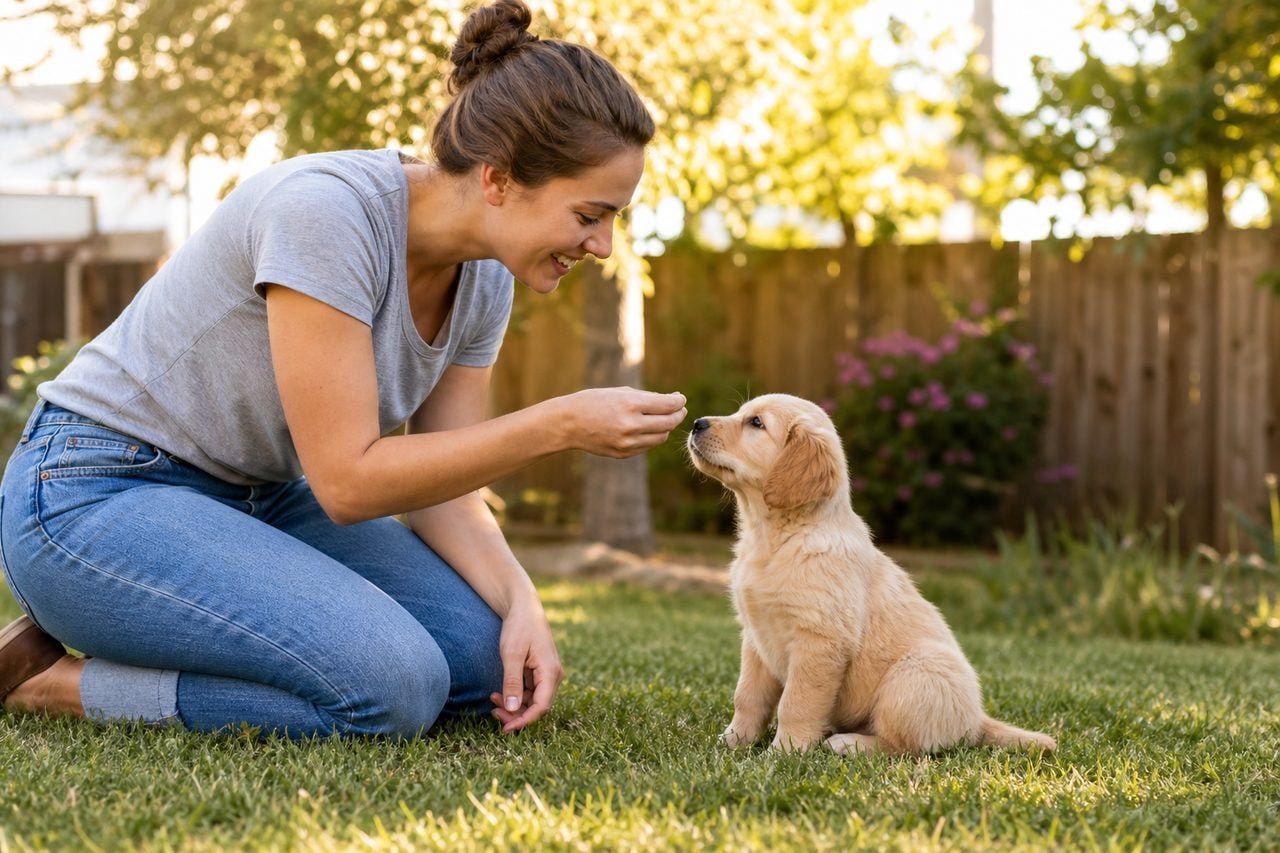
Bringing a puppy home in the Blue Water Area means starting training against a very particular backdrop. Port Huron sits at the mouth of the St. Clair River, where Lake Huron narrows and pours south beneath the Blue Water Bridge, and life here is shaped by water, weather, and small-town rhythms. A puppy raised in Marysville, St. Clair, or up the Lake Huron shore toward Lakeport will meet freighter horns, beach crowds in July, quiet farm roads around Emmett and Yale, and long stretches of ice and snow from December through March. The first four months set the tone for all of that, and the work you do now is far cheaper and easier than the retraining you would otherwise pay for later.
- The critical window: why the first four months matter most
- Housetraining in a four-season river climate
- Crate training and settling: your indoor winter tool
- Early leash skills before the summer crowds arrive
- Bite inhibition, chewing, and the sharp puppy phase
- When to hire a trainer, and what to look for locally
- A realistic first-16-weeks plan for a Blue Water puppy
- Reviewed trainers
- FAQ
Puppy training is less about obedience commands and more about teaching a young dog how to live calmly in your particular world. Housetraining, crate comfort, gentle handling, a reliable name response, and early manners on leash matter far more at eight to sixteen weeks than a polished sit-stay. This guide walks through what actually moves the needle for a Port Huron puppy, how the local seasons and geography change the plan, and how to decide when to bring in a professional trainer versus handling the basics at home.
None of the advice below assumes a specific breed, budget, or living situation. Waterfront condo owners downtown, families on acreage near Capac, and renters in Marine City all face the same core puppy questions, just with different logistics. The goal is a confident, house-trained, socially easy dog by six months, and a foundation strong enough to build real obedience on after that.
The critical window: why the first four months matter most
Puppies move through a sensitive developmental period that runs roughly from three to sixteen weeks. During this stretch their brains are primed to file away what is normal and safe versus what is threatening. A puppy who meets a wide, positive range of people, surfaces, sounds, and situations before sixteen weeks tends to grow into a stable adult. A puppy who is kept sheltered and under-exposed during that window is far more likely to develop fear or reactivity that takes months of careful work to unwind.
This is the single most important thing to understand about puppy raising in the Port Huron area, because our calendar can work against you. A puppy born in November hits that critical window in the dead of a Blue Water winter, when it is tempting to keep everything indoors and quiet. That convenience can quietly cost you a fearful adult. If your puppy is going through those weeks in January or February, you have to be deliberate about manufacturing safe exposure indoors and in short, controlled outings.
Practical takeaway: do not wait for the puppy to be fully vaccinated before starting socialization and gentle handling. Talk to your veterinarian about risk-managed outings, carry the puppy in busy areas if needed, and prioritize positive experiences over sheer distance covered. The clock on this window does not stop for weather or a vaccine schedule.
It helps to think of the window as a savings account you can only pay into once. Every calm, positive experience you deposit before sixteen weeks earns interest for years in the form of a confident, adaptable adult. You cannot go back and make those deposits later at the same rate; remedial work on an under-socialized adult is slower, harder, and often only partial. That framing is worth keeping in mind on the cold, dark evenings when it would be easier to skip an outing. The convenience of staying in is real, but so is the long-term cost, and a few minutes of deliberate exposure now saves you far more effort down the road.
Housetraining in a four-season river climate
Housetraining works on a simple loop: prevent accidents through supervision and confinement, take the puppy to the same outdoor spot on a predictable schedule, reward heavily the instant they finish outside, and clean any indoor accident with an enzymatic cleaner so no scent marker remains. Puppies generally can hold their bladder for roughly one hour per month of age, so an eight-week-old needs an outdoor trip every couple of hours, plus after every nap, meal, and play session.
The Blue Water climate adds two real complications. The first is the long cold season. Deep snow, wind coming off the lake, and salted sidewalks make a young puppy reluctant to go out and finish quickly, and a puppy who rushes back to the door with an empty bladder will finish the job on your floor ten minutes later. Shovel and clear a small, consistent potty patch close to the house, keep those trips short and businesslike, and layer a coat on thin-coated breeds so cold is not a reason to stall.
The second complication is spring. Snowmelt and river-valley rain turn yards to mud, and a puppy tracking wet paws inside is a nuisance but not a training problem. Do not let sloppy weather push you back toward indoor pads if your goal is an outdoor-trained dog, because switching surfaces mid-training slows everything down. Pick your end goal, usually outdoors, and stay consistent through every season.
- Keep a fixed feeding schedule so elimination becomes predictable.
- Use a leash for potty trips even in your own yard so the puppy learns the trip has a purpose.
- Reward outside, the moment they finish, not once you are back indoors.
- Track accidents for a week; a pattern usually reveals a schedule gap you can close.
Crate training and settling: your indoor winter tool
A crate is not a cage or a punishment; used well it is a den that gives the puppy a safe place to rest and gives you a way to prevent accidents and chewing when you cannot supervise. In a Port Huron winter, when outdoor time is limited, a solid crate and settle routine is one of the most valuable things you can build. It protects your house, supports housetraining, and teaches the puppy the single most underrated skill a dog can have: the ability to be calm and alone.
Introduce the crate as a good place. Feed meals inside it, toss treats in for the puppy to discover, and keep the door open at first so there is no trap-and-slam association. Build duration gradually, starting with seconds and working up to minutes, always aiming to let the puppy out while they are calm rather than in response to whining. A puppy who learns that crying opens the door will cry louder and longer.
Pair crate work with a broader settle routine on a mat or bed in your living space. A puppy who can switch off while the household is busy is a puppy who will be welcome at a friend’s place in Marysville, calm during a summer cookout, and manageable when the house fills with people. This calm-on-cue skill prevents a huge share of the behavior problems trainers see in adolescent dogs.
Early leash skills before the summer crowds arrive
Leash manners are far easier to build in a quiet setting than to repair in a chaotic one. Start indoors and in your own yard, teaching the puppy that a loose leash and staying near you pays off, before you ever attempt the Blue Water River Walk on a busy Saturday. The core mechanic is simple: reward the puppy for being at your side, stop moving when the leash goes tight, and resume only when it slackens. Pulling should never successfully drag you forward, because every successful pull trains the next one.
Once the basics are solid at home, graduate to progressively busier environments. A weekday morning at Marysville City Park or a quiet stretch of the Wadhams-to-Avoca rail-trail offers space and mild distraction. Save the peak-summer River Walk downtown, the Fort Gratiot beaches, and Lakeside Park for when your puppy can already hold attention in easier places. Throwing a fifteen-week-old into a July beach crowd and expecting focus sets both of you up to fail.
Watch the ground temperature in summer. Pavement and boardwalk surfaces along the river and at the beaches can get hot enough to hurt paw pads; if you cannot hold the back of your hand to the surface for several seconds, it is too hot for the puppy. Early morning and evening walks are kinder on paws and give you calmer environments to train in anyway.
Bite inhibition, chewing, and the sharp puppy phase
Every normal puppy bites, mouths, and chews. This is not aggression; it is how they explore the world and, crucially, how they learn to control the force of their jaws. Your job is not to eliminate mouthing overnight but to teach the puppy that human skin is delicate and that hard bites end the fun. When a puppy bites too hard, a brief pause in play, a short calm timeout, and a redirect to an appropriate chew toy teaches the lesson without intimidation.
Provide plenty of legal outlets. Teething puppies need to chew, and a rotation of safe chews saves your furniture, shoes, and baseboards. Frozen items can soothe sore gums during the worst teething weeks. Puppy-proof aggressively: manage access with baby gates and the crate rather than expecting a four-month-old to resist temptation in a room full of interesting objects.
Keep expectations realistic. The sharpest mouthing and the wildest energy often peak in the adolescent months that follow puppyhood, roughly five to ten months, when many owners feel their sweet puppy has regressed. This is normal, it passes, and consistent management plus continued training carries you through it. Owners who panic and get harsh during adolescence usually create more problems than they solve.
Energy management is part of the same picture. A bored, under-stimulated puppy chews more, mouths harder, and gets into more trouble, and owners often mistake this for a training failure when it is really an outlet problem. Physical exercise matters, but it should be age-appropriate; a young puppy’s joints are still developing, so avoid forced long-distance running or repetitive high-impact activity and favor short bursts of free play. Mental work is just as tiring and often more so. Simple food-puzzle feeders, short training games, scent games where the puppy finds hidden treats, and letting the puppy sniff and explore on walks all drain energy in a healthy way. A puppy that gets both kinds of outlet is a calmer puppy indoors, which matters enormously in the long Blue Water winter when outdoor time is limited and the household is cooped up together.
When to hire a trainer, and what to look for locally
Plenty of the basics above can be handled at home by a committed owner. A professional becomes worth the money when you want structured socialization in a controlled setting, when a behavior worries you, or simply when you want to compress the learning curve and avoid building bad habits you will later pay to fix. A good early group puppy class is one of the best investments available, because it delivers socialization, handler coaching, and real-world distraction practice in one package.
Because the Blue Water Area is spread out, many trainers here cover a wide travel radius across St. Clair County and up into the Sanilac County Thumb toward Lexington and Croswell. Some run group classes from a fixed location, some come to your home, and some do both. When evaluating any trainer, prioritize methods over marketing.
- Ask what happens when a puppy gets something right, and what happens when it gets something wrong; you want reward-based methods and humane, clear consequences, not intimidation or pain.
- Ask about their approach to socialization and whether puppy classes are structured to prevent bullying and bad experiences, not just free-for-all play.
- Ask about their travel radius and whether they serve your town, since coverage across the county and Thumb varies.
- Ask for a clear picture of what a package includes and how progress is measured.
Trust your read of how the trainer handles your puppy. A puppy that leaves a session looser, happier, and more engaged is a good sign; a puppy that leaves shut down or frightened is a red flag regardless of credentials.
A realistic first-16-weeks plan for a Blue Water puppy
Pulling it together, here is a sane sequence rather than a rigid checklist. In weeks eight to ten, focus on settling into the home, starting the crate and housetraining routines, and beginning gentle handling and name games. Keep the world small and positive. In weeks ten to twelve, expand socialization deliberately, add short leash sessions in the yard, and begin structured exposure to the sights and sounds the puppy will live with, adapting indoors if it is deep winter.
In weeks twelve to fourteen, take training on the road to easy public settings, quiet stretches of local parks and trails at off-peak hours, and start layering mild distractions. In weeks fourteen to sixteen, consolidate: reliable name response, calm settling around activity, loose-leash basics, and continued positive exposure. By sixteen weeks you are not aiming for a finished dog; you are aiming for a confident, house-trained puppy with a strong foundation and no fear holes.
Seasonality should flex the plan, not cancel it. A summer puppy leans on early-morning outings before the beach and River Walk crowds; a winter puppy leans harder on manufactured indoor exposure and a rock-solid crate routine. Either way, the principles hold: prevent rehearsal of bad habits, reward the behaviors you want, and expose the puppy widely and positively while the developmental window is open. Do that, and adolescence and formal obedience both get dramatically easier.
Reviewed Puppy Training Trainers in Port Huron
These reviewed Port Huron-area trainers from our directory handle puppy training. Each links to a full profile with specialties, certified credentials, reviews, and contact info:
- Recon K9 — 5.0★ (8 reviews)
- Cool Spring Farm Kennel, LLC — 4.9★ (67 reviews)
- Great Lakes K-9 Inc — 4.5★ (66 reviews)
See all Port Huron puppy training trainers →
Frequently Asked Questions
When should I start training my new puppy?
Immediately, the day you bring the puppy home. Housetraining, crate comfort, gentle handling, and name response all start at eight weeks. You do not wait for a certain age or for full vaccinations to begin the foundation. The critical socialization window closes around sixteen weeks, so the early weeks are the most valuable ones you will ever have with your dog.
How long does housetraining take in a Michigan winter?
Most puppies are reliably house-trained within a few weeks to a couple of months, but a Blue Water winter can slow things down because puppies rush back inside without finishing in the cold. Clear a small, consistent potty patch near the door, keep trips short and businesslike, use a coat on thin-coated breeds, and reward the instant they finish outside. Consistency matters more than speed.
Is my puppy safe to walk on the beaches and River Walk before vaccinations are done?
Talk to your veterinarian about risk. High-traffic dog areas carry more disease exposure for an unvaccinated puppy, but total isolation until sixteen weeks damages social development. The usual compromise is risk-managed exposure: carry the puppy in busy areas, choose cleaner and quieter settings, and prioritize positive experiences with people and surfaces over crowded dog hotspots until the vaccine series is further along.
My puppy bites constantly. Is something wrong?
No, mouthing and biting are completely normal puppy behavior and part of how they learn to control their jaws. Teach that hard bites end play with a brief pause and a redirect to a chew toy, provide plenty of legal chewing outlets, and manage the environment so the puppy is not constantly tempted. The behavior peaks and then fades, especially with consistent handling through the teething and adolescent months.
Do I need a professional trainer or can I do it myself?
Committed owners can handle the core basics at home. A professional is worth it for structured socialization, for any behavior that worries you, and to shortcut the learning curve so you do not build habits you later pay to fix. A well-run group puppy class is one of the best early investments because it combines socialization, coaching, and distraction practice. Many area trainers travel across the county and Thumb.
Are dogs allowed off leash in local parks around Port Huron?
Do not assume so. Rules vary by park and by town, and they are governed by local ordinances across the Port Huron area and St. Clair County parks, not a single statewide law. Michigan has no statewide park or leash statute, so always check the posted signage and the specific park or municipality’s rules before letting a dog off leash, and remember a young puppy is not ready for off-leash freedom regardless.
Related: read our complete puppy training guide or the full Port Huron dog training overview.
Ready to find the right puppy training pro in Port Huron?