
Puppy Training in Richmond, IN
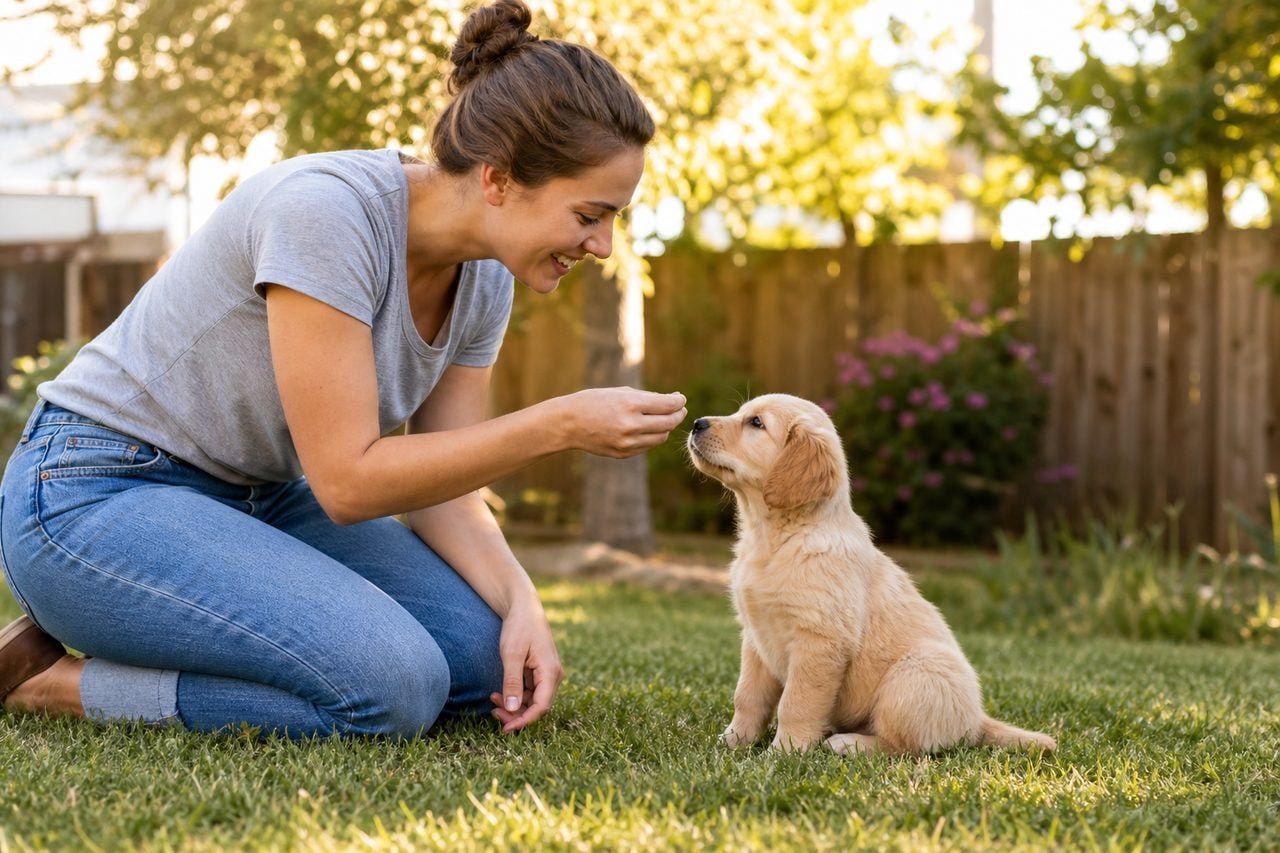
A puppy arriving in Richmond in February and a puppy arriving in June are two different training projects, and anyone who has raised one here through an east-central Indiana winter knows it. The window that matters most in a dog’s life is short, mostly measured in weeks rather than months, and it does not pause for weather, for a full class list, or for the fact that Wayne County has a handful of trainers rather than a page of them.
- The clock you are actually training against
- What to teach first, in the order that actually works
- Choosing a format: class, course, facility or in-home
- Raising a puppy through an east-central Indiana winter
- Vaccination, risk and the mistake that costs the most
- Adolescence: the part nobody warns you about
- A realistic first six months in Wayne County
- Reviewed trainers
- FAQ
That scarcity is the honest starting point for this page. Richmond has genuine local options for puppy work — a course-based obedience school in the city, a facility a few minutes west on the National Road, a nonprofit club running evening group classes, and one trainer who comes to the house — but it does not have twenty. Sessions fill. Waiting six weeks for a spot costs a puppy a meaningful slice of its best learning period. So this page is written the way a local would need it: what to teach in what order, what a Richmond owner can realistically book, and what to do at home in the meantime.
The clock you are actually training against
Puppy training is unusual among dog services because it is time-limited. Most of what a dog will ever believe about the world — whether strangers are safe, whether a rattling truck on Main Street is worth panicking about, whether being handled by a stranger in a vet coat is tolerable — gets laid down in a developmental window that opens at a few weeks old and closes around the four-month mark. After that you are not writing on a blank page any more; you are editing.
This matters for scheduling more than anything else. A puppy that comes home at eight weeks and starts structured work at nine or ten weeks gets the full benefit of that window. A puppy that waits until it is six months old because the class was full or the family was busy is still perfectly trainable, but the job has changed from shaping to counter-conditioning, and counter-conditioning is slower, harder and more expensive.
Local programs reflect this. One Richmond obedience school runs a puppy course with a hard age boundary: puppies start at a minimum of eight weeks and the course has to be completed by twenty weeks, which is an honest acknowledgement that the same material delivered later is a different course. The nonprofit club’s puppy class follows a similar shape, running in fixed multi-week sessions on a posted calendar.
The practical instruction is simple. Book before the puppy comes home if you can. If you cannot get a spot for a month, do not wait passively — start the home curriculum below on day one and treat the class as reinforcement rather than as the beginning.
What to teach first, in the order that actually works
New owners tend to start with sit, because sit is the thing everyone knows how to teach. Sit is fine, but it is nowhere near the top of the list of things that determine whether the next fourteen years are pleasant.
- House-training — a schedule, supervision and a confinement plan, not a punishment plan. The single biggest predictor of success is how often the puppy is taken out, not how firmly it is told off.
- Crate and settle — a puppy that can be alone and calm in a crate is a puppy that can be left, traveled with, and kept safe after surgery. Build it in tiny increments with the door open long before you ever shut it.
- Name and attention — the foundation under every other cue. If the puppy will look at you in a distracting place, everything else becomes teachable.
- Bite inhibition — puppy mouthing is normal, developmental, and worst between roughly twelve and eighteen weeks. It is managed with redirection, rest and rules about play, not with punishment of the mouth.
- Handling and body work — paws, ears, mouth, collar grabs, being lifted. Ten seconds a day now prevents a decade of wrestling at the vet.
- Recall as a game — never a summons to something unpleasant, never a word you burn by repeating it into an empty yard.
- Loose leash walking — started on quiet Wayne County streets before it is ever tested near traffic.
Sit, down and stay sit comfortably at the bottom of that list. They are easy and they are useful, but they are not what makes or breaks a puppy.
Choosing a format: class, course, facility or in-home
Richmond happens to offer all four shapes, which is unusual for a county this size, and the right one depends far more on your household than on the dog.
A multi-week group class is the cheapest structured option and the only one that puts your puppy in a room with other puppies under supervision. That controlled exposure is worth a great deal at this age. The trade-off is the calendar: sessions start on fixed dates, run for six or seven weeks, and can sell out.
A course ladder at a facility — a puppy course that feeds into basic obedience and then into advanced tiers — suits owners who want a plan for the next year rather than a single class. You are buying progression and a consistent instructor.
Private lessons or a consultation-led program give you a plan built around your specific puppy, which matters if it is unusually fearful, unusually bold, or living in a complicated household.
In-home training is the answer when the problems are house problems — toileting, crate distress, stealing off counters, chaos at the front door — because those behaviors are context-bound and often do not show up at a facility at all.
Most Richmond owners end up combining two: a group class for the social exposure, plus home coaching or a private session for whatever the class cannot address. Nothing about that is a failure of either format.
Raising a puppy through an east-central Indiana winter
A December or January puppy in Wayne County faces a genuine problem: the outdoor half of the curriculum is much harder to deliver. Short daylight, frozen ground, salted roads and weeks where nobody wants to stand outside at eleven at night waiting for a toilet break all conspire against the schedule.
Some of this is solvable with equipment and stubbornness. Pick one toilet spot near the door and keep it clear of snow so the puppy is not asked to relearn the surface every week. Wipe paws after salted pavement. Accept that a puppy will need more, shorter outings rather than fewer long ones.
The socialization half needs a different answer entirely. When you cannot manufacture exposure by walking, you import it: carry the puppy through a hardware store or a feed store where it is allowed, sit in the car with the window cracked in a busy parking lot and let the world go past, invite visitors of different ages and appearances into the house, play recordings of thunder and fireworks at low volume paired with food, and use novel surfaces indoors — a baking tray, a folded tarp, a wobbly cushion.
Indoor group classes become disproportionately valuable in winter for exactly this reason. If you have a winter puppy and the local evening class has a spot, take it even if the timing is inconvenient. The alternative is a puppy whose entire first impression of the world was formed in one warm living room.
Vaccination, risk and the mistake that costs the most
The most damaging advice a new puppy owner still receives is to keep the puppy home entirely until the vaccination course is finished, often at sixteen weeks or later. Follow it literally and the socialization window closes while the puppy is indoors.
The veterinary behavior consensus has been settled on this for years: the risk to a puppy’s long-term welfare from under-socialization is greater than the well-managed disease risk of careful early exposure. Behavior problems, not infectious disease, are the leading reason young dogs are surrendered.
Managed exposure is the compromise, and it is not complicated. Avoid places where unknown dogs of unknown vaccination status toilet — that means avoiding the ground at busy public parks and any dog park entirely. Carry a small puppy rather than walking it through a high-traffic area. Meet known, vaccinated, healthy adult dogs belonging to friends rather than strangers’ dogs at random. Choose a class that requires proof of first vaccinations and cleans its floor.
Talk it through with your own veterinarian, who knows what is circulating locally and can advise on where the real risk sits in Wayne County. What you should not do is interpret “wait” as “do nothing,” because those are not the same instruction and the second one has a cost that shows up two years later as a dog that cannot cope with visitors.
Adolescence: the part nobody warns you about
Around five to seven months something unwelcome happens. The puppy that came reliably when called starts pretending not to hear. The one that walked politely starts pulling. Owners commonly interpret this as the training having failed, or as the dog becoming stubborn, and it is neither.
Adolescence in dogs runs roughly from six months to somewhere between eighteen months and two years depending on size, and it involves genuine neurological reorganization alongside a sharp increase in interest in the wider world. Behaviors that were solid become unreliable. Fears that were absent can appear from nowhere in a second sensitive period. It is developmental, it is temporary, and it is when most rehoming happens.
The response that works is boring: go back a step rather than escalating. Shorten distances, raise the value of what you are paying with, use a long line so recall cannot be practiced as a failure, and keep the rules identical rather than negotiating them because the dog is having a hard week. Add structured physical and mental work, because an under-occupied adolescent invents its own job and you will not like it.
This is also the point where a second course, an adult obedience class, or a few private sessions earns its money. Local providers offering a progression from a puppy course into basic and then advanced obedience are built precisely around this arc.
A realistic first six months in Wayne County
Here is what a workable plan looks like for a family in Richmond, Centerville or one of the county towns, assuming an eight-week-old puppy.
Weeks one and two at home. Establish the toilet schedule and the crate. Begin name recognition, handling and mouthing management. Start the exposure list indoors and in the car. Book a class now, for whenever the next session starts.
Weeks three to eight. Structured exposure ramps up: different surfaces, sounds, people, vehicles, the sound of the world from a parked car on a busy road. First class if the calendar allows. Loose-leash work begins on quiet streets, not on Main Street.
Months three and four. Consolidate. Proof the basics in slightly harder places — a quiet corner of a park rather than the middle of it, an edge of the Cardinal Greenway when it is empty. The puppy course should be finishing around now if you started on time.
Months five and six. Adolescence arrives. Long line goes on for anything off-property. Expect regression and treat it as normal. This is the moment to book the next tier of training rather than to conclude the dog is broken.
Owners in Connersville, Liberty, Hagerstown or Fountain City should add drive time honestly into that plan. A twenty-five to thirty-five minute drive each way makes a weekly evening class a real commitment, and an in-home trainer who travels the county may be the more sustainable choice.
Reviewed Puppy Training Trainers in Richmond
These reviewed Richmond-area trainers from our directory are the local options for puppy training. Each links to a full profile with specialties, certified credentials, reviews, and contact info:
- Charlie’s Dog Obedience Training — 5.0★ (183 reviews)
- Peak Dog Training — 5.0★ (25 reviews)
- Dog Doz it Training — 4.5★ (2 reviews)
- Whitewater Valley Dog Training Club
- All Aboard Dog Training
See all Richmond puppy training trainers →
Frequently Asked Questions
How old should my puppy be before starting training in Richmond?
Training starts the day the puppy comes home, usually at eight weeks. Formal classes locally generally accept puppies from around eight to twelve weeks with proof of a first vaccination. One local course sets a firm boundary of starting at a minimum of eight weeks and finishing by twenty weeks, which reflects the developmental window rather than an arbitrary rule. If you are waiting for a class start date, do not wait to begin house-training, crate work, handling and name recognition at home.
Is there an actual puppy class in Richmond, or only private training?
Both exist. Richmond has a nonprofit training club that runs multi-week group classes in the evenings on a published seasonal schedule, including a puppy class that follows the AKC S.T.A.R. Puppy program. There are also facility-based puppy programs in Richmond and just west in Centerville, and one trainer who works in-home only. The constraint is timing rather than availability: group sessions start on fixed dates and popular ones sell out, so check the posted calendar early.
Can I take my puppy to Glen Miller Park before its shots are finished?
Be careful with the ground rather than with the outing. The risk in a busy public park is the soil and grass where unknown dogs have toileted, not the fresh air or the sight of people. Carrying a young puppy through, or sitting with it on a bench or in the car at the edge, gives you almost all of the socialization value with very little of the disease risk. Avoid dog parks entirely until the vaccination course is complete, and ask your own vet what is circulating locally.
How long does puppy training take, and is one course enough?
A typical local puppy course runs six to eight weekly sessions, so about two months. That is enough to install the foundations and teach the owner how to train, but it is not enough to produce a finished dog. Most families need a second block of work in adolescence, somewhere between six and twelve months, when reliability drops. Plan for training as two or three stages across the first eighteen months rather than a single course that solves everything.
My puppy bites constantly. Is something wrong with it?
Almost certainly not. Mouthing peaks between roughly twelve and eighteen weeks and is how puppies explore and play. It is worst when the puppy is overtired, which is most of the time in a busy household. The fix is management rather than correction: enforce naps in the crate, redirect onto an appropriate item every time, end play the moment teeth land on skin, and never use hands as toys. Punishing the mouth tends to make a puppy hand-shy without reducing the biting.
Will a trainer come out to Connersville, Hagerstown or Liberty for puppy work?
One local trainer works in-home only and covers Fayette, Wayne, Union and Franklin counties, which is the usual route for owners in the outlying towns. Availability is limited and mostly in the evenings, and a travel charge for longer round trips is normal in a rural county. Facility-based options in Richmond and Centerville generally expect you to drive in. Either way, book early, because in-home slots in a thin market are the first to go.
Related: read our complete puppy training guide or the full Richmond dog training overview.
Ready to find the right puppy training pro in Richmond?