
Dog Boot Camp in Clarksville, TN
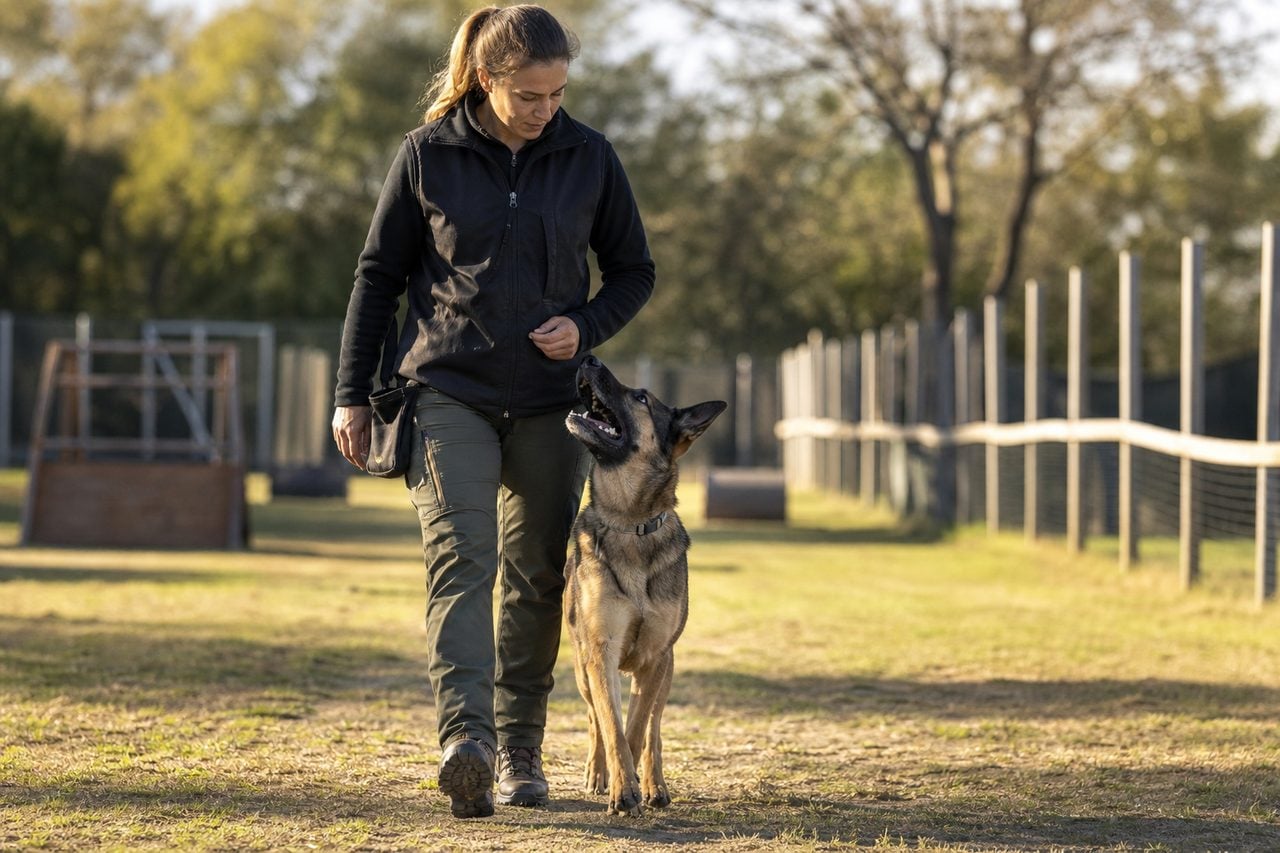
“Boot camp” is a term with unusual weight in Clarksville, and it is worth pulling apart before you spend money on one. In dog training it means an intensive residential program — the same thing sold elsewhere as board-and-train — and one local trainer describes their obedience program as “not only a training boot camp, but a super fun experience” with substantial playtime alongside the work. Nothing about it resembles the military sense of the phrase, and any program that leans on that association to sell severity is telling you something.
- Intensity is a mechanism, not a mood
- Which dogs it suits, and which it does not
- What three or four weeks actually buys you
- Day training: the version that sleeps at home
- Reading the marketing in a garrison town
- Cost, value and the cheaper route
- Questions to ask before you book an intensive program
- Reviewed trainers
- FAQ
What the phrase does usefully capture is intensity and immersion: a dog living in a training environment for weeks, with multiple short sessions a day, a predictable routine and no opportunity to rehearse old habits. That works, and it works for a specific kind of dog and a specific kind of household.
This page is about deciding whether the intensive route is the right one for you, what a fortnight or a month of it actually changes, what the local versions include, and how to read the marketing around a phrase that in this town carries more freight than it should.
Intensity is a mechanism, not a mood
The reason an immersive program outperforms weekly lessons is arithmetic, not severity. A dog in a residential program gets several structured sessions a day, seven days a week, with consistent criteria and immediate feedback. Over three weeks that is somewhere north of sixty sessions. A weekly class over the same period delivers three, plus whatever homework actually gets done in a busy household — and homework is exactly what stops happening when one adult is in the field.
The second mechanism is the absence of rehearsal. Habits are maintained by practice, including the bad ones. A dog that has spent a year successfully pulling toward every other dog it sees has practiced that thousands of times. In an immersive program it simply does not get to do it, and the new pattern is laid down without competition.
The third is consistency of criteria. Households are inconsistent by nature — one person allows the sofa, another does not; one enforces the wait at the door when running late, the other does not. A single trainer applying one standard for three weeks removes the ambiguity that is often the actual problem.
None of that requires harshness, and the local programs that publish the most detail also publish the most play, rest and enrichment. Intensity means frequency and consistency. If a program’s selling point is how tough it is rather than how often it trains, be careful.
Which dogs it suits, and which it does not
Good candidates are, in the local programs’ own framing, dogs from about six months up whose issue is that they have never been taught, or that what they were taught never held under distraction. Adolescent dogs that have stopped listening, dogs that pull, bolt, jump, counter-surf, ignore recall, or cannot settle. Working and high-drive breeds that are under-employed rather than badly behaved do particularly well, because the program gives them a job at last.
Poor candidates fall into three groups. Very young puppies need socialization more than they need drilling — local puppy residentials exist and are explicitly framed as foundation and exposure rather than boot camp, which is the right framing. Dogs whose problem is fear generally need slow, careful counter-conditioning at manageable distances rather than immersion, and forcing exposure on a frightened dog is how a shy dog becomes a growling one. And dogs whose problem exists only in your household — the panic when the front door closes, the guarding of one specific chair — will look perfect at the trainer’s and unchanged at home.
One local trainer publishes an explicit exclusion: no residential program for aggressive behavior, with an offer to refer elsewhere. Others publish aggression tracks with a six-to-eight week minimum. Both are honest positions, and they tell you the same thing — aggression is not a boot-camp problem, it is a longer and more specialized one.
What three or four weeks actually buys you
The published local curricula are specific enough to set expectations against. A short program guarantees a foundation: sit and extended sit, place and extended place, an on-lead heel, and recall in multiple distractions and environments, plus greeting, door and meal manners. A longer one adds down and extended down, distance work, off-lead heel, and handling multiple distractions in multiple environments. A local four-to-five week obedience program adds structured monitored playgroups and outings for real-life practice.
What you will not get, from any length, is a finished dog that never needs anything again. Training decays without maintenance, adolescence undoes things temporarily, and a new environment always costs some reliability — which matters in a town where a third of households will move within two years.
Be realistic about what “guaranteed” means too. Local programs guarantee a specific command list, sometimes with an off-lead recall guarantee attached, and back it with refresher provision — one publishes lifetime free refreshers. A guarantee is about the dog’s demonstrated behavior at handover, not a promise that your household will maintain it. The refresher policy is the more useful half of that offer.
Day training: the version that sleeps at home
Clarksville has a middle option that is genuinely underused and rarely explained: day training. The dog is dropped off in the morning — local drop-off windows published as roughly seven to nine, collection between three and six — trains through the day with the professional, and sleeps at home.
You keep most of the intensity mechanism. One local program publishes up to four individual training sessions a day, on whatever behaviors you have specified, including outing days where the new behaviors are practiced in different environments, and a short lesson for the owner at pick-up so the work continues at home. Optional transport is published at about $100 a week.
The published local pricing is $1,000 for two weeks, $1,500 for three and $2,000 for four — roughly half the residential rate for the same calendar length, because you are not buying board.
It suits three situations especially well. Households that cannot bear to send the dog away for weeks. Dogs that would find a strange house stressful enough to slow the learning. And — importantly here — households where the problem behavior happens in the evening at home, because you get daily coaching and daily practice in the environment that actually matters. The trade-off is that it needs your daily involvement at both ends, which is exactly what a deployment window removes.
Reading the marketing in a garrison town
Clarksville’s dog-training marketing leans heavily on military credibility, and it is not fake — this county genuinely has trainers with military working-dog and law-enforcement backgrounds, and one local business is led by a Marine Corps veteran who handled multi-purpose canines. That experience is real and relevant, particularly for high-drive dogs.
But it is worth separating three things that get blurred in copy. A trainer’s service history tells you about their background, not their method. Military-style vocabulary — boot camp, transformation, guaranteed obedience — is marketing language chosen for this audience. And what actually happens to your dog is a question about method, equipment and criteria that you have to ask directly.
The questions that cut through it are unglamorous. What happens when the dog gets something wrong? What equipment goes on, when, and when does it come off? How is a remote collar conditioned, over what period, and at what levels? How many dogs will be in the household or facility at once? And can I see the dog mid-program, or get video?
Local programs publish weekly owner visits, photo and video updates on request, and in one case a private client group for troubleshooting. Those are the marks of an operation confident about what happens day to day. A trainer who will not have you visit at all, in a market where most dogs are trained in someone’s home, is worth a second thought.
Cost, value and the cheaper route
Intensive programs here run from about $1,500 for one week to $4,500 for five, with an expedited tier at $3,500 and a published local ceiling of $5,800. Day training is roughly $1,000 to $2,000 for the same calendar spans. Private lessons are published locally at about $30 for a half hour and $60 for an hour.
Set against that: the cheapest genuinely effective route for a household with time is private lessons plus consistent homework, and it is a fraction of the cost. Six one-hour lessons at local rates is a few hundred dollars. If you will do the work, do that.
The intensive route is worth its premium in three cases. When there is no time — a deployment, a rotation, shift work, a new baby. When the dog’s habits are entrenched enough that the daily rehearsal has to be stopped rather than out-trained. And when the household is inconsistent enough that a single professional standard for three weeks is the only way to break the ambiguity.
One local price note worth knowing: at least one operator publishes a twenty per cent discount for a second dog enrolled together, and at least one publishes that programs are non-refundable with early collection transferable to other services. Multi-dog households and anyone with an uncertain calendar should ask about both before booking.
Questions to ask before you book an intensive program
Ten minutes on the phone with this list will separate the local options faster than any amount of reading.
What is the daily routine? How many sessions, how long, how much rest, how much play, and does the dog leave the property to train?
Who trains my dog? The named trainer or an assistant? One local business sells an expedited tier specifically on the basis that the head trainer does the work — which implies the standard tier sometimes does not.
How many dogs are there? A home program with two is a different product from a facility with fifteen.
What is included at the end? Handover length, number and expiry of follow-up lessons, refresher policy, equipment.
What is your policy on aggression? Even if your dog has none, the answer tells you whether the trainer knows the limits of the format.
What if it is not working? A trainer who has a plan for the dog that does not respond by week two is a trainer who has met that dog before.
What is the wait, and the refund policy? Both are published locally, and both have caught people out.
Dog Boot Camp in Clarksville: Local Options & Nearest Specialists
Right now there are no listed Clarksville trainers focused specifically on dog boot camp. Many general Clarksville dog trainers can help you get started, and the nearest specialists for this focus are below.
Nearest dog boot camp specialists — Nashville
For complex cases, some families travel to the larger pool of specialists in the Nashville area for an assessment or a board-and-train stay. Top-reviewed options:
- Suburban K9 Dog Training — 5.0★ (77 reviews)
See all Nashville dog boot camp trainers →
Frequently Asked Questions
Is a dog boot camp the same as board-and-train?
Yes — the two names describe the same product, an intensive residential program, and local businesses use both. One Clarksville trainer describes their obedience residential as a training boot camp while also emphasizing playtime and playgroups, which is a fair description of what these programs actually are: frequent, consistent training with structured rest, not severity.
How long does a dog boot camp take?
Local programs run from one week to five. One week builds a foundation and recall for a dog with no behavioral issues; two to three weeks covers a full obedience list; four to five adds off-lead reliability, distance work and real-world outings. Aggression tracks in this county start at a six-to-eight week minimum, which is a different product.
Is it harsh?
It should not be, and intensity in this context means frequency and consistency rather than force. Clarksville has both balanced trainers who use remote collars and force-free trainers who do not, and both run intensive formats. Ask what happens when the dog gets it wrong, what equipment is used and how it is conditioned — those answers describe the experience far better than the program’s name.
What is day training, and is it cheaper?
The dog is dropped off in the morning, trains through the day with the professional, and sleeps at home. Locally it is published at $1,000 for two weeks, $1,500 for three and $2,000 for four — roughly half the residential rate for the same span, with optional transport at about $100 a week. It keeps most of the intensity and needs your daily involvement at drop-off and pick-up.
Can I visit my dog during the program?
In this county, usually yes, and one local program asks owners to come out weekly to see progress and learn how to maintain the training. Photo and video updates on request are common. Given that most of these programs run out of a trainer’s own home here, a business that will not let you visit at all deserves a follow-up question.
Will the training last after a PCS move?
Partly, and it is a fair concern in this town. Trained behaviors travel; reliability is environment-specific and always costs something in a new setting. Tell the trainer a move is coming — a program built with generalization in mind, practiced in several environments rather than one property, holds up considerably better on the other end.
Related: read our complete dog boot camp guide or the full Clarksville dog training overview.
Ready to find the right dog boot camp pro in Clarksville?