
In-Home Dog Training in Hudson, Columbia & Greene Counties, NY
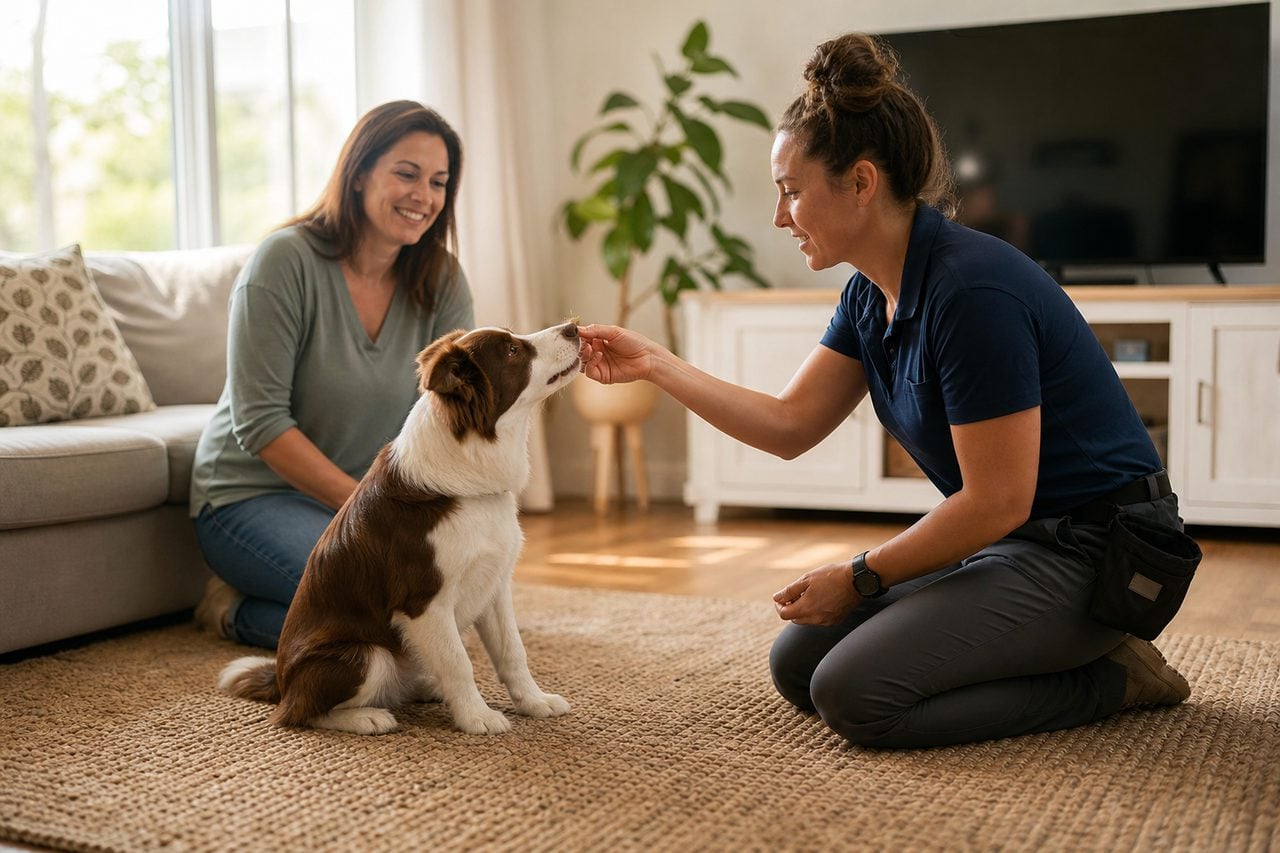
Nine of the twenty trainers we have verified across Columbia and Greene Counties offer one-to-one work, and five of them are built entirely around driving to you. That proportion is far higher than you would find in a city, and it is not a coincidence or a fashion. It is what a training market looks like when the customers are spread across nine hundred square miles of hill country with one bridge in the middle and no public transport.
In-home training is also the format that fits the problems people here actually have. The behaviors that ruin daily life – barking at the window at every passing truck, losing control when the delivery van comes up the drive, guarding a spot on the sofa, a newly adopted dog that has not settled, a dog that cannot be left – all happen at home. A facility is a poor place to work on a problem that only exists in your kitchen.
This page covers the five in-home models available here, what they cost including the travel terms each practice publishes, which problems they suit, and how to make the most of the hour once somebody is standing in your hallway.
Five models, and they are genuinely different
The classic private lesson. The trainer comes, works with you and the dog for an hour, and leaves you homework. You are the one being taught. This is the backbone of the local in-home market and the format most of the nine offer.
Coaching the owner, explicitly. One Hudson-area practice separates this out as its own service and describes it plainly: we coach you to train your own dog. The distinction matters because the deliverable is your skill, not the dog’s performance in that hour.
In-home day training. The trainer comes while you are at work, trains the dog without you, and transfers the skills afterwards. Two local practices publish a twice-weekly version of this. One local practice calls its version Home Schooling and describes teaching the dog the target behaviors – basic manners, polite greetings – and then transferring them to the owner. It is the format for the household where nobody is free at six in the evening, which in a county where a lot of people commute to Albany or Poughkeepsie is a large share of households.
Day training combined with coaching. A behavior consulting practice working across the area runs a combination program: several sessions a week with just the dog, then regular coaching sessions with owner and dog together so both stay level. Its stated reason is that some owners benefit from the dog getting a head start before they join in.
Walk and train. The most distinctive local product. A Hillsdale-based practice collects the dog from the house, runs the training walk without the owner present, and afterwards sends a video clip of the dog’s progress plus a short written note on exactly what was worked on so the household can maintain it. It is pitched squarely at people with no spare daylight hours, and for a dog whose main problem is that the house is empty between eight and six, it is a better answer than a Saturday class.
The travel terms, published
This is the question that decides whether an in-home trainer is available to you at all, and the local practices are unusually clear about it.
One Hillsdale-based practice works a ten-mile radius as its standard service area and charges a minor per-mile fee beyond it, to cover time and vehicle wear. A Palenville behavior practice publishes its travel towns by name: Hudson, Rhinebeck, Germantown, Kingston, Catskill, Saugerties, Woodstock, Cairo, Athens and Coxsackie, plus what it calls all the little towns in between. A Germantown practice publishes its service area as Germantown and Red Hook – one town on each bank, a short crossing rather than a long drive. A Columbia County practice publishes the county itself as its area.
Read those together and a map appears. The river corridor from Coxsackie down to Germantown and across to Rhinebeck is well covered. The Route 9H spine is well covered. The Hillsdale and Copake corner is covered. What is thin is western Greene – Windham, Hunter, Tannersville, Maplecrest, Cairo – where only the Palenville practice names towns nearby, and the eastern edge around Canaan and New Lebanon, where the nearest facility is a day camp rather than an in-home practice.
If you are in a thin area, ask about travel on the first call. Most of these are one-person businesses; a trainer may well come further than their published radius for a good reason, and may equally be honest that the drive does not work.
What in-home training is best at
There is a clean rule for choosing between in-home and facility work, and it is about where the behavior lives.
Problems that only exist at home. Barking at the window, charging the door, guarding furniture or a person, stealing from counters, refusing to settle, house soiling, conflict between two dogs in the same household. These need to be worked where they happen, with your furniture, your doorway and your routine. One local practice’s published list for private training is exactly this shape: building confidence in shy and fearful dogs, creating calm behavior, jumpy and mouthy dogs, multi-dog household management, crate training, greeting behavior, excessive barking and destructive chewing.
The newly adopted dog. This is a local specialty. One practice runs a program built entirely around the adjustment period, on the argument that expectations about how quickly a rescue settles are usually unrealistic, that it can take three months or considerably longer, and that the frustration in the meantime is what sends dogs back to the shelter, rescue or breeder. Another names the behavior and transition problems of shelter and rescue dogs as its published specialty, and has done that work here since 1972.
Households that cannot get out. Elderly owners, a dog that cannot travel, a household with young children, a work pattern that rules out evening classes, or simply a sixty-mile round trip to the nearest class.
Puppies in the first weeks. Before a puppy can safely join a class, in-home work gets the handling, crate and potty foundations in during the window when they go in fastest.
What in-home work is worse at is distraction. A dog that is perfect in its own living room and unmanageable on Warren Street has learned the living room. Every good local in-home trainer knows this and will move the work outward – to the yard, the driveway, the road, the village – which is why the Coxsackie facility’s clients describe sessions in the home, the backyard, the front yard and on neighborhood walks in sequence.
Credentials, and what the local ones mean
The in-home lane in these counties carries a disproportionate share of the metro’s checkable credentials, which is worth knowing because in-home training has no facility to judge by.
CPDT-KA – Certified Professional Dog Trainer, Knowledge Assessed – is held by two local in-home practices. It requires documented hands-on training hours, a proctored examination and continuing education to maintain.
A CCPDT certified dog behavior consultant credential is held by a behavior practice working across the area, which is a higher-tier certification aimed at behavior cases rather than manners.
Karen Pryor Academy credentials appear twice: a Dog Trainer Professional certificate at a Hudson in-home practice and a Certified Training Partner at a Hillsdale practice.
A Certified Family Dog Mediator credential is held by the Columbia County practice.
None of these guarantees you will like the trainer, and the absence of one does not mean someone is bad – the longest-running practice in the metro predates most of these programs by decades. What a credential does tell you is that somebody submitted their work to an outside standard. In a market where anybody can print a business card, that is worth something, and one local trainer says so directly on her own home page: dog training is a completely unregulated industry, so ask what certifications a trainer holds and who issued them.
What it costs here
The in-home lane is the best-documented part of this market for prices, because several practices publish them in full.
Elsewhere in the metro, a seventy-five minute initial consultation and strategy session is the published entry point at one practice, a free consultation is the entry point at another, and a free meet-and-greet evaluation precedes the structured programs at a third.
Two things are worth noticing in those numbers. Second, the package pricing means the marginal session gets cheaper, so if you already know you have several weeks of work ahead, ask about the package rather than paying session by session.
Getting the most out of a home visit
Do not tidy the problem away. If your dog goes berserk when the postal van comes at eleven, book for eleven. The trainer needs to see the behavior, not a description of it.
Have everyone there. Dog training in a household fails at the weakest link, and the weakest link is usually the person who was at work during the session. Local trainers routinely work with the whole family; one published account describes a session run with a client’s son who has autism so that he could give the dog simple commands safely.
Write down what you actually want. Not better behaved – be specific. I want to be able to open the front door without holding the dog’s collar. I want to eat a meal without the dog’s head on the table. Specific goals produce specific plans.
Do the homework in short pieces. Five minutes, three times a day, beats one long session at the weekend. This is the single biggest difference between households that see change and households that do not.
Move the work outside once it holds. Yard, driveway, road, village. A behavior that only exists in the living room is not finished.
Ask about the follow-up before you book. Package pricing, phone coaching and written notes all exist locally. A practice that gives you a video and a written summary after every session, as the walk-and-train service does, is handing you the maintenance plan as well as the training.
In-Home Dog Training in Hudson, Columbia & Greene Counties: Local Options & Nearest Specialists
Local Hudson, Columbia & Greene Counties-area options for in-home dog training:
- Dogs Country Hudson — 5.0★ (2 reviews)
- Pro Canine Coaching & Pet Care Services — 5.0★ (1 review)
Nearest in-home dog training specialists — Kingston
For complex cases, some families travel to the larger pool of specialists in the Kingston area for an assessment or a board-and-train stay. Top-reviewed options:
- Hudson Valley Hounds — 5.0★ (17 reviews)
- New Moon Pet Training — 5.0★ (9 reviews)
- All About Dogs
See all Kingston in-home dog training trainers →
Frequently Asked Questions
How many trainers in Columbia and Greene Counties will come to my house?
Nine of the twenty we have verified offer one-to-one work, and five are built entirely around traveling to the client. That proportion is much higher than in a typical suburban market, and it exists because these are two rural counties spread across a lot of ground with no public transport.
What does an in-home session cost?
One practice’s entry point is a seventy-five minute consultation and strategy session; two others start with a free consultation or a free meet-and-greet.
Will a trainer drive out to the mountain towns?
Some will, but ask first. Western Greene County – Windham, Hunter, Tannersville, Maplecrest – is the thinnest part of the metro for in-home coverage.
What is day training and who offers it here?
The trainer works your dog without you present, then transfers the skills in a coaching session. Locally it runs as twice-weekly in-home sessions while the household is at work – one practice calls its version Home Schooling – and as a combined program where the dog gets several solo sessions a week plus regular coaching with the owner. It suits households where nobody is free in the evening.
What is walk and train?
A Hillsdale-based practice collects the dog from the house, runs the training walk without the owner present, and afterwards sends a video clip of the dog’s progress and a short written note on what was worked on so the household can maintain it. The owner does not need to be home. For a dog whose real problem is an empty house between eight and six, it does more than a weekend class.
Is in-home training as good as a class?
For different things. In-home is better for anything that only happens at home – barking at the window, charging the door, guarding furniture, a rescue that has not settled, conflict between two household dogs. A class is better for anything that has to survive distraction, because a class supplies other dogs, which you cannot manufacture at home. Many local trainers do both, and for a lot of dogs the honest answer is a mix.
I have just adopted a rescue and it is not settling. Is in-home the right choice?
Usually yes, and this metro is well set up for it. One local practice runs a program built entirely around the adjustment period, arguing that expectations about how fast a dog settles are normally wrong and that the resulting frustration is what sends dogs back. Another names the behavior and transition problems of shelter and rescue dogs as its specialty and has done that work here since 1972.
What credentials do the local in-home trainers hold?
More than the facility lane, as it happens. Two hold CPDT-KA. One is a CCPDT certified dog behavior consultant. Two hold Karen Pryor Academy credentials – a Dog Trainer Professional certificate and a Certified Training Partner. One is a certified Family Dog Mediator. None of that guarantees a good fit, but it does mean somebody submitted their work to an outside standard, which in an unregulated industry is worth asking about.
Related: read our complete in-home dog training guide or the full Hudson, Columbia & Greene Counties dog training overview.
Ready to find the right in-home dog training pro in Hudson, Columbia & Greene Counties?
Find in-home dog training in Hudson, Columbia & Greene Counties →