
Board & Train in New Albany, IN
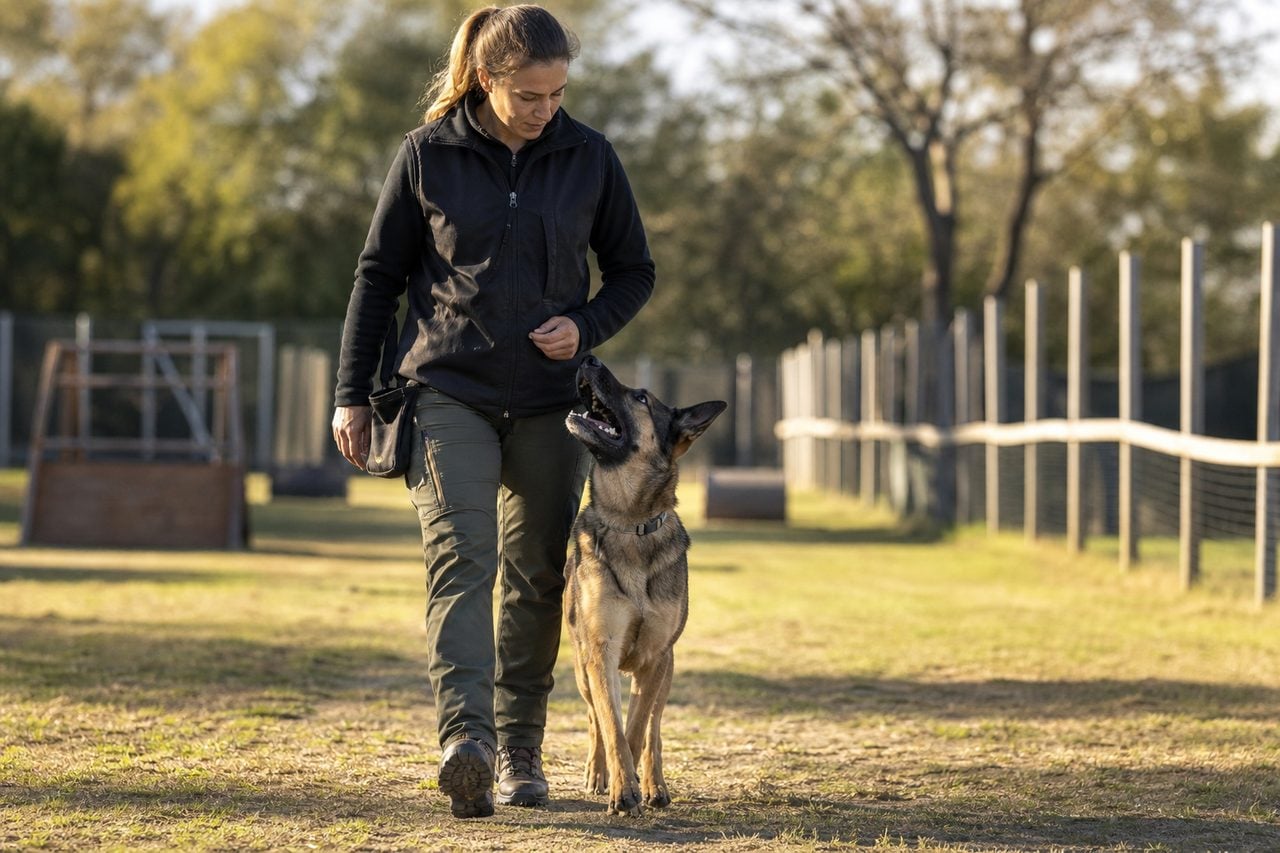
Board-and-train programs send a dog to live with a trainer for a set stretch of time — often two to four weeks — so the animal can be worked every single day in a controlled setting. For busy families across the New Albany area, from Floyds Knobs and Georgetown out to Sellersburg, Charlestown, and Clarksville, this format solves a real problem: consistency. A dog that gets one lesson a week and inconsistent follow-through at home learns slowly, while a dog handled by a professional multiple times a day builds habits quickly.
- What a Board-and-Train Program Actually Is
- Who Board-and-Train Suits in the New Albany Area
- What to Expect Week by Week
- Vetting a Facility: Kentuckiana Specifics
- The Handoff: Why Go-Home Lessons Decide Everything
- Costs, Contracts, and Questions to Ask
- Keeping the Results: Local Places to Proof and Practice
- Reviewed trainers
- FAQ
The catch is that board-and-train is not a drop-off-and-forget service, no matter how it is marketed. The dog comes home to the same people, the same yard near the Ohio River, and the same daily routine that shaped its behavior in the first place. Whether the results hold depends almost entirely on the handoff — the go-home lessons where the owner learns to run the same commands and rules the trainer used.
This guide explains what a board-and-train program in the Kentuckiana region actually involves, who it suits, how to vet a facility responsibly, and what questions separate a professional operation from one to avoid.
What a Board-and-Train Program Actually Is
In a board-and-train, the dog boards at the trainer’s facility or home and receives structured training sessions throughout the day. The appeal is intensity and repetition: rather than a single weekly class, the dog practices skills in short, frequent bursts, which is how dogs learn best. A good program layers obedience into daily life — the dog earns meals, freedom, and play by responding to cues, so training is not a separate event but a way of living.
Programs vary widely in scope. Some focus purely on foundation obedience: sit, down, place, recall, loose-leash walking, and polite greetings. Others tackle specific problem behaviors such as jumping, counter-surfing, door-dashing, leash reactivity, or crate anxiety. A smaller number take on serious cases, but genuine aggression or deep-rooted anxiety usually belongs with a behavior specialist rather than a general board-and-train — a distinction covered in more detail on the behaviorist side of this directory.
It helps to think of a board-and-train as buying two things at once: the trainer’s time and the trainer’s environment. At home, a young dog practices the wrong behavior dozens of times a day — every ignored recall, every successful counter-raid, every reinforced leash-lunge deepens the habit. In a structured facility, those opportunities to rehearse mistakes are removed, and the dog is instead set up to practice the right choice again and again. That combination of prevention and repetition is what compresses weeks of ordinary progress into days, and it is the real mechanism behind the format rather than any single trick or tool.
Length matters. A two-week program can install reliable basics on a stable, food-motivated dog. Three to four weeks gives more time for proofing — practicing commands with distractions and in new places — which is where lasting reliability comes from. Be skeptical of any promise that a weekend fixes a long-standing habit; behavior that took months to form does not unwind in forty-eight hours. It also helps to be clear about what a board-and-train is not: it is not a boarding vacation with a little training sprinkled in, and it is not a permanent substitute for the everyday leadership every dog needs. It is a jump-start — a way to install a clean foundation efficiently so you are handed a dog that already understands the rules, leaving you the far easier job of maintaining habits rather than building them from nothing.
Who Board-and-Train Suits in the New Albany Area
Board-and-train is a strong fit for households that are short on time but committed to follow-through. A family in New Albany or Jeffersonville juggling work schedules, kids, and a young dog that is spiraling into bad habits often benefits from a professional resetting the foundation, then handing back a dog that already knows the rules.
It also suits specific situations well:
- Adolescent dogs — the six-to-eighteen-month window when puppies test boundaries and pull hardest on the leash.
- Newly adopted or rescue dogs with unknown histories that need structure and confidence-building.
- Large or powerful breeds where pulling and jumping become safety issues before they become manners issues.
- Owners recovering from injury or illness who cannot physically manage a strong, untrained dog during the early learning phase.
It is a weaker fit for a few cases. Very young puppies are usually better served by staying home during their critical socialization window and attending puppy classes, since bonding and gentle exposure matter more than formal obedience at that age. Dogs with serious separation distress may find kennel life stressful, and owners who are unwilling or unable to do the go-home homework will see results fade regardless of how good the program was. Honesty about your own follow-through is the single most useful thing you can bring to the decision.
There is also a middle path worth knowing about. Some households in the New Albany and Jeffersonville area do not need a full residential program — they need a focused reset on one or two specific problems, delivered through a shorter stay or a day-training arrangement. A trainer worth hiring will listen to your actual situation and recommend the smallest intervention that solves it, rather than upselling every inquiry into the longest possible package. If your dog is fundamentally good but pulls hard on walks and ignores recall, you may not need three weeks in a kennel; if your dog is a chaotic adolescent with a stack of ingrained habits, the full immersion may genuinely be the fastest route. The right answer depends on the dog in front of you, not on a one-size-fits-all sales script.
What to Expect Week by Week
While every trainer runs a different curriculum, most residential programs follow a recognizable arc. Knowing it helps you judge whether a facility has a real plan or is improvising.
Days one to three: settling and assessment
The dog decompresses, learns the facility routine, and is assessed for temperament, food and toy motivation, stress signals, and existing knowledge. Reputable trainers spend this window building rapport before demanding much, because a stressed dog does not learn.
The first week: foundation
Core cues go in — marker training (a clear yes signal), name response, sit, down, place, and the beginnings of recall and leash manners. Sessions are short and frequent, and the dog starts earning daily privileges through cooperation.
The middle stretch: fluency and duration
Commands become reliable at home base, then get longer and steadier. Place and stay durations grow, recall sharpens, and the dog learns to hold behavior even when it would rather do something else.
The final stretch: proofing
This is where a serious program earns its fee. The dog practices in new environments and around distractions — other dogs, people, traffic noise, food on the ground. Around New Albany that might mean quiet corners of Sam Peden Community Park, walking paths near the Ohio River Greenway, or busy sidewalks downtown. Ask whether and where the trainer proofs; a dog that only performs in a quiet kennel has not truly learned.
Understanding this arc protects you from two common disappointments. The first is expecting a polished, distraction-proof dog after only a few days — early gains look impressive but stay fragile until proofing locks them in. The second is assuming progress will be perfectly linear; dogs, like people, have off days, and a good trainer reads plateaus and small regressions as normal parts of learning rather than failures. When you get updates during the stay, look for a trainer who is candid about where the dog is easy and where it is still a work in progress. That honesty is more valuable than a stream of flawless highlight clips, because it tells you exactly what to keep reinforcing once the dog is back under your roof.
Vetting a Facility: Kentuckiana Specifics
Because a board-and-train involves handing over your dog and your money for weeks at a time, due diligence matters more than with a weekly class. Visit before you commit. A trainer who welcomes a tour of the kennels, training areas, and turnout space is showing you they have nothing to hide; one who refuses any in-person look is a red flag.
When you visit, look for and ask about:
- Clean, secure, climate-controlled housing. Southern Indiana swings from humid summers to cold, damp winters — kennels must handle both.
- Where the dogs actually sleep and spend downtime, not just the training room shown to visitors.
- Vaccination and health requirements for all boarding dogs, which protect your animal from illness in a shared space.
- Staff-to-dog ratio and who handles the dog when the lead trainer is off.
- The training methods used, explained in plain language, including any tools and why they are chosen.
- Progress updates — photos, videos, or written notes during the stay so you are not left wondering.
Ask for references or to see video of dogs the trainer has finished, ideally with before-and-after footage. Read the contract carefully for what happens if your dog gets sick or injured, and what the policy is if the program does not deliver what was promised. A confident professional puts these terms in writing.
Pay attention to how the trainer talks during the visit, not just to the facilities. A professional worth trusting asks you as many questions as you ask them — about your dog’s history, your household, your goals, and what has already been tried. That curiosity signals they intend to tailor the program rather than run every dog through the same template. Be wary of anyone who quotes a price and a timeline before they have even met your dog, or who guarantees a specific outcome sight unseen. The New Albany, Clarksville, and Sellersburg area has enough training options that you can afford to be selective; a trainer who earns your confidence in person is worth more than one with the flashiest website, and the extra hour spent touring and asking questions up front routinely saves weeks of regret later.
The Handoff: Why Go-Home Lessons Decide Everything
The most common reason board-and-train results fade is a weak transfer. The dog learned to respond to the trainer’s timing, body language, and rules — but the owner has to become the person the dog listens to. That skill transfer happens in the go-home lessons, and it is not optional.
A quality program includes one or more handoff sessions where you learn to give the same commands, mark and reward the same way, use any tools correctly, and enforce the same house rules. Expect to feel clumsy at first; you are learning mechanics the trainer has practiced for years. Good trainers coach you until the dog responds to you, not just to them.
Ask what happens after the dog comes home. The best operations offer follow-up sessions, a check-in schedule, or a support window for questions once real life resumes — the moment the dog encounters your kids, your doorbell, your neighbor’s dog on the walk. The first two weeks at home are when habits either stick or slide, so having a professional reachable during that window is worth a great deal.
Set your household up to succeed by agreeing in advance that everyone will use the same cues and hold the same standards. A dog that is asked to stay off the couch by one person and invited up by another will simply learn that the rule is negotiable.
A useful way to frame the handoff is that the trainer spent the program teaching your dog a new language, and the go-home lessons teach you to speak it. Small details carry enormous weight here — the exact word you use, whether you repeat a command or say it once, how quickly you mark and reward, and whether you follow through when the dog hesitates. Many owners unknowingly erode good training in the first week simply by nagging cues, rewarding late, or letting the dog ignore a command with no consequence. Recording your go-home sessions on your phone, so you can rewatch the trainer’s timing, is a simple habit that pays off. If something stops working once you are home, resist the urge to invent a new approach; contact the trainer and get back to the method the dog already knows.
Costs, Contracts, and Questions to Ask
Board-and-train is one of the more expensive training formats because you are paying for lodging, daily care, and intensive professional time over several weeks. Prices in the New Albany and greater Louisville-metro market vary with program length, the trainer’s experience, and how specialized the work is, so gather quotes and compare what each includes rather than shopping on headline price alone. A cheaper program with no go-home lessons and no follow-up can cost more in the long run than a pricier one that actually transfers to you.
Bring these questions to any consultation:
- What specific behaviors or commands will my dog reliably know at the end?
- What exactly is included — boarding, all sessions, go-home lessons, and any follow-up?
- What methods and tools do you use, and how will you teach me to use them?
- How often will I get updates, and can I visit during the stay?
- What is your vaccination and health policy, and what happens if my dog gets sick?
- Can I speak with recent clients or see video of finished dogs?
- What is your guarantee or support policy if results do not hold?
Be wary of guarantees that sound absolute. Living creatures are not appliances, and no ethical trainer promises perfect behavior forever regardless of what the owner does. A realistic promise sounds more like reliable skills plus the coaching and support to maintain them.
It is also worth thinking about the value equation beyond the sticker price. A board-and-train that genuinely resolves daily chaos — a dog that now walks politely, settles when guests arrive, and comes when called near a busy road — pays for itself in reduced stress, fewer damaged belongings, and a safer household. Conversely, the cheapest option is rarely a bargain if it delivers a dog that reverts within a month. When comparing quotes across the Kentuckiana market, line up exactly what each includes, ask what happens if you need extra support after the program, and weigh the trainer’s track record and communication as heavily as the number. The goal is not to spend the least; it is to buy the outcome that actually lasts.
Keeping the Results: Local Places to Proof and Practice
A finished dog is a starting point, not a finish line. Skills fade without practice, so the smartest thing an owner can do after a board-and-train is keep working the dog in progressively harder settings. The New Albany area offers plenty of graduated difficulty.
Start easy and build up:
- Sam Peden Community Park and quiet neighborhood streets for low-distraction reps early on.
- The Ohio River Greenway for practicing loose-leash walking, recall on a long line where permitted, and calm passing of cyclists and other walkers.
- Falls of the Ohio State Park in Clarksville and Charlestown State Park for varied terrain, wildlife scents, and steadier duration work.
- Deam Lake and Clark State Forest for confident, well-proofed dogs that can handle open, stimulating environments.
- Outdoor shopping areas and pet-friendly patios for real-world manners around people and food.
Always follow the local ordinances that apply across the New Albany area; Indiana has no statewide leash law, so rules are set locally and by each park, and many public spaces require dogs to be leashed. Keep sessions short and upbeat, reward generously early on, and gradually raise the difficulty. A dog that keeps practicing stays reliable; a dog that never trains again slowly forgets. The board-and-train buys you a trained dog — your habits keep it that way.
Build practice into the routine you already have rather than treating it as a separate chore. Ask for a sit before meals, a place command while dinner cooks, a brief stay before the door opens on a walk, and a recall in the backyard before coming inside. These woven-in reps cost no extra time and keep the training current every day. Seasonal factors matter too: southern Indiana summers get hot and humid, so work the dog in the cooler morning or evening hours and watch for overheating, while winter footing along the river paths can be icy. Adjusting for weather keeps sessions safe and positive, which is exactly what keeps a dog eager to keep working with you.
Reviewed Board & Train Trainers in New Albany
These reviewed New Albany-area trainers from our directory handle board & train. Each links to a full profile with specialties, certified credentials, reviews, and contact info:
- Always Faithful Dog & Puppy Training Louisville KY — 4.9★ (40 reviews)
- Duffy’s Dog Training Center — 4.6★ (252 reviews)
- SeerK9
See all New Albany board & train trainers →
Frequently Asked Questions
How long should a board-and-train program last?
Most programs run two to four weeks. Two weeks can install solid basics on a stable, motivated dog, while three to four weeks allows more proofing with distractions and in new locations, which is what makes obedience reliable in real life. Be cautious of promises that a weekend can undo long-standing habits.
Will my dog forget everything once it comes home?
Not if the handoff is done well. The most common reason results fade is a weak transfer, where the dog learned to respond to the trainer but the owner never learned to run the same commands and rules. Prioritize programs that include go-home lessons and follow-up support, and commit to practicing consistently.
Is board-and-train safe for my dog?
It can be, at a reputable facility. Visit in person, confirm clean and secure climate-controlled housing suited to southern Indiana weather, check vaccination and health requirements, ask about staff-to-dog ratios, and read the contract for what happens if your dog becomes sick or injured. A trainer who refuses a tour is a red flag.
What behaviors can board-and-train fix?
Most programs handle foundation obedience and common nuisance behaviors: pulling on leash, jumping, not coming when called, door-dashing, counter-surfing, and crate or settling problems. Serious aggression or deep anxiety usually calls for a behavior specialist and, in some cases, a veterinary workup rather than a general board-and-train.
How much does a board-and-train cost near New Albany?
Pricing varies with program length, the trainer’s experience, and how specialized the work is, so gather quotes and compare what each includes rather than shopping on headline price. Weigh boarding, all sessions, go-home lessons, and follow-up together — a cheaper program with no transfer can cost more in the long run.
Can I visit or get updates while my dog is in the program?
Good programs provide regular updates through photos, video, or written notes, and many welcome a visit during the stay. Ask about the update schedule before you enroll. Regular communication is a sign of a professional operation and helps you feel confident about how your dog is doing.
Related: read our complete board & train guide or the full New Albany dog training overview.
Ready to find the right board & train pro in New Albany?