
Board & Train in Muncie, IN
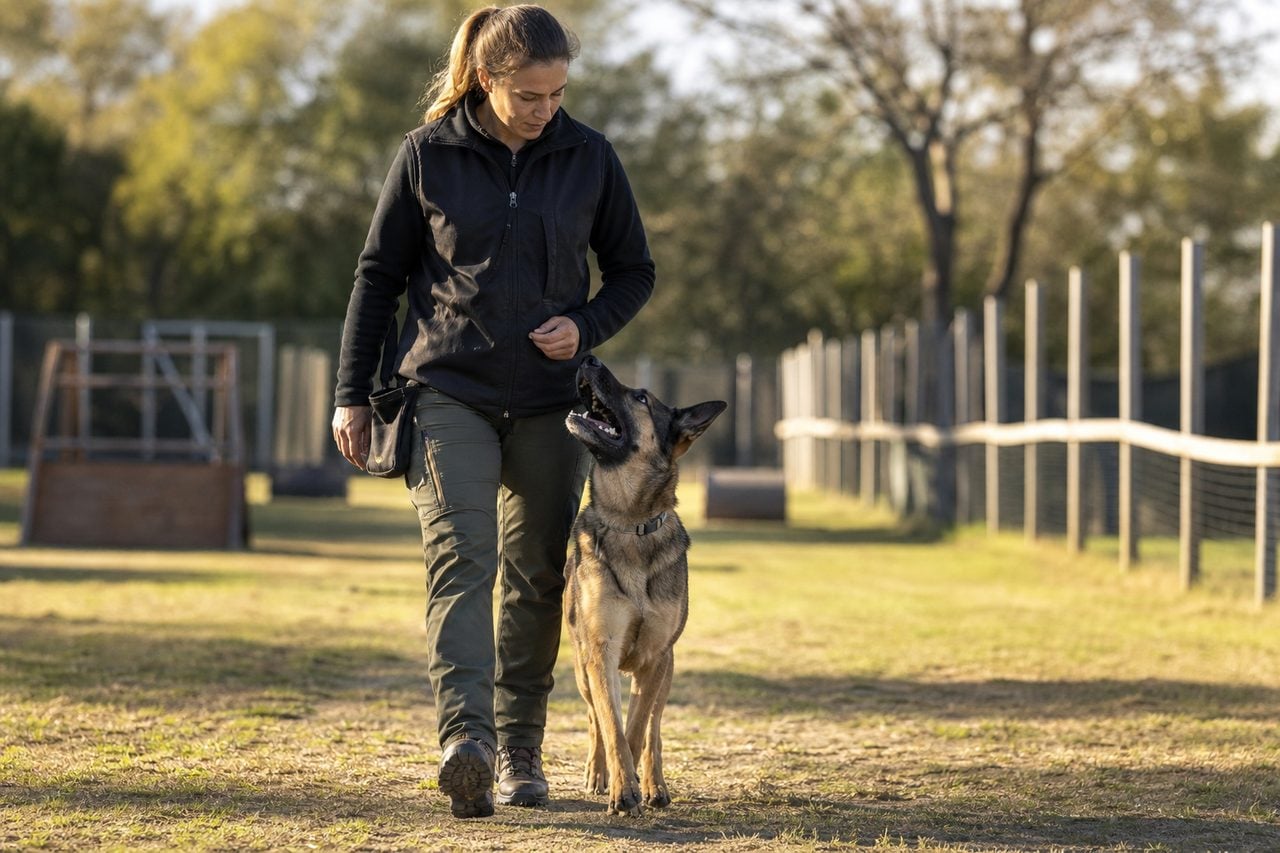
Board-and-train — sometimes called a “send-away” or residential program — is one of the most misunderstood options in dog training. Your dog moves in with a professional trainer for a set stretch of days or weeks, works through a structured curriculum every day, and comes home with new skills that you then maintain. For busy owners around Muncie, Ball State University families, and folks juggling work across Delaware and Madison Counties, the appeal is obvious: the heavy daily reps happen while you are at the office, and your dog returns with a foundation already in place.
- What board-and-train actually is
- What board-and-train is good for — and what it is not
- The local picture: Muncie, Anderson & the wider metro
- What to look for in a quality program
- The handoff: why owner training makes or breaks results
- What drives the cost
- Preparing your dog and questions to ask
- Reviewed trainers
- FAQ
But board-and-train is not a magic fix, and east-central Indiana has a thin local bench for it. This guide explains what these programs actually deliver, how to judge one honestly, and where the options are — there is at least one genuine local provider in the Muncie area (Advanced Canine Techniques in Albany offers board-and-train), while the deeper and more varied pool of residential programs sits about an hour southwest in Indianapolis, the nearest large specialist market.
The goal here is to make you a sharper buyer: what a good program actually includes, what to ask on the first call, which red flags to walk away from, and how to make sure the training sticks once your dog is back home in Yorktown, Anderson, New Castle, Middletown, or wherever you live. Read it before you book, and you will save yourself both money and disappointment.
What board-and-train actually is
In a board-and-train program, your dog lives at the trainer’s facility (or in the trainer’s home, in the case of smaller in-home programs) and receives daily, structured training sessions over a defined period — commonly two, three, or four weeks, though shorter and longer options exist. Instead of the once-a-week rhythm of a group class, the dog gets consistent, professional repetition every single day, in an environment designed to reduce distractions and build habits quickly.
The typical curriculum covers foundational obedience — sit, down, place, recall, loose-leash walking, and impulse control around doors, food, and other dogs. Many programs also address common nuisance behaviors like jumping, counter-surfing, and door-dashing. The concentrated schedule is the whole point: the trainer can layer skills faster than a weekly class allows, and the dog spends its downtime in a controlled routine rather than rehearsing bad habits at home.
The single most important thing to understand is that board-and-train trains the dog, but the transfer to you is what determines success. A reputable program builds in owner handoff sessions where you learn the exact cues, timing, and reinforcement your dog now responds to. Without that transfer, the dog behaves beautifully for the trainer and reverts at home — which is the classic complaint about programs that skip owner coaching.
It is also worth separating board-and-train from ordinary boarding. Boarding simply houses your dog while you travel; board-and-train adds a structured daily training program on top of the stay. Some facilities blur the line, advertising “training” that amounts to a few minutes of attention between long stretches in a kennel. That distinction — how many hours a day the dog is genuinely worked, and by whom — is one of the first things to pin down, because it separates a real program from a pricey kennel with a training label.
What board-and-train is good for — and what it is not
Board-and-train shines for owners who are short on time to run daily sessions themselves, for dogs that need to break entrenched habits away from the environment where those habits formed, and for families who want a strong obedience foundation compressed into a few focused weeks. It can be especially efficient for adolescent dogs — that unruly six-to-eighteen-month window — where consistency is everything and a household of well-meaning but inconsistent humans keeps sending mixed signals.
It is genuinely useful for leash manners, reliable recall, crate and place training, and taking the edge off high-energy dogs through structure and exercise. It is a reasonable choice when an owner has tried group classes and simply cannot keep up with the homework between sessions.
It is not a cure-all, and honesty matters here. Serious behavioral problems — genuine aggression, severe separation anxiety, resource guarding with a bite history, or fear-based reactivity — are not reliably “fixed” by sending a dog away, and some can be made worse by the wrong methods. Those cases call for a qualified behavior professional (see our companion guide on finding a dog behaviorist). Board-and-train also cannot install a personality or override poor genetics, and it will not hold if you go home and stop doing the work. Treat it as an accelerator for training, not a substitute for your involvement.
A quick self-test helps you decide if it fits your household. If you have a fundamentally sound dog, a clear list of obedience and manners goals, limited time to run daily sessions, and the willingness to keep up the routine afterward, board-and-train is a strong candidate. If your dog’s issue is emotional or safety-related, or if you are hoping to hand off the problem entirely and stay uninvolved, it is the wrong tool and you will be disappointed. Being honest with yourself here saves weeks of frustration.
The local picture: Muncie, Anderson & the wider metro
East-central Indiana does not have the dense cluster of residential training facilities you would find in a larger market, so set expectations accordingly. That said, the area is not a complete desert: Advanced Canine Techniques in Albany — a short drive northeast of Muncie in Delaware County — offers board-and-train, which makes it a genuine local starting point worth contacting directly to learn their approach, curriculum, and availability.
Beyond that single local option, the fuller range of board-and-train programs — different methodologies, specialized curricula, larger facilities, and more scheduling flexibility — is concentrated about an hour southwest in the Indianapolis metro. For many owners in Muncie, Anderson, Yorktown, New Castle, Middletown, Daleville, and Chesterfield, it is entirely reasonable to widen the search to Indy, especially if the local option is booked out or is not the right fit for your dog’s specific needs.
A practical approach: call the local Albany option first, ask the vetting questions in this guide, and if it is a match, great — you save the drive. If it is not, or if you need a specialized program, plan on Indianapolis. Anderson residents in particular are already closer to the Indy metro, which shortens the handoff-session commute that good programs require. Do not assume a distant, heavily-marketed facility is better than a nearby one; judge on methods and transfer, not on advertising.
One more local consideration: distance interacts with the owner-handoff sessions that make board-and-train work. If a program includes in-person follow-up — and the good ones do — a facility an hour or more away means repeated round trips from Muncie or Daleville for those sessions. Weigh that honestly against a closer option. A slightly less flashy nearby program that you can actually get back to for follow-up may deliver better real-world results than a distant one whose handoff sessions you end up skipping because of the drive.
What to look for in a quality program
The methods matter more than the marketing. Ask directly how the trainer teaches and how they handle unwanted behavior. Look for clear, humane, reward-based foundations and a trainer who can explain why they do what they do — not just promises of guaranteed results. Be wary of anyone who leans on intimidation, who refuses to show you the kenneling and training areas, or who will not let you observe or video sessions.
Transparency is non-negotiable. A good program will tell you where your dog sleeps, how many hours a day it actually trains versus rests, how it is exercised and socialized, and what a normal day looks like. Ask for updates during the stay — photos, short videos, or written progress notes — and treat a refusal to communicate as a red flag.
Credentials and experience are worth checking. Certifications from bodies like the Certification Council for Professional Dog Trainers (CPDT-KA) or membership in professional organizations signal ongoing education, though experience and references matter too. Ask for references from past clients and, ideally, speak to an owner whose dog had a similar issue to yours. Finally, confirm the facility is clean, that dogs are up to date on vaccinations, and that there is a clear plan for veterinary care if your dog gets sick or hurt during the stay.
Pay attention to the dog-to-trainer ratio and to how downtime is handled, too. A program that takes on more dogs than it can genuinely work each day is really boarding with a training label. Ask how many dogs are in residence at once, how many staff run sessions, and what your dog does during the roughly twenty-two hours a day it is not in a formal lesson — enrichment, rest, and calm routine, or a bored dog stacking up stress in a kennel. Those answers reveal the true quality of a program faster than any marketing copy.
The handoff: why owner training makes or breaks results
Here is the part people skip and later regret. Your dog will learn to respond to the trainer’s cues, timing, body language, and reinforcement schedule. If you never learn those things, the dog does not generalize the behavior to you — it looks trained at pickup and unravels within days at home. The transfer of skills from trainer to owner is the single biggest predictor of whether a board-and-train investment holds.
Strong programs build the handoff into the price: one or more in-person sessions where you practice the cues yourself, plus written notes or video of the exact commands and hand signals your dog now knows. Some include a follow-up session a week or two after homecoming, or a period of phone and email support. Ask specifically what is included before you book — “we’ll show you at pickup” in a rushed ten minutes is not enough.
Once your dog is home, expect a short regression as it adjusts to a less-structured environment. This is normal. Your job is to keep the routine tight for the first few weeks: same cues, same criteria, same consistency across everyone in the household. If the trainer taught “place” and you let the dog wander off the mat, the skill erodes. The dogs that keep their training are the ones whose owners kept holding the line at home in Muncie, Anderson, and everywhere in between.
Consistency across the whole household is easy to underestimate. If one person enforces the trained cues and another lets things slide, the dog learns that the rules are negotiable and drifts back toward old habits. Before pickup, get everyone who lives with the dog — partners, kids old enough to participate, roommates — on the same page about the cues and the criteria. A shared, written “house rules” sheet from the trainer’s handoff notes keeps everyone aligned and turns a few structured weeks into a lasting change.
What drives the cost
Prices for board-and-train vary widely and we will not quote a local figure as fact, because it depends heavily on the program — but understanding the cost drivers lets you judge whether a quote is reasonable. The biggest factors are duration (a four-week program naturally costs more than two weeks), the trainer’s experience and credentials, and the intensity of the curriculum. A program targeting a specific advanced skill will cost more than basic obedience.
Facility quality plays a role: climate-controlled kenneling, low dog-to-trainer ratios, and daily one-on-one sessions cost more to run than a high-volume operation, and that shows up in the price. In-home programs (where your dog lives with the trainer) sometimes price differently than commercial-facility programs. Included owner-handoff sessions and post-program support add value and can be worth paying for — they are often what separates a lasting result from a temporary one.
When you compare quotes between a local Albany option and Indianapolis programs, compare like for like: total training days, hours of actual training per day, what handoff and follow-up are included, and the methods used. The cheapest option that skips owner transfer can end up costing more than a thorough program, because you may have to retrain the dog anyway. Factor in the drive too — Indy handoff sessions mean repeated round trips from Muncie or New Castle.
Think in terms of value rather than sticker price. A useful way to frame it: what is the total cost to get from where your dog is now to your actual goal, including any follow-up you will realistically need? A program that costs more up front but includes thorough owner coaching and a follow-up session often reaches the goal for less total money and hassle than a bargain stay that leaves you to figure out the maintenance alone. Ask what is included, get it in writing, and compare the whole package, not the headline number.
Preparing your dog and questions to ask
Before a stay, get your dog current on vaccinations — reputable facilities require it — and be honest with the trainer about your dog’s history, triggers, medical issues, and any bite record. Withholding a bite history is dangerous for the staff and for other dogs, and it undermines the program. Pack familiar items if allowed, and confirm feeding, medication, and emergency-contact arrangements in writing.
Bring a clear-eyed set of questions to your first call. Useful ones include: What methods do you use, and how do you handle mistakes? Can I observe or see video of sessions? Where does my dog sleep and how much does it actually train each day? What is included for owner handoff and follow-up? Can you share references from clients with similar dogs? What happens if my dog gets sick or injured? What realistic results should I expect for my dog’s specific issue?
Finally, be realistic about goals. Write down the two or three behaviors that matter most to you — reliable recall, calm on leash, settling on a mat — and make sure the program targets those. A focused, well-matched program with a strong owner handoff will serve you far better than a big-name facility with vague promises. Whether you land on the local Albany option or make the trip to Indianapolis, judge the fit against your dog, not against the brochure.
It also helps to plan the first week home before your dog even leaves. Line up the crate or the “place” mat, decide on a consistent feeding and potty schedule, and block out short daily practice windows so you are ready to reinforce the new skills from day one. Dogs settle fastest when they come home to structure rather than a free-for-all. A little preparation on your end protects the investment you just made and gives the training the best possible chance to become permanent.
Board & Train in Muncie: Local Options & Nearest Specialists
A few Muncie-area trainers can help with milder board & train needs:
- Advanced Canine Techniques — 5.0★ (34 reviews)
Nearest board & train specialists — Indianapolis
For complex cases, some families travel to the larger pool of specialists in the Indianapolis area for an assessment or a board-and-train stay. Top-reviewed options:
- Nate Schoemer Dog Training — 5.0★ (188 reviews)
- Good Bones K9 Training — 5.0★ (31 reviews)
- Steven’s Bootcamp Dog Training Indianapolis — 5.0★ (9 reviews)
- Lead & Learn Canine Solutions — 5.0★ (7 reviews)
- Paws a Moment Dog Training LLC — 5.0★ (1 review)
- Indy K-9 — 4.9★ (123 reviews)
- Big N’ Small Paws 317 — 4.9★ (97 reviews)
- Kingdom Bully Kennels — 4.9★ (58 reviews)
See all Indianapolis board & train trainers →
Frequently Asked Questions
Is board-and-train available locally in the Muncie area?
Yes, in a limited way. Advanced Canine Techniques in Albany, a short drive from Muncie, offers board-and-train, so it is a genuine local starting point. Beyond that single option, the fuller range of residential programs — different methods, specialized curricula, more scheduling flexibility — is concentrated about an hour southwest in the Indianapolis metro.
How long does a board-and-train program usually last?
Most programs run two to four weeks, though shorter and longer options exist depending on the goals. Longer stays allow the trainer to layer more skills and proof them against distractions. The right length depends on your dog’s age, temperament, and the specific behaviors you want addressed — a trainer should recommend a duration after assessing your dog.
Will my dog stay trained after coming home?
Only if the skills are transferred to you. The dog learns to respond to the trainer’s cues and timing, so a good program includes owner handoff sessions where you practice those cues yourself. Expect a brief regression as your dog adjusts, and keep the routine consistent for the first few weeks — owner follow-through is the biggest predictor of lasting results.
Can board-and-train fix aggression or severe anxiety?
Not reliably, and sometimes it can make things worse with the wrong methods. Serious issues like genuine aggression, resource guarding with a bite history, or severe separation anxiety call for a qualified behavior professional rather than a general obedience send-away. See our companion guide on finding a dog behaviorist for how those cases differ.
What should I ask before booking a program?
Ask what methods they use and how they handle mistakes, whether you can observe or see video of sessions, where your dog sleeps and how much it actually trains per day, what owner handoff and follow-up are included, and for references from clients with similar dogs. Transparency about all of this is a strong sign of a reputable program.
How much does board-and-train cost?
It varies too widely to quote a local figure honestly, but the main cost drivers are program length, the trainer’s experience and credentials, curriculum intensity, facility quality, and whether owner handoff and follow-up are included. When comparing a local option to Indianapolis programs, compare total training days, hours of actual training per day, methods, and included support — not just the headline price.
Related: read our complete board & train guide or the full Muncie dog training overview.
Ready to find the right board & train pro in Muncie?