
In-Home Dog Training in Allentown, PA
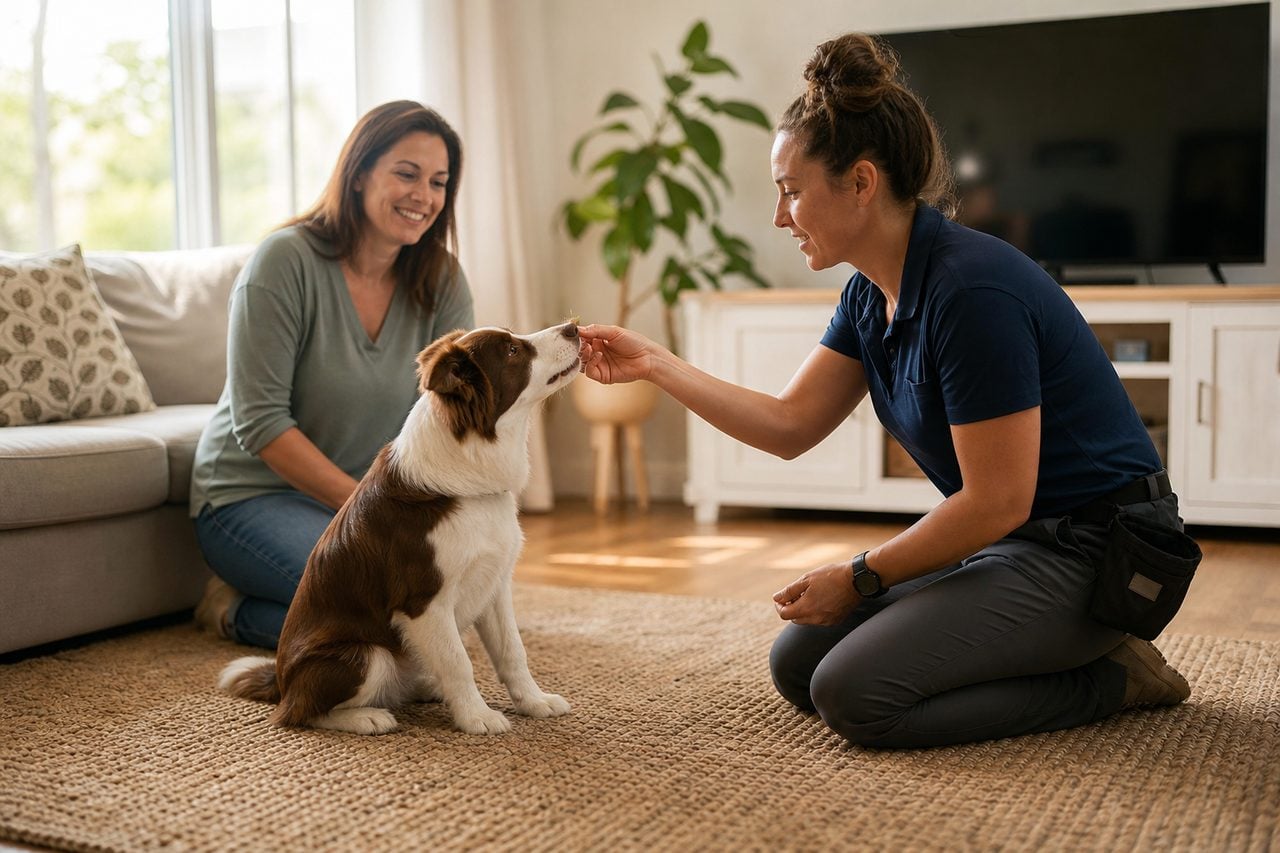
In-home dog training brings a professional trainer directly to your house, apartment, or yard — whether that’s a Center City Allentown rowhome, a Bethlehem twin near Moravian, a townhouse in Whitehall, or a property out toward the Northampton County farm country. Instead of loading the dog into the car and driving to a class on the other side of the Lehigh Valley, the training happens in the exact environment where your dog actually lives and where the behaviors you want to change actually occur. For many owners, that single difference is what finally makes training stick.
The appeal of in-home work is practical and behavioral. Practically, it suits busy schedules, owners without easy transportation, multi-dog households, and people who simply prefer one-on-one attention over a group setting. Behaviorally, it tackles problems where they happen — the dog who lunges at the mail carrier on a West End porch, bolts out the front door of an Easton home, guards the couch, or loses its mind when the doorbell rings. These are context-specific behaviors that are hard to recreate in a rented training hall but easy to address on site, where the trainer can see exactly what your dog reacts to and how your home is laid out.
This page covers how in-home training works in the Lehigh Valley, what problems it suits best, how it compares to group classes and board-and-train, and how to prepare so you get full value from every session. In-home training is not automatically better than other formats — it is better for certain goals and households — and understanding that fit is the key to choosing well across Lehigh and Northampton counties. From the tight streets of downtown Allentown to the wider lots of Macungie, Nazareth, and the farm country to the north, the right format depends on your dog, your schedule, and the specific behaviors you need to change, and this page is meant to help you weigh those factors honestly.
What In-Home Training Includes
A typical in-home program starts with an assessment session where the trainer comes to your Lehigh Valley home, observes your dog in its normal environment, talks through your goals, and watches the problem behaviors firsthand. From there the trainer builds a plan tailored to your dog, your household, and your living situation — a plan that accounts for your specific layout, your family’s routine, and the real triggers in and around your home.
Sessions usually run roughly an hour and combine hands-on work with the dog and coaching for you, the owner. That owner-coaching piece is central: the trainer is teaching you to maintain and extend the training between visits, since the dog spends the other 167 hours of the week with you, not the trainer. Programs are often sold as packages of several sessions spaced a week or two apart, with homework in between. Common goals include basic obedience, leash manners, house manners, polite greetings, crate training, and addressing nuisance behaviors. More serious behavior issues like reactivity or resource guarding can also be worked in-home, sometimes alongside controlled outings into your actual Allentown or Bethlehem neighborhood.
Problems In-Home Training Solves Best
In-home training shines for behaviors that are tied to a specific place — usually your house, yard, and immediate street. Door-dashing, jumping on guests, barking at people passing the front window, reactivity to the mail carrier or delivery drivers, guarding furniture or food bowls, and house-training relapses are all best addressed where they actually happen. A trainer can stage a realistic doorbell scenario in your Whitehall entryway far more usefully than describing it in a class.
It also suits dogs who are too anxious, reactive, or unvaccinated-puppy-young to thrive in a group class, and households juggling multiple dogs whose dynamics only appear at home. Owners with mobility limits, no car, or demanding schedules across the Lehigh Valley benefit from the trainer coming to them. The flip side is honest, too: dogs whose main need is socialization and working around other dogs and people often benefit from the controlled exposure a group class or public outing provides. The best programs recognize this and layer in real-world Lehigh Valley outings — a walk through your neighborhood, a session near a trailhead — once the home foundation is solid.
In-Home Versus Group Classes
Group classes and in-home training serve different strengths, and the right choice depends on your goal. Group classes — common through clubs, daycares, and pet stores around the valley — offer built-in distraction, structured socialization, and a lower per-session cost. For a friendly puppy or an adolescent dog who needs to learn focus around other dogs and people, that environment is genuinely valuable and hard to replicate at home.
In-home training trades that group exposure for personalization. You get the trainer’s full attention, a plan built around your exact problems, and work that happens in the environment where behaviors occur. There’s no driving, no waiting your turn, and no dog who is too stressed by the room to learn anything. The trade-off is typically a higher per-session price and less casual dog-to-dog socializing. Many Lehigh Valley owners do both in sequence: in-home work to build a calm foundation and tackle house-specific issues, then a group class or structured outings to proof those skills around distractions. Neither is universally superior — match the format to what your dog actually needs to learn.
In-Home Versus Board-And-Train
Board-and-train sends your dog to live with a trainer for a stretch of intensive instruction, then returns a dog with skills already installed. In-home training keeps the dog with you the whole time and trains you alongside the dog. The core difference is who does the learning: in board-and-train the trainer does the heavy lifting up front; in in-home training you build the skills yourself with expert guidance, which tends to produce more durable results because you understand how to maintain them.
Board-and-train can appeal to owners short on time, but it carries a well-known transfer problem — skills learned in the trainer’s environment don’t automatically carry over to your Allentown home, and without solid handoff coaching, behaviors can drift back. It also means trusting your dog to someone else’s facility and methods for weeks. In-home training avoids the transfer gap entirely because the dog never trains anywhere but home, and you’re part of every session. For owners willing to put in the between-session homework, in-home work generally delivers longer-lasting change. The right pick depends on your time, budget, and how hands-on you want to be.
How To Prepare For An In-Home Session
A little preparation makes each visit far more productive. Before the trainer arrives, have your goals written down — be specific (“stops jumping on guests,” “walks past dogs on the D&L Trail without lunging”) rather than vague. Gather the gear you already use: the dog’s regular collar or harness, leash, favorite high-value treats, and a hungry-ish dog (training before a meal, not after, sharpens food motivation).
Plan the environment, too. Decide whether you want the dog at its calmest for foundation work or, for a session targeting doorbell reactivity, ready to demonstrate the real trigger. Have all household members who interact with the dog present when possible, since consistency across the family is what makes training hold. Clear a workable space, and note any patterns you’ve observed — what time the problem peaks, what sets it off, what you’ve already tried. After the session, the most important step is doing the homework: short, daily practice in the days between visits is where the real progress happens. A trainer can show the path, but the daily reps in your own Lehigh Valley home are what change the dog.
Choosing An In-Home Trainer In The Lehigh Valley
When evaluating an in-home trainer, focus on methods, communication, and fit. Ask what training approach they use and how they handle mistakes — you want someone who can clearly explain their methods and who prioritizes the dog’s welfare and your understanding. A good trainer coaches you as much as the dog and welcomes questions rather than gatekeeping their techniques.
Practical questions worth asking: What does an assessment involve? How are programs structured — single sessions or packages? What happens between visits, and how do they support your homework? Do they have experience with your specific issue, whether that’s reactivity, puppy basics, or multi-dog dynamics? Confirm their service area covers your part of the valley — some trainers cover Allentown, Bethlehem, and Easton proper but charge travel for the rural fringe or Upper Bucks. Trust your read on rapport, too: this person will be in your home working closely with you and your dog, so clear communication and a comfortable dynamic matter. The best fit is a trainer whose methods you understand, whose plan matches your goals, and who leaves you more capable after every visit.
Making In-Home Results Last
The dogs who hold onto their training are the ones whose owners turn the trainer’s plan into daily habit. In-home training gives you a head start because the skills are built in the real environment, but maintenance is on you between and after the sessions. Build short practice into your routine — a few minutes of leash manners on the way to the car, a sit-to-greet rehearsal each time someone comes to the door, recall practice in the fenced yard.
Consistency across everyone in the household is the other half. If one person enforces “off the couch” and another doesn’t, the dog learns the rule is negotiable. Get the whole family using the same cues and standards. As skills solidify at home, proof them in gradually harder settings — a quiet stretch of the Saucon Rail Trail, then a busier park, then a stroll through a livelier part of your Lehigh Valley town. This generalization step is what turns “behaves at home” into “behaves everywhere.” Keep notes on what’s improving and where the dog still struggles, and don’t hesitate to book a tune-up session if a behavior creeps back. Training is maintenance, not a one-time fix.
Reviewed In-Home Dog Training Trainers in Allentown
These reviewed Allentown-area trainers from our directory handle in-home dog training. Each links to a full profile with specialties, certified credentials, reviews, and contact info:
- Raise Your Right Paw Dog Training — 5.0★ (94 reviews)
- The Canine Cowgirl Training Co. — 5.0★ (35 reviews)
- Cerberus Dog Training Services — 5.0★ (13 reviews)
- The Art of Dog Training — 5.0★ (10 reviews)
- K9 Leadership Academy — 5.0★ (2 reviews)
- Get Connected Canine Coaching — 5.0★ (1 reviews)
- New Beginnings Dog Training, LLC — 4.9★ (101 reviews)
- Molasses Creek Dog Training, LLC — 4.9★ (96 reviews)
- Curiosity Satisfied Dog Camp — 4.9★ (61 reviews)
- Neverland K-9 Institute — 4.9★ (16 reviews)
See all Allentown in-home dog training trainers →
Frequently Asked Questions
What is in-home dog training and how is it different from a class?
In-home training brings a professional trainer to your house, yard, or apartment instead of you driving to a group class. The work happens in the exact environment where your dog lives and where the problem behaviors occur. The big difference is personalization: you get one-on-one attention and a plan built around your specific home and goals, whereas a group class offers built-in distraction and socialization at a lower per-session cost. Many Lehigh Valley owners use both formats for different purposes.
What problems is in-home training best for?
It’s ideal for behaviors tied to a specific place — door-dashing, jumping on guests, barking at people passing the window, reactivity to delivery drivers, furniture or food guarding, and house-training issues. It also suits anxious or reactive dogs who struggle in groups, multi-dog households, and owners with limited time or transportation. Dogs whose main need is socialization around other dogs often benefit more from a group class or structured public outings, which good in-home trainers will add once the home foundation is solid.
Is in-home training better than board-and-train?
Neither is universally better — they suit different owners. Board-and-train sends your dog away for intensive instruction and returns it with skills installed, which appeals to time-pressed owners but carries a transfer problem: skills learned at the trainer’s facility don’t automatically carry over to your home. In-home training keeps the dog with you and trains you alongside it, which tends to produce more durable results because you learn to maintain the skills. If you’ll do the between-session homework, in-home work generally lasts longer.
How many in-home sessions will my dog need?
It depends on your goals and your dog, but in-home work is commonly sold in packages of several sessions spaced a week or two apart, with homework in between. Basic manners might take a handful of sessions; more involved issues like reactivity take longer. The pace also depends heavily on how much you practice between visits — the dog spends the vast majority of its week with you, so your daily reps drive the timeline as much as the trainer’s visits do.
How should I prepare for the first session?
Write down specific goals, gather your dog’s regular collar or harness, leash, and high-value treats, and time the session before a meal so the dog is food-motivated. Have all household members who interact with the dog present so everyone learns the same cues. Note any patterns you’ve seen — when the problem peaks, what triggers it, what you’ve already tried — and clear a workable space. The more context you give the trainer up front, the more they can accomplish in the visit.
Do in-home trainers cover the whole Lehigh Valley?
Coverage varies by trainer. Many serve Allentown, Bethlehem, and Easton proper plus the closer suburbs like Whitehall, Emmaus, and Macungie, but some charge a travel fee or limit visits to the rural fringe, northern Northampton County, or Upper Bucks. When you reach out, confirm your address is in their service area and ask whether travel affects pricing. It’s a simple question that saves a scheduling headache later, especially if you’re out toward the farm country north of the valley.
Related: read our complete in-home dog training guide or the full Allentown dog training overview.
Ready to find the right in-home dog training pro in Allentown?