
In-Home Dog Training in York, PA
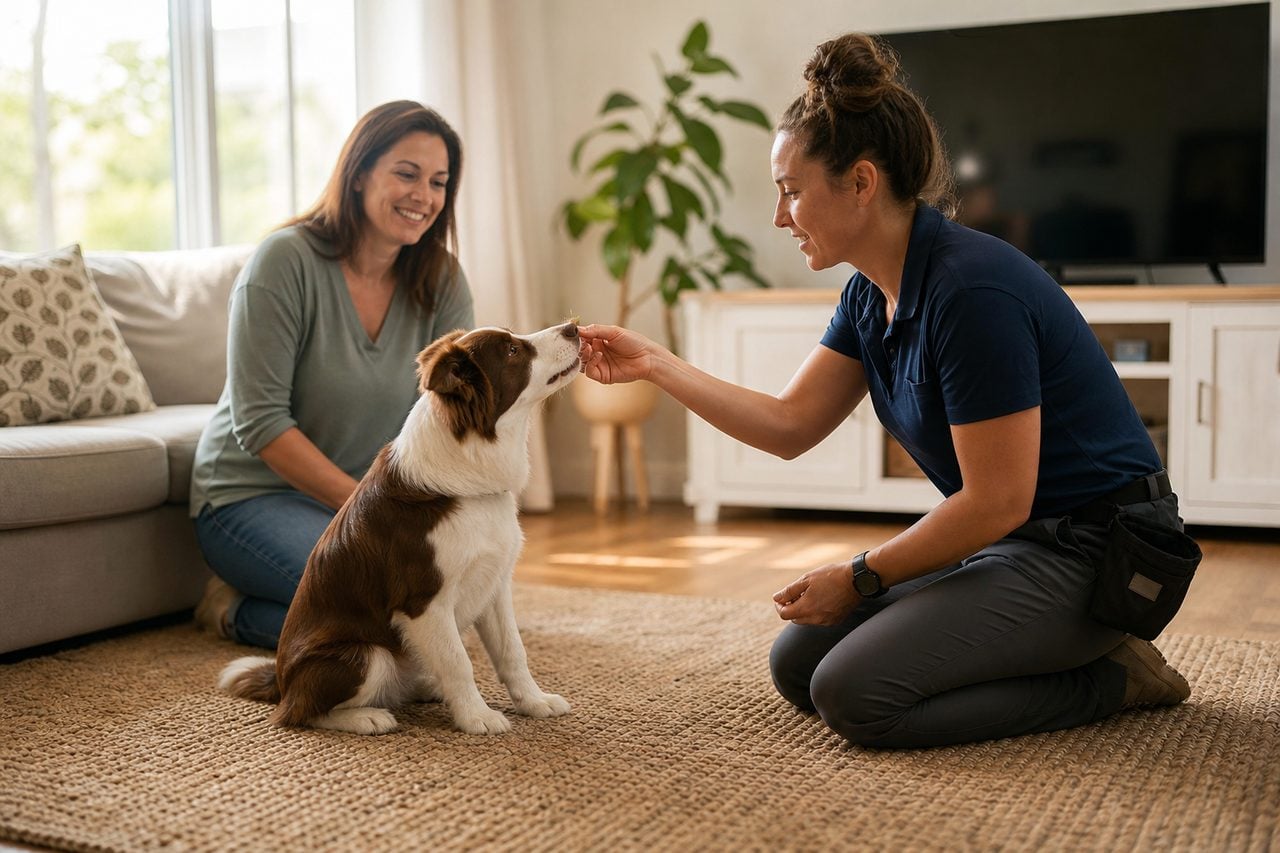
In-home dog training brings the lessons to where your dog actually lives, and for many York County families that turns out to be the most practical and effective option of all. Instead of loading the dog into the car and driving across town to a class, a professional trainer comes to your house — whether that is a rowhome near Central Market in the White Rose City, a spread-out property out toward Spring Grove, or a townhouse in a Central York development. The behaviors you care about most usually happen at home: the jumping on guests, the door-dashing, the barking at the mail carrier, the chaos at dinnertime. In-home training tackles them in the exact spot they occur.
This approach has real advantages for certain dogs and households. A reactive or fearful dog who can barely think in a crowded class often learns beautifully in the calm of his own living room. A busy family stretched between work along the I-83 corridor, kids’ activities, and the daily grind may simply find a trainer coming to them the only schedule that works. And puppies who are not yet fully vaccinated can begin foundation work safely at home before they are cleared for group settings. For these situations, the home is not a compromise — it is the ideal classroom.
In-home training is not the right fit for every goal, though, and a good trainer will tell you so. This guide walks York owners through how private home sessions work, what problems they solve best, where group classes still have the edge, what to expect on cost, and how to choose a qualified trainer who will actually come to your door across York County and the surrounding river towns and farm communities. With the county sprawling from the Hanover and Spring Grove area in the west to the Susquehanna river towns near Wrightsville in the east, geography and travel matter here in ways they would not in a denser city, so we cover that practical side too. The aim is to help you decide whether a trainer coming to your home is the smart choice for your dog — and to get the most out of it if it is.
How In-Home Training Works
An in-home program almost always begins with a consultation visit. The trainer comes to your York-area home, talks through your goals and frustrations, watches how your dog behaves in his normal environment, and observes the household routines that may be feeding the problem. This context is something no facility-based class can offer — the trainer sees the actual doorway your dog bolts through and the actual couch he guards.
From there, sessions are private and one-on-one, built entirely around your dog and your home. A typical session runs roughly an hour, with the trainer demonstrating techniques, coaching you through them, and leaving you with specific homework to practice between visits. That coaching of the owner is the real value: the trainer is only at your house for an hour a week at most, so the bulk of the learning happens when you practice the rest of the time. Programs are usually sold as packages of several sessions rather than one-offs, because behavior change takes repetition. Expect to do real work between appointments — in-home training is a partnership, not a drop-off service.
Problems In-Home Training Solves Best
Certain issues are tailor-made for in-home work because they are rooted in the home environment. Jumping on visitors, counter-surfing in the kitchen, bolting out the front door, barking at people passing the window, resource guarding a specific bed or spot, and crate or house-training struggles all live in your house — so that is where they are best addressed. A trainer can set up the real scenario, like a staged knock at your Dover front door, and work the problem in context rather than asking your dog to generalize from a sterile classroom.
In-home training also shines for dogs who struggle in busy environments. A dog who is reactive toward other dogs, or one so anxious he shuts down around strangers, often cannot learn anything useful in a crowded class — he is too far over threshold to think. Starting in the quiet of home lets that dog succeed first, building a foundation that can later be carefully transferred to more distracting settings. The same goes for senior dogs with mobility limits, multi-dog households where the dynamics matter, and families wanting tailored manners that fit their specific routine.
When Group Classes Are the Better Choice
A trustworthy trainer will be honest that in-home sessions are not always the best tool, and for some goals a group class clearly wins. The biggest reason is distraction and socialization. A dog who behaves like a saint in his own living room may fall apart the moment he is around other dogs, unfamiliar people, and the bustle of a real-world setting. Building reliable behavior around distractions requires practicing around distractions, and a well-run group class supplies exactly that controlled chaos.
For a well-adjusted puppy, group puppy classes also offer something home training cannot: structured socialization with other dogs during the critical developmental window. That early positive exposure pays dividends for life. Similarly, owners aiming at dog sports, advanced obedience around heavy distraction, or therapy-dog readiness usually need the varied environments and proofing that classes and facilities provide. Many York families end up using both — in-home work to fix the household problems and build a foundation, then a group class to proof those skills in the wider world. The right answer depends on your dog and your goal, not on which format is fashionable.
What In-Home Training Costs in York
In-home private training generally costs more per session than a group class, and that is to be expected — you are paying for one-on-one expertise plus the trainer’s travel time to your home. Across south-central Pennsylvania, private in-home sessions typically fall into a moderate per-session range, and most trainers sell multi-session packages that bring the effective rate down compared with booking individually. Specialized work, such as serious behavior cases, usually sits at the higher end.
A few York-specific factors affect price. Travel distance matters: a trainer based in the York city core may add a surcharge for a property well out toward Littlestown, East Berlin, or the Adams County fringe, simply because of drive time across farm country. Ask up front whether travel is included in the quoted rate or billed separately. Be wary of unusually cheap pricing, which can signal a lack of real credentials, and equally wary of anyone guaranteeing a fixed number of sessions to fully resolve a complex behavior problem — reputable trainers quote ranges and packages, never guarantees. We list ranges here only as general orientation; always confirm current pricing directly with the trainer.
Covering York County's Spread-Out Geography
York County is large and varied, and that geography shapes how in-home training plays out. A trainer who lists York as a base may comfortably serve the city, Central York, and nearby suburbs, but reaching the southern tier toward Shrewsbury and Glen Rock, the western towns around Hanover and Spring Grove, the northern communities of Dillsburg and Lewisberry, or the Susquehanna river towns near Wrightsville can mean a real drive.
When you contact a trainer, confirm your specific town is inside their service area before you get attached to the idea. Some cover the whole county and beyond; others stay close to home. The county’s rural stretches and farm country also mean a session at a property out near the Adams County line may simply cost a little more in travel. On the upside, in-home training removes the burden of you driving a reactive or carsick dog across the county to a class — the trainer absorbs the travel instead. For families in outlying areas where the nearest training facility is a long haul, that convenience alone can make in-home the obvious choice. Our directory can help you find trainers who genuinely cover your corner of York County.
Choosing a Qualified In-Home Trainer
Because a trainer will be working inside your home and shaping how you handle your own dog, vetting matters even more than usual. The dog training industry is unregulated in Pennsylvania, meaning anyone can call themselves a trainer regardless of background, so the burden is on you to check credentials. Look for recognized certifications and trainers who clearly describe a reward-based, humane methodology. Be cautious of anyone leaning heavily on fear, pain, or intimidation, or promising overnight fixes for ingrained behavior.
Ask practical questions before booking. What is their approach to your specific problem? Do they coach you, the owner, or just handle the dog? How many sessions do they expect, and what does a package include? Will they refer out cases beyond their expertise, such as severe aggression or separation anxiety? A confident, qualified trainer answers all of this readily and is honest about the limits of their skill set. Trust your read of the consultation, too — this person will be a guest in your York home and a partner in your dog’s progress, so a good working rapport genuinely counts. Take your time choosing; the right fit makes all the difference.
Making the Most of Every Session
The owners who get the best results from in-home training treat it as a collaboration rather than a service they have purchased. Since the trainer is only present for an hour or so at a time, what you do during the rest of the week determines how far your dog actually gets. Set up for success before each visit: have your dog a little hungry so food rewards land well, gather any treats or gear the trainer asked for, and clear a space to work in.
Take notes or record the trainer’s demonstrations on your phone so you can replay the technique correctly later — it is easy to forget the small mechanical details that make a method work. Then practice in short, frequent sessions throughout your day rather than one long marathon; a few five-minute reps while waiting for coffee or before a walk on the Heritage Rail Trail beat a single exhausting half-hour. Loop in everyone in the household so your dog gets consistent cues from each person, not conflicting signals. And be patient through plateaus, which are a normal part of learning. Bring your questions to each session; a good trainer wants you engaged, because an informed, practicing owner is what turns a few visits into lasting change.
Reviewed In-Home Dog Training Trainers in York
These reviewed York-area trainers from our directory handle in-home dog training. Each links to a full profile with specialties, certified credentials, reviews, and contact info:
- Ray’s Canine Services — 5.0★ (32 reviews)
- Cold Creek Dog Training – Hagerstown, MD — 5.0★ (26 reviews)
- Pack Leader Dog Training — 5.0★ (20 reviews)
- Cannon Canine Training, LLC — 5.0★ (18 reviews)
- Smart Paws Academy, LLC. — 5.0★ (4 reviews)
- Ray’s Canine Services, LLC — 5.0★ (1 reviews)
- Growing love dog training llc — 5.0★ (1 reviews)
- Knucklehead K9 Services LLC — 4.9★ (309 reviews)
- Beacon Dog — 4.9★ (70 reviews)
- Gray House Dog Training — 4.9★ (17 reviews)
See all York in-home dog training trainers →
Frequently Asked Questions
Is in-home training better than a group class?
Neither is universally better — it depends on your dog and your goal. In-home training is ideal for home-specific problems like jumping, door-dashing, or barking at the window, and for reactive, anxious, or under-vaccinated dogs who struggle in busy settings. Group classes are better for socialization and for proofing behaviors around real-world distractions. Many York families use both: in-home work to build a foundation, then a class to generalize it.
How much does in-home dog training cost in the York area?
Private in-home sessions generally cost more per session than group classes because you get one-on-one attention plus the trainer’s travel time. Across south-central Pennsylvania, rates usually fall into a moderate per-session range, with multi-session packages lowering the effective cost. Properties well outside York — toward the Adams County fringe, for instance — may carry a travel surcharge. Always confirm current pricing and what a package includes directly with the trainer.
What kinds of problems is in-home training best for?
Issues rooted in the home environment, such as jumping on guests, counter-surfing, bolting out the door, barking at passersby, resource guarding a specific spot, and crate or house-training struggles. It also works well for dogs who are reactive or anxious around other dogs and people, since starting in the calm of home lets them learn before facing distractions. Senior dogs and multi-dog households often benefit too.
Will a trainer come to my part of York County?
Many will, but coverage varies and York County is large. A trainer based in the city or Central York may serve the suburbs easily, while reaching Shrewsbury, Hanover, Dillsburg, or the river towns near Wrightsville can mean a real drive and sometimes a travel surcharge. Always confirm your specific town is in a trainer’s service area before booking. Our directory can help you find trainers who cover your corner of the county.
Can puppies start with in-home training?
Yes, and it is often a smart way to begin. Puppies who are not yet fully vaccinated can start foundation work like name recognition, house-training, and gentle handling at home before they are cleared for group settings. That said, well-run puppy group classes offer structured socialization with other dogs during the critical early window, so once your vet gives the go-ahead, combining home foundations with a puppy class is a strong approach.
How many in-home sessions will my dog need?
It varies with the dog and the goal. Basic manners might come together in a handful of sessions, while ingrained or complex behaviors take longer. Most trainers sell packages of several sessions because behavior change requires repetition and owner practice between visits. Be skeptical of anyone guaranteeing a fixed number of sessions to fully resolve a serious problem — reputable trainers quote ranges, not guarantees. Remember too that you participate actively rather than dropping the dog off: a good trainer coaches you to handle your dog during the week, when most of the real learning happens.
Related: read our complete in-home dog training guide or the full York dog training overview.
Ready to find the right in-home dog training pro in York?