
In-Home Dog Training in Erie, PA
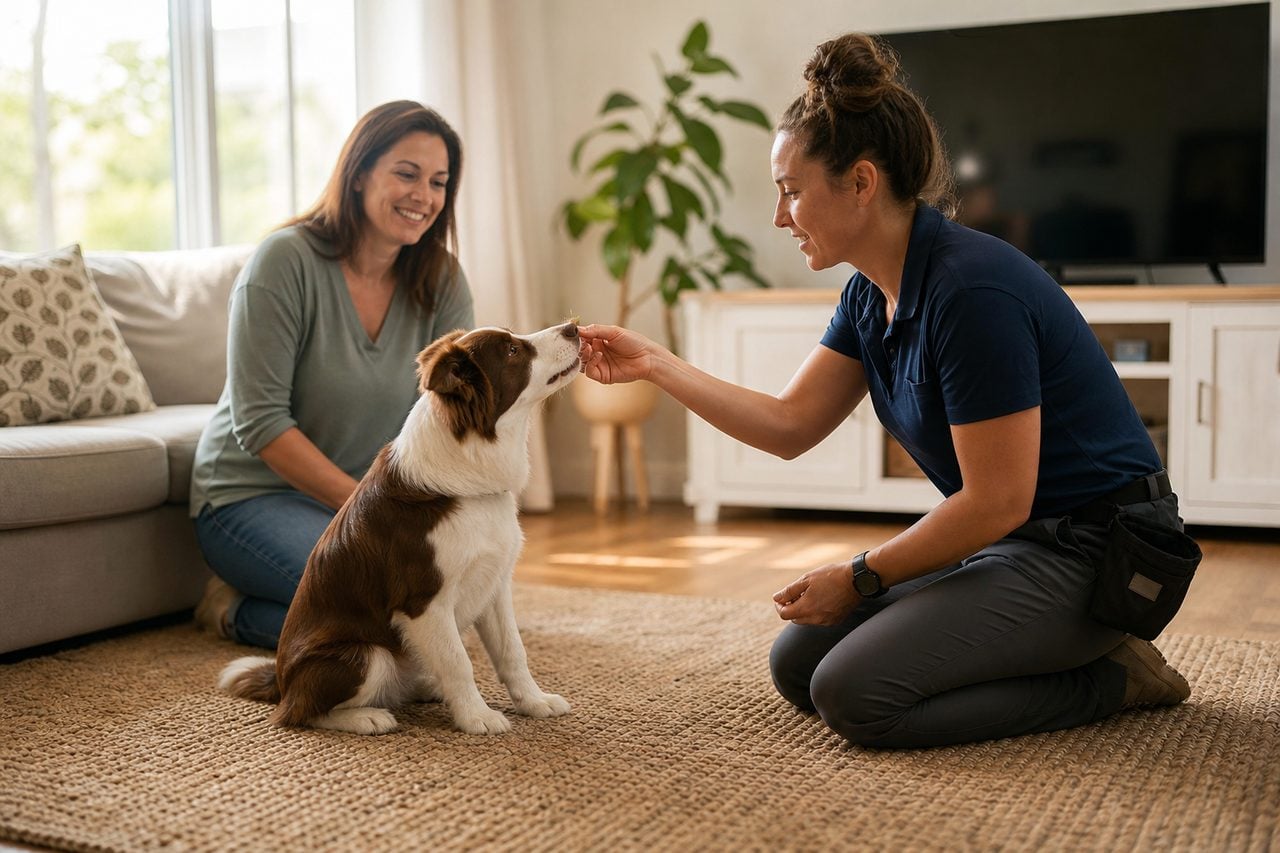
In-home dog training brings the trainer to you, working with your dog in the exact environment where its habits actually live — your kitchen, your front door, your backyard, your street. For many Erie families this is the most practical and effective format, because so much of dog behavior is context-specific. A dog that behaves beautifully in a group class at a facility can still bolt out the door, guard the couch, or bark at every delivery truck at home, simply because those behaviors are tied to the real triggers in the real place. In-home training tackles them where they happen.
Erie County is spread out, and that shapes how in-home training works here. From the dense Bayfront neighborhoods of the city, west through Millcreek and Fairview and Girard, east along the lakeshore through Harborcreek and North East, and south to Edinboro, Waterford, Corry, and Union City, a trainer covering this region is often driving a wide radius between clients. Add the isolation of the area — with Pittsburgh two hours south — and the value of a professional who comes to your home, rather than requiring repeated trips to a distant facility, becomes obvious, especially through the long lake-effect winter when getting out to a class across town is its own ordeal.
This guide from the GetDogSchool Editorial Team explains what in-home training is best suited for, how sessions typically run, how it compares to group classes and board-and-train, what to expect on cost and scheduling given Erie’s geography, and how to choose a qualified trainer. Whether you’re dealing with a new puppy, an adopted rescue settling into a Millcreek home, or a specific problem like leash reactivity on your own street, understanding the format helps you decide if bringing the training to your door is the right fit — and helps you avoid paying for a format that doesn’t match your actual goals.
What In-Home Training Is Best For
In-home training shines whenever the problem is tied to a specific place or context. Household manners — door-dashing, counter-surfing, jumping on guests, settling on a mat, polite greetings — are naturally trained where they occur. House-training a puppy is far more effective when the trainer can see your actual setup, your schedule, and your routines. Resource guarding around a particular couch or food bowl, reactivity that fires on your own street, and multi-dog household tension all benefit from being addressed in the environment that produces them.
It’s also ideal for dogs and owners who struggle in group settings. A fearful or reactive dog that can’t cope with a room full of strangers and other dogs can learn calmly at home first. New puppy owners often prefer starting one-on-one so they build good foundations before adding the distraction of a class. And for busy or mobility-limited Erie residents, the convenience of not loading a dog into the car and driving across the county — particularly in winter — is a real advantage. In-home training is less suited to dogs whose main need is socialization and proofing around other dogs, where a well-run group class or a blended plan adds value; a good trainer will tell you honestly which format your specific goals call for.
How A Typical In-Home Session Works
Most in-home programs open with an assessment visit. The trainer comes to your home, talks through your history and goals, watches your dog in its normal environment, and identifies what’s driving the behaviors you want to change. This first session is often longer than the rest and sets up a customized plan. From there, sessions usually run around an hour, focused on hands-on coaching — not just training the dog, but training you to handle the dog, since you’re the one living with it every day.
A defining feature of in-home training is that much of the value lives in the homework. The trainer demonstrates techniques, watches you practice, corrects your timing and mechanics, then leaves you with specific exercises to run between visits. Progress depends heavily on that daily practice, so sessions are often spaced a week or two apart to give you time to work. Many Erie trainers structure programs as packages of several sessions rather than one-offs, because lasting behavior change needs repetition and follow-through. Expect the plan to evolve as your dog progresses, and expect the trainer to adjust exercises based on what’s working in your particular home — the personalization is the whole point of the format. A good trainer will also loop in everyone who lives with the dog, since a technique only one family member uses tends to fail — household consistency is a strong predictor of success. Don’t be surprised if early sessions focus as much on management, setting up your space so the dog can’t rehearse the unwanted behavior, as on active training.
The Travel Radius Across Erie County
Erie County’s geography directly affects in-home training logistics. A trainer serving the region may cover everything from the Bayfront and east side of Erie City, through Millcreek’s dense suburbs, out to Fairview and Girard in the west, along the lakeshore to Harborcreek and North East, and south to Edinboro, Waterford, Corry, and Union City — sometimes reaching into the Crawford County edge. That’s a wide territory, and travel time is a genuine cost for any mobile trainer.
Practically, this means a few things for you. Trainers based closer to the city core may charge a travel fee or set a service-area boundary for outlying towns, or they may cluster appointments by area on given days to keep drive times manageable. If you’re out in the rural southeast — think Corry or Union City — it’s worth confirming coverage and any travel surcharge up front rather than assuming. Winter compounds this: heavy lake-effect snow can force rescheduling, and rural roads south of the city may be slower to clear, so building some flexibility into your expectations helps. When you contact a trainer, be clear about your exact location so both sides can confirm the arrangement works before you commit to a package. It’s worth asking how the trainer schedules within the county — someone who batches west-side visits to Fairview and Girard on one day may have more flexibility for your area. And if you’re on the Crawford County edge, don’t assume you’re out of range; ask directly, since some trainers cover a wide radius and factor the drive into the package.
In-Home Versus Group Classes And Board-And-Train
Each training format has a place, and understanding the trade-offs helps you spend wisely. Group classes are strong on socialization, proofing skills around distractions, and cost-per-session value, but they train in a facility rather than your home and move at the class’s pace, not your dog’s. Board-and-train hands the dog to a trainer for an immersive stretch and can build skills quickly, but the dog learns in the trainer’s environment, and the crucial transfer back to your home — and your handling — is where results are often won or lost.
In-home training sits between these. You get fully personalized, one-on-one attention in the exact place the behavior happens, and because you’re coached directly, the skills are already transferring to you and your home from day one. The trade-off is that it’s typically pricier per hour than a group class, and it doesn’t provide the dog-to-dog socialization a class does. Many Erie families end up blending formats — starting in-home to fix household-specific issues and build foundations, then adding a group class for socialization and real-world proofing once the dog is ready. A good trainer will help you sequence these rather than pushing a single format for every problem. The right mix depends on your dog: a reactive rescue that can’t yet cope near other dogs needs to start at home, while a stable, social puppy might get more value from a class plus a session or two at home. Be skeptical of any operation that insists its single format fits every dog.
Cost And Scheduling Expectations
In-home training generally costs more per session than a group class, reflecting the one-on-one attention, the customized plan, and the trainer’s travel time to your door. Rather than quote figures that vary by trainer, experience, and program, it’s most useful to understand the structure: most in-home training is sold as multi-session packages, sometimes with a longer initial assessment priced separately, and travel fees may apply for outlying parts of Erie County. Always ask for the full package price, exactly what’s included, and how many sessions it covers before committing.
On scheduling, expect sessions spaced roughly one to two weeks apart to leave room for homework, with the full program running over a couple of months for typical goals. Erie’s winter is a real scheduling factor — heavy snow days can force reschedules, so ask how the trainer handles weather cancellations. Some trainers offer follow-up support between sessions by phone or message, which is worth asking about. When comparing options, weigh the total cost against convenience and fit rather than session price alone: for a household that would otherwise struggle to get to a facility across the county in winter, the value of training delivered to your living room can more than justify the premium.
Preparing Your Home For A Session
A little preparation makes each in-home session far more productive. Before the trainer arrives, have the tools they’ve asked for ready — a flat collar or harness, a standard leash, and the treats or food your dog is motivated by. High-value, soft treats that your dog can eat quickly work best for training, so it’s worth stocking up. Make sure other household members who interact with the dog can be present when relevant, since consistency across everyone in the home is a major driver of success.
Think about the environment too. For a first assessment, it helps to let the trainer see your dog’s normal behavior, so you generally don’t want to over-manage the dog into unnatural calm beforehand — the trainer needs to observe the real triggers. That said, if your dog is anxious with visitors, tell the trainer in advance so they can plan a low-key entry. Reduce chaotic distractions where it makes sense, secure any dog that shouldn’t be loose during focused work, and have a quiet space available for exercises. Keep a notebook or your phone handy to jot down the homework and the mechanics the trainer demonstrates, because remembering the details between visits is what turns a good session into lasting change in your Erie home. Many owners find it helpful to record a short video of the trainer showing a technique, with permission, to replay the timing later. Finally, plan the session for a time when the household is calm and you can give the trainer your full attention, since your engagement shapes how much you carry forward.
Choosing A Qualified In-Home Trainer
Dog training is an unregulated field, so verifying credentials matters as much for in-home trainers as for any other kind. Look for recognized certifications — such as CPDT-KA, KPA-CTP, CBCC-KA for behavior cases, or a background with a reputable training school — and ask what methods the trainer uses. Reward-based, force-free approaches are the current standard of care and are appropriate for the vast majority of household training and behavior work; be cautious of anyone leaning heavily on aversive tools as a first resort, especially for fear-based problems.
Because in-home training happens in your personal space, fit and clear communication are essential. Ask how the trainer structures programs, whether they offer a specific plan for your goals, what’s included in a package, and how they handle Erie County travel and winter weather. It’s reasonable to ask about experience with your particular issue — puppy foundations, reactivity, resource guarding, multi-dog homes — since specialties vary. For serious behavior concerns like aggression or severe reactivity, prioritize someone with genuine behavior credentials, and be aware that the deepest specialists may be a drive toward Pittsburgh; some also offer remote support. Above all, choose a trainer who coaches you as much as the dog, communicates clearly, and gives you honest expectations rather than guarantees — that combination is what makes in-home training pay off.
Reviewed In-Home Dog Training Trainers in Erie
These reviewed Erie-area trainers from our directory handle in-home dog training. Each links to a full profile with specialties, certified credentials, reviews, and contact info:
- Scholars in Collars Academy — 5.0★ (105 reviews)
- Destinys Dog Training LLC — 5.0★ (21 reviews)
- Off Leash K9 Training, Erie — 4.8★ (46 reviews)
See all Erie in-home dog training trainers →
Frequently Asked Questions
What problems is in-home dog training best for?
In-home training is ideal for behaviors tied to your specific environment: door-dashing, jumping on guests, counter-surfing, puppy house-training, resource guarding, and reactivity that fires on your own street. It’s also great for fearful or reactive dogs who struggle in group settings, and for busy or mobility-limited owners. It’s less focused on dog-to-dog socialization, where a group class adds value — many families blend both.
How much does in-home training cost in the Erie area?
It generally costs more per session than a group class because of the one-on-one attention, customized plan, and travel to your door. Rather than a fixed figure, expect it sold as multi-session packages, sometimes with a separate initial assessment, and possibly a travel fee for outlying towns. Always ask for the full package price, what’s included, and how many sessions it covers before committing.
Will a trainer come all the way out to Corry or Union City?
Many will, but Erie County is spread out, so coverage and travel fees vary by trainer. Some set service-area boundaries or add a travel surcharge for the rural southeast, and some cluster appointments by area on certain days. If you’re outside the city and Millcreek core, confirm coverage and any travel cost up front, and keep in mind winter snow can affect scheduling on rural roads.
How is a typical in-home session structured?
Most programs start with a longer assessment visit where the trainer observes your dog at home and builds a plan. Later sessions usually run about an hour of hands-on coaching, focused on teaching you to handle the dog. A lot of the value is in the homework between visits, so sessions are often spaced a week or two apart, and programs typically run over a couple of months.
Is in-home training better than a group class or board-and-train?
None is universally better — they serve different needs. Group classes are strong on socialization and value; board-and-train is immersive but relies on transferring skills back home; in-home gives fully personalized work in the exact place problems happen, with you coached from day one. Many Erie families blend formats, starting in-home for household issues then adding a class for socialization once the dog is ready.
How do I prepare my home for the first session?
Have the requested gear ready — flat collar or harness, a standard leash, and high-value soft treats your dog loves. Make sure household members who interact with the dog can be present for consistency. For the first assessment, let the trainer see your dog’s real behavior rather than over-managing it, but warn them in advance if your dog is anxious with visitors. Keep a notebook handy for the homework.
Related: read our complete in-home dog training guide or the full Erie dog training overview.
Ready to find the right in-home dog training pro in Erie?