
In-Home Dog Training in Kalamazoo, MI
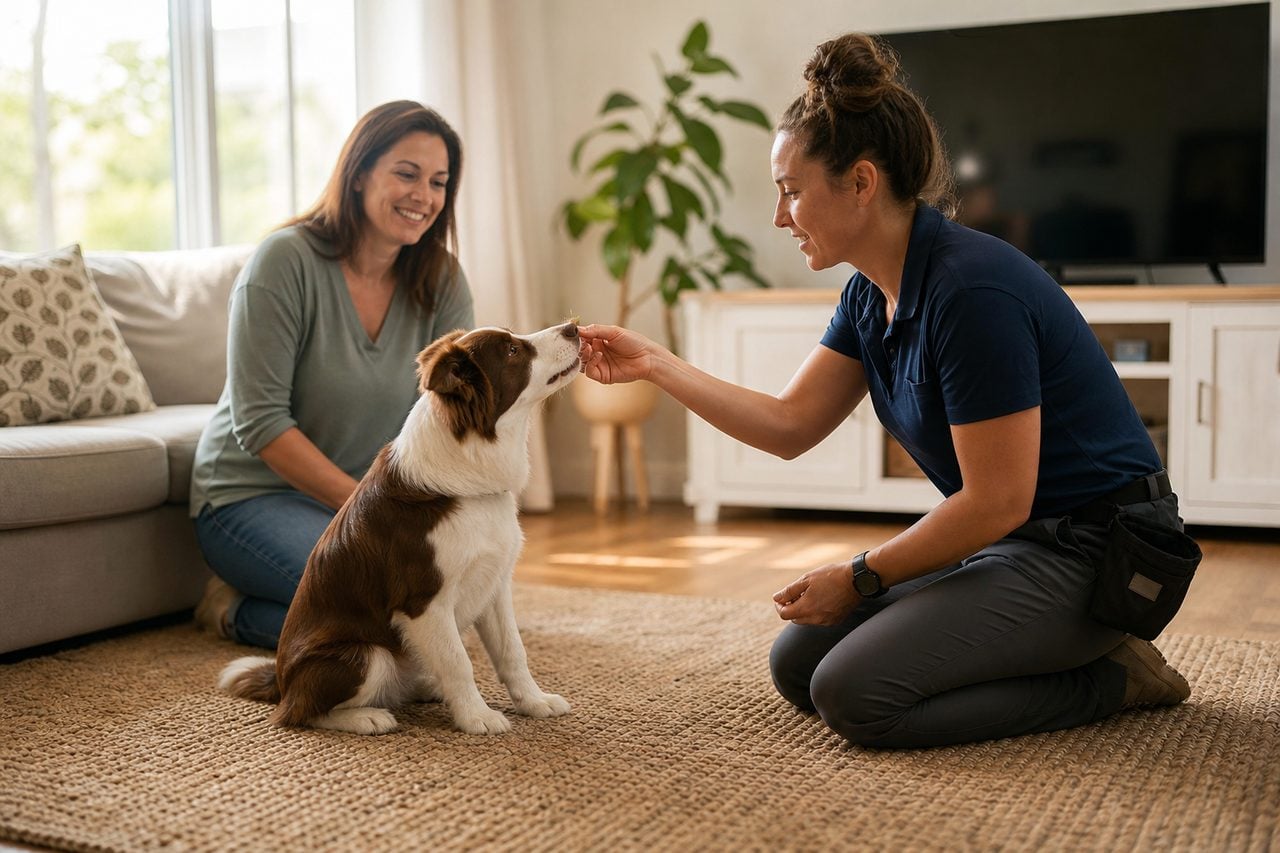
In-home dog training brings the trainer to you, working with your dog in the exact environment where it lives, eats, sleeps, and often misbehaves. For many Kalamazoo-area families, that’s a decisive advantage. The jumping happens at your front door, the counter-surfing happens in your kitchen, and the leash pulling starts on your own driveway, so it makes sense to address those behaviors where they actually occur rather than in an unfamiliar facility.
Dedicated in-home and behavior-focused trainers are somewhat thinner on the ground locally than group-class providers, and some families do travel toward the wider region, including Grand Rapids, for specialized help. But in-home training is widely available across the Kalamazoo metro, from the WMU-area neighborhoods out to Comstock, Richland, Vicksburg, Mattawan, and Plainwell, and it suits a broad range of situations.
This guide explains how in-home training works, who benefits most from it, what a good session looks like, and how to choose a provider. It also compares in-home work honestly against group classes, since the two solve different problems and many families end up using both. Use the directory on this page to compare local options once you know what you’re looking for, and use the framework below to make sure you’re choosing based on fit rather than convenience alone.
How In-Home Training Works
In-home training is one-on-one instruction delivered at your house, usually in a series of scheduled sessions. Rather than you loading the dog into the car and driving to a class, the trainer arrives at your door and works with you, your dog, and your household in the setting where behavior problems live.
Most programs follow a rough arc. The first visit is typically an assessment and consultation: the trainer meets your dog, watches how it behaves in its normal environment, asks about your history and goals, and lays out a plan. Subsequent sessions teach specific skills and address specific problems, with the trainer coaching you as much as working the dog directly. A core principle of good in-home training is that you are the one who will maintain the behaviors, so a big part of each session is teaching you the mechanics and the timing.
Between visits, you practice the assigned homework in daily life. Because the training happens in your real environment, that homework transfers seamlessly; there’s no gap between the training context and the living context. This is a major reason in-home work can produce durable results for household behavior problems.
Session frequency varies. Some families do weekly visits over several weeks; others space sessions further apart to allow more practice time in between. A few providers offer day-training, where the trainer works your dog during the day while you’re out, paired with handover sessions so you learn to maintain what the dog learned. The right cadence depends on your goals, your schedule, and your budget.
The coaching-first structure is a feature, not a shortcut. A trainer who works only the dog and leaves without transferring the skills to you sets you up to lose progress the moment they drive away, because your dog will happily respond to the person holding the treats and the plan while ignoring the rest of the household. The better model treats each session as a lesson for the humans as much as the dog: the trainer demonstrates, then hands you the leash and coaches your timing, your mechanics, and your reading of the dog in real time. That’s why good in-home programs ask the family to participate and assign homework, so what happens in the session becomes what happens all week.
Who Benefits Most from In-Home Training
In-home training isn’t only for problem dogs, but certain situations make it the clear choice.
Household behavior problems. Jumping on guests, door-dashing, counter-surfing, stealing laundry, barking at the window, pushy begging at the table, these are all context-specific behaviors that are best fixed where they happen. A trainer standing in your entryway can address door greetings far more precisely than any classroom drill.
Puppies and house-manners foundations. House-training, crate training, settling routines, and preventing bad habits before they form are naturally suited to in-home work, since these are all about how your dog lives in your specific space.
Fearful, anxious, or reactive dogs. Dogs that shut down or come apart in a busy class often do far better learning in the calm, familiar surroundings of home. In-home work lets them build skills without the added stress of a strange, crowded environment, and it’s frequently the recommended starting point before any group setting.
Multi-dog and whole-family dynamics. When the issue involves how several dogs interact, or when the whole family needs to get on the same page with rules and cues, having the trainer observe the real household dynamic is invaluable.
Busy or logistics-constrained households. For families in the outer parts of the county, Richland and the Gull Lake area, Schoolcraft and the south, Otsego and Plainwell to the north, where a weekly drive to a city facility is a hassle, having the trainer come to you removes a real barrier. It’s also a fit for owners juggling tight schedules or limited transportation.
In-Home Training vs. Group Classes
In-home training and group classes each have genuine strengths, and the best choice depends on your dog and your goals. It helps to see them side by side.
Individual attention. In-home training is entirely focused on your dog, so the plan is fully customized and the pace matches your dog exactly. Group classes split the instructor’s attention among several dogs, though a good instructor still tailors advice.
Environment. In-home work addresses real-world household problems in the place they occur, which is its biggest edge for issues like door greetings and counter-surfing. The trade-off is that home is low-distraction, so a dog trained only at home may need extra work to generalize skills to busy places.
Distraction and socialization. Group classes shine here. The controlled presence of other dogs and people is built-in distraction practice and, for social dogs, valuable exposure. A dog that behaves perfectly in your quiet living room but falls apart around other dogs benefits from that group experience.
Cost. Group classes are generally the more budget-friendly option per hour because the instructor’s time is shared. In-home and private training costs more per session in exchange for that undivided, customized attention.
Convenience. In-home wins on logistics: no drive, no packing up the dog, sessions on your schedule in your space. For families in the outer suburbs or with transportation constraints, that convenience can be the deciding factor.
Many families end up combining the two. A common path is to start with in-home sessions to fix pressing household problems and build a foundation, then move into a group class to add distraction training and social exposure once the dog is ready.
Serving the Kalamazoo Metro
In-home training’s biggest practical benefit is that it comes to you, which matters across a county as spread out as Kalamazoo’s. Coverage and travel considerations differ by area, so it’s worth thinking about where you are.
Kalamazoo & the WMU area: The city core and campus neighborhoods have the most in-home options and the shortest trainer travel times. Apartment and rental households near WMU often prefer in-home work because it addresses the specific challenges of training in shared buildings and small spaces.
Comstock, Galesburg & the East: Eastside families along I-94 are usually within easy reach of city-based trainers who travel, though it’s worth confirming a provider’s service area before booking.
Richland, Augusta & the Gull Lake area: This more rural, lake-oriented northeast pocket is exactly where in-home training earns its keep, since standing group classes are sparser here. Ask about any travel considerations for the outer edges.
Schoolcraft, Vicksburg & the South: South along US-131, in-home work is a practical answer to thinner local class options. Many providers based in the city will travel south; confirm coverage.
Mattawan, Paw Paw & the West: Heading toward Van Buren County, families should check whether a trainer serves that far west, as some draw a service boundary at the county line.
Otsego, Plainwell & the North: North of Kalamazoo, in-home training spares residents the drive south. As with all outer areas, confirm the provider’s range before scheduling.
Whatever your location, ask up front about a trainer’s service area and whether travel affects scheduling or availability. A quick conversation avoids surprises and ensures the provider can reliably reach you week after week.
Common Problems In-Home Training Solves
It helps to see the specific everyday problems that in-home training is especially good at, because these are the ones that make living with a dog harder and that a facility class can’t easily reach.
Door and greeting chaos. The dog that bolts for the door, barks at every knock, or bowls over arriving guests is displaying a behavior that’s tightly bound to your actual entryway. A trainer working at your door can stage realistic arrivals and teach a calm, repeatable routine, going to a mat, waiting for a release, greeting politely, in the exact spot it needs to happen.
House-training and crate issues. Reliable house-training depends on your specific schedule, layout, and routines. In-home coaching lets a trainer set up a realistic plan around your home and catch the small management errors, like an over-large crate or an inconsistent potty schedule, that stall progress.
Kitchen and counter behaviors. Counter-surfing, begging, and stealing food are rehearsed in your kitchen with your counters and your smells. Addressing them where they happen, with management tailored to your space, works better than trying to generalize from a classroom.
Barking at windows and yard triggers. Alert-barking at people, delivery vehicles, or squirrels is location-specific. A trainer can see the actual sightlines and triggers, then combine simple management, like adjusting access to a favorite lookout window, with training an alternative response.
Settling and calm in the home. Teaching a dog to relax on a bed or mat while the household goes about its evening is naturally an in-home skill. So is building independence for a dog that shadows you from room to room.
Leash foundations from the driveway. Loose-leash walking often falls apart the moment you leave the house. Starting the work on your own driveway and street, where the walk actually begins, gives a more honest and durable result than practicing only in a facility.
Choosing an In-Home Trainer
Because a trainer will be coming into your home and working closely with your family, choosing well is worth some care. A few checks go a long way.
Confirm the methods. As with any training, look for reward-based, positive-reinforcement approaches that teach the dog what to do and address the root of problems rather than just suppressing symptoms. Ask the trainer to explain how they’d tackle one of your specific issues. Clear, humane, reasoned answers are a good sign.
Ask about relevant experience. Match the trainer to your need. General manners and puppy foundations are widely covered, but if you’re dealing with fear, reactivity, or aggression, ask specifically about experience with those issues, since not every trainer handles them and some cases warrant a behavior specialist.
Understand the program structure. Ask how many sessions a typical plan involves, how long each session runs, what homework looks like, and how they measure progress. A vague, open-ended arrangement is harder to evaluate than a clear plan with defined goals.
Clarify what’s included. Find out whether the first visit is an assessment, whether packages or single sessions are offered, and whether follow-up support between visits is included. Understanding the structure up front prevents misunderstandings later.
Ask about the household’s role. A strong in-home trainer will want the people who live with the dog to participate, because you’re the ones maintaining the behavior. If a provider proposes to do all the work with no involvement from you, ask how the skills will transfer once they leave.
Use the listings on this page to compare in-home providers across the Kalamazoo metro. Reach out to a couple, describe your dog and your goals honestly, and pick the trainer whose approach and plan you understand and trust.
Preparing for Your First Session
A little preparation makes the first in-home session more productive and sets the tone for the whole program.
Write down your goals and history. Before the trainer arrives, jot down the specific behaviors you want to change, when and where they happen, and anything you’ve already tried. Note your dog’s background, health, and any patterns you’ve spotted. This gives the trainer a head start and ensures nothing important gets forgotten.
Have the whole household present if you can. Since everyone who lives with the dog influences its behavior, having the family there for at least the first session means everyone hears the plan and learns the same cues. Consistency across handlers is one of the biggest factors in success.
Gather supplies. Ask ahead what to have ready. Usually it’s high-value treats, your dog’s regular leash and collar or harness, a favorite toy, and any equipment you already use. Having a hungry-but-not-starving dog helps, so plan meals around the session if the trainer suggests it.
Set up the space and manage expectations. Decide with the trainer whether the dog should greet them at the door as a working example or be settled first. Be ready to show the real behavior; a trainer needs to see the actual door-greeting or counter-surf, not a rehearsed version. And remember that the first session is largely assessment and foundation, so give the process time before judging results.
With clear goals, the right people in the room, and an honest picture of your dog, an in-home program can address the everyday problems that make life with a dog harder, right where they happen. Compare the local providers on this page and start with the one that fits your household best.
In-Home Dog Training in Kalamazoo: Local Options & Nearest Specialists
A few Kalamazoo-area trainers can help with milder in-home dog training needs:
- Cloud 9 Canine – Kalamazoo Dog Training & Pet Care — 4.9★ (132 reviews)
Nearest in-home dog training specialists — Grand Rapids
For complex cases, some families travel to the larger pool of specialists in the Grand Rapids area for an assessment or a board-and-train stay. Top-reviewed options:
See all Grand Rapids in-home dog training trainers →
Frequently Asked Questions
What is in-home dog training?
In-home dog training is one-on-one instruction delivered at your house rather than at a facility. A trainer comes to you, works with your dog in the environment where it actually lives and misbehaves, and coaches you and your household to maintain the behaviors between sessions. It’s especially effective for household problems like jumping, door-dashing, and counter-surfing, and for dogs that struggle in busy class settings.
Is in-home training better than a group class?
It depends on your goals. In-home training offers fully customized, one-on-one attention and fixes real-world household problems where they happen, which is ideal for behavior issues, puppies, and anxious or reactive dogs. Group classes are more budget-friendly and provide built-in distraction and socialization, which social dogs benefit from. Many families combine them, starting in-home to fix pressing problems, then joining a group for distraction practice once the dog is ready.
Do in-home trainers travel to the Kalamazoo suburbs?
Many do, but service areas vary, so always confirm coverage before booking. City-based trainers commonly travel to eastside communities like Comstock and Galesburg and often reach Richland, Vicksburg, Schoolcraft, Mattawan, and the Otsego and Plainwell area to the north. For the outer edges of the county, ask whether travel affects scheduling or availability, and confirm the provider serves your specific location.
Can in-home training handle serious behavior problems?
In-home training is well suited to many behavior problems, and the calm, familiar setting often helps fearful, anxious, and reactive dogs learn better than a busy class would. However, not every trainer handles serious issues like aggression, so ask specifically about relevant experience. Severe cases may warrant a behavior specialist, and some families travel toward the wider region, including Grand Rapids, for that level of expertise. A veterinary check is also wise when behavior changes suddenly.
How many in-home sessions will my dog need?
It varies with your goals and your dog. Some households resolve specific problems in a handful of sessions; broader training or behavior work takes longer. Good trainers outline a suggested plan up front, including how many sessions they expect and what homework you’ll do in between. Since you maintain the behaviors between visits, consistent practice often shortens the overall program.
How should I prepare for the first in-home session?
Write down the specific behaviors you want to change and when they happen, note your dog’s history and health, and have the whole household present if possible so everyone learns the same cues. Ask ahead what supplies to have ready, usually high-value treats, your regular leash and harness, and a favorite toy. Be prepared to show the real behavior so the trainer can assess it, and expect the first visit to focus on assessment and foundation.
Related: read our complete in-home dog training guide or the full Kalamazoo dog training overview.
Ready to find the right in-home dog training pro in Kalamazoo?