
In-Home Dog Training in Saginaw, MI
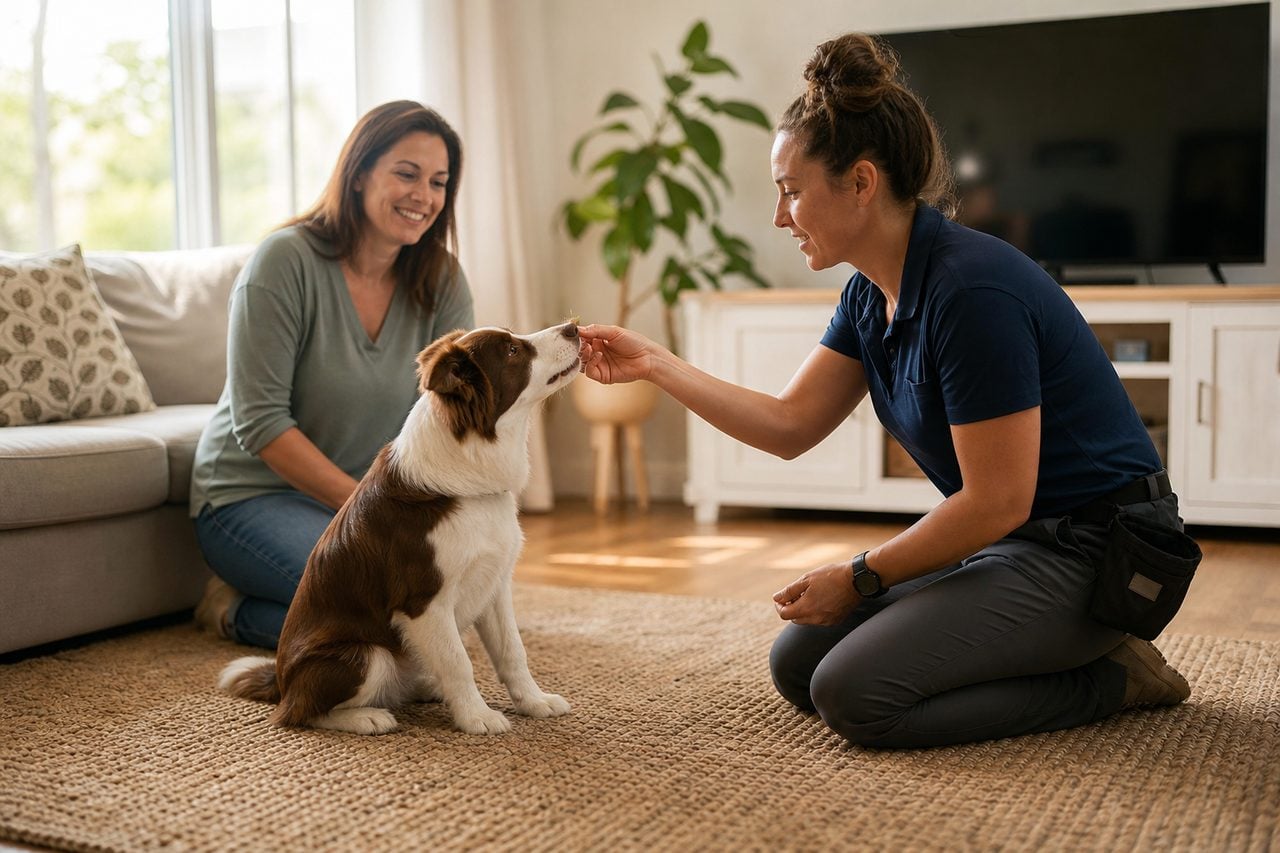
In-home dog training brings a professional trainer to your house instead of asking you to load the dog into the car and drive to a class. For a lot of Tri-Cities families — busy schedules, a dog that struggles in new environments, or problems that only happen at home — that convenience is exactly the point. But in-home training is more than just a house call; it changes how and where your dog learns, and understanding those trade-offs helps you decide whether it’s the right fit.
- How In-Home Training Works
- What In-Home Training Is Best For
- In-Home vs. Group Classes: Choosing the Right Format
- Choosing an In-Home Trainer in the Tri-Cities
- Making the Most of In-Home Sessions
- Setting Expectations and Costs in Perspective
- Common In-Home Training Goals and How They're Addressed
- Reviewed trainers
- FAQ
The core idea is that many behavior issues are tied to a specific environment. A dog that bolts out the front door, guards a spot on the couch, barks at every delivery, or won’t settle in the evening is showing you behavior rooted in your actual home. Training in that exact context — your doorway, your furniture, your yard in Saginaw or Freeland — lets the trainer address the problem where it lives rather than in a rented room across town.
One honest note: trainers who focus on in-home and private work are somewhat less plentiful in the Tri-Cities than group-class facilities, so some families look to the wider region, including Flint, when they want a specialist for a particular issue. This guide covers how in-home training works, what it’s best for, and how to choose a good provider whether you find one nearby or a bit farther out.
How In-Home Training Works
In-home training is a private-lesson format delivered at your house. A trainer typically starts with an assessment session: they observe your dog in its normal environment, ask about your routines and goals, watch the problem behaviors happen in context, and build a plan tailored to your household. From there, sessions usually run on a schedule — often weekly — with the trainer coaching you through techniques and assigning practice to do between visits.
The crucial thing to understand is that most in-home programs train you as much as your dog. Because the trainer isn’t there day to day, your ability to carry out the plan between sessions is what drives results. A good in-home trainer functions like a coach: they demonstrate a technique, hand you the leash, watch you do it, and correct your timing and mechanics on the spot. That hands-on feedback in your own home is one of the format’s real strengths.
There’s also a “board-and-train” variant where the dog stays with a trainer for a period, but that’s distinct from true in-home training and comes with its own considerations, chiefly the need to transfer the trained behaviors back to you and your home afterward. Classic in-home training keeps the dog with you the whole time, which sidesteps that transfer problem entirely — the learning happens in the place it needs to stick.
Sessions are usually flexible in scheduling, which is a big draw for shift workers and families whose evenings don’t line up with a fixed weekly class across the metro.
What In-Home Training Is Best For
In-home training shines for a specific set of situations. First and most obviously, home-context problems: door-dashing, jumping on guests, counter-surfing, barking at the mail carrier, not settling in the living room, house-training struggles, or trouble with a specific room or piece of furniture. These behaviors are woven into your home’s layout and routines, and training them on-site is far more direct than trying to recreate the scenario elsewhere.
Second, dogs that don’t cope well in group settings. A fearful, easily overwhelmed, or reactive dog may be unable to learn in a room full of other dogs, at least at first. Starting at home, in a calm and familiar environment, lets that dog actually absorb the lessons before — if appropriate — graduating to more distracting settings later.
Third, convenience and schedule. Families juggling work, kids, and a long Tri-Cities commute sometimes simply can’t commit to a fixed weekly class time across town. In-home sessions that come to you in Auburn, Essexville, or Hemlock remove the drive and the scheduling friction, which for some households is the difference between training happening and not happening at all.
Fourth, puppies and new dogs, where establishing good habits and house rules from day one at home — house-training, crate comfort, gentle handling, early manners — sets a strong foundation. It’s worth naming the trade-off, though: because in-home work starts in a low-distraction environment, dogs that need to learn to behave around other dogs and in public will eventually need controlled exposure to those settings. In-home training and group classes aren’t rivals so much as tools for different jobs, and many families use in-home work first, then a group class to generalize.
In-Home vs. Group Classes: Choosing the Right Format
The honest comparison comes down to what your dog needs to learn and where. Group classes have one thing in-home training structurally lacks: other dogs and a busy environment. That built-in distraction is exactly what makes a cue reliable in the real world, and it’s the reason a socially normal dog learning basic manners is often well served by a group class. Group classes also tend to be the more economical route to professional instruction.
In-home training’s advantages are context, individualization, and convenience. You get the trainer’s full attention on your dog’s specific issues, in the exact environment where they occur, on a schedule that bends to your life. The downside is the absence of natural distraction and the higher per-session attention that private work involves.
For many Tri-Cities families the smartest path is sequential rather than either/or. In-home training first — to solve home-context problems, build a foundation with a nervous dog, or get a puppy started right — followed by a group class to add the distraction tolerance that only a room full of dogs provides. A dog that has settled its door-dashing and learned solid cues at home is far more ready to succeed in a group than one thrown into the deep end.
When you evaluate options, be clear with yourself about the primary goal. If the problem is “my dog goes berserk when the doorbell rings,” that’s an in-home job. If it’s “my dog needs to learn to walk calmly past other dogs,” you’ll need controlled exposure a group setting provides, even if you start at home. Matching format to goal saves money and frustration.
Choosing an In-Home Trainer in the Tri-Cities
Because an in-home trainer works in your space and coaches your family directly, fit matters even more than with a group class. Start with method: reward-based, humane techniques are the mainstream standard, and a trainer who can clearly explain their approach — and why — is a safer choice than one who relies on jargon or promises. Ask what a typical session looks like, how they structure the program, and what they’ll expect of you between visits.
Ask specifically about experience with your issue. In-home training covers a broad range, from puppy basics to serious behavior problems, and a trainer strong in one area may be less experienced in another. If your concern is something like guarding or significant anxiety, ask directly how often they work such cases and how they approach them. Trainers who focus on private and in-home behavior work are somewhat fewer in the Tri-Cities than group-class providers, so if your issue is specialized, be prepared to look toward the wider region — Flint is the nearest larger market — to find the right person.
Practical questions matter too: service area (will they drive to Chesaning or out toward the bay shore?), session length, how many sessions a typical program runs, and what happens if progress stalls. A trustworthy trainer sets honest expectations and won’t promise a guaranteed fix in a fixed number of visits — behavior change depends on the dog and on your follow-through.
Finally, trust your read on rapport. A trainer will be in your home coaching your family, so you want someone who communicates clearly, is patient with the humans as well as the dog, and whose handling you’re comfortable with. Use this directory to shortlist candidates by location and focus, then talk to a couple before committing — the conversation usually tells you a lot.
Making the Most of In-Home Sessions
Since in-home training lives or dies on what happens between visits, a little preparation and follow-through go a long way. Before the first session, jot down the specific behaviors you want to address and the situations where they happen — the more concrete you are, the faster the trainer can zero in. Note the times of day problems occur and anything you’ve already tried, successful or not.
During sessions, get everyone in the household involved as much as possible. Dogs do best with consistency, and if one family member enforces a rule while another doesn’t, the dog stays confused and progress stalls. Having the whole family learn the same cues and the same responses — even the kids, at an age-appropriate level — is one of the biggest advantages of training at home, where the whole household is present. Agree on cue words and house rules together so the dog gets one consistent message.
Between sessions, do the homework. Short, frequent practice folded into daily routines beats occasional long drills. Practice cues in the real moments they matter — ask for calm at the actual doorway when someone actually arrives, not just in a staged setup. As your dog gets solid at home, start generalizing: practice in the yard, then on quiet walks, then in gradually busier Tri-Cities settings like a low-traffic stretch of the Saginaw Valley Rail Trail or the calmer trails at the Chippewa Nature Center. That progression is how home-learned behaviors become reliable out in the world.
Keep notes on what’s working and what isn’t, and bring them to each session. That feedback lets the trainer adjust the plan to your actual dog rather than a generic template — which is the whole point of paying for individualized, in-home work.
Setting Expectations and Costs in Perspective
In-home training is a private-instruction format, and it’s worth setting expectations honestly on both results and value. On results: like all training, it’s a process. An assessment plus a handful of sessions can produce real change on a focused problem, but lasting reliability comes from your consistent follow-through afterward. A trainer who promises to eliminate a behavior in one visit is overselling; behavior change depends on the dog, the issue, and how faithfully you do the between-session work.
On value: in-home and private training generally reflects the personalized, one-on-one attention and the trainer’s travel time, so per-session it tends to sit at the higher end of the training spectrum compared with group classes, which spread a trainer’s time across many dogs. Whether that’s the right spend depends on your situation — for a home-specific problem, a nervous dog that can’t cope in a group, or a schedule that rules out fixed classes, the individualized approach can be more efficient overall because it targets exactly what you need. For a socially normal dog just learning basic manners, a group class may deliver more for less. There’s no universal answer; match the format to the job.
When comparing providers, look at the whole package rather than a single session figure: how many sessions a program includes, what’s covered, whether follow-up support is available, and the service area. A slightly longer drive for a trainer who’s genuinely experienced with your issue can be the better value than a closer one who isn’t.
Whatever you choose, think of training as an investment with a long payoff. A dog that greets guests politely, settles calmly in the evening, and can be trusted at the door makes daily life in your Saginaw-area home better for years — and that’s the real return on getting the training right.
Common In-Home Training Goals and How They're Addressed
It helps to see how in-home training actually tackles the everyday problems that lead Tri-Cities families to call a trainer in the first place. The specifics vary by dog, but the pattern — work the behavior in the exact context where it happens — is consistent.
Door manners and door-dashing are classic in-home jobs precisely because they’re tied to your actual doorway. A trainer works with your real door, your real doorbell, and staged arrivals to teach the dog an alternative behavior — going to a mat, sitting back from the door — that’s incompatible with bolting or mobbing guests. Because it happens at the real door, the learning sticks where you need it.
Jumping on people is addressed the same way: rewarding four-on-the-floor and calm greetings in the entryway where guests actually arrive, with the whole household practicing the same response so the dog gets one consistent message. Settling and calmness — a dog that can’t relax in the evening — is trained in your living room, teaching the dog to settle on a bed or mat in the space where the family actually spends its evenings.
House-training and crate comfort are natural fits for in-home work with puppies and newly adopted dogs, since both depend entirely on your home’s layout and your daily schedule. A trainer can look at your specific setup and routine and build a plan around it rather than offering generic advice. Barking at windows or deliveries gets worked at the actual window, combining management (blocking the view) with training an alternative response.
For each of these, the trainer’s real job is to coach you to run the plan when they’re not there, because the mail carrier and the evening wind-down happen daily and the trainer visits weekly. That’s why in-home training emphasizes clear homework and getting the whole family on the same page — the goal is a household that can maintain the behavior long after the sessions end, in the Auburn or Essexville home where the dog actually lives.
In-Home Dog Training in Saginaw: Local Options & Nearest Specialists
A few Saginaw-area trainers can help with milder in-home dog training needs:
- Paws & Beyond — 5.0★ (81 reviews)
- K9 Optimal Training Solutions — 5.0★ (42 reviews)
Nearest in-home dog training specialists — Flint
For complex cases, some families travel to the larger pool of specialists in the Flint area for an assessment or a board-and-train stay. Top-reviewed options:
See all Flint in-home dog training trainers →
Frequently Asked Questions
What exactly is in-home dog training?
In-home dog training is a private-lesson format where a trainer comes to your house instead of you attending a class. It usually starts with an assessment of your dog in its normal environment, followed by scheduled sessions — often weekly — where the trainer coaches you through techniques and assigns practice between visits. A key feature is that it trains you as much as your dog, since your follow-through between sessions is what drives results. Unlike board-and-train, the dog stays with you the whole time.
What problems is in-home training best for?
It’s strongest for home-context behaviors — door-dashing, jumping on guests, counter-surfing, barking at deliveries, not settling, or house-training struggles — because these are tied to your home’s layout and routines. It also suits dogs that can’t cope in a busy group setting, puppies and new dogs establishing house rules from day one, and families whose schedules rule out a fixed weekly class. The trade-off is that dogs needing to learn to behave around other dogs will eventually need controlled exposure a group setting provides.
Is in-home training better than a group class?
Neither is universally better — they do different jobs. Group classes provide other dogs and a busy environment, which builds the distraction tolerance that makes cues reliable in public, and they tend to cost less. In-home training provides context, individual attention, and convenience for home-specific problems and dogs that struggle in groups. Many Tri-Cities families use in-home work first to build a foundation, then a group class to generalize the skills around distraction.
Are in-home trainers easy to find in the Saginaw area?
Trainers focused on private, in-home behavior work are somewhat less plentiful in the Tri-Cities than group-class facilities. For general in-home training you’ll usually find local options, but for a specialized issue — serious guarding, significant anxiety — some families look to the wider region, with Flint the nearest larger market, to find the right specialist. Ask trainers directly how often they work your specific issue, and be willing to widen your radius if needed.
How do I get the most out of in-home sessions?
Come prepared with a concrete list of the behaviors and situations you want to address, get the whole household involved so everyone uses the same cues and rules, and do the between-session homework in short, frequent reps folded into daily life. Practice in the real moments that matter — at the actual doorway when someone arrives — then gradually generalize to the yard, quiet walks, and busier settings like the Saginaw Valley Rail Trail. Keep notes on what’s working and share them each session so the plan stays tailored to your dog.
Does in-home training cost more than group classes?
Generally yes on a per-session basis, because in-home and private training reflects one-on-one attention and the trainer’s travel time, while group classes spread a trainer’s time across many dogs. Whether it’s the better value depends on your situation: for a home-specific problem, a nervous dog, or a schedule that rules out fixed classes, the targeted approach can be more efficient overall. For a socially normal dog learning basic manners, a group class often delivers more for less. Compare the whole program — number of sessions, coverage, follow-up — rather than a single session figure.
Related: read our complete in-home dog training guide or the full Saginaw dog training overview.
Ready to find the right in-home dog training pro in Saginaw?