
In-Home Dog Training in Muskegon, MI
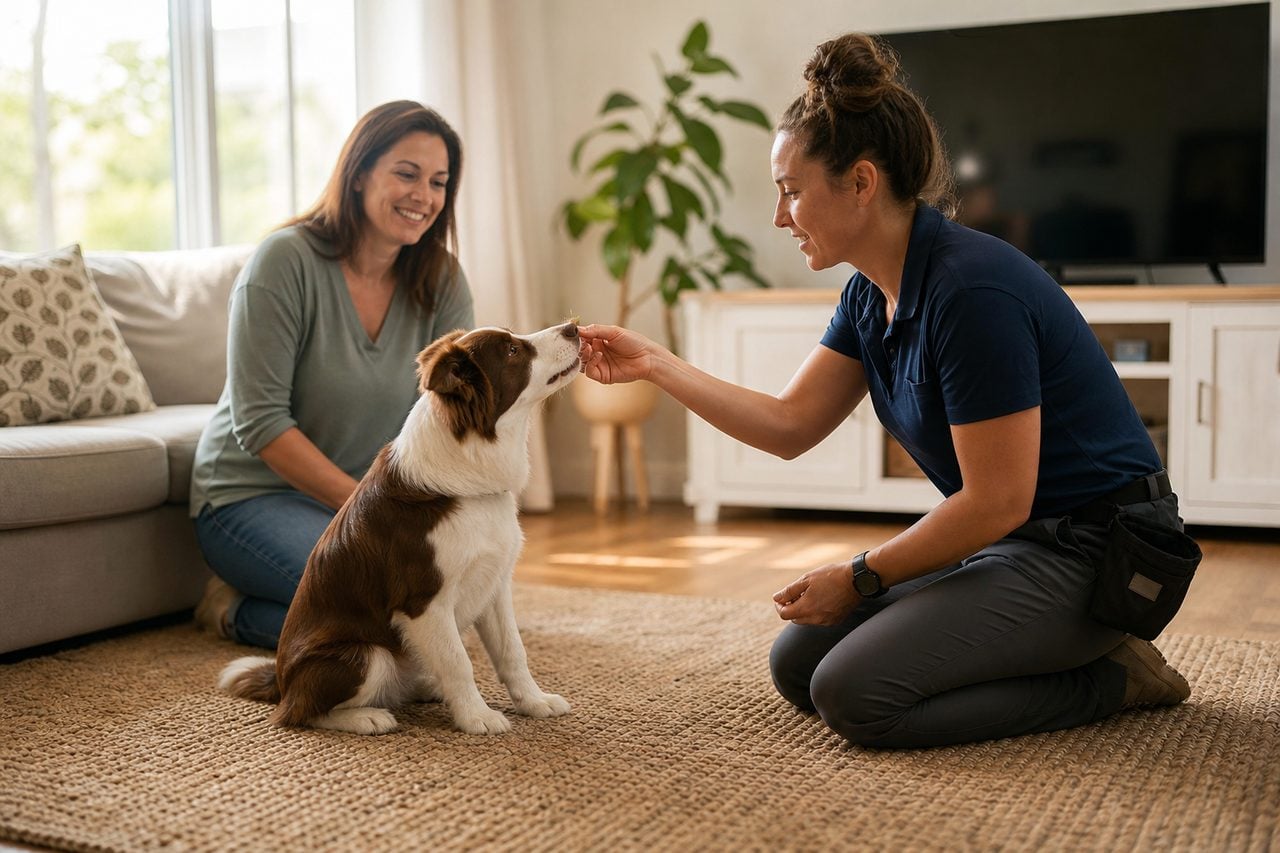
In-home dog training brings the trainer to you, working with your dog in the exact environment where most of its behavior actually happens: your living room, your kitchen, your front door, your yard. For many Muskegon-lakeshore families, that convenience and real-world relevance make it an appealing alternative to loading the dog into the car for a class across town.
- How In-Home Training Works
- When In-Home Training Is the Right Choice
- In-Home vs. Group Classes vs. Board-and-Train
- Choosing an In-Home Trainer on the Lakeshore
- Preparing Your Home and Getting the Most From Sessions
- Common In-Home Problems and How Sessions Address Them
- Realistic Expectations and Long-Term Success
- Reviewed trainers
- FAQ
Whether you are in a Norton Shores subdivision, an older home near Muskegon Lake, a place out in Twin Lake or Fruitport, or somewhere along the Grand Haven and Spring Lake waterfront, in-home training meets you where you live. It is particularly well suited to house-related problems, doorbell chaos, jumping on guests, house-training, and separation issues, because the trainer sees the problem in its natural context.
In-home and private training options are somewhat more limited on the immediate lakeshore than general group classes, and a few families do reach toward the wider region, including Grand Rapids, for a specific trainer. Even so, local options exist, and this guide walks you through how in-home training works, when it is the right choice, and how to get the most from it.
How In-Home Training Works
In-home training is simply private, one-on-one instruction delivered at your house instead of at a facility. A trainer typically starts with an initial consultation, discussing your goals, watching your dog behave in its normal setting, and identifying the routines and environmental factors that shape the behavior. From there, they build a plan tailored to your household.
Sessions usually run from about an hour, scheduled weekly or on whatever cadence fits your progress. Crucially, a large part of what the trainer does is coach you. Because they are in your home, they can show you how to manage the actual doorway your dog charges, the actual couch it steals, and the actual walking route you use, then hand the skills off so you can maintain them.
Most in-home trainers use reward-based, positive-reinforcement methods, the same humane, mainstream approach used in good group classes. The difference is context and customization, not philosophy. Between sessions, you are expected to practice the assigned exercises; the trainer’s visits are checkpoints and course-corrections, not the whole of the training.
Some trainers offer packages of several sessions, sometimes blending in-home visits with phone or video check-ins. Ask how a program is structured, how many sessions are typical for your goals, and what is expected of you day to day, so you know what you are committing to.
One of the underrated strengths of the in-home format is how naturally it fits into a real household’s rhythm. Instead of carving out a weeknight to drive across the metro to a facility, the training comes to your kitchen table, and the exercises you’re assigned use the very objects, doorways, and routines that fill your days. That tight connection between what you practice and where you actually live is a big part of why in-home training transfers so well, there is no gap to bridge between the lesson and daily life, because they happen in the same place.
When In-Home Training Is the Right Choice
In-home training shines for problems that are tied to the home environment, because the trainer can address them exactly where they occur.
House-training and puppy basics benefit enormously from an on-site eye. A trainer can assess your schedule, your crate setup, and your home’s layout to build a house-training plan that actually fits your life, something hard to do from a classroom.
Door and greeting behavior, jumping on visitors, bolting out the front door, barking at the doorbell, is best fixed at the real door with real practice. The same goes for resource guarding around the home, counter-surfing, and furniture rules.
Separation-related issues are inherently home-based; a trainer needs to understand your departure routine and your dog’s response to it in situ.
In-home training is also ideal for dogs that are fearful, anxious, or overwhelmed in new places, or that don’t do well riding in the car. A dog too stressed to learn in a busy class may thrive learning in its own calm space. It suits busy households that value the convenience of not commuting, families with young children for whom coordinating class attendance is hard, and owners of senior or mobility-limited dogs.
Where in-home training is not the ideal first choice is when the goal is heavy socialization or proofing around other dogs, a group class provides distractions and canine company that your living room cannot. Many families do both: in-home work for household manners, and a group class or outings for socialization once the foundations are set.
In-Home vs. Group Classes vs. Board-and-Train
Each training format has a niche, and choosing well depends on your dog and your goals.
Group classes offer affordability, built-in distraction, and socialization with other dogs and people. They are the workhorse for basic obedience and for well-adjusted dogs that need to learn to focus around distraction. The trade-off is a fixed pace, divided instructor attention, and a commute to class each week.
In-home private training offers customization, convenience, and direct relevance to your actual living situation. The trainer’s full attention is on you and your dog, and progress can be fast on targeted problems. The trade-offs are a higher cost per session than group classes and less exposure to the distractions that build real-world reliability, though a good trainer can arrange outings to address that.
Board-and-train, where your dog stays with the trainer for intensive work, is the most hands-off for the owner and the largest investment. It can jump-start progress, but the results still depend on you learning to maintain them once the dog comes home, and your dog is away from you during the stay. Evaluate any board-and-train program carefully, ask about methods, the daily schedule, and how skills are transferred back to you.
A useful lens is to ask where the behavior you want to change actually lives. If the problem is fundamentally about your home, house-training, doorway manners, settling in the evening, then training in your home is the most direct path. If the problem is about the wider world, focus and calm around other dogs, people, and distractions, then a format with built-in distraction, or deliberate outings, becomes important. The point is to train in, or at least regularly practice in, the context where you ultimately need the behavior, because dogs are famously context-specific learners.
There is no universally best format, only the best fit. A reactive or fearful dog often does best starting in-home; a social butterfly that needs manners around distractions may thrive in a group class; a family wanting maximum convenience and targeted results may prefer in-home even at a higher per-session cost. And plenty of families combine formats over time, meeting each need with the tool best suited to it.
Choosing an In-Home Trainer on the Lakeshore
Because a trainer will be coming into your home and working closely with your family, vetting matters. A few things to check:
Methods. Favor trainers who describe reward-based, positive-reinforcement approaches and can explain how they handle unwanted behavior without fear, pain, or intimidation. Ask directly, and be cautious of anyone leaning on aversive tools as a first resort or promising guaranteed outcomes.
Service area. In-home trainers charge for their time and often their travel, so confirm they serve your town, whether that is Muskegon, Whitehall, Grand Haven, Coopersville, or the more rural inland areas around Twin Lake and Nunica. A trainer based on the far side of the metro may add a travel fee or simply be out of range.
Experience with your specific issue. A trainer great at puppy basics may not specialize in separation anxiety or fear, and vice versa. Ask whether they have handled cases like yours.
Structure and expectations. Understand how many sessions are typical, what a package includes, and what you are expected to practice between visits. Clear communication up front prevents disappointment later.
Because in-home and private options are somewhat thinner on the immediate lakeshore, you may find fewer local specialists for niche issues, and some families do travel toward the wider region, including Grand Rapids, for a particular trainer. Still, start local, use the directory to see who serves your area, and contact a few trainers to compare their approach, availability, and fit before committing.
Preparing Your Home and Getting the Most From Sessions
A little preparation makes in-home sessions far more productive.
Before the first visit, jot down your specific goals and the situations where problems occur, when does the dog jump, guard, bark, or have accidents? Concrete examples help the trainer diagnose quickly. Have your dog’s usual gear, treats, crate, and any relevant items on hand.
Involve the whole household. One of the biggest advantages of in-home training is that everyone who lives with the dog can participate and learn the same handling. When all family members use consistent cues and rules, progress sticks. Inconsistency, one person allowing the couch, another forbidding it, is a common reason training stalls.
Practice between sessions. The trainer’s visit is the coaching; the daily reps are where learning happens. Short, frequent practice sessions, a few minutes several times a day, outperform occasional long ones. Fold cues into ordinary routines: a sit before meals, a wait at the door before walks along your neighborhood streets.
Generalize beyond the house. Because in-home training happens in a familiar, low-distraction setting, deliberately practice cues in new places too, the yard, the sidewalk, and eventually busier spots like the Lakeshore Trail or a park, so behaviors hold up in the real world. Ask your trainer how to add distraction gradually.
Manage the environment while training is in progress. Use gates, leashes, closed doors, and crates to prevent your dog from rehearsing unwanted behaviors between sessions. Preventing the bad habit is as important as teaching the good one. With consistent practice and a whole-family effort, in-home training can produce a well-mannered dog that behaves where it counts most, at home.
Common In-Home Problems and How Sessions Address Them
It helps to picture how in-home training actually tackles the everyday problems that drive families to call a trainer, because seeing the process makes the value concrete.
The chaotic front door is a classic. A trainer working in your home can set up realistic rehearsals, someone knocking or ringing while your dog is on leash and a management plan is in place, and coach you through teaching an alternative behavior, such as going to a mat or sitting for greetings. Because it happens at your real door, the skill transfers directly instead of needing to be re-taught at home.
House-training accidents get diagnosed on-site. The trainer can review your dog’s schedule, feeding times, water access, crate setup, and the specific spots where accidents happen, then build a plan tailored to your home’s layout and your daily routine. Small environmental fixes an in-person trainer spots, like an out-of-the-way area the dog treats as acceptable, are easy to miss when describing the problem over the phone.
Jumping, counter-surfing, and stealing items are addressed with a blend of management and training. The trainer helps you set up the environment so the dog can’t rehearse the habit, then teaches incompatible behaviors, four feet on the floor for attention, a solid leave-it, so the good choice becomes the dog’s default.
Settling and calmness at home, a hugely underrated skill, is well suited to in-home work. Teaching a dog to relax on a mat while the family goes about its evening, or to be calm during the busy after-school and dinner hours, is far easier to build in the actual space where you need it. For families with children, this kind of household calm is often the single most valuable outcome of a training program, and it is difficult to build anywhere but home.
Realistic Expectations and Long-Term Success
In-home training is effective, but it is not instant. How quickly you see change depends on the behavior, your dog, and, above all, your consistency between visits.
Simple manners, sit, down, polite greetings, often improve within a few weeks of steady practice. Deeper issues like separation anxiety, established resource guarding, or long-standing fear take longer and require patience; they are worked through in gradual steps, not fixed overnight. A reputable trainer will give you an honest timeline rather than a guarantee, and any promise of a quick, permanent cure should raise a flag.
Think of the trainer as a coach who sets you up to succeed, not a mechanic who hands back a fixed dog. The most durable results come when the family absorbs the handling skills and keeps using them long after the sessions end. Training is less a one-time project than an ongoing part of living well with a dog.
Expect some unevenness, good days and off days are normal, and occasional regressions, especially around big changes like a move, a new baby, or a shift in routine, are to be expected. When behavior slips, a brief return to the basics usually restores it. Some families schedule an occasional refresher session or check-in to keep things on track.
Finally, keep it positive and enjoyable. Training should strengthen your bond with your dog, not strain it. The lakeshore’s long winters are a good time to work on indoor manners and enrichment, so that when summer returns you have a dog that greets guests politely, settles calmly at home, and is ready to enjoy the beaches and trails with you. With realistic expectations and steady effort, in-home training delivers exactly that.
In-Home Dog Training in Muskegon: Local Options & Nearest Specialists
A few Muskegon-area trainers can help with milder in-home dog training needs:
Nearest in-home dog training specialists — Grand Rapids
For complex cases, some families travel to the larger pool of specialists in the Grand Rapids area for an assessment or a board-and-train stay. Top-reviewed options:
See all Grand Rapids in-home dog training trainers →
Frequently Asked Questions
What kinds of problems is in-home training best for?
In-home training excels at issues tied to the home environment: house-training, jumping on guests, door-dashing and doorbell barking, counter-surfing, furniture rules, resource guarding around the house, and separation-related behavior. It is also a strong choice for dogs that are fearful or overwhelmed in new places, or that don’t travel well, since they learn in their own calm space. For heavy socialization around other dogs, a group class is a better complement.
How is in-home training different from a group class?
In-home training is private, one-on-one instruction in your house, fully customized to your dog and your living situation, with the trainer’s undivided attention and no commute. Group classes are more affordable and provide distraction and socialization with other dogs and people, but move at a fixed pace with divided attention. Many families combine them: in-home work for household manners and a group class or outings for socialization.
How many in-home sessions will my dog need?
It depends on your goals and your dog. Basic manners often improve within a few weeks of consistent practice, while deeper issues like separation anxiety or established fear take longer. Many trainers offer packages of several sessions, sometimes with phone or video check-ins between visits. Ask a prospective trainer for a realistic estimate for your specific situation, and be wary of anyone guaranteeing a fast, permanent fix.
Do in-home trainers serve the smaller and more rural lakeshore towns?
Many do, though because they charge for their time and travel, coverage and any travel fees vary. Confirm that a trainer serves your specific town, whether that is Muskegon, Norton Shores, Whitehall, Grand Haven, Coopersville, or the inland areas around Twin Lake and Nunica, before booking. In-home options are somewhat more limited on the immediate lakeshore than group classes, so it is worth contacting a few and comparing.
Should the whole family be involved in the sessions?
Yes, whenever possible. One of the main advantages of in-home training is that everyone who lives with the dog can learn the same handling and use consistent cues and rules. When one person allows a behavior another forbids, the dog stays confused and progress stalls. Having the household participate is one of the best predictors of lasting success.
Will my dog behave outside the home if it only trains inside?
Not automatically, dogs don’t generalize behaviors as well as people assume. That is why good in-home trainers have you deliberately practice cues in new settings too: the yard, the sidewalk, and eventually busier places like the Lakeshore Trail or a local park. Adding distraction gradually is what makes behaviors hold up in the real world, so ask your trainer how to expand practice beyond the house.
Related: read our complete in-home dog training guide or the full Muskegon dog training overview.
Ready to find the right in-home dog training pro in Muskegon?