
In-Home Dog Training in Traverse City, MI
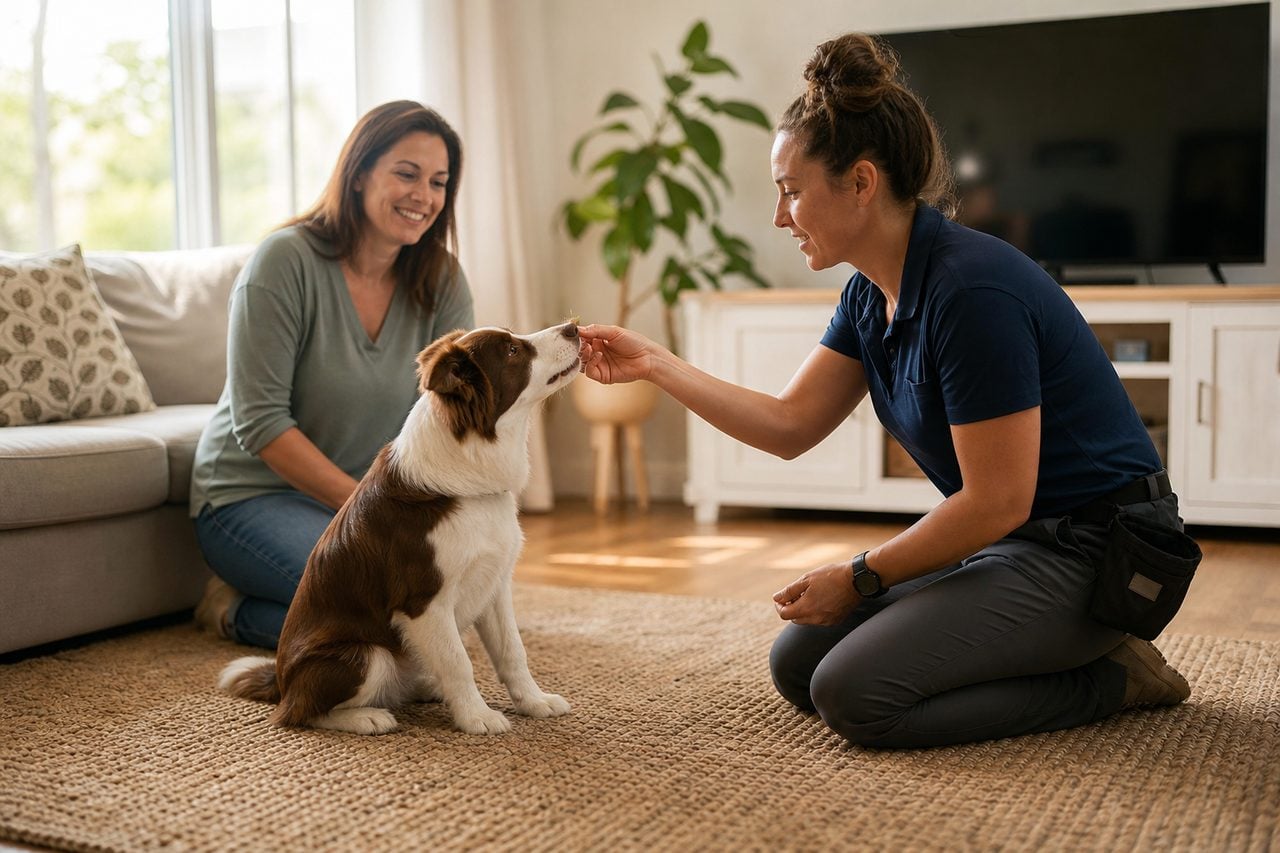
In-home dog training brings a professional trainer directly to your house, which means your dog learns exactly where the problems actually happen. The dog that jumps on guests at the front door, ignores you in the backyard, or bolts up the stairs when the doorbell rings is trained in that precise setting, with the real distractions of daily life present rather than simulated in an unfamiliar facility.
- How In-Home Training Works
- What In-Home Training Is Best For
- In-Home Versus Group Classes and Board-and-Train
- Choosing an In-Home Trainer in the Traverse City Area
- Preparing for Your First Session and Making It Stick
- When to Consider Traveling for Specialized Help
- Setting Up Your Home for Training Success
- Reviewed trainers
- FAQ
For many Traverse City-area families, this format solves practical problems too. If you live out toward the Leelanau Peninsula, up near Elk Rapids and Kewadin, or out in the inland forests around Kalkaska, driving into town for a weekly class can be a real barrier, especially in winter. In-home training removes the commute entirely and fits training around your household’s schedule, which matters when work is seasonal and busy.
In-home behavior specialists are somewhat less common in a smaller northern metro than in a large city, and for certain intensive cases some families do travel to the wider region, including as far as Grand Rapids, for specialized help. Even so, in-home training is widely available for the everyday obedience and manners issues most households face. This guide explains how it works, what it is best suited for, and how to choose a provider before you contact any of the trainers on this page.
How In-Home Training Works
In-home training is straightforward in concept: the trainer comes to you. Sessions usually take place in and around your home, and sometimes extend to your immediate neighborhood or a nearby walking route for real-world practice. Most programs are structured as a series of visits rather than a single appointment, because behavior change happens through repetition and coaching over time.
A typical program begins with an initial assessment. The trainer spends time understanding your dog, your household routine, and the specific behaviors you want to address. Because they are seeing your dog in its actual environment, they often spot contributing factors an owner has stopped noticing, such as a piece of furniture that lets the dog stare out the window at passersby, or a feeding routine that fuels over-excitement.
From there, the trainer builds a plan and coaches you through it session by session. A crucial point that surprises some owners is that in-home training is largely about training you. The trainer demonstrates a technique, watches you practice it with your dog, and refines your timing and handling. Between visits you do the daily practice, and each session builds on the last. This is why the format works so well for changing everyday habits, since the new behavior is established in the exact spot where the old habit lives.
What In-Home Training Is Best For
In-home training shines for problems that are tied to a specific location or routine, and for households where a facility-based class is impractical. Common situations where it is an excellent fit include:
- Household manners issues, such as jumping on guests, counter surfing, door dashing, or barking at the window. These behaviors happen at home, so training them at home is the most direct route.
- Puppy raising, including house training, crate training, settling routines, and early manners. Getting a trainer into your home in the first weeks can prevent a long list of problems from taking root.
- Basic and intermediate obedience for owners who prefer or need one-on-one coaching over a group setting, or whose schedules do not line up with class times.
- Multi-dog households, where the dynamic between the dogs is part of the picture and is best observed in the home.
- Dogs that struggle in group settings, including nervous or easily overwhelmed dogs that cannot yet learn in a busy class full of other dogs.
- Rural and outlying households, from the Leelanau Peninsula to Kalkaska, where the drive to a weekly class in Traverse City is a genuine obstacle.
In-home training can also lay the groundwork for outings by first building solid skills at home, then extending them to the yard, the driveway, and eventually the wider world such as a quiet stretch of the TART Trails. Because the trainer knows your specific dog and setting, they can tailor that progression to your goals.
In-Home Versus Group Classes and Board-and-Train
In-home training is one of several formats, and the right choice depends on your dog, your goals, and your circumstances. Understanding the alternatives helps you decide.
Group classes are typically more affordable and add socialization and distraction practice that a quiet home cannot replicate. They are excellent for a well-adjusted dog whose main need is general obedience and exposure to other dogs. The trade-off is the fixed schedule, the commute, and a curriculum that cannot fully adapt to your specific home situation.
In-home training trades that socialization value and lower cost for convenience, personalization, and location-specific results. It is the better choice when the problem lives at home, when the commute is a barrier, or when your dog needs individual attention it cannot get in a group.
Board-and-train, where the dog stays with a trainer for a period, is a more intensive and more expensive option that removes the dog from home entirely. It can accelerate certain results, but it places the greatest premium on the transfer step, since skills learned in the trainer’s environment still have to carry back to your home and your handling. If you consider this route, the quality of the handoff and follow-up coaching matters enormously.
Many families combine formats over time, perhaps starting with in-home work to solve pressing household issues, then joining a group class for ongoing socialization once the basics are solid. There is no single best format, only the one that fits your situation right now.
Choosing an In-Home Trainer in the Traverse City Area
Because an in-home trainer works in your personal space and coaches you directly, fit matters even more than with a group class. As you compare the options on this page, weigh the following.
- Service area. The northern Michigan metro is spread out, so confirm the trainer covers your location, whether that is central Traverse City, Acme and Williamsburg on the East Bay, Interlochen and Kingsley to the south, or the outlying communities to the north and east. Ask whether travel to your area affects scheduling or cost.
- Methods and philosophy. Ask how they train and how they handle mistakes. You want clear, humane, reward-based methods and a trainer who can explain their reasoning. Since they will be coaching you, communication style matters as much as technique.
- Program structure. Find out whether they offer single sessions, packages, or ongoing programs, and what a typical plan looks like for your kind of issue. A good trainer can outline how many visits a problem like yours usually takes and what happens between them.
- The owner-coaching emphasis. A quality in-home trainer expects to teach you, not just the dog. Be wary of anyone who wants to work only with the dog while you watch passively, because the results have to live with you after they leave.
- Assessment and honesty. Look for a trainer who assesses your dog before promising outcomes and who is candid about what is realistic. For serious behavior cases, a responsible trainer will tell you if the issue needs a specialist or a veterinary behavior consultation.
It is entirely reasonable to ask a prospective trainer a few questions by phone before booking. How they answer tells you a lot about how the sessions will go.
Preparing for Your First Session and Making It Stick
A little preparation makes the first in-home session far more productive. Before the trainer arrives, jot down the specific behaviors you want to address and any patterns you have noticed, such as when and where a problem tends to happen. Have your dog’s favorite treats on hand, and think about who in the household should be present, since consistency across everyone is one of the biggest factors in success.
During the session, expect to be an active participant. The trainer will demonstrate, then hand the leash or the technique to you and coach you through it. Ask questions freely, and do not worry about getting it wrong in front of them, since fixing your timing and handling is precisely why they are there. Take notes or ask if you can record the key techniques so you can refer back during the week.
Between sessions is where the results are actually made. Practice in short, frequent sessions woven into your daily routine, and hold every household member to the same cues and rules. If the trainer gave you a management step, such as blocking the dog’s access to the window or using a crate at certain times, follow it, because those steps prevent the old habit from being rehearsed while the new one takes hold.
Progress will not be perfectly linear, and that is normal. Judge success over weeks rather than days, and communicate with your trainer between visits if something is not working. The households that get lasting results from in-home training are the ones that treat each session as an assignment to practice, not a service that fixes the dog while they watch.
When to Consider Traveling for Specialized Help
For the everyday obedience, manners, and puppy-raising issues most families face, in-home training is well within reach in the Traverse City area, and the trainers on this page can help. It is worth being realistic, though, about the limits of a smaller market for the most specialized cases.
In-home behavior specialists who focus on complex problems such as severe anxiety, serious aggression, or entrenched fear are less common in a smaller northern metro than in a large urban area. For a case like that, a single generalist may not be the right fit, and the most responsible thing a local trainer can do is point you toward someone with deeper specialization. Some families do travel to the wider region for this level of help, and a behavior specialist as far away as Grand Rapids can be worth the trip for a serious or complicated case.
A few signs that a case may warrant specialized help include a bite history, aggression toward household members or other pets, severe separation distress, or deep-seated fear that has not improved with a solid, consistent plan. In these situations, ask whether a veterinary behaviorist or a certified behavior consultant should be involved, since a combined medical and behavioral approach is sometimes necessary.
For the great majority of households, though, this is not the road you will need. Most in-home training goals, from a puppy that needs house training to an adult dog that jumps on guests and pulls on the leash, are exactly what local in-home trainers handle every day. Start local, be honest about what you are dealing with, and travel only if a trusted local trainer tells you the case calls for it.
Setting Up Your Home for Training Success
One quiet advantage of in-home training is that your environment itself becomes a training tool, for better or worse. The layout of your home, your daily routines, and even the placement of furniture all shape your dog’s behavior, and a good in-home trainer will help you see the ones that are working against you. Making a few thoughtful adjustments amplifies everything you do in the sessions and helps new habits take hold faster.
Consider how your space either invites or discourages the behaviors you want to change. A dog that barks at everyone passing the window is being rehearsed by that view every single day; a simple change like closing a blind or rearranging a couch that serves as a lookout can dramatically reduce the practice that fuels the habit. A dog that dashes the front door benefits from a management setup, such as a baby gate or a designated spot away from the entry, that prevents the rush while you teach a calmer alternative. These environmental tweaks are not cheating. They stop the unwanted behavior from being repeated while the new one is still fragile, which is exactly what makes training stick.
Setting up dedicated spaces helps too. A comfortable, consistent resting place, whether a crate, a bed, or a mat, gives your dog a clear spot to settle and gives you a target to train toward. Keeping training treats staged in a few key locations around the house means you can capture and reward good behavior the moment it happens, rather than missing the opportunity while you hunt for rewards. Small conveniences like these make it far more likely that you will actually practice during the busy in-between moments of daily life.
Routine is the final piece. Dogs thrive on predictability, and a household with consistent feeding times, walk times, and rest periods gives a dog a stable framework that reduces anxiety and makes training easier. This is especially worth attention in the Traverse City area, where seasonal and tourism-driven work can make schedules irregular. Even a loose, dependable rhythm to the day helps your dog know what to expect, and a dog that knows what to expect is a calmer, more trainable dog. When you shape your environment and routine to support the training, the professional guidance you invest in goes considerably further.
In-Home Dog Training in Traverse City: Local Options & Nearest Specialists
A few Traverse City-area trainers can help with milder in-home dog training needs:
- Sit Means Sit Dog Training — 5.0★ (1 review)
- Barks and Rec. Animal Training and Behavior — 4.8★ (60 reviews)
Nearest in-home dog training specialists — Grand Rapids
For complex cases, some families travel to the larger pool of specialists in the Grand Rapids area for an assessment or a board-and-train stay. Top-reviewed options:
See all Grand Rapids in-home dog training trainers →
Frequently Asked Questions
What happens during a typical in-home training session?
The trainer comes to your home, and most programs begin with an assessment of your dog, your routine, and the specific behaviors you want to change. From there, sessions follow a coach-and-practice rhythm: the trainer demonstrates a technique, then guides you as you practice it with your dog in the exact setting where the behavior happens. Programs are usually a series of visits rather than a single appointment, with daily practice by you in between. Expect to be an active participant, since in-home training is as much about coaching you as the dog.
Is in-home training better than a group class?
Neither is universally better; they suit different needs. In-home training excels for problems tied to your home, such as jumping on guests or door dashing, and for households where the commute to a weekly class is a barrier. Group classes are usually more affordable and add socialization and distraction practice a quiet home cannot provide. Many families use both over time, starting with in-home work to solve pressing issues, then joining a group class for ongoing socialization once the basics are solid.
Do in-home trainers serve the outlying areas around Traverse City?
Many do, but service areas vary, so confirm coverage before booking. The northern Michigan metro is spread out across Grand Traverse, Leelanau, Antrim, and Kalkaska counties, and some trainers travel farther than others. When you contact a trainer, tell them your location, whether that is central Traverse City, the East Bay communities, the Leelanau Peninsula, or out toward Kalkaska, and ask whether travel affects scheduling or cost. In-home training is often especially valuable for rural households precisely because it removes the winter commute.
What issues is in-home training best suited for?
It is ideal for behaviors tied to a specific location or routine, such as jumping on guests, counter surfing, door dashing, and window barking, as well as puppy raising including house training and crate training. It also suits basic and intermediate obedience for owners who prefer one-on-one coaching, multi-dog households where the dynamic matters, and nervous dogs that struggle in busy group settings. Skills built at home can then be extended outward to the yard and eventually places like a quiet stretch of the TART Trails.
How many sessions will my dog need?
It depends on the issue, your dog, and how consistently you practice between visits. A focused manners problem may resolve in a handful of sessions, while broader obedience goals or more ingrained habits take longer. A good trainer will assess your dog first and give you a realistic estimate rather than a one-size-fits-all promise. Remember that the practice you do between sessions is what actually drives the results, so consistency on your end shortens the overall timeline.
When should I look beyond local in-home training?
For everyday obedience, manners, and puppy issues, local in-home trainers are well equipped and are the right place to start. Consider seeking specialized help for complex cases such as a bite history, aggression toward people or other pets, severe separation distress, or deep-seated fear that has not improved with a consistent plan. Specialists are thinner in a smaller northern metro, so some families travel to the wider region, occasionally as far as Grand Rapids. A responsible local trainer will tell you if your case calls for that.
Related: read our complete in-home dog training guide or the full Traverse City dog training overview.
Ready to find the right in-home dog training pro in Traverse City?