
Off-Leash Dog Training in Columbus, IN
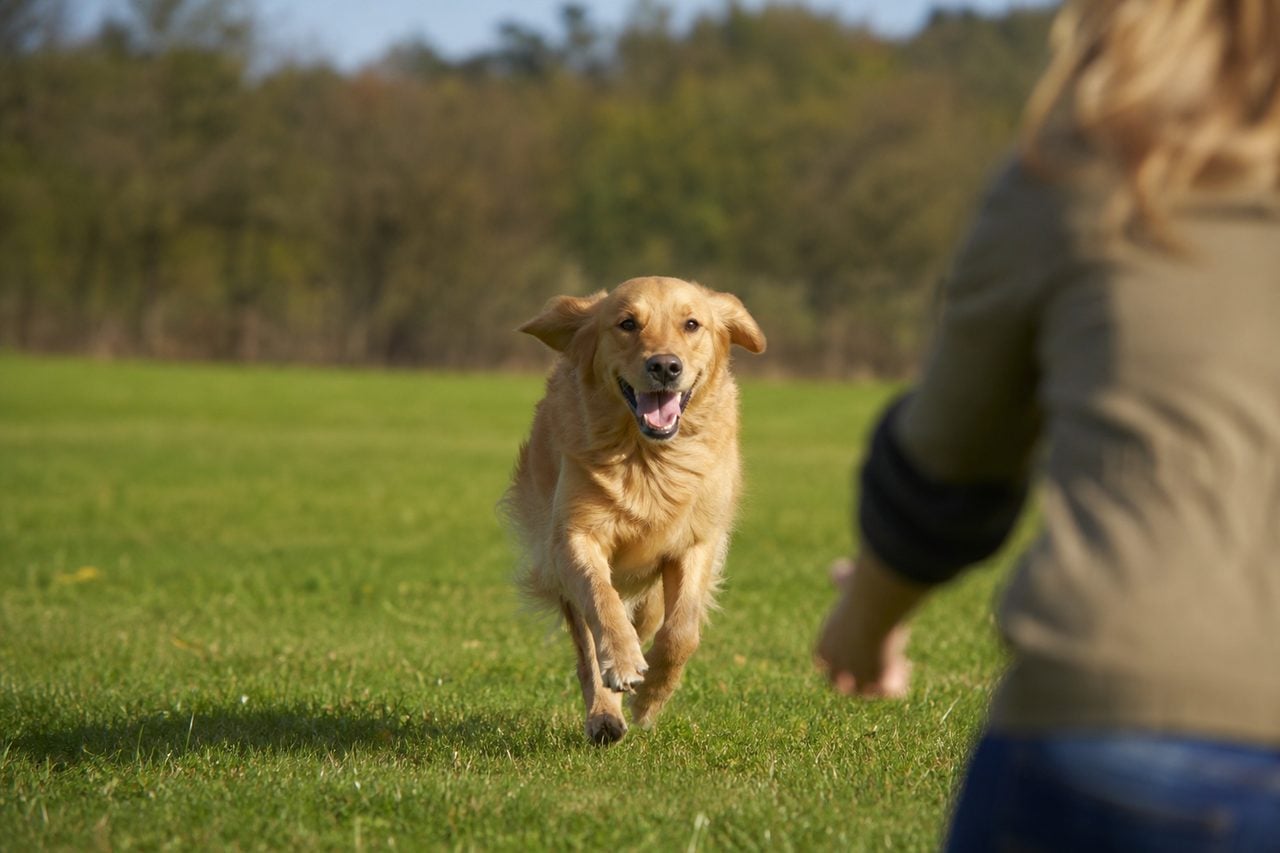
Off-leash freedom is one of the best things you can give a dog, and one of the easiest things to get badly wrong. The picture in most owners’ heads — a dog trotting loose along a wooded ridge in Jackson-Washington State Forest, or ranging ahead across an open field and swinging back on a single word — is achievable for a lot of dogs. What sits between here and there is not a trick or a tool. It is a recall that has been built deliberately, tested against real distraction, and maintained for the life of the dog.
- What off-leash reliability actually means
- The prerequisites nobody wants to hear about
- Long-line training: how the standard method works
- E-collar training: an even-handed look
- The local reality: no dedicated off-leash programme here
- Where off-leash is appropriate — and legal — around Columbus
- Proofing, maintenance, and the limits of off-leash
- Reviewed trainers
- FAQ
Owners around Columbus and Seymour should know one thing about local supply before they start ringing round: there is no dedicated off-leash or advanced recall programme based in this metro. The trainers who serve Bartholomew and Jackson counties do genuinely useful work — general obedience and day-school at Guardian-K9 and Barkefellers in Columbus, a six-week beginner group class at Feeders Pet Supply in Greensburg, and certified behaviour work at Hot Diggity Dog in Columbus — but a structured off-leash curriculum, with the field time and distraction proofing that implies, is not something the local bench specialises in. For a dedicated programme you are realistically looking an hour north on I-65 to Indianapolis, where several trainers run off-leash and advanced recall tracks.
This page covers what off-leash reliability actually means, the prerequisites nobody wants to hear about, how long-line and e-collar approaches each work and where each is honestly weak, where off-leash is appropriate around here, and what maintenance really costs.
What off-leash reliability actually means
Owners and trainers often use the phrase to mean different things, which is why so many people feel cheated by results. There is a wide gap between a dog that comes when called in your own garden and a dog that will abandon a deer scent line on a state forest trail and return at speed.
A useful way to think about it is as three separate skills that are usually sold as one. The first is a recall: the dog returns to you when called. The second is a stop or an emergency down: the dog freezes where it is, which is often the safer response when the danger is between you and the dog. The third is proximity, or ranging — the dog stays within a sensible radius and checks in without being called, which is what actually keeps a loose dog safe most of the time. A dog that ranges well needs recall far less often.
Reliability is a percentage, not a state. Trainers talk about proofing against the three Ds — distance, duration and distraction — and a recall that works at ninety-five per cent in a quiet field may be at forty per cent when a rabbit breaks cover. That last five per cent is where the road, the livestock, and the other dog live. This is why honest trainers avoid the word guaranteed. No recall is one hundred per cent, and any dog is one perfect trigger away from a failure.
Breed and individual temperament set the ceiling too, and this is worth being realistic about. Sighthounds, many scent hounds, and some terriers have been selected for hundreds of years to run a line and stop listening, and a great deal of careful work may still leave you with a dog that should not be loose in unfenced country. Herding breeds and many retrievers, by contrast, were bred to work at a distance while staying oriented to a handler, and often take to it comparatively easily. Age matters as well: a socially clingy six-month-old will happily stay near you, and the same dog at fourteen months will discover that the world is more interesting than you are.
The prerequisites nobody wants to hear about
Before any off-leash work is sensible, a few things need to be true, and skipping them is why so many recall projects stall.
Your dog needs a solid relationship with reinforcement. Recall is a paid behaviour, forever. If your dog does not currently work enthusiastically for food, toys, or play, that has to be built first, because you are about to ask it to give up something genuinely rewarding — a scent, a squirrel, another dog — in exchange for whatever you are offering. Boiled chicken beats kibble. A thrown ball beats a pat on the head. The reward is judged by the dog, not by you.
Your dog needs to be neutered of the biggest liabilities, in the behavioural sense. A dog with a genuine chase drive that has already killed something, a dog that runs to other dogs and does not come back, or a dog that is reactive to people or dogs, is not an off-leash candidate yet. Off-leash freedom for a reactive dog is not a kindness; it is a bite waiting for a bystander.
Your dog needs to be identifiable. Microchip registered to a current phone number, a collar tag with your mobile on it, and for serious field work a GPS tracker. This is not pessimism; it is what turns a bad afternoon into a short one.
And you need a legal, appropriate place to work. This is the constraint that bites hardest in a rural-ish metro where most open ground belongs to someone. Fenced areas, permissioned private land, and quiet properties where leash rules allow it are the raw material. Working an off-leash recall somewhere it is not permitted is both a liability and, if it goes wrong once, the end of the project.
Finally, be honest about the household. Recall degrades fast when one person in the family calls the dog and then does something the dog dislikes — ends the walk, clips the lead on, gives the bath. Every member of the household has to keep the recall word clean.
Long-line training: how the standard method works
The long line is the backbone of most modern off-leash programmes, and it is the method you can start on your own with almost no equipment cost. A long line is a fifteen to thirty foot lead, usually biothane or light rope, attached to a harness rather than a collar so that a sudden hit at the end of it does not damage the dog’s neck.
The logic is simple: the line gives the dog functional freedom while removing the possibility of the dog rehearsing a failed recall. Every time a dog ignores a recall and gets away with it, the cue is being poisoned. The line means that never happens. You are not using it to reel the dog in — that turns recall into something the dog resists — you are using it as insurance while the behaviour becomes a habit.
The build usually looks like this. Charge a brand-new recall word that has no history of being ignored. Pay it lavishly, every single time, in a quiet room. Move to the garden. Then to a quiet field on the long line, calling when the dog is doing nothing interesting, then when mildly interested, then when properly engaged in something. You raise one variable at a time: greater distance, then longer duration of distraction before the call, then more difficult distractions. When a repetition fails, you do not repeat the cue and you do not get louder — you make the next repetition easier, then rebuild.
Two habits matter enormously. First, never call your dog to end something good. Call, pay, release the dog back to what it was doing; that way the recall predicts a bonus rather than the end of freedom. Second, do a small number of high-value recalls per outing rather than constantly nagging the dog to come back. A recall cue used forty times a walk becomes background noise.
The transition off the line is gradual, and the classic error is doing it all at once. Trainers commonly go from thirty feet, to a lighter line, to a short trailing line, to a dragging cord, to nothing — in a familiar, low-risk location first — and only then start reintroducing distraction. Rushing this stage is how a dog that was perfect on Tuesday is on the far side of a field on Saturday.
E-collar training: an even-handed look
Remote or electronic collars are widely used in off-leash training in Indiana, and the debate around them is louder than it is useful, so here is an even-handed account.
The case made for them is straightforward. A remote collar gives a handler a way to communicate with a dog at three hundred yards, which a long line cannot do. Used the way skilled practitioners describe it, the collar is worked at very low stimulation levels — often at or barely above the level the dog can just perceive — and is applied as a cue the dog has already been taught to turn off by returning. Advocates argue this gives dogs more freedom than they would ever otherwise get, particularly high-drive dogs in open country.
The honest cautions are equally real. Timing and level are everything, and both are easy to get wrong; an ill-timed application teaches the dog the wrong association entirely, and a level that is too high produces fear rather than information. A dog in high arousal chasing a deer may not perceive a working level at all, which is exactly when owners escalate. There is a real documented risk of unintended associations, where a dog experiencing discomfort while looking at a person, a dog, or a place forms a negative association with that thing rather than with its own behaviour. The mainstream veterinary behaviour position leans against aversive tools for these reasons, and several professional bodies in the field discourage or prohibit their use among members.
What both camps largely agree on: the collar is not a shortcut. Any competent e-collar programme teaches the recall thoroughly on a long line first and only then layers the collar on top as a remote reinforcement of a behaviour the dog already knows. A collar strapped to an untrained dog and used to punish failure to come is the single most common misuse and it produces avoidant, unhappy dogs.
If you go this route, the practical minimums are: a quality collar with fine-grained level adjustment rather than a cheap one with three brutal settings, professional instruction rather than a video, correct fit with regular repositioning to avoid pressure sores, and honest willingness to stop if your dog is showing stress signals. And if you are not comfortable with the tool, you do not need it. Plenty of dogs achieve excellent off-leash reliability on long-line work alone.
The local reality: no dedicated off-leash programme here
This is the honest bit. Search for off-leash training in Columbus, Indiana and you will find general obedience providers, day-school and boarding operations, and one certified behaviour practice. What you will not find is a trainer running a dedicated off-leash or advanced recall curriculum with structured field sessions, which is a different product entirely.
What is here is still useful. Guardian-K9 and Barkefellers in Columbus offer general obedience and day-school style work, and Feeders Pet Supply in Greensburg runs a six-week beginner group class — all of which build exactly the foundation an off-leash project needs: engagement, a marker system, impulse control, a reliable sit and down, and a dog that finds working with you worthwhile. Hot Diggity Dog in Columbus, run by Lisa Korf with CPDT-KA and IAABC CDBC credentials, is the local behaviour practice and takes reactivity, aggression, resource guarding and separation anxiety — relevant here because if any of those are in play, they are the prerequisite that has to be solved before off-leash freedom is even on the table. Dog Training With Monica in Seymour handles training work but does not take aggression or reactivity behaviour cases, which is worth knowing when you are working out who to call for what.
For a dedicated off-leash programme, Indianapolis is the realistic answer — about an hour north on I-65 from Columbus, longer from Seymour or Brownstown. The larger market supports trainers who specialise in advanced recall, off-leash obedience, and gundog-style handling, and who have access to the fields and controlled distraction setups that this kind of work needs. Many run intensives or multi-week programmes rather than weekly hour classes, which suits a drive-in client better anyway: a smaller number of longer sessions, with the homework done in your own fields between visits.
The pragmatic path for most people here is a split one. Build the foundation locally or yourself with a long line. Get a specialist assessment and a proofing plan from Indianapolis if you want serious off-leash reliability. Then run the maintenance at home. It is not as convenient as having a specialist in town, but it is a realistic route rather than a fiction.
Where off-leash is appropriate — and legal — around Columbus
Leash rules in Indiana are mostly a local matter, and the single most useful habit you can build is checking the rules for the specific property rather than assuming a general right.
City and town parks are governed by municipal ordinance, and in most Indiana towns — Columbus, Seymour, Greensburg, North Vernon, Brownstown — that means dogs on lead in public parks unless an area is specifically designated otherwise. Mill Race Park at the confluence of the Flatrock and Driftwood, the Columbus People Trails network, and Ceraland Park should all be treated as leash-required environments, and the People Trails in particular are a shared-use paved network with cyclists on it, which is a poor venue for a loose dog regardless of what the sign says.
Indiana DNR properties, including Jackson-Washington State Forest and the Starve Hollow area south of Brownstown, are the closest thing to genuine open country here, but DNR rules generally require pets to be leashed and under control on state properties, with narrow exceptions for licensed activities such as hunting or training in permitted areas and seasons. Do not assume the wooded ridge trail is an off-leash trail. Check the current DNR rules and the property’s own posted regulations, and if you want to do legitimate off-leash field work there, find out precisely which exception applies to you and when.
National wildlife refuges have their own separate rules. Muscatatuck National Wildlife Refuge east of Seymour is a superb quiet training environment, but refuges are managed for wildlife first and pet regulations are typically restrictive. Verify before you go.
Two more local realities worth planning around. Autumn and winter bring hunting seasons on state forest and other public land, which is a strong argument for blaze orange on both of you and for keeping your dog close regardless of training level. And this is farm country: livestock, poultry and farm equipment are everywhere on the county roads, and a dog that chases stock is a legal and financial problem as well as a moral one. If your recall is not proofed against livestock, do not test it near any.
The best honest options for most owners are a securely fenced private area, permissioned private land where you know the boundaries, or a paid private field if one is available within your drive radius. Boring, but they are where reliability actually gets built.
Proofing, maintenance, and the limits of off-leash
The stage owners skip is proofing, and it is the only stage that matters for safety. A recall built in a quiet field is a recall for quiet fields. Real reliability comes from deliberately rehearsing the cue against progressively harder distractions: another dog at distance, then closer; a person your dog likes; a thrown ball; a scent-rich hedgerow; wildlife movement in the distance. Each new category needs its own work, because dogs generalise poorly and a dog that recalls off a ball may have never once been asked to recall off a rabbit.
Set the work up rather than waiting for it to happen. A recruited friend with a calm dog at a hundred yards, on a long line, is worth a month of accidental encounters. Reward heavily when the distraction is hard — the payment should scale to the difficulty of what the dog just gave up. And keep the emergency behaviours separate and rare: an emergency recall word that is used only a handful of times a year and is always paid extravagantly stays powerful precisely because it never becomes routine.
Maintenance is permanent. Recall decays if it is never paid, which is what happens when owners stop carrying food once the dog is reliable. Keep paying, at a lower rate, for the life of the dog. Keep the long line in the boot and use it in unfamiliar places. Re-proof after any gap — a winter of short lead walks costs you real reliability by spring. And expect adolescence to knock a hole in everything between roughly eight and eighteen months, which is developmental rather than defiance.
Finally, the limits. Some dogs should not be off lead in unfenced country, and accepting that is not a failure of training. A dog with a serious chase drive, a dog with a bite history, a deaf or elderly dog in unfamiliar terrain, or a dog whose recall consistently falls apart around wildlife can have a rich life on a long line, in fenced spaces, and through scent work and other enrichment. There is a version of freedom for every dog. It is just not the same version for every dog, and a good trainer — local or in Indianapolis — will tell you which one you have rather than selling you the picture in your head.
Off-Leash Dog Training in Columbus: Local Options & Nearest Specialists
Right now there are no listed Columbus trainers focused specifically on off-leash dog training. Many general Columbus dog trainers can help you get started, and the nearest specialists for this focus are below.
Nearest off-leash dog training specialists — Indianapolis
For complex cases, some families travel to the larger pool of specialists in the Indianapolis area for an assessment or a board-and-train stay. Top-reviewed options:
- Off-Leash K9 Training Indianapolis — 5.0★ (454 reviews)
- Canine Retreat — 4.9★ (10 reviews)
See all Indianapolis off-leash dog training trainers →
Frequently Asked Questions
Is there an off-leash training programme in Columbus, Indiana?
Not a dedicated one. The local providers — Guardian-K9 and Barkefellers in Columbus — run general obedience and day-school work, Feeders Pet Supply in Greensburg runs a six-week beginner group class, and Hot Diggity Dog in Columbus is the certified behaviour practice. All of those build useful foundations, but a structured off-leash or advanced recall curriculum with real field proofing is not something the local bench specialises in. For that, Indianapolis is about an hour north on I-65 and has trainers running dedicated off-leash tracks.
Long line or e-collar — which should I choose?
Start with a long line regardless. It costs almost nothing, it prevents your dog from ever rehearsing a failed recall, and for a great many dogs it is the whole answer. E-collars offer remote communication at distances a line cannot cover, which some handlers of high-drive dogs in open country value, but they demand precise timing and low working levels, carry a real risk of unintended negative associations, and are discouraged by much of the veterinary behaviour field. If you use one, get in-person professional instruction and teach the recall on a line first.
Can I let my dog off lead in Jackson-Washington State Forest?
Do not assume so. Indiana DNR properties generally require pets to be leashed and under control, with narrow exceptions tied to specific licensed activities and seasons. State forest trails feel like open country but the rules still apply, and enforcement aside, hunting seasons make autumn and winter a poor time to have a dog ranging. Check the current DNR regulations and the property’s posted rules before you go, and use blaze orange during hunting seasons.
What about Mill Race Park or the Columbus People Trails?
Treat both as leash-required. Municipal parks and trail networks in Indiana are governed by local ordinance, and dogs are normally required to be on lead unless an area is specifically designated off-leash. The People Trails are a shared paved network with cyclists and pedestrians, which makes them a poor off-leash venue regardless. They are excellent for building engagement and loose-lead work; the off-leash reliability gets built somewhere with fewer variables.
How long does it take to get a reliable recall?
Months of consistent work for most dogs, and longer for high-drive or independent breeds. The first stages — a charged recall word in low distraction — come quickly and feel encouraging. What takes the time is proofing against progressively harder distractions, one category at a time, and then the gradual fade from long line to trailing line to nothing. Adolescence between roughly eight and eighteen months will knock a hole in your progress, and that is developmental rather than defiance.
Are some dogs simply not off-leash candidates?
Yes, and a good trainer will say so. Dogs with a serious chase drive and a kill history, dogs that are reactive to people or other dogs, dogs with a bite history, and some sighthounds and scent hounds bred for centuries to run a line independently may never be safe loose in unfenced country. That is not a training failure. Long-line freedom, securely fenced space, scent work and other enrichment give those dogs a genuinely good life without the risk.
Related: read our complete off-leash dog training guide or the full Columbus dog training overview.
Ready to find the right off-leash dog training pro in Columbus?