
In-Home Dog Training in Columbus, IN
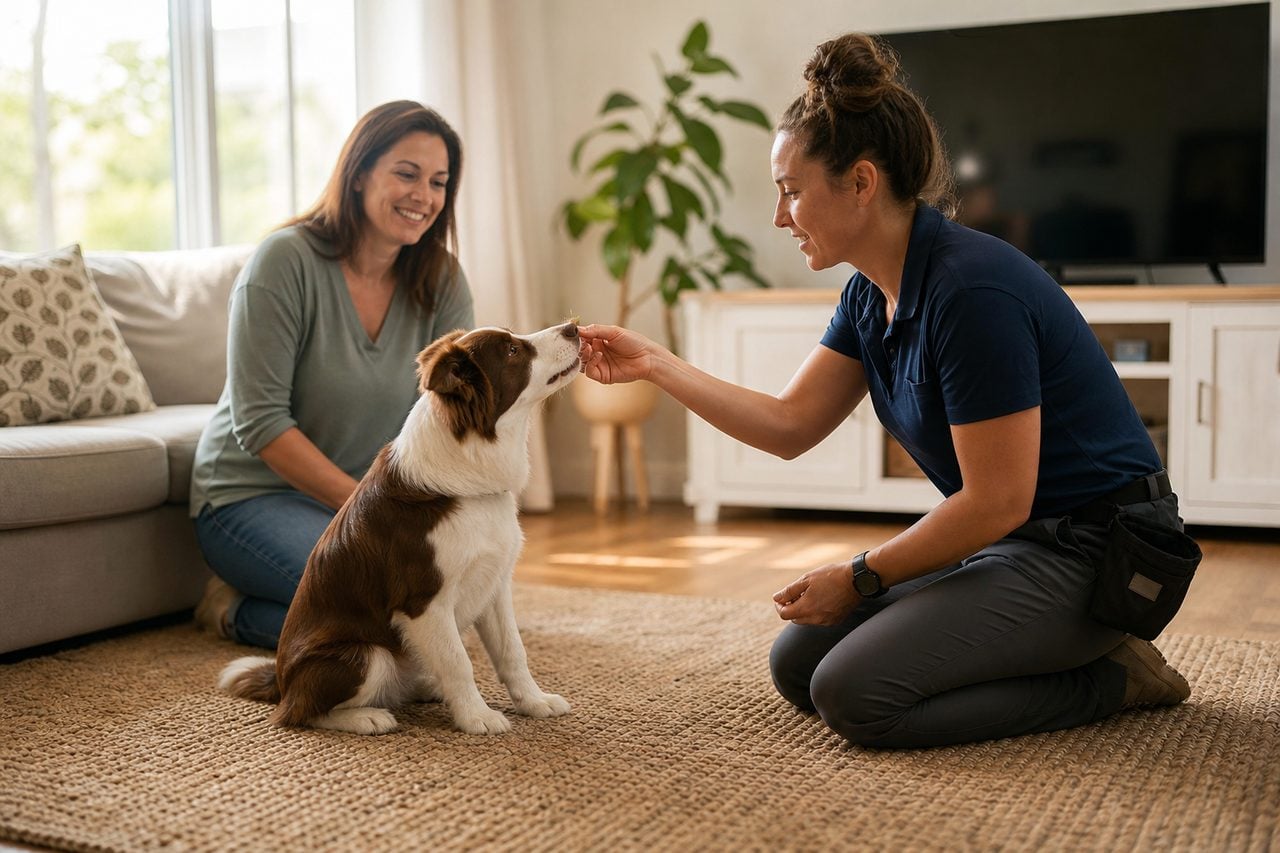
Columbus, Indiana is a city of about 50,000 people that behaves, geographically, like a much larger region. The Bartholomew County seat sits at the middle of a spread of small towns — Hope, Taylorsville, Elizabethtown, Edinburgh to the north, Seymour and Brownstown south along I-65 and US-50, North Vernon southeast in Jennings County, Greensburg northeast in Decatur County — separated by farm ground, county roads, and the bottomlands where the Flatrock and Driftwood meet to form the East Fork White River. For a lot of dog owners here, the practical question is not which training method is best. It is whether a weekly class is realistic when the drive alone eats 40 minutes each way.
- Why in-home training suits the Columbus and Seymour radius
- What actually happens in an in-home session
- Local in-home options around Columbus and Seymour
- Rural-specific problems a classroom never sees
- In-home versus group class versus board-and-train
- When the drive to Indianapolis is worth it
- How to vet an in-home trainer before you book
- Reviewed trainers
- FAQ
That is why in-home dog training deserves a serious look in this metro rather than being treated as the expensive upgrade option. The behaviors people struggle with around Columbus and Seymour are, overwhelmingly, home-and-property behaviors: door-charging, fence-line and driveway reactivity, chasing livestock or farm equipment, bolting toward a road with no sidewalk and no streetlight, tension between two dogs who share a house. Those problems live where the dog lives. A trainer who walks your driveway, stands in your kitchen at feeding time, and watches your dog react to the actual UPS truck is working with the real variables instead of a description of them.
This guide covers what in-home training involves, where it falls short, what is available locally, and when the honest answer is to drive an hour north on I-65 to Indianapolis for a specialist.
Why in-home training suits the Columbus and Seymour radius
Group classes are efficient for the trainer and cheap for the owner, and in a dense city they make obvious sense. In a county-road metro they carry a hidden tax. A six-week course in Columbus is six round trips for someone in Crothersville or Austin, six evenings arranged around chores or a Cummins shift schedule, and six sessions in a room that resembles nothing about the environment where the dog actually misbehaves.
In-home training inverts that. The trainer absorbs the drive time, and the training happens in the environment that is producing the behavior. That matters more than most owners expect, because dogs generalize poorly. A dog who holds a rock-solid down-stay in a training facility has learned to hold a down-stay in a training facility. The same dog may have no idea what you are asking when the cue comes at your own front door with a delivery driver on the porch and two kids in the hallway.
The second advantage is diagnostic. Trainers repeatedly find that the presenting complaint is not the problem. An owner books for pulling on leash; the trainer arrives and finds a dog with no off-switch, no crate conditioning, free access to every window in the house, and a feeding routine that produces a permanently over-aroused animal by 4pm. You cannot see that on a training floor. You see it in ten minutes standing in someone’s living room.
The third is household consistency. Training fails most often because one person in the house enforces the rules and another does not. When the session happens at the kitchen table, everyone who lives there can be in the room — including the teenager who lets the dog on the couch and the grandparent who feeds table scraps. Getting all of them the same script in one sitting is worth more than any single obedience exercise.
The honest tradeoff: you lose controlled exposure to other dogs and other people. If your goal is a dog who can work calmly around unfamiliar dogs, pure in-home work will not get you there. Most good local trainers handle this by starting in-home and then moving sessions out to a parking lot, a park, or a downtown sidewalk once the foundation holds.
What actually happens in an in-home session
A first in-home appointment is usually longer than the ones that follow — often 60 to 90 minutes — and much of it is conversation and observation rather than drilling. Expect the trainer to ask about the dog’s history, current feeding and exercise routine, sleeping arrangements, what the dog does when left alone, who in the household does what, and the specific sequence of events around each incident you are worried about. Good trainers push for detail. Not “he’s aggressive with strangers” but “walk me through the last three times, from the moment the car pulled in.”
Then they watch. Many will deliberately trigger a mild version of the problem — knock on the door, walk past the fence, put a food bowl down — to see the actual behavior chain rather than the owner’s summary of it. What they are reading is the dog’s threshold: at what distance, volume, or intensity does the dog stop being able to think and start reacting. Nearly every plan that follows is built around keeping the dog just under that line while it learns something new.
The working portion is typically the owner being coached, not the trainer working the dog. This surprises people who expect to hand the leash over. A competent in-home trainer will demonstrate a mechanic once, then hand it back and correct your timing, your leash hand, your marker word, your rate of reinforcement. The dog is not the client — you are the one who has to reproduce this on Tuesday at 6am with nobody watching.
You should leave with a written or emailed plan: two or three specific exercises, how many minutes a day, what to stop doing entirely, and management changes for the interim. Management is the unglamorous half — baby gates, a crate in a different room, a long line clipped for driveway trips, blocking window access, changing where the dog eats. These are not training, they are damage control while the training takes hold, and skipping them is the single most common reason home programs stall.
Follow-ups are usually shorter and spaced one to three weeks apart, which gives you time to build reps between visits. Between-session homework is where the actual learning happens; the appointment is a checkpoint and a course correction.
Local in-home options around Columbus and Seymour
The local bench here is small, but the trainers who do serve this area are genuinely set up for the way people live in Bartholomew and Jackson counties.
Dog Training With Monica, based in Seymour, offers in-home sessions and private lessons. Being Jackson County based puts her at the I-65 and US-50 crossroads, which is a practical hub for the southern half of the metro — Brownstown, Crothersville, Austin, and the county-road addresses between them where scheduled class attendance is a genuine logistical problem. Private, in-home lessons are the core of that kind of practice.
Hot Diggity Dog in Columbus, owned by Lisa Korf, offers private consultations. Korf holds the CPDT-KA credential (Certified Professional Dog Trainer — Knowledge Assessed, issued by the Certification Council for Professional Dog Trainers) and the IAABC-CDBC credential (Certified Dog Behavior Consultant through the International Association of Animal Behavior Consultants). Those are two of the more meaningful independent credentials in a field with no licensing requirement, and the behavior-consultant designation in particular signals training in cases that go past obedience — fear, aggression, separation-related behavior, and similar.
Between those two you have real coverage for the ordinary and moderately difficult end of the range: puppy foundations, house manners, leash work, recall, basic reactivity, and household management. Anyone telling you that a small metro cannot produce competent trainers is wrong. What a metro this size does not produce is depth — multiple specialists to choose from, redundancy if the first one is booked out, or someone whose entire practice is narrowed to one behavior problem.
Before you assume you need to look elsewhere, call locally first. Availability, temperament fit, and communication style matter as much as credentials, and a good local trainer you can actually get on the calendar in two weeks will usually outperform a better-known one you can see in two months. It is also worth asking directly how far out they travel — travel radius and any mileage arrangement varies by trainer, and a Greensburg or North Vernon address may or may not be inside it.
Rural-specific problems a classroom never sees
A handful of behavior problems are close to universal around here and almost invisible in a suburban training curriculum.
The unfenced acre. A great many properties in Bartholomew, Jackson, Jennings, and Decatur counties have no perimeter fence, and fencing five acres is not a realistic answer. That means off-leash reliability is not a luxury skill for these owners, it is the safety plan. An in-home trainer working the actual property can build a boundary and recall protocol against the actual sight lines — the tree line the dog disappears into, the neighbor’s drive, the point where a dog crests a rise and stops being able to hear you. Long-line work on the real ground beats a perfect recall in a fenced yard that does not exist at your house.
Livestock. Chickens next door, cattle across the fence, horses down the road. Chasing stock is dangerous for the dog in ways owners underestimate, and in Indiana it can also become a serious neighbor and liability problem fast. This has to be trained around real livestock at a distance the dog can handle, which is a home-visit exercise by definition.
Long driveways and county roads. A dog who bolts out a door in town has a fenced yard or a sidewalk between it and traffic. A dog who bolts here may have 300 feet of gravel and then a road where cars run 50 mph with no shoulder. Door manners and a hard-stop emergency recall move from nice-to-have to non-negotiable, and the drilling should happen at the actual door.
Farm and delivery traffic. Tractors, grain trucks, four-wheelers, propane deliveries, and the rural mail carrier who never gets out of the vehicle all create arousal patterns you cannot replicate in a class.
Isolation-driven under-socialization. A dog raised on a quiet property may reach adulthood having met four people. That dog is not aggressive; it is inexperienced. The plan for it is graduated exposure — and around here that means deliberately building trips into town, to downtown Columbus, to a Seymour parking lot, rather than assuming daily life will supply the practice.
In-home versus group class versus board-and-train
The three common formats solve different problems, and matching the format to the goal saves a lot of money.
Group classes are the best value for a normal puppy or young adolescent dog with no serious behavior problem. The core benefit is not the curriculum, which you could get anywhere — it is working near other dogs and other handlers in a controlled, supervised setting. That is precisely the thing in-home training cannot give you. If your dog is friendly and your goal is manners plus social confidence, a class is the right first spend.
In-home private training is the right call when the problem is context-bound (it happens at the house), when the household needs to be coached as a unit, when the dog is too reactive or too fearful to learn in a group, when scheduling makes classes unrealistic, or when you want a plan built around your specific property. It is also the appropriate format for anything in the fear or aggression family, where putting the dog in a room with strangers is counterproductive and, in some cases, unsafe.
Board-and-train puts the dog in the trainer’s care for a period of days or weeks. It can move quickly on obedience mechanics, and it appeals to owners with no time. The honest limitation is transfer: the dog learns to perform for that trainer in that environment, and the skills come home only as well as the handover is taught. Any board-and-train worth considering builds in substantial owner-transfer sessions at the end. Programs that return the dog with a demo and a handshake tend to disappoint within a month. Because board-and-train also means handing over your dog’s daily welfare, ask specifically about housing, hours of actual training per day, what happens if the dog is stressed, and whether you can visit.
Many owners here end up combining formats: private in-home sessions to fix the house problem and build the foundation, then a group class or structured outing once the dog can handle proximity to others. That sequence usually costs less overall than trying to force the wrong format to do a job it was never suited for.
When the drive to Indianapolis is worth it
Columbus sits roughly an hour south of Indianapolis on I-65, and Seymour about 25 minutes further. That is a real but manageable trip, and for certain cases it is the right one.
The metro area north has a deeper bench of trainers who work in-home as their primary practice, which means more specialists, more availability, and more ability to find someone whose specific focus matches your case. If you are dealing with serious aggression — bites with real damage, a dog who has injured a person or another animal, resource guarding that has escalated, or predatory behavior toward children or livestock — the pool of qualified behavior consultants and veterinary behaviorists is materially larger there. Cases at that level often benefit from a veterinary behaviorist, a board-certified specialist who can combine a behavior plan with medication where indicated. There is no substitute for that credential when a case genuinely calls for it.
Other reasons to look north: separation-related distress that has not responded to a straightforward plan; a dog with an underlying medical or pain component that needs behavior and veterinary work coordinated; sport or working goals with a small competitor base locally; and simple scheduling — if both local options are booked out for two months and the behavior is escalating, waiting is itself a risk.
Practically, plan the trip around traffic. Northbound I-65 into Indianapolis in the morning and southbound in the late afternoon can add real time, and a dog who arrives stressed from a long car ride does not train well. Many owners aim for mid-morning or early-afternoon appointments, and it is worth asking whether the trainer travels south for in-home visits — some will, for a fee, and if you can recruit a second household in Columbus or Seymour to book the same day, that can sometimes be arranged more affordably as a pair of visits.
None of this means writing off the local option. Start local, be clear about your case in the first phone call, and take a referral seriously if you get one. A good trainer who tells you the case is outside their scope is doing you a favor, and both credentialed local trainers are the kind who will say so.
How to vet an in-home trainer before you book
Dog training is unlicensed in Indiana as it is nearly everywhere in the United States. Anyone can print a business card. Credentials are voluntary, which makes them informative — the ones that require testing and continuing education, like CPDT-KA from the Certification Council for Professional Dog Trainers or a CDBC through the IAABC, tell you the person submitted to an outside standard. Absence of a credential is not automatically disqualifying, especially for an experienced trainer, but it means you have to do more verification yourself.
Ask what happens when the dog gets it wrong. This single question separates approaches faster than any other. You want a clear, specific answer — what the trainer does, what tools are involved, and why. Vague answers, heavy jargon, or irritation at being asked are all signals. You are allowed to decline any method you are not comfortable with, and you should be told in advance what equipment the trainer intends to use rather than discovering it mid-session.
Ask what the plan looks like if it is not working by session three. Competent trainers have an answer, usually involving reassessment, a possible veterinary referral to rule out pain or illness, or a referral onward. Anyone who guarantees results is overselling — behavior involves a living animal and a household, and no honest professional can promise an outcome.
Other practical questions: how many sessions do you expect this case to take, and what does the package include; do you travel to my address and is there a travel charge; what do you need me to do between sessions; can you send the written plan afterward; and what is your policy if my dog turns out to need something outside your scope. Also ask whether they carry liability insurance — professionals generally do.
Finally, watch the first session for how the trainer treats your dog when nothing is going well, and how they treat you. You should feel coached, not scolded. If the dog is frightened of the trainer at the end of the visit, that is information regardless of what the obedience looked like. You know your dog and you are permitted to stop a session at any point.
Reviewed In-Home Dog Training Trainers in Columbus
These reviewed Columbus-area trainers from our directory handle in-home dog training. Each links to a full profile with specialties, certified credentials, reviews, and contact info:
- Hot Diggity Dog — 5.0★ (14 reviews)
- Dog Training With Monica — 4.8★ (110 reviews)
- Guardian-K9 — 4.7★ (103 reviews)
See all Columbus in-home dog training trainers →
Frequently Asked Questions
Is in-home training more expensive than a group class in the Columbus area?
Private in-home work generally costs more per session than a group class, because you are buying one-on-one time plus the trainer’s travel. Rates vary by trainer and by how far out of Columbus or Seymour you are, so ask directly — and ask whether they price by session or by package. The comparison worth making is not per-session cost but total cost to solve your specific problem. For a friendly puppy needing manners, a class is usually the better value. For a household-specific problem, three targeted private sessions often cost less than a course that never addresses the actual issue.
Will an in-home trainer come out to Seymour, Brownstown, North Vernon or Greensburg?
Often yes, but travel radius varies by trainer and it is the first thing to confirm on the phone. Dog Training With Monica is based in Seymour, which puts the southern half of the metro close at hand, and Hot Diggity Dog operates out of Columbus. For addresses well out toward Decatur or Jennings County, expect that a travel arrangement may apply. If you are on the far edge of the radius, ask whether they group appointments by area on particular days — many trainers do, and fitting into that routing can make scheduling easier.
My dog only misbehaves when someone comes to the door. Can a trainer fix that in one visit?
Rarely in one visit, but door behavior is one of the best possible reasons to book in-home work, because the trainer can stage the exact scenario repeatedly under control. Expect the first session to establish a management plan — a gate, a leash, a station away from the door — and start teaching an alternative behavior. Real reliability comes from repetition over weeks with actual visitors, which is your homework. Most owners see meaningful change within a few sessions if they do the between-visit reps.
We have no fence and several acres. Is off-leash reliability realistic?
For many dogs, yes, but it is a project rather than a lesson, and it should be built on your own ground. The usual path is a long line, a heavily reinforced recall, and gradual expansion of distance and distraction, with management — the line stays on until the recall is proven — throughout. Breed and individual drive matter a great deal. A strongly scent-driven or prey-driven dog may never be safe off-line near a road or livestock, and an honest trainer will tell you that rather than sell you a program.
Do I need in-home training or a behaviorist for my dog’s aggression?
It depends on severity. Growling, stiffening, or snapping without injury in predictable contexts is often workable with a qualified behavior consultant, and Columbus has one in Lisa Korf, who holds an IAABC behavior-consultant credential. Bites that caused real injury, unpredictable aggression, or aggression toward children put the case in territory where a veterinary behaviorist — a board-certified veterinary specialist, most accessibly found in the Indianapolis area — is the appropriate referral. Start with a veterinary exam regardless; pain is a common and overlooked driver.
How long does in-home training usually take to work?
Simple manners and puppy foundations often show clear progress within two to four sessions spread over a month or two, assuming daily short practice at home. Behavior cases involving fear, reactivity, or long-established habits typically run longer — several months of gradual work is normal, with progress measured in reduced intensity and faster recovery rather than a switch flipping. The variable that predicts outcome best is not the trainer or the method; it is how consistently the household follows the plan between visits.
Related: read our complete in-home dog training guide or the full Columbus dog training overview.
Ready to find the right in-home dog training pro in Columbus?