
Board & Train in Lorain, OH
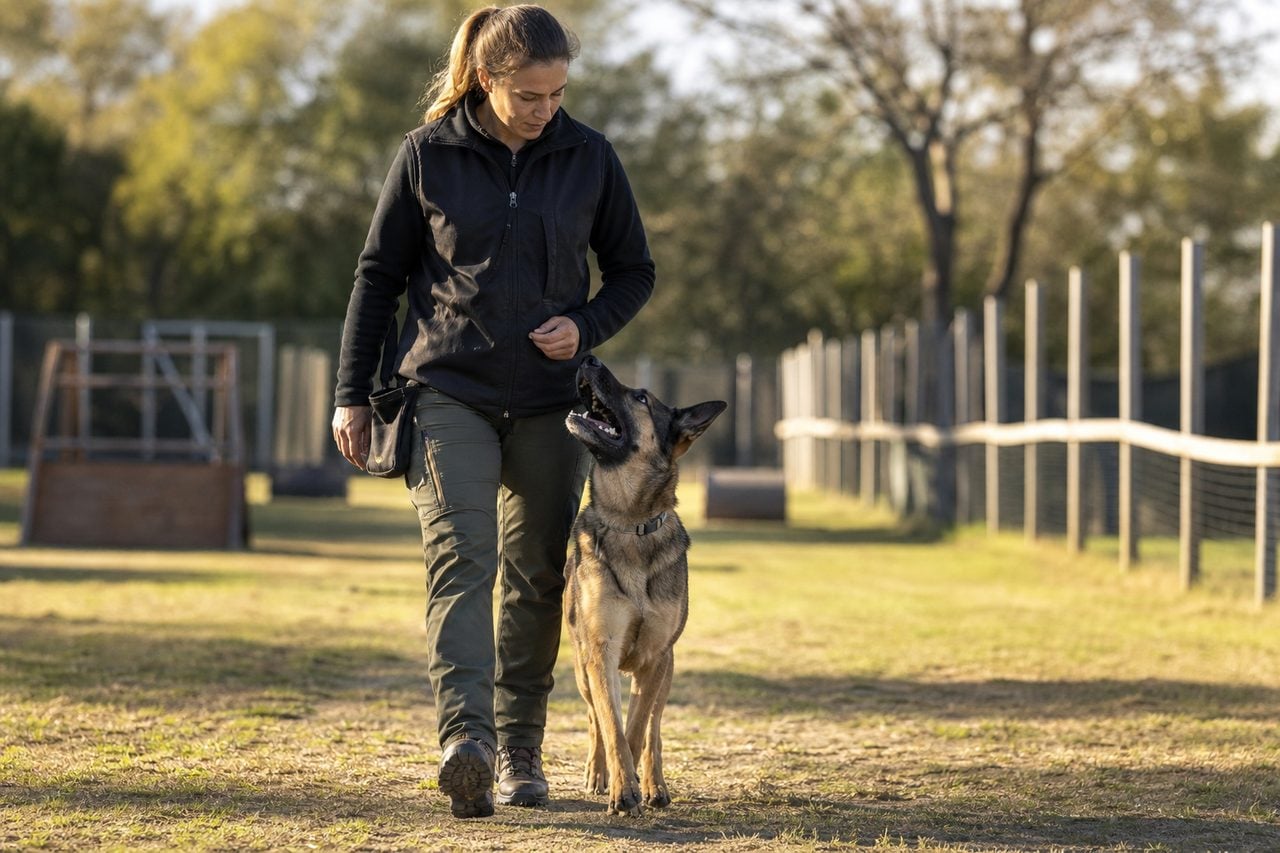
Lorain sits where the Black River empties into Lake Erie, an old steel-and-shipping town that earned the nickname “International City” from the dozens of nationalities who came to work its docks and mills. Today the harbor is quieter, the Lorain Lighthouse anchors the postcards, and on a good weekend the paved trail at Black River Reservation fills with families, cyclists, and dog owners trying to walk a dog that, frankly, isn’t walking very well. If you live here and your dog pulls like a freighter, bolts at the geese along the Lakeview Park beach, or can’t be trusted off a six-foot leash anywhere near the lake, you’ve probably typed “board and train” into your phone at least once.
- What "board and train" actually means
- A realistic timeline: what happens week by week
- What board and train can and can't fix
- What it costs in the Lorain / Cleveland market
- The handoff: why your work starts when the dog comes home
- Why the Lorain environment matters for your results
- How to choose a board and train in Lorain County
- Reviewed trainers
- FAQ
Board and train is one of the most misunderstood services in dog training. People imagine dropping a dog off as a problem and picking it up as a finished, magazine-perfect companion. That’s not how it works, and any honest trainer in Lorain County will tell you so. Board and train is a tool, a powerful one, but it’s a tool that only pays off when you understand what it does, what it costs, and what your role is when the dog comes home. This guide walks through the entire process specific to the Lorain area, from what a typical program looks like to realistic Cleveland-market pricing to the questions that separate a good facility from a kennel that’s just charging boarding rates with the word “training” attached.
What "board and train" actually means
Board and train means your dog lives at a trainer’s facility (or in some cases the trainer’s home) for a set stretch of time, usually two to six weeks, while a professional works with the dog daily on obedience, manners, or specific behavior problems. Instead of you attending a weekly class and doing the homework yourself, the trainer does the foundational reps for you, often multiple short sessions a day, every day, in a controlled environment.
The appeal is obvious for a busy Lorain household. If you commute east on SR-2 toward Cleveland for work, getting home with enough energy to run structured training drills is a real ask. A board and train compresses weeks of inconsistent at-home practice into a concentrated period where the dog gets clear, repeated, professional handling. Dogs learn fastest with consistency, and consistency is exactly what most family schedules struggle to deliver.
What it is not: it’s not a personality transplant, and it’s not a way to outsource the relationship. The single most important thing to understand about board and train is that the dog is learning to respond to a skilled handler in the trainer’s environment. Transferring those skills to you, in your house, on your walks down to the Black River, is the second half of the job, and it’s the half that determines whether the investment sticks.
A realistic timeline: what happens week by week
Programs vary, but a typical two-to-four-week board and train in the Lorain area follows a recognizable arc.
Days 1-3: decompression and assessment. A good facility doesn’t start drilling the moment your dog arrives. The dog needs to settle, learn the routine, and let cortisol levels come down from the stress of a new place. The trainer is watching: how does the dog handle confinement, other dogs, new people, food, the crate? This assessment shapes the plan.
Week 1: foundations. Marker training (a clear “yes” signal), engagement, name response, the start of leash pressure and basic positions like sit and down. The dog is learning the language the trainer uses. Progress in week one often looks unimpressive to an outsider, but this is the scaffolding everything else hangs on.
Week 2: reliability and distraction. Now the known commands get tested under mild distraction, then moderate. The trainer might work the dog in a parking lot, near other dogs, around food. This is where a leash-reactive dog starts learning to look at the handler instead of lunging.
Weeks 3-4 (longer programs): proofing and real-world application. Commands get practiced in genuinely difficult settings, the kind of environments you’d hit on a real Lorain outing, foot traffic, geese, kids on bikes along the Bridgeway Trail. The dog learns to hold a behavior even when it would rather do something else.
Throughout, the best facilities send updates, photos, or short videos so you can see the work happening. If a place won’t show you what your dog is doing day to day, treat that as a warning.
What board and train can and can't fix
Board and train shines for obedience foundations, leash manners, recall, crate and place training, jumping, door-dashing, counter-surfing, and general impulse control. These are skill deficits, the dog simply hasn’t learned the behavior, and concentrated daily practice fills the gap efficiently.
It’s far more nuanced for emotional and behavioral problems rooted in fear or anxiety. Separation anxiety, severe resource guarding, fear-based aggression, and genuine reactivity are not “skills the dog is missing,” they’re emotional responses. A board and train can absolutely make progress on these, but the gains depend heavily on continued work at home, and some of these issues are managed rather than cured. Be deeply skeptical of any program that promises to “fix” aggression or anxiety in two weeks. Behavior modification is a long game.
One honest caveat specific to environment changes: a dog that learns rock-solid behavior in a quiet rural kennel south of Elyria may regress when it comes back to a busy household near the Lakeview Park beach with kids, visitors, and constant novelty. This isn’t the program failing, it’s the predictable challenge of generalization. It’s also exactly why the handoff matters so much.
What it costs in the Lorain / Cleveland market
Board and train is the most expensive training format, and the price reflects what you’re buying: full-time room, board, and daily professional labor for weeks. In the greater Cleveland market, which includes Lorain County, board and train programs commonly run from roughly $1,500 on the lower end to $6,000 or more for premium multi-week intensives. For comparison, a group obedience course in this market typically runs $150-300 for a multi-week series, and private one-on-one sessions land around $100-175 each.
Why the wide range? Several factors move the number:
- Length. A two-week program costs far less than a six-week one.
- Goals. Basic obedience is cheaper than behavior modification for reactivity or off-leash reliability.
- Facility type. A trainer’s in-home program with two or three dogs at a time is priced differently than a larger commercial kennel.
- Follow-up included. Better programs build in transfer sessions (where they teach you) and follow-up support. That’s not padding, it’s the part that makes the rest work.
When comparing quotes, don’t anchor only on the headline number. A $4,000 program with three weeks of training plus four transfer lessons and lifetime phone support can be a far better value than a $2,000 program that hands your dog back at the curb with a printed sheet of commands.
The handoff: why your work starts when the dog comes home
This is the section most people skip, and it’s the reason board and trains “fail” when they don’t actually fail. The dog learned. The owner didn’t.
When your dog returns from a program, it knows a set of behaviors on the trainer’s cues, timing, and rules. If you go back to old habits, letting the dog drag you toward the geese, repeating commands five times, feeding from the table, the trained behaviors erode within weeks. Dogs are exquisitely sensitive to who enforces rules and who doesn’t.
A quality program includes transfer sessions: the trainer puts the leash in your hand and coaches your mechanics, your timing, your tone, until the dog responds to you the way it responds to them. Insist on these. Then commit to a structured first few weeks at home: keep the routine tight, practice in low-distraction settings before you head to a busy spot like the Black River trailhead, and use the management tools (crate, place, structured walks) the trainer set up.
Think of board and train as buying a strong head start, not a finished product. The dog comes home knowing how to do the right thing. Keeping it that way is the part only you can do.
Why the Lorain environment matters for your results
Where you live shapes what your dog needs to be trained for, and a board and train should account for it. Lorain isn’t a quiet rural backdrop, it’s a lakefront city with a specific set of real-world triggers your dog will face the moment it comes home.
Start with the lakefront itself. The beach and rose garden at Lakeview Park, the open shoreline, the constant traffic of waterfowl, geese and gulls are catnip for a dog with no recall and a strong prey drive. A dog that’s never been proofed around birds will treat your loose leash as a starting gun. If chasing wildlife is one of your problems, tell the trainer up front so the program can build distraction work around it rather than producing a dog that’s perfect in an empty parking lot and useless at the water’s edge.
Then there’s the Black River Reservation. The paved Bridgeway and Steel Mill trails run roughly 5.5 miles through the river corridor and draw a steady mix of cyclists, joggers, strollers, and other dogs, exactly the high-traffic, multi-trigger environment that exposes whether obedience actually generalized. A trained dog that can’t hold a heel here didn’t finish learning, it just learned in a vacuum.
Finally, factor the seasons. Lake-effect winters limit outdoor work for months, which is part of why so many local dogs develop habits over the cold season and why a concentrated program can be especially valuable as a reset. But it also means you’ll be maintaining the training largely indoors for a while, so ask the trainer for a realistic cold-weather practice plan, not just warm-weather drills you can’t run in February. The point of a board and train is a dog that works in your Lorain life, not a generic one.
How to choose a board and train in Lorain County
Use these questions to separate real trainers from boarding kennels with a marketing upgrade:
- Can I tour the facility? You should be able to see where dogs sleep, where they train, and how they’re handled. A flat “no” is a red flag.
- What methods do you use? Ask them to explain their approach in plain language. You want a trainer who can articulate why they do what they do, not just brand names.
- How many dogs do you take at once? More dogs means less individual attention per dog. Ask how many daily training sessions each dog actually gets.
- What’s included for me? Transfer sessions, follow-up, and a written plan should be standard, not upsells.
- What happens if my dog’s issue is outside your scope? Honest trainers refer out fear, aggression, or anxiety cases they aren’t equipped to handle. That honesty is a green flag.
- Can I talk to past clients? Local references from other Lorain County owners are worth more than a wall of star ratings.
Finally, trust your read on the trainer’s relationship with dogs during the tour. You’re handing over a family member for weeks. The facility should feel like a place where dogs are understood, not warehoused.
Reviewed Board & Train Trainers in Lorain
These reviewed Lorain-area trainers from our directory handle board & train. Each links to a full profile with specialties, verified credentials, reviews, and contact info:
- The Dog Wizard Westlake — 5.0★ (86 reviews)
- Dignified K9 Grooming, Training & Boarding — 5.0★ (17 reviews)
- Elite K911 — 4.8★ (191 reviews)
- Sit Means Sit Dog Training – Cleveland Westside — 4.7★ (74 reviews)
See all Lorain board & train trainers →
Frequently Asked Questions
How long does a typical board and train last in the Lorain area?
Most programs run two to six weeks. Two weeks is enough for basic obedience foundations on a young, stable dog. Reactivity, off-leash reliability, and behavior modification generally need three to six weeks, plus continued work at home afterward.
How much should I expect to pay?
In the greater Cleveland market that includes Lorain County, board and train commonly ranges from about $1,500 to $6,000 or more depending on length, goals, facility type, and how much follow-up support is included. By comparison, group courses run $150-300 and private sessions about $100-175 each.
Will my dog forget everything when it comes home?
Not if you do your part. Dogs respond to whoever enforces the rules consistently. Skills fade when owners revert to old habits. A program with transfer sessions, where the trainer coaches you directly, and a committed first few weeks at home is what makes the training stick.
Can board and train fix aggression or anxiety?
It can make real progress, but be skeptical of any program promising to cure aggression or anxiety in a couple of weeks. These are emotional responses, not just missing skills. They often require ongoing management and behavior modification, and some are managed rather than fully resolved.
Is board and train better than group classes?
Neither is universally better. Board and train is best when you lack the time or experience to do consistent daily work yourself, or when a problem needs concentrated intervention. Group classes cost far less and build the owner’s handling skills directly. Many Lorain owners do a board and train first, then maintain with classes or private follow-ups.
What should I look for when touring a facility near Lorain?
Ask to see where dogs sleep and train, how many dogs they take at once, how many daily sessions each dog gets, what methods they use and why, and what follow-up is included for you. Honest referrals out for cases beyond their scope and willingness to share local references are strong positive signs.
Related: read our complete board & train guide or the full Lorain dog training overview.
Ready to find the right board & train pro in Lorain?