
Board & Train in South Bend, IN
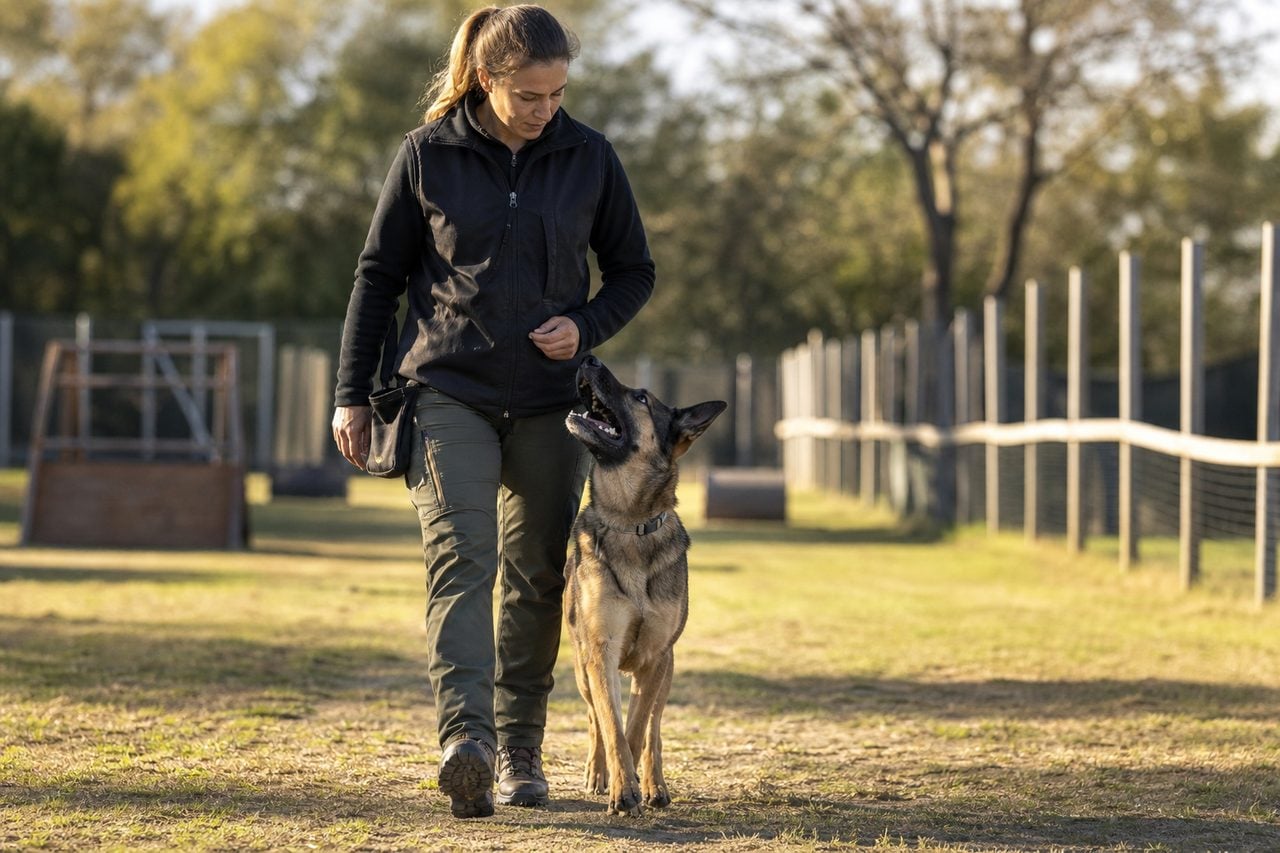
Board and train programs send a dog to live with a professional trainer for a set stretch of time — often two to six weeks — so the bulk of the learning happens away from home, then transfers back to the owner through handoff lessons. For busy families across the South Bend area, from Granger and Mishawaka to Elkhart, Goshen, and the smaller towns like Bremen and Nappanee to the south, this format solves a real problem: the daily grind of work, school runs, and Notre Dame football weekends leaves little room for the consistent, repetitive practice that obedience actually requires.
- What Board and Train Actually Means
- Who Board and Train Fits — and Who It Does Not
- Choosing a Facility in the Michiana Area
- Training Methods and Tools: What to Expect
- The Transfer Home: Where Results Are Kept or Lost
- Costs, Timelines, and Setting Realistic Expectations
- Preparing Your Dog and Household for the Program
- Reviewed trainers
- FAQ
An in-kennel or board-and-train program is not a magic reset button, and any trainer who sells it that way should raise a flag. What a good program does is compress the foundation-building phase — the part that takes an average owner months of scattered five-minute sessions — into concentrated daily work by someone who does this for a living. The dog comes home knowing the mechanics; the owner then learns to keep them alive.
This guide explains how board and train works, who it fits, what to look for in a Michiana-area facility, and the questions that separate a responsible program from a warehouse operation. It names no specific businesses and quotes no prices as fact — those change, and every dog is different — but it should leave you able to walk into any consultation and ask the right things.
What Board and Train Actually Means
In a board-and-train arrangement, your dog boards at the trainer’s facility or home and receives structured training sessions every day for the length of the program. The trainer handles feeding, exercise, enrichment, and multiple short training blocks daily, then documents progress. At the end, the dog returns to you with a defined skill set, and — in the programs worth paying for — you receive one or more transfer lessons so the commands work in your hands, not just the trainer’s.
The core distinction to understand is between a program built around obedience and manners and one built around behavior modification. A standard board and train targets skills like loose-leash walking, reliable recall, place or bed command, sit and down stays, door manners, and settling calmly indoors. A behavior-focused program tackles reactivity, fear, resource guarding, or serious leash aggression, and those cases often need a different skill set entirely — sometimes a credentialed behavior professional rather than a general obedience trainer.
Program length matters. A two-week program can install a handful of solid foundation behaviors on a stable, sociable dog. Anything involving genuine behavior change — unwinding months of practiced reactivity, for instance — realistically needs three to six weeks, and even then the work continues at home for months. Be skeptical of any promise that a fixed number of days guarantees a specific outcome regardless of the individual dog.
Where the dog lives during the program
Facilities vary widely. Some trainers run a dedicated kennel building with climate control, indoor-outdoor runs, and separate training spaces. Others take a small number of dogs into their own home for a more household-integrated experience, which can suit dogs that struggle in kennel environments. Neither model is automatically better; what matters is cleanliness, safety, the ratio of dogs to trainers, and whether the living setup matches your dog’s temperament.
Who Board and Train Fits — and Who It Does Not
The strongest candidates for board and train are households where the obstacle is time and consistency rather than knowledge. If you understand what your dog needs but simply cannot commit to daily structured practice — because of a demanding job, young kids, a household with mixed messaging where everyone cues the dog differently — a program can build the foundation faster than you realistically will on your own.
Adolescent dogs are a classic fit. The six-month-to-two-year window is when many South Bend families hit a wall: the cute puppy is now a strong, distractible, boundary-testing teenager, and the pulling, jumping, and selective hearing feel unmanageable. Concentrated training during this stage can reset the trajectory before bad habits calcify.
Board and train fits less well in a few situations. Very young puppies — under roughly four to five months — are usually better served by socialization and owner-led puppy classes, because the developmental window for building positive associations with the world cannot be outsourced. A puppy needs to meet its own family’s life, not a kennel’s routine.
Dogs with serious aggression or deep fear also need careful vetting before any board-and-train commitment. Removing an anxious dog from its home and placing it in a novel, high-arousal kennel environment can sometimes worsen the underlying state. For those cases, a private, in-home behavior program or a consultation with a behavior specialist is often the smarter first step. And no program fits an owner who expects to receive a finished dog and never practice again — that owner will watch the results erode within weeks.
The honest self-assessment
Before booking, ask yourself whether you will actually do the homework after the dog comes home. The transfer phase is where board-and-train results are won or lost. If the honest answer is that you want the problem to disappear without your involvement, spend the consultation discussing whether a different format — day training or private lessons spread over months — would serve you better.
Choosing a Facility in the Michiana Area
The South Bend and Elkhart region has a mix of options: dedicated training kennels, boarding facilities that add training as a service, and independent trainers who take a small number of dogs into a home setting. Location within Michiana is worth weighing. A facility in Granger or Mishawaka keeps drop-off and transfer lessons close for St. Joseph County families, while trainers based near Elkhart, Goshen, or Bristol may be more convenient for Elkhart County. Because transfer lessons matter, do not choose a facility so far away that you will skip the follow-up work.
Ask to tour the facility in person before committing. A trainer who welcomes an unannounced or scheduled walkthrough of where dogs sleep, eat, and train is showing you they have nothing to hide. Note whether the space is clean and odor-managed, whether dogs have secure separation, whether there is safe outdoor exercise space, and whether the temperature is controlled — Michiana summers get humid and winters get cold, and a dog living in a program for weeks needs a comfortable environment.
Questions that reveal the real program
- What methods do you use, and what happens when a dog gets something wrong? The answer should be specific, not evasive.
- What tools do you use — flat collar, harness, long line, remote collar, prong — and why? A responsible trainer explains their reasoning and shows you how any tool is conditioned and faded, not just slapped on.
- How many dogs do you train at once, and who handles mine day to day? You want to know your dog is not one of thirty in a rotation.
- How do you keep me updated? Look for regular photos, videos, or written progress notes.
- What does the transfer process look like, and how many owner lessons are included?
- What is your policy if my dog is not a good fit for the program partway through?
A trainer’s willingness to answer these plainly — and to tell you honestly if your dog is not a good candidate — is one of the best signals you will get.
Training Methods and Tools: What to Expect
Modern professional training spans a range of approaches, and reasonable practitioners disagree on specifics. What matters more than any label is whether the trainer can explain their approach clearly, adjusts to the individual dog, and prioritizes the animal’s wellbeing alongside results. Be wary of anyone at either extreme — someone who claims a single tool solves everything, or someone who dismisses all structure as cruelty.
Most board-and-train foundations rely heavily on reward-based marker training: the dog learns that a specific sound or word predicts something good, and behaviors are built by rewarding successive approximations. This is the backbone of teaching new skills. Where trainers differ is in how they handle known behaviors the dog chooses to ignore, and in whether and how they use tools like remote (electronic) collars or prong collars for off-leash reliability.
If a program uses a remote collar — common in off-leash obedience work — ask how it is introduced. Done responsibly, the dog is conditioned to low-level, clearly understood signals over days before it is ever used in real situations, and the goal is communication at a level the dog barely notices, not punishment. Done carelessly, it is a shortcut that can create fear. The difference is entirely in the trainer’s skill and patience, which is why methods questions matter so much.
Red flags in methodology
Guarantees of specific results are a red flag — living animals do not come with guarantees, and reputable trainers say so. Refusal to let you observe or ask about handling is another. So is any suggestion that your dog will be trained through intimidation, or that harsh corrections are the primary method. You are looking for a trainer who builds understanding and confidence, not one who simply suppresses behavior.
The Transfer Home: Where Results Are Kept or Lost
The single most underappreciated part of board and train is the handoff. A dog can perform beautifully for the trainer and fall apart at home if the owner does not learn to hold the same standards. Dogs are contextual and situational learners — behavior that is rock-solid in the training kennel does not automatically appear in your living room, at the East Bank Trail, or in the chaos of a family dinner.
A quality program builds transfer into the structure. Expect at least one, ideally several, hands-on lessons where the trainer coaches you through the same cues, timing, and reward mechanics the dog already knows. You should leave able to reproduce the results yourself, with written notes or video you can refer back to. If a program hands your dog back at the curb with a quick demo and no owner coaching, the results will likely fade within weeks.
Plan for a decompression and re-integration period. Your dog has been living on a strict routine and comes home to a looser one. Keeping structure tight for the first few weeks — consistent rules, the place command, controlled greetings — helps the new behavior stick during the vulnerable early window. Gradually you can relax as the habits generalize.
Generalizing across Michiana life
Practice the trained skills in the real settings your dog will encounter. Work on loose-leash walking along the East Bank Trail or through a quiet Granger neighborhood before attempting a busy farmers market. Rehearse recall in a securely fenced yard or an enclosed space before ever trusting it in an open park. Proof the place command during a football Saturday gathering. The trainer gave you the foundation; generalizing it to the specific reality of your household and your part of St. Joseph or Elkhart County is your job, and it is achievable with consistent short sessions.
Costs, Timelines, and Setting Realistic Expectations
Board and train is generally the most expensive training format because it bundles weeks of full-time care, daily professional handling, and lodging into one price. Costs vary widely by program length, facility quality, the trainer’s experience, and how much behavior work is involved. Rather than chasing the lowest number, weigh what is included: how many training sessions per day, how many transfer lessons, what follow-up support you get after the dog comes home, and whether the trainer stands behind the work with ongoing help.
On timelines, set expectations by the goal, not the calendar. A short program on a stable dog can install reliable foundation obedience. Off-leash reliability, real-world proofing, and behavior modification take longer and require sustained owner follow-through after the return. Ask the trainer to describe, in concrete terms, what your specific dog should be able to do at the end — and under what conditions. Reliability in a quiet training yard is a different claim than reliability around distractions.
What a fair program includes
- A pre-enrollment evaluation of your dog rather than a blind booking.
- Clear written goals and an honest assessment of what is achievable in the time.
- Regular progress updates during the stay.
- Structured transfer lessons for the owner, not just a handover.
- Some window of post-program support for questions and tune-ups.
Finally, remember that value is measured over the dog’s life, not the training weeks. The households happiest with board and train are the ones who treated it as the start of a maintained relationship — keeping the structure, practicing regularly, and returning for the occasional refresher — not as a one-time transaction.
Preparing Your Dog and Household for the Program
A little preparation before drop-off day makes the whole experience smoother for the dog and more productive for the trainer. Most reputable facilities require proof of current vaccinations — commonly rabies, distemper-parvo, and bordetella for a dog living in a group environment — along with flea, tick, and often heartworm prevention, which matters in Michiana where warm, humid summers keep parasite pressure high well into fall. Confirm the facility’s health requirements early so you have time to schedule any vet visits, and address any minor medical issues before a multi-week stay rather than mid-program.
Ask what to send with your dog. Many trainers prefer you provide your dog’s regular food to avoid digestive upset from a sudden diet change, and they may ask for any current medications with clear dosing instructions. Some welcome a familiar item; others keep kennels spare for safety. Being clear about your dog’s quirks — how it does with other dogs, any handling sensitivities, its history around food or toys, and any triggers you know of — gives the trainer the information needed to keep everyone safe and to tailor the work from day one.
Setting the household up for the return
Preparation is not only about the drop-off; it is about the homecoming too. Use the weeks your dog is away to get the whole household on the same page about the rules that will apply when it returns. If one person allows the dog on the couch and another does not, or if some family members reward jumping with attention, the transferred training will erode fast. Agree in advance on the cues, the boundaries, and who enforces what. A dog that comes home to a consistent set of expectations from every member of the family keeps its new habits far longer than one that returns to mixed messages — and that alignment costs nothing but a conversation.
Reviewed Board & Train Trainers in South Bend
These reviewed South Bend-area trainers from our directory handle board & train. Each links to a full profile with specialties, certified credentials, reviews, and contact info:
- Oak Ridge Dog Training and Boarding — 5.0★ (2 reviews)
- All About Dogs Training & Pet Sitting — 5.0★ (1 review)
- Top Notch Dog Training LLC — 4.9★ (49 reviews)
- Kasten’s Dog Training Inc — 4.8★ (127 reviews)
- Windsong Kennel LLC — 4.8★ (11 reviews)
See all South Bend board & train trainers →
Frequently Asked Questions
How long should a board and train program be for a dog in the South Bend area?
It depends entirely on the goal and the individual dog. A two-week program can build a handful of solid foundation obedience skills on a stable, sociable dog. Off-leash reliability and real-world proofing usually need three to four weeks, and genuine behavior modification — reactivity, fear, or aggression — often requires four to six weeks plus months of owner follow-through afterward. Be cautious of any trainer who promises a fixed outcome by a fixed date regardless of your particular dog.
Will my dog forget everything once it comes home?
Not if you do the transfer work. Dogs learn contextually, so skills that are solid in the training kennel need to be practiced and reinforced in your own home and around the South Bend area to generalize. A good program includes hands-on transfer lessons that teach you the same cues, timing, and reward mechanics the dog already knows. Keeping structure tight for the first few weeks home and practicing regularly is what makes the results last.
Is board and train safe for an anxious or fearful dog?
It can be, but it needs careful vetting first. For some anxious dogs, being removed from home and placed in an unfamiliar kennel environment adds stress and can set the work back. For serious fear or aggression cases, an in-home private program or a consultation with a behavior specialist is often a smarter starting point. A responsible trainer will evaluate your dog honestly and tell you if board and train is not the right fit rather than taking every dog that walks in.
How do I know a facility is treating my dog well while I am not there?
Tour the facility in person before booking and look at where dogs sleep, eat, and train — it should be clean, secure, temperature-controlled for Michiana’s hot summers and cold winters, and have safe exercise space. Ask how many dogs are in training at once and who handles yours day to day. Then look for regular updates during the stay, such as photos, short videos, or written progress notes. A trainer who welcomes questions and shows you the space openly is giving you the strongest reassurance available.
What is the difference between board and train and regular boarding?
Regular boarding is care and supervision while you are away — feeding, exercise, and safety, but no structured teaching. Board and train adds daily professional training sessions with a defined skill goal and, in quality programs, transfer lessons so the results work in your hands after the dog comes home. Some boarding facilities offer training as an add-on, so ask specifically how many training sessions per day are included and who conducts them before assuming a program is more than glorified daycare.
My dog is a young adolescent that pulls and does not listen — is board and train worth it?
Adolescent dogs, roughly six months to two years, are one of the best fits for board and train. This is the stage where many families hit a wall as the puppy becomes a strong, distractible teenager and pulling, jumping, and selective hearing feel unmanageable. Concentrated daily training during this window can reset the trajectory before habits harden. The key is following through at home afterward — the program builds the foundation, and your consistency keeps it.
Related: read our complete board & train guide or the full South Bend dog training overview.
Ready to find the right board & train pro in South Bend?