
Dog Boot Camp in Franklin, TN
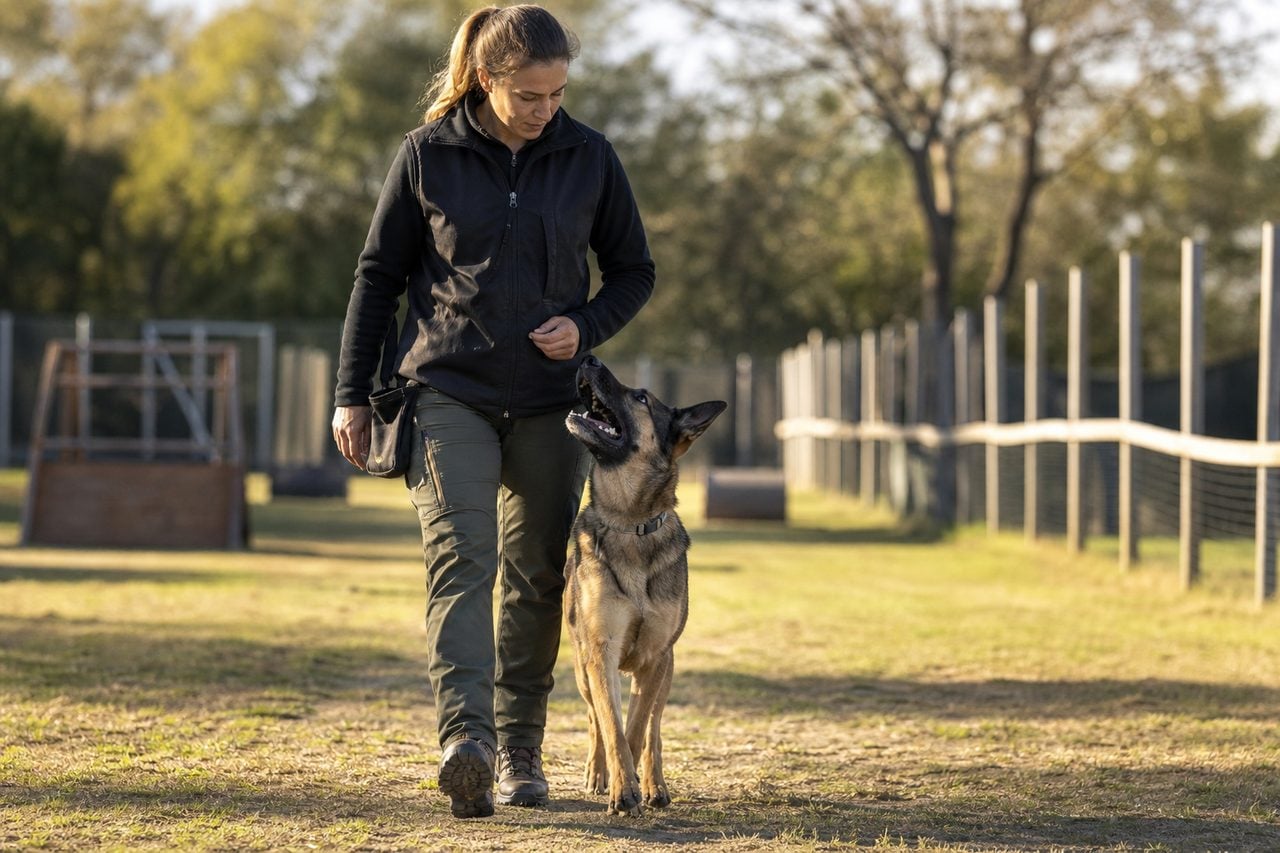
“Dog boot camp” is a search term more than it is a product. In Williamson County, when people type it they are almost always looking for one of three things: a residential program where the dog goes away and comes back trained, an intensive day program that runs Monday to Thursday, or a quick fix for a dog that has become genuinely difficult to live with. The first two exist here in quantity. The third does not exist anywhere.
It is worth separating the name from the thing, because the name carries an implication — military intensity, correction-heavy, results by pressure — that does not describe most of what is actually sold in this county. The local intensive programs run the full range of methods, several of the busiest describe themselves in terms of positive reinforcement and structure rather than discipline, and the ones with genuine working-dog and law-enforcement lineage are the ones least likely to use the word.
This page covers what an intensive program in Franklin and the rest of Williamson County actually involves, what the formats and prices are, when intensity genuinely helps, and when it makes a problem worse.
What people mean by boot camp, and what is actually on offer here
Three distinct local products answer the search.
Residential blocks. Two to four weeks with the dog living at a facility or in a trainer’s home, trained several times a day. This is the closest thing to the popular image and it is well supplied in this county — more than half the trainers serving Williamson publish one. Locally these run from about $1,800 for a week to $4,200 for four, with one operator publishing a $2,500–$8,500 range.
Day-training programs. The dog attends for the working day, trains with staff, and goes home at night. Williamson has an unusual concentration of these, and they are structured as blocks — six, ten or twelve sessions, typically Monday to Thursday, priced locally between $800 and $1,800 depending on length and stream. Several are explicitly named for the problem they address rather than the age of the dog: an adolescent life-skills stream, a reactivity stream, a confidence stream for fearful dogs over four months.
Intensive private blocks. A compressed series of private lessons over a short period rather than spread over months. Less advertised, but most of the county’s in-home trainers will arrange it, and for a household in genuine difficulty it is often the fastest route to relief because the work starts in the room where the problem is.
What nobody credible sells here is a week that resolves aggression, a fortnight that cures separation distress, or a program that transfers without the owner doing anything afterwards. If you are offered one of those, the price is the least of the problems.
When intensity genuinely helps
Concentration of practice is a real advantage and it is not marketing. A professional doing fifteen or twenty short, correct repetitions a day for three weeks accumulates something an owner practicing twice a week for six months will not, and the dog spends far less time rehearsing the wrong answer in between. For certain problems that difference is decisive.
Foundation skills on an adolescent dog. Place, recall, lead manners, crate, thresholds, impulse control. A nine-month-old that has had freedom and no structure responds very well to a fortnight of consistency, and this is the single most common local use of an intensive program.
Households at breaking point. There is a legitimate version of intensity that is about relief: a family that is no longer coping needs the pressure taken off before anything else can be built. Getting the dog into a structured program for a fortnight while the household resets is a reasonable clinical decision, and several local trainers will frame it that way.
Skills that need a controlled environment. Muzzle conditioning, crate training, settling around other dogs at a managed distance — all easier to build somewhere purpose-set-up than in a kitchen with three children in it.
Dogs whose owners physically cannot do the work. An injury, a demanding job, a large strong dog and a small handler. This is a common and honest reason in this county, and there is no virtue in pretending otherwise.
When it makes things worse
Intensity is a multiplier, and it multiplies in both directions.
A dog that is frightened rather than unruly. Fear does not respond to concentration; it responds to distance and time. A worried dog put into an unfamiliar kennel among unfamiliar dogs for three weeks may well come home quieter, and quieter is not the same as better. This is precisely why one local facility recommends that sensitive or anxious dogs do a plain boarding stay or a day camp first, so the environment is old news before training begins, and states plainly that its ability to train a dog depends on the focus the dog can bring. That is the right instinct and worth borrowing as a test question.
Problems that are contextual to your household. Separation distress, resource guarding around your children, a specific fence-line conflict with a specific neighboring dog. The dog can be entirely settled elsewhere and unchanged at home, because the trigger did not travel.
Any program sold on speed for a bite history. Aggression cases need assessment, a safety plan, muzzle work and, frequently, veterinary involvement. A program that quotes a duration before it has met the dog is selling a schedule, not a treatment. Several Williamson trainers handle these cases properly and their pricing reflects the uncertainty — one publishes an explicit per-week extension rate for severe cases and requires muzzle conditioning. That is what candour looks like.
Anywhere you are not allowed to see. If a facility will not show you where your dog sleeps, at a normal hour, the answer to every other question is irrelevant.
Day training: the format Williamson does best
If there is a local speciality, this is it. Day training — the dog comes for the working day and goes home at night — is unusually well developed in this county and it deserves more attention than it gets, because it solves the residential program’s central problem.
The dog sleeps at home every night. That means the household’s routine, the garden, the family and the actual environment are part of the picture from day one rather than something reintroduced at the end. The trainer sees the dog daily, so plans adapt fast. And because the owner collects the dog, there is a natural handover point every single day rather than one meeting at the end.
Local programs are sold in blocks and typically run Monday to Thursday, with make-up days for holidays. Structures published in this county include a six-session puppy block at $800, an eight-day continuation at $800, a twelve-session adolescent block at $1,800, a ten-session reactivity block, a confidence block for fearful dogs over four months at $1,400, and a mid-length program at $1,200. Several bundle short private lessons at pick-up — twenty-minute slots taken on the last day of the dog’s week — plus a full in-home lesson at completion. That last element is the one that makes the format work, and it is worth confirming it is included.
The trade-offs are real: it costs roughly what a residential block costs, it requires two car journeys a day, and it is concentrated in the Cool Springs area and the Franklin core, which is a long round trip from Fairview or College Grove. For a household within fifteen minutes of the facility, it is often the best value intensive option in the county.
What actually changes, week by week
Owners buying an intensive program rarely get told what the curve looks like, and knowing it is the difference between a reasonable expectation and a disappointed one.
Week one is mostly settling. A dog in a new environment spends the first few days working out the routine, the other dogs, the sounds and where it sleeps. Real learning is limited and any trainer promising transformation in seven days is either counting the settling as progress or pushing a dog that is not ready. This is exactly why one local facility recommends that sensitive dogs do a plain boarding stay or a day camp first — it moves the settling out of the training block.
Week two is where the repetitions land. Foundation behaviors — place, recall on a line, lead position, thresholds, crate — go in fast once the dog is comfortable, because a professional running fifteen short sessions a day accumulates more correct practice in a fortnight than most owners manage in six months. Local two-week programs are priced and structured around exactly this window, and their published outcomes are consistently framed as obedience and household manners rather than behavior change.
Week three is generalization. This is where the published local programs start adding public exposure — practicing the same skills in parking lots, on pavements, in dog-friendly shops — and where mild behavior cases are addressed. It is the first week in which the dog is being asked to do anything outside the trainer’s controlled environment, which is why three weeks is the realistic minimum for a dog whose problem is out in the world.
Week four and beyond is behavior work. Local four-week programs are explicitly aimed at moderate-to-severe cases, and at least one publishes a per-week extension rate because those cases do not run to a calendar. If you are buying week four you are buying change rather than skills, and you should expect the trainer to talk in terms of management and maintenance rather than completion.
Set your expectations against that shape. A fortnight buys you a dog with skills. It does not buy you a different dog, and no honest local operator will tell you otherwise.
What to ask before you book an intensive program
“What does a training day contain?” You want numbers: how many sessions, how long, what happens between them, how much rest. A dog trained ten times a day and rested properly learns; a dog occupied for eight hours does not.
“What are you going to do if my dog does X?” Ask about the specific behavior, and listen for a described procedure rather than a philosophy. Any answer is better than a slogan, in either direction.
“How many sessions with me are included and where do they happen?” The transfer is the product. A completion lesson in your own home is worth more than two hours at the facility.
“What would make you tell me this is not the right programme?” The best local answers are specific: dogs that cannot settle in a kennel, fear cases, dogs whose issue is squarely at home. A trainer with no exclusions has not thought about it.
“Can I see where the dogs sleep, today?” Not a scheduled tour. Today.
“What does the first month at home look like?” In Williamson County, the right answer includes rationing access to the garden. A dog returning to unsupervised freedom on a fenced acre will resume whatever it used to do there, and the program will get the blame.
Finally, a naming note that matters locally. A great many businesses here have K9, canine, academy or tactical in the name, and none of it describes the service. Read the published program list. The county’s one genuinely serious protection and working-dog operation does not describe its pet programs as a boot camp at all.
Dog Boot Camp in Franklin: Local Options & Nearest Specialists
Right now there are no listed Franklin trainers focused specifically on dog boot camp. Many general Franklin dog trainers can help you get started, and the nearest specialists for this focus are below.
Nearest dog boot camp specialists — Nashville
For complex cases, some families travel to the larger pool of specialists in the Nashville area for an assessment or a board-and-train stay. Top-reviewed options:
- Suburban K9 Dog Training — 5.0★ (77 reviews)
See all Nashville dog boot camp trainers →
Frequently Asked Questions
Is boot camp the same as board-and-train?
Usually yes — in this county the term almost always means a residential program, and occasionally an intensive day-training block. There is no separate product called a boot camp with different content. The word signals marketing tone rather than method, and several of the most intensive local programs describe themselves in terms of structure and positive reinforcement rather than discipline.
How much does an intensive program cost in Franklin?
Residential runs from about $1,800 for one week to $4,200 for four, with one local range published at $2,500 to $8,500. Day-training blocks run about $800 for six sessions to $1,800 for twelve, and a facility training day is $150. Severe behavior cases may be extended, and one local trainer publishes $700 per additional week for that.
Can two weeks fix aggression?
No. Two weeks can establish management, muzzle conditioning, impulse control and a safety plan, which is genuinely valuable. Changing an aggressive response reliably takes months of graded work with the people who live with the dog, and any program quoting a duration before assessing the dog is selling a schedule. Local trainers who handle these cases properly price the uncertainty openly.
Is an intensive program cruel?
It depends entirely on the operator, not on the format. Ask what a day contains, how much rest the dog gets, what tools are used and why, and go and look. In this county you will find both careful, well-rested programs and ones that keep dogs occupied all day, at similar prices. The visit tells you more than the website does.
My dog is nervous rather than naughty. Should I send it away?
Probably not, and one local facility says so itself — it recommends that sensitive or anxious dogs first complete a plain boarding stay or a day camp so the environment is familiar before any training starts. A frightened dog in an unfamiliar kennel usually gets quieter rather than better. Consider day training or in-home work, and a trainer who publishes fear and confidence work as a named service.
Why is day training so common around Franklin?
Because it fits the county. This is a commuting market where the household wants the work done but the dog’s problems are household problems, and day training splits the difference: professional repetitions all day, home every night, and a handover point every afternoon. The concentration is around Cool Springs and central Franklin, which makes it a long round trip from Fairview or the rural south-east.
Related: read our complete dog boot camp guide or the full Franklin dog training overview.
Ready to find the right dog boot camp pro in Franklin?