
Dog Boot Camp in Hendersonville, TN
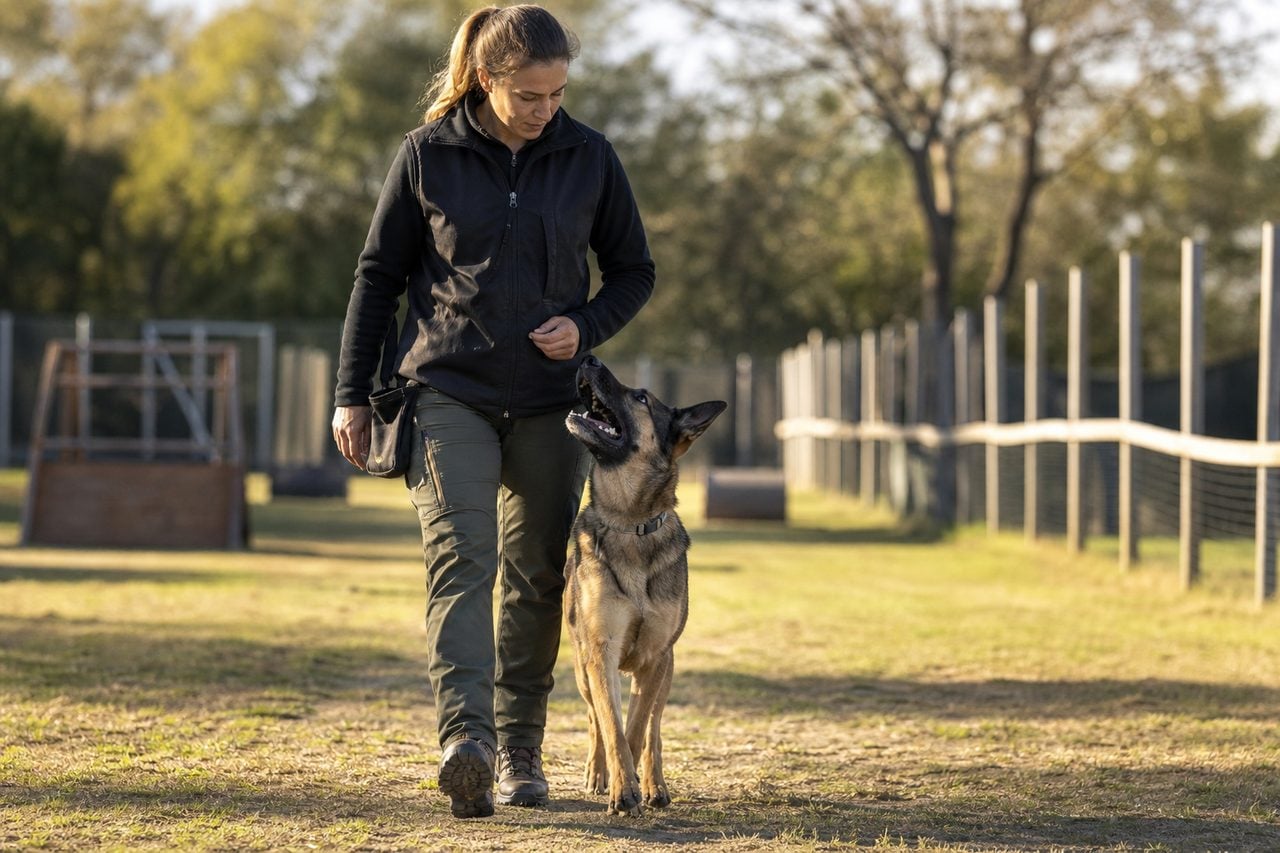
Boot camp is a marketing word rather than a technical one, and in this area it is used for two quite different things. Sometimes it means an intensive residential obedience program – a short, dense block of foundation work, usually one to three weeks. Sometimes it means a longer, more demanding residency aimed at a dog whose behavior has become genuinely difficult to live with. The two get sold under the same heading and have very different prices, timescales and prospects.
- Boot camp versus board-and-train: is there a real difference?
- What an intensive block can and cannot do in the time
- Why the land matters, and what to look for on the property
- The daily structure, and what happens the other twenty-two hours
- Handover: the part that decides whether you wasted the money
- Proofing it back into your own life
- Cost, guarantees, and the questions that get real answers
- Reviewed trainers
- FAQ
What makes the term worth its own page around Old Hickory Lake is that intensive residential work is unusually available here. The training businesses across Sumner, Trousdale and Wilson counties overwhelmingly operate from rural acreage rather than storefronts, and land is what an intensive program actually needs: room to work a dog off-lead safely, room to grade distractions, and room to house dogs without them living on top of each other. A program described as a boot camp in a strip-mall unit and a program described as a boot camp on twenty fenced acres outside Hartsville are not comparable products, whatever the website says.
This page is about how to tell the difference, what an intensive block can realistically achieve, and the specific questions that separate a serious program from a slogan.
Boot camp versus board-and-train: is there a real difference?
Often not. Many businesses in this cluster use the terms interchangeably, and where a program is described as a boot camp it is usually the same residential product with a more emphatic name.
Where there is a real difference, it tends to be one of three things.
Intensity. A boot-camp framing sometimes signals more sessions per day and a faster progression. That can be entirely appropriate for a robust adolescent dog with no emotional issues and inappropriate for an anxious one. Ask how many sessions a day and how long each is; the answer tells you more than the label.
Scope. Some programs use boot camp to mean an all-in package – obedience plus manners plus the household problems – as opposed to a targeted residency aimed at two or three behaviors. Broader is not automatically better; a program that promises to fix everything in fourteen days is describing a wish.
Method. Occasionally the term signals a firmer approach, and it is worth being direct about that rather than coy. This cluster contains committed balanced trainers and committed reward-based trainers, both running intensive residencies, and the word boot camp is more common among the former. It is not a reliable signal, though, and you should never infer method from the name. Ask.
The practical upshot: treat boot camp as a marketing label and evaluate the program underneath it exactly as you would evaluate any residency – on the training environment, the staffing ratio, the daily structure, the method, and above all the handover.
What an intensive block can and cannot do in the time
The honest arithmetic is worth spelling out because it is what makes intensive residency work at all.
An owner training alone gets perhaps ten to fifteen minutes a day, unevenly, with imperfect timing, tired, after a commute. A residential program running three or four short structured sessions a day with good mechanics delivers something like fifteen to twenty times that volume, in a fortnight. That is the entire mechanism. There is nothing else going on.
What that volume buys, reliably, in two to three weeks with a normal dog: a solid place or settle behavior, a reliable down and stay at moderate duration, loose-lead walking in the training environment, a recall that works on the property, and a considerable improvement in general impulse control. That is a genuine transformation in how a dog is to live with, and owners who get it are not imagining things.
What that volume does not buy: a change in how the dog feels about anything. Volume trains behavior. Fear, anxiety, and aggression are emotional states, and they respond to careful graded exposure over time rather than to more repetitions per day. This is the single most important distinction on this page, and it is where intensive programs are most often oversold. A dog that is frightened of strangers can be taught to hold a down while a stranger approaches, and that is worth having, and it is not the same as a dog that is no longer frightened.
Nor does it buy proofing. Two weeks is enough to acquire behaviors and to begin proofing them in one environment. It is not enough to make them bulletproof everywhere, and a dog that comes home performing beautifully at the facility will need weeks of your work to make the same behaviors hold on a lakeside path in Hendersonville or outside Providence Marketplace on a Saturday.
Why the land matters, and what to look for on the property
The rural setting of most local programs is a genuine advantage and worth understanding rather than treating as a rustic detail.
Off-lead reliability cannot be taught safely without space in which the dog can be wrong. A long line in a suburban garden teaches a dog that it is on a long line. Several hundred feet of securely fenced field, with the trainer able to increase distance and distraction in controlled steps, is what actually builds a recall that holds. Properties around Hartsville, Bethpage, Castalian Springs, Westmoreland and rural Wilson County offer exactly that, and it is the reason serious off-lead work is well supplied in this cluster.
Graded distraction also needs room. A working property with other dogs, vehicles, livestock, outbuildings and open sightlines lets a trainer take a behavior from twenty feet to a hundred and add a distraction at a chosen distance. That is difficult in a small indoor space and trivial on acreage.
Things to actually check when you visit, and you should visit:
- Fencing. Look at it. Height, condition, gates, whether there is a secondary containment layer between the working area and a road. Rural roads in Trousdale and eastern Wilson County are fast and unlit.
- Shade and water in the working area. Middle Tennessee summers are punishing and an unshaded field in July is not a training environment for most of the day. Ask how the schedule changes in summer; a good answer involves early mornings and late evenings.
- Housing. Clean, dry, temperature-controlled, secure. Ask what happens on a hundred-degree afternoon and on the coldest night. Outdoor-only kennelling in a Tennessee July is a welfare question worth asking about plainly.
- Numbers. How many dogs in residence at once, worked by how many people. Some excellent operators here deliberately cap at two or three. The number matters less than whether it is stated without hesitation.
The daily structure, and what happens the other twenty-two hours
Most owners ask about the training. Fewer ask about the rest of the day, which is where a program’s real character shows.
A dog in residence trains for perhaps ninety minutes to two hours in total, split across the day. The remaining twenty-two hours are spent somewhere, doing something, and that something is also teaching the dog. A dog that spends twenty-two hours in a kennel run with nothing to do is learning to be frustrated, and it will come home with that as well as with a nice down-stay.
Questions worth asking about the non-training hours:
- Where is the dog between sessions – a kennel run, a crate indoors, a rotating group?
- Is there structured decompression: sniffing time, long-line walks, enrichment feeding?
- Is the dog handled by more than one person? Some variation is good for generalization; a revolving cast is not.
- Does it live with other dogs, and if so, how is that managed and how was the grouping decided?
Programs that have thought about this will answer immediately, because it is what they spend most of their time on. The best small operations in this cluster – and several of them cap deliberately at a handful of dogs – are essentially selling the twenty-two hours as much as the two.
One thing worth watching for: a program that describes its non-training hours entirely in terms of daycare-style group play. Free play with other dogs is not decompression for every dog, it is arousing for many, and a residency that pairs intensive obedience with hours of unstructured play is training two contradictory states in the same day.
Handover: the part that decides whether you wasted the money
Everything above is preamble to this. An intensive program produces a dog that performs beautifully for the trainer, on the trainer’s property, with the trainer’s timing. Your house is a different environment, you are a different handler, and your timing is worse. Every one of those is a variable the dog has to work through, and the behavior will look weaker at home than it did at the demonstration.
This is not a failure and it is not a con. It is how dogs learn. The variable is whether the program planned for it.
A serious handover involves you handling your own dog under supervision for a substantial period – hours, not minutes – until you can produce the behaviors yourself. It includes a written or recorded record of exactly what the dog knows, what the cues are, and what the criteria are, because you will forget. It includes what equipment is used and how. And it includes follow-up sessions spread over the following weeks, when the problems actually appear, rather than clustered in the first three days when the dog is still running on facility habits.
The specific question to ask before booking: how many follow-up sessions are included, over what period, and what is your policy if the behavior falls apart in month two? A program with a clear answer has thought about transfer. A program that answers with the length of the residency has not.
Some local operators include ongoing group sessions, refresher stays, or an alumni arrangement. Where they do, it is a meaningful signal – it means they expect to see the dog again and have priced for it. It is also the practical answer to the boot-camp format’s real weakness, which is that a fortnight of someone else’s excellent handling does not by itself change what happens in your kitchen on a Tuesday.
Proofing it back into your own life
The weeks after the dog comes home are yours, and this area gives you a good ladder to climb.
Week one, keep it easy and keep it identical. Use the same cues, the same equipment, the same criteria, in your house and garden. Resist the urge to show the dog off; the point is to let it succeed in the new context before you make it harder.
Week two, add your own street. New subdivisions across Hendersonville, Gallatin and Mt. Juliet are quiet on weekday mornings and busy at weekends, which gives you two difficulty settings without leaving the postcode.
Week three, go to the lake. The shoreline parks along Old Hickory – Sanders Ferry and Drakes Creek at Hendersonville, the Lock 4 and Cages Bend areas toward Gallatin – are open enough that you choose your own distance from people, dogs and water. Leash rules apply on shared paths; check the current ones rather than assuming.
Week four and after, step up to a state park with unpredictable arrivals: Bledsoe Creek at Castalian Springs, Cedars of Lebanon south of Lebanon, Long Hunter on the Percy Priest shore near Mt. Juliet. All permit leashed pets. The open cedar glades at Cedars of Lebanon are particularly useful for long-line recall because you can see what is coming before your dog does.
Then the hard tests, briefly and rarely: Providence Marketplace, the Gallatin square on an event weekend, the edge of a youth sports morning. Five minutes, then leave while it is still working.
Two local traps. Heat: a dog drilled in spring will fall apart on July asphalt and it will look like disobedience. Train early and late through the summer. And the Wilson County Fair in August, with the events on that site through the year, is a reliable annual noise and crowd stressor – start desensitization in spring, not the week before.
Cost, guarantees, and the questions that get real answers
Few trainers here publish residential prices, and where they are quoted they are quoted by program length. The spread across this cluster is wide because the facilities genuinely differ – a home-scale operation taking two dogs at a time and a staffed twenty-acre facility are not selling the same product, and neither is automatically better.
To compare two quotes honestly, make them describe the same thing first. Follow-up sessions included, and over what period. Number of dogs in residence and number of staff. Sessions per day and their length. What happens the rest of the day. Equipment included versus equipment you will buy. Anything ongoing afterwards. Two programs a few hundred dollars apart frequently differ by several hours of post-program coaching, which is where most of the durable value sits.
On guarantees, a distinction worth holding. A guarantee that the dog will perform specified behaviors at handover, to a stated standard, is a real commitment and a reasonable thing to offer. A guarantee that a behavior problem is permanently fixed is not, because the dog goes home to a household the trainer cannot control. Be especially wary of a lifetime guarantee attached to an aggression case.
Four questions that reliably separate serious programs from slogans: What specifically happens when my dog gets it wrong? How many dogs are here at once and who works them? May I see the field and the kennels before I book? And what would make you tell me my dog is not a good fit for this program?
That last one matters most. A trainer who can describe the dogs they turn away – the ones too anxious for residency, the ones whose problem is really the household, the ones who need a vet or a veterinary behaviorist first – is a trainer who has turned people away. That is the reassurance you are actually shopping for.
Dog Boot Camp in Hendersonville: Local Options & Nearest Specialists
Right now there are no listed Hendersonville trainers focused specifically on dog boot camp. Many general Hendersonville dog trainers can help you get started, and the nearest specialists for this focus are below.
Nearest dog boot camp specialists — Nashville
For complex cases, some families travel to the larger pool of specialists in the Nashville area for an assessment or a board-and-train stay. Top-reviewed options:
- Suburban K9 Dog Training — 5.0★ (77 reviews)
See all Nashville dog boot camp trainers →
Frequently Asked Questions
Is a boot camp different from board-and-train?
Usually not. Across this cluster the terms are largely interchangeable and describe the same residential product. Where there is a real difference it is in intensity – more sessions per day – or in scope, and occasionally in method, since the boot-camp framing is somewhat more common among firmer trainers. Never infer the method from the name; ask what specifically happens when the dog gets something wrong.
How long does a boot camp need to be?
For general obedience foundations with a normal dog, two to three weeks is the workhorse length and produces real change. One week is a jump-start. Off-lead reliability and advanced work run three to six. Genuine behavior cases – aggression, severe fear or anxiety – need four weeks or considerably more, and an honest trainer will be more cautious about what they promise for those, not less.
Will an intensive program fix my dog's fear or aggression?
It can produce meaningful improvement, and several trainers in this cluster publish behavior rehabilitation as their core business. But understand what volume buys. More repetitions per day trains behavior; it does not by itself change how a dog feels. A frightened dog can be taught to hold a down while a stranger approaches, which is genuinely worth having and is not the same as a dog that is no longer frightened. Emotional change takes graded exposure over time.
What should I look at when I visit the facility?
The fencing, including whether there is a second containment layer between the working area and the road – rural roads here are fast. Shade and water in the working field, and what the summer schedule looks like. Where the dogs sleep and what happens on a hundred-degree afternoon. How many dogs are in residence and how many people work them. And what the dogs do for the twenty-two hours a day they are not training, which is where a program’s real character shows.
My dog was perfect at pick-up and is ignoring me at home. What happened?
Nothing unusual. Dogs learn in context, so a behavior built on the trainer’s property with the trainer’s timing is weaker in your house with yours. Go back to easy – same cues, same equipment, same criteria, at home only – for a week before adding difficulty, and use your follow-up sessions rather than saving them. If the program included none, that is the gap, and it is the thing to ask about before booking next time.
Related: read our complete dog boot camp guide or the full Hendersonville dog training overview.
Ready to find the right dog boot camp pro in Hendersonville?