
Dog Boot Camp in Knoxville, TN
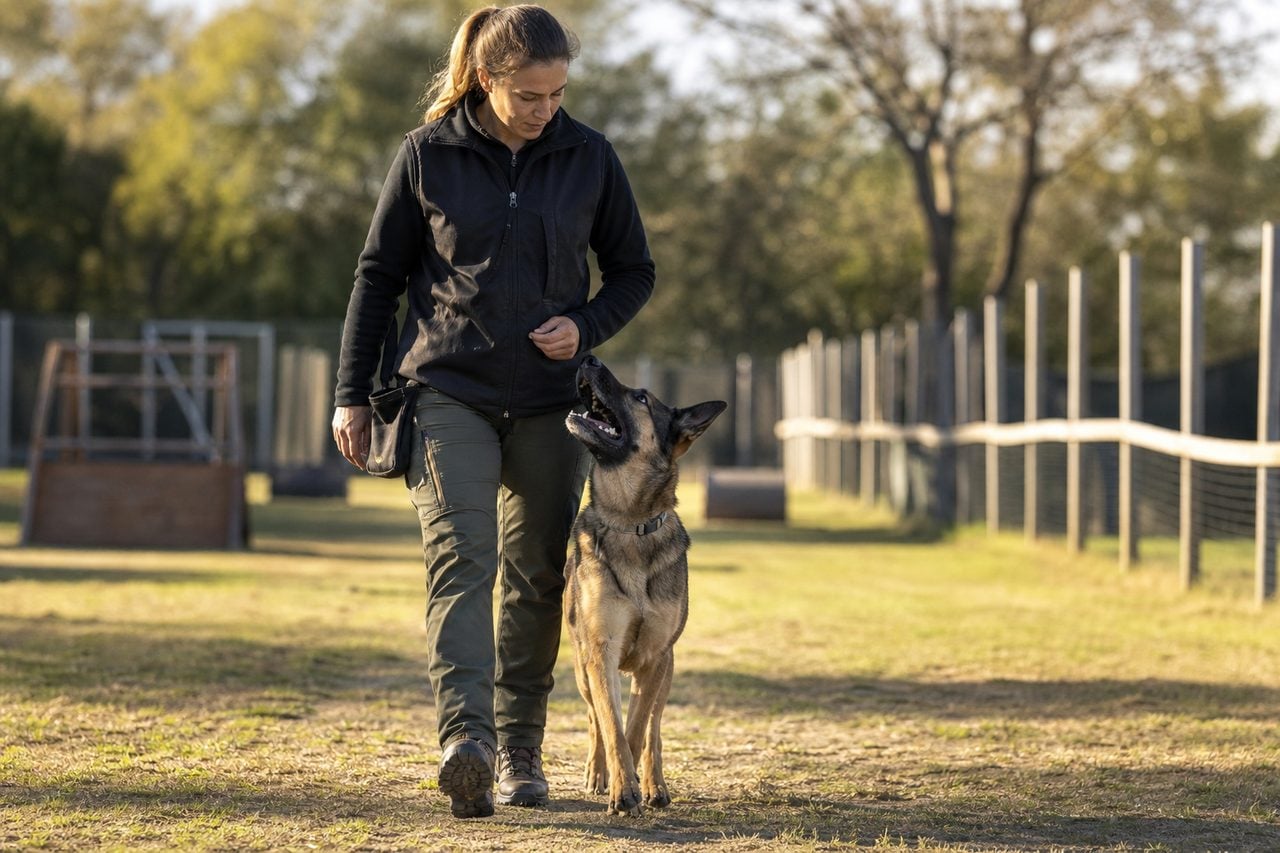
‘Boot camp’ is a marketing term rather than a training category, and in the Knoxville area it is attached to at least three genuinely different products. Some local providers use it for a short, intensive residential stay. Others use it for a drop-off day program — the dog arrives in the morning, works through the day and goes home at night. At least one Farragut-area provider lists ‘Boot Camp’ as a named tier alongside group classes and private training, which is a third thing again.
That ambiguity matters because the word itself sells an idea — fast, intensive, transformative — that some of the underlying products deliver and others do not. An owner with an eleven-month-old dog that has become genuinely unmanageable is usually not looking for a philosophy; they want the situation to change soon. This page is about what actually changes quickly, what does not, and which of the local intensive formats fits which problem.
Around eighteen trainers in this directory publish an intensive or residential option. They are spread from Powell and Halls in the north through the city, out to Farragut and Lenoir City in the west, and heavily concentrated across Blount County towards Maryville, Alcoa and Walland.
The three things sold under the same name
The first is the residential intensive: the dog lives with the trainer for one to three weeks. This is the product most people picture, and it is covered in detail on our board-and-train page. It is the most expensive and the most disruptive to the dog.
The second is day training, sometimes advertised as day camp or boot camp. The dog is dropped off in the morning, works several short sessions across the day with a professional, and comes home at night. Several local providers publish this as a distinct program, and one Sevier County trainer sells a ‘board and train day camp’ explicitly. It costs less than residential, the dog sleeps at home, and the household sees incremental change rather than a single reveal at the end.
The third is an intensive class tier — a compressed course, more sessions per week than a standard eight-week beginner class, sometimes with a stricter curriculum. This is the cheapest of the three and the most owner-dependent, because you are still the one handling the dog.
When you enquire anywhere in this metro, the useful question is not ‘do you do boot camp’ but ‘where does my dog sleep, and who handles it during the day’. The answer sorts the three immediately, and the price differences between them stop looking arbitrary.
Day training: the format this metro under-uses
Day training is the quiet workhorse of intensive programs and it suits Knoxville’s commuting geography unusually well. A dog dropped in Powell or Alcoa on the way into work and collected at six has had four or five professional sessions in a day, with no boarding cost and no separation from the household.
Its structural advantage over residential training is that the handover is continuous. You see the dog every evening, so drift is caught within a day instead of discovered a fortnight later. Most local providers running this format add a weekly or fortnightly owner session on top, which is where you are taught to hold what the dog has learned.
Its limitation is equally clear. A dog with severe separation distress will not cope with the drop-off, and a dog whose problems are strictly nocturnal or household-specific may show none of them during the day at a facility.
Practically, the metro’s day-training capacity sits where the facilities are: the Powell and Halls corridor in north Knox County, the western end around Farragut and Lenoir City, and the Maryville–Alcoa cluster. If you commute from Seymour, Clinton or Dandridge, ask about drop-off windows before assuming the logistics work; a program that opens at seven and closes at six fits a Knoxville commute, and one that closes at four does not.
What genuinely changes fast, and what does not
Intensive formats produce real, quick change in a specific band of behaviors, and it is worth knowing which so you can judge whether the money will do what you want.
Fast: mechanical skills with a clear criterion. Loose-lead walking, a place or bed cue, waiting at doors and car boots, sitting to be leashed, coming when called on a long line, and stopping the low-grade household chaos of counter-surfing and jumping. Two weeks of competent daily repetition moves these a long way, because they are learned behaviors with obvious success conditions.
Slow: anything with an emotional engine. Fear of strangers, genuine aggression, separation distress, noise phobia, resource guarding rooted in anxiety. These are not skill deficits. They involve changing how a dog feels, and feelings do not respond to repetition on a two-week schedule. An intensive can teach management skills around them and can start the process, but a provider promising to resolve a fear-based problem in a fortnight is overselling.
Genuinely variable: adolescent overwhelm. Most local ‘boot camp’ clients are dogs between eight and eighteen months whose owners are exhausted. Some of that is a training deficit and responds fast. Some of it is simply an adolescent brain, which improves with age and structure regardless of what anyone does. An honest local trainer will tell you which portion is which after an evaluation, and this metro’s near-universal free evaluation makes that assessment cheap to get.
The adolescent dog, which is most of the clients
Between about eight and eighteen months a dog that was manageable becomes something else. Recall that worked at six months evaporates. The lead pulling gets worse. The dog starts noticing other dogs across the street in a way it never did. Owners describe this as the dog having ‘turned’, and in the Knoxville metro it is the single commonest reason an intensive program gets bought.
Two things are happening. The dog’s default juvenile habit of staying near you has switched off, which is normal and permanent. And the dog is now physically capable of doing what it wants, which in West Knox County means dragging you towards another dog and in Union or Blount County means going over a ridge after a deer.
An intensive helps here more reliably than almost anywhere else, because the problem genuinely is a skill and structure deficit at a moment when the owner has run out of capacity. Daily professional repetition rebuilds recall and lead manners quickly at exactly the age the dog is most able to learn them.
The caveat is the one every honest local operator repeats. Adolescence continues after the program ends. A dog that comes home at eleven months brilliant will test everything at thirteen months, and the households that hold their gains are the ones that booked the follow-up session for that moment rather than waiting for the relapse.
Reading the marketing honestly
Some claims attached to intensive programs are reasonable and some are not, and the difference is learnable in about five minutes.
Reasonable: a defined list of behaviors the dog will perform, in defined conditions, with defined support afterwards. One local provider advertises five specific commands in five days with a money-back guarantee — that is a narrow, testable claim about mechanical skills over a short intensive, and it is the shape an honest promise takes.
Unreasonable: guarantees about how a dog will feel. Nobody can promise your dog will no longer be frightened of men, and any program framing a fear case as a fixable-in-two-weeks obedience problem has misdiagnosed it or is hoping you will not notice.
Worth interrogating: ‘lifetime guarantee’ and ‘lifetime support’, both of which appear locally. They can mean genuinely valuable ongoing access to the trainer, or they can mean you may return for free group classes indefinitely. Both are legitimate; they are not the same thing, and the website rarely says which. Ask.
Also worth asking about is who handles your dog day to day. On larger sites the person you meet at the evaluation is not always the person doing the daily sessions, and there is nothing wrong with that as long as you know it. A provider that names its trainers and explains who does what is easier to trust than one that does not.
Fitting it into the metro's geography
Where you live changes which intensive format is realistic, more than in most metros, because this one is spread across eight counties and the facilities are not evenly distributed.
In Knox County itself, day training and hybrid programs are practical almost everywhere — the Powell and Halls corridor, the Farragut and Hardin Valley end, and the facilities along the Kingston Pike axis are all within a normal commute of most of the city.
In Blount County the picture is different and better: this is where the land is, and the residential and boarding-plus-training capacity is concentrated around Maryville, Alcoa and out towards Walland. A Maryville owner has more residential choice than a downtown Knoxville owner does.
In Anderson County the Oak Ridge area is served by both local provision and trainers driving out from the city, but heavy residential capacity is thinner; expect to travel or to have the trainer travel.
On the eastern and southern fringes — Seymour, Sevierville, Dandridge, New Market, Greenback — the practical options are usually a mobile trainer coming to you, or a residential program that includes transport. At least one local academy publishes pickup and return for eligible addresses across a wide regional area, which is worth asking about specifically if the drive would otherwise rule a program out.
Dog Boot Camp in Knoxville: Local Options & Nearest Specialists
Local Knoxville-area options for dog boot camp:
- Balanced Paws K9 Training — 4.9★ (77 reviews)
Nearest dog boot camp specialists — Nashville
For complex cases, some families travel to the larger pool of specialists in the Nashville area for an assessment or a board-and-train stay. Top-reviewed options:
- Suburban K9 Dog Training — 5.0★ (77 reviews)
See all Nashville dog boot camp trainers →
Frequently Asked Questions
What is the difference between boot camp and board and train?
Usually nothing, and that is the problem with the term. Some local providers use ‘boot camp’ for a residential stay, others for a drop-off day program where the dog goes home at night, and at least one uses it for an intensive class tier. Ask two questions when you enquire: where does my dog sleep, and who handles it during the day. That sorts the three formats immediately and explains the price differences.
How fast will an intensive actually work?
It depends entirely on the behavior. Mechanical skills with a clear criterion — loose lead, place, door manners, recall on a long line, jumping and counter-surfing — move a long way in two weeks of daily work. Anything with an emotional engine, such as fear of strangers, genuine aggression, separation distress or noise phobia, does not, because those require changing how the dog feels rather than what it knows. A provider promising to resolve a fear case in a fortnight is overselling.
My dog is eleven months old and has become impossible. Is that normal?
Completely, and it is the most common reason people in this metro book an intensive. Between roughly eight and eighteen months a dog loses the juvenile habit of staying close to you and simultaneously becomes strong enough to do what it wants. Part of that is a genuine training gap, which responds quickly to daily professional work, and part is simply an adolescent brain, which improves with structure and age. A free evaluation — near-universal here — will tell you the proportions before you spend anything.
Is day training cheaper than residential?
Yes, usually substantially, because you are not paying for boarding. The dog is dropped off in the morning, works several sessions with a professional and goes home at night. It also removes the biggest structural weakness of full residential training: you see the dog every evening, so drift is caught in a day rather than discovered at the end. Check the drop-off and collection windows fit a Knoxville commute before you commit.
What does a 'lifetime guarantee' mean at a Knoxville trainer?
It varies and the website rarely says. It can mean genuine ongoing access to the trainer for follow-up questions and sessions, or it can mean you may return to group classes free of charge indefinitely. Both are real value; they are different things. Ask specifically what is included in month two, month six and year two, and whether follow-up sessions are in your home or at their facility.
Can a two-week program fix aggression?
It can start work on it and it can teach management, but it will not resolve it. Aggression is an emotional response, usually rooted in fear or in a learned strategy that has worked for the dog, and changing it takes months of graded work with the people who live with the dog. A residential stay can be a useful component, particularly where the household needs breathing room, but it is the beginning rather than the treatment.
I live in Sevierville and the facilities are all in Knoxville. What are my options?
Three. A mobile trainer who covers Sevier County — several in this directory publish service areas that include it. A residential program that includes transport; at least one local academy publishes pickup and return for eligible addresses across a wide regional area. Or a hybrid where the dog boards during the week and comes home at weekends, which turns a daily drive into a weekly one.
Related: read our complete dog boot camp guide or the full Knoxville dog training overview.
Ready to find the right dog boot camp pro in Knoxville?