
Dog Boot Camp in Muncie, IN
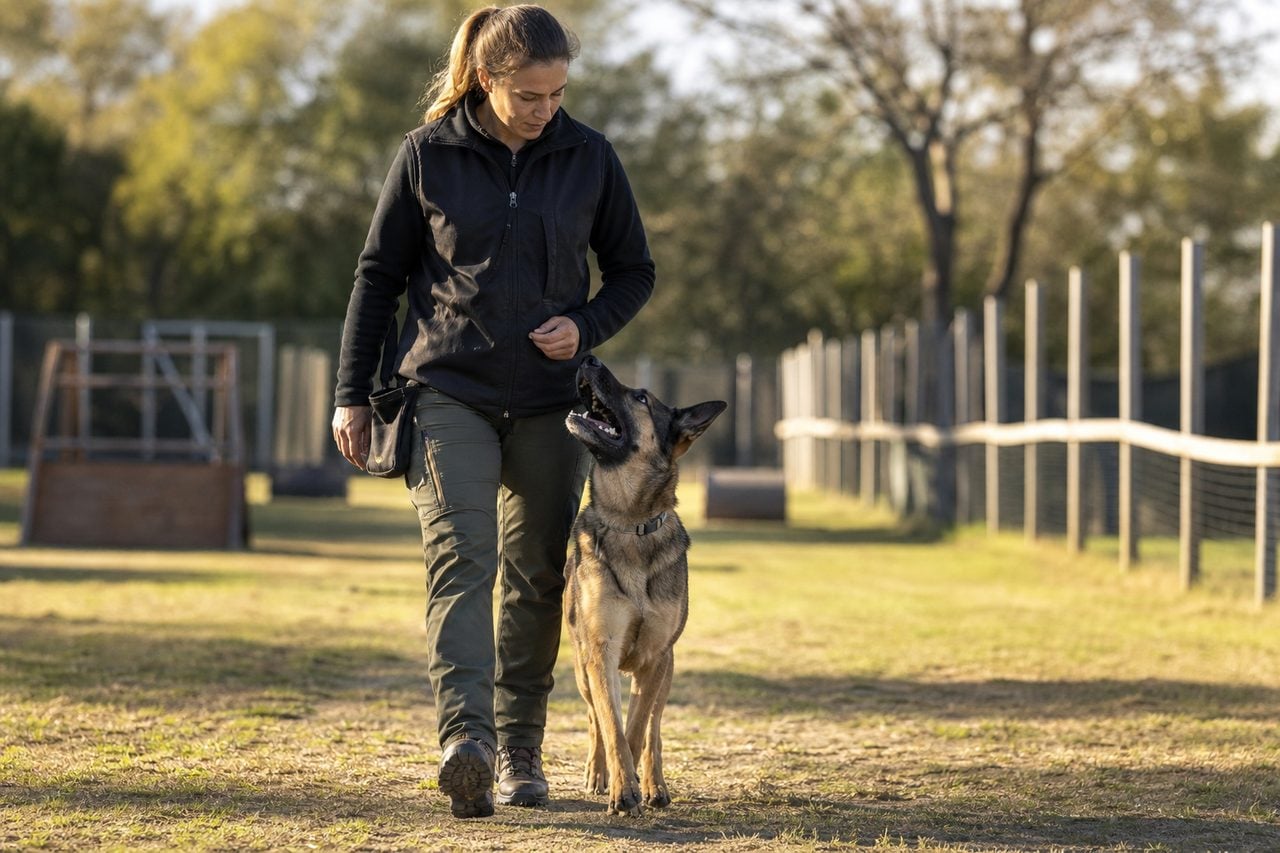
“Dog boot camp” is a marketing phrase more than a defined training method. In practice, it almost always refers to an intensive, immersive program — most often a residential board-and-train stay, though the term is sometimes stretched to cover daycare-style day-training or condensed multi-day workshops. The name conjures discipline and fast results, which is exactly why it sells. What matters for a dog owner in Muncie, Anderson, or the surrounding towns is what actually happens during the “boot camp,” not the word on the sign or the tone of the advertising.
This guide cuts through the branding. It explains what boot-camp-style training really involves, how it compares to other options like day-training and group classes, which common claims to distrust, and what humane, effective intensive training actually looks like. It also gives you an honest read on local availability across east-central Indiana — there is a genuine local board-and-train option near Muncie, while the broader menu of intensive programs and formats sits about an hour southwest in Indianapolis, the nearest large market.
Read this before you hand over your dog or your money, so you can tell a solid program from a slick pitch — and so you know whether an intensive format is even the right fit for the problem you are trying to solve. In many cases it is; in some cases a very different approach will serve you and your dog far better.
What “boot camp” actually means
There is no industry-standard definition of a dog “boot camp,” so the first job is to translate the term into what is actually on offer. Most commonly it means a residential board-and-train program: your dog lives with the trainer for a set period and trains intensively every day. Sometimes it means an all-day “day-training” arrangement where you drop the dog off in the morning and pick it up at night while a trainer works with it, and occasionally it refers to a condensed multi-day workshop for owners and dogs together.
The common thread is intensity and immersion — more reps in less calendar time than a weekly group class. That compression is the genuine advantage: consistency builds habits, and a full daily schedule of short, well-structured sessions can move a dog faster than one class a week followed by six days of inconsistent homework.
Because the label is fuzzy, always ask a provider to describe the format in plain terms: Does my dog live with you or come home each night? How many hours of actual training per day? What is the curriculum? Solid trainers answer clearly. Vague, hype-heavy answers — heavy on “transformation” and light on specifics — are a warning sign that the “boot camp” is more brand than substance.
The word itself carries baggage worth setting aside. “Boot camp” borrows military imagery that implies harsh discipline produces the best dogs — a premise the modern training field has largely moved past. The best intensive programs are intense in their structure and frequency, not in their harshness. So treat the term as a search keyword, not a description of method, and dig past it to understand what the trainer will actually do with your dog each day. That is the only thing that determines the outcome.
Boot camp vs. day-training vs. group classes
Each format trades off differently. A residential boot camp (board-and-train) offers maximum immersion — the dog is in a controlled routine around the clock and cannot rehearse bad habits at home. The trade-off is cost, the separation, and the critical need for an owner handoff at the end so the skills transfer to you rather than staying with the trainer.
Day-training — drop off in the morning, home at night — keeps your dog sleeping in its own house and lets you see progress daily, but the dog returns each evening to the home environment where problems may be reinforced. It works well for owners who want professional daily reps without a full send-away, provided the trainer coaches you on evenings and weekends. It also removes the anxiety some owners feel about leaving a dog overnight with someone new, and it keeps you closely involved throughout, which can make the eventual transfer of skills smoother. The trade-off is that it requires a provider within a reasonable daily commute — harder to find in a smaller market like Muncie — and that the home environment keeps exerting its pull every single evening, so your own consistency at home matters even more than with a residential stay.
Group classes are the most affordable and are excellent for socialization and foundational obedience, but they depend heavily on the homework you do between sessions — which is precisely where busy owners fall down. Private lessons sit in between: personalized and effective, but they still put the daily training load on you. There is no universally “best” format; the right choice depends on your schedule, your budget, your dog’s issues, and how much daily work you can realistically do yourself. A boot camp is worth the premium mainly when time is your binding constraint or when a dog needs to break habits away from home.
For many families, the smartest path is a combination rather than a single format. A short intensive stay can install a foundation fast, and follow-up private lessons or a group class then help you maintain and generalize it in your own home and neighborhood. Thinking in terms of “what gets my dog to the goal” rather than “which single product do I buy” usually leads to a better and often cheaper answer. A good trainer will happily recommend the mix that fits your situation instead of pushing the most expensive option.
The myths worth deflating
The biggest myth is that boot camp is a magic reset button — drop the dog off, get back a finished product, do nothing yourself. It does not work that way. The dog learns to respond to the trainer; if you do not learn the cues and keep the routine, the training fades. Any program that promises a permanent fix with zero owner involvement is overselling.
A second myth is that “boot camp” implies harsh, military-style discipline is necessary. It is not. Intensity refers to frequency and structure, not to punishment. Effective intensive programs are built on clear, humane, reward-based foundations. Harshness is not a feature; it is a risk — heavy-handed methods can suppress behavior temporarily while creating fear or fallout that surfaces later, sometimes as aggression.
A third myth is that faster is always better. Some behaviors genuinely take time and cannot be rushed, particularly anything rooted in fear or emotion. A trainer who guarantees to “fix” a deep behavioral problem in a week is either redefining the problem or overpromising. Speed is real for obedience and manners; it is far less real for changing how a dog feels about something. Match your expectations to what intensive training can and cannot compress.
A final myth is that once the dog “graduates,” the job is done. Training is a maintenance activity, not a one-time event — skills that are not practiced fade, and a dog that is never asked to hold its manners gradually stops offering them. The best programs tell you this plainly and build in owner coaching precisely because they know the finish line is not pickup day. Any pitch that implies your involvement ends when the boot camp does is setting you up for disappointment a month later.
Local availability in east-central Indiana
Muncie and the surrounding area do not have a wide selection of intensive-training providers, so calibrate your search. The good news is there is a real local option: Advanced Canine Techniques in Albany, just outside Muncie in Delaware County, offers board-and-train — the residential format most “boot camp” marketing describes. That makes it a sensible first call for owners in Muncie, Yorktown, Daleville, and Chesterfield who would rather not drive far.
For a broader menu — different methodologies, specialized curricula, day-training formats, larger facilities, and more scheduling options — the Indianapolis metro about an hour southwest is where the depth is. Owners in Anderson and New Castle are already a bit closer to Indy, which can make the trip and any owner-handoff sessions more manageable. There is nothing wrong with widening the search to Indianapolis if the local option is booked, is not the right fit, or does not offer the specific format you want.
The practical play is the same as with any intensive program: call the local Albany option first and put it through the vetting questions in this guide. If it fits, you save the drive; if not, plan on Indianapolis. Do not let a bigger advertising budget substitute for evidence — a nearby trainer who explains their methods clearly and lets you observe beats a distant one with a flashier website.
Remember, too, that not every problem needs a residential program at all. If your dog is fundamentally sound and your real obstacle is consistency, a local trainer running private lessons or a group class — plus your follow-through — may solve it without any “boot camp” at all. Reserve the intensive-format search, and the drive to Indianapolis if needed, for cases where time is genuinely your constraint or the dog needs to break entrenched habits away from the home environment. Choosing the lightest tool that actually works saves money and stress.
Methods and humane standards to insist on
Whatever it is called, insist on knowing how the program actually trains. Look for clear, reward-based foundations and a trainer who can explain their approach and reasoning rather than hiding behind results guarantees. Ask specifically how they respond when a dog gets something wrong — the answer tells you a lot. Humane, modern programs teach the dog what to do and reinforce it, rather than relying primarily on intimidation or pain.
Demand transparency. You should be allowed to see where your dog sleeps, understand how many hours it trains versus rests, and know how it is exercised and, if relevant, socialized. Reputable providers welcome observation or share video and progress updates during a stay. A refusal to let you see the space or the sessions is a serious red flag — good trainers have nothing to hide.
Check credentials and references too. Certification from bodies like the Certification Council for Professional Dog Trainers (CPDT-KA) signals ongoing education, and references from past clients — ideally with dogs similar to yours — tell you whether results held up. Confirm vaccination requirements, cleanliness, and a clear plan for veterinary care if your dog gets sick or hurt. These standards apply equally to the local Albany option and to any Indianapolis program you consider.
Be especially cautious with tools and equipment. Ask what training tools the program uses and why, and whether your dog will be introduced to any equipment you are not comfortable with. A trustworthy trainer explains their choices, tailors the approach to the individual dog, and respects your boundaries as the owner. Blanket, one-size-fits-all use of aversive equipment on every dog — or an unwillingness to discuss it — is a signal to keep looking. You are entrusting them with a family member, and you are entitled to clear, respectful answers.
What results are realistic
Set expectations by behavior type. Intensive programs are genuinely effective at building obedience and manners — reliable sit, down, place, recall, loose-leash walking, and impulse control around doors, food, and distractions. An adolescent dog that pulls, jumps, and ignores cues can make real, visible progress in a few focused weeks. These are the wins boot-camp formats deliver well.
Where results are slower and less certain is anything emotional: fear, reactivity born of anxiety, or true aggression. These respond to behavior-modification work over time, not to a compressed obedience blitz, and the wrong intensive methods can worsen them. If your core problem is how your dog feels rather than what it knows, an obedience boot camp may not be the right tool — a qualified behavior professional is (see our guide on finding a dog behaviorist).
Also plan for the homecoming. Expect a short adjustment period where behavior slips as the dog returns to a less-structured environment; this is normal and recovers if you keep the routine tight. The lasting results belong to owners who maintain consistent cues and criteria across the whole household. A boot camp accelerates training; it does not replace your ongoing role, and the honest programs will tell you exactly that up front.
A useful mindset is to judge results against your dog’s specific starting point, not against a highlight reel. A rowdy adolescent that learns to settle, walk on a loose leash, and come when called has made enormous, life-changing progress even if it is not a competition-perfect dog. Define success as measurable improvement on the two or three behaviors that actually disrupt your daily life, and you will both get real value from an intensive program and avoid the letdown of chasing an unrealistic “perfect dog” fantasy.
Choosing and vetting a program
Start by writing down the two or three behaviors that matter most to you — calm on leash, reliable recall, settling on a mat — and make sure any program targets those specifically. A focused program matched to your goals beats a generic “transformation” package. Be honest with the trainer about your dog’s history, triggers, medical issues, and any bite record; concealing a bite history endangers staff and other dogs and undermines the whole effort.
Then run the format questions: Does my dog live with you or come home nightly? How many hours of real training per day? What methods do you use and how do you handle mistakes? Can I observe or see video? What owner handoff and follow-up are included? Can you share references from similar cases? What happens if my dog gets sick or injured? Clear, specific answers indicate a real program; hype and dodging indicate a brand.
Finally, weigh convenience against fit. The local Albany board-and-train saves you the drive and the repeated trips for handoff sessions, which is a real advantage. But if it is not the right match for your dog or does not offer the format you need, Indianapolis’s deeper pool is only about an hour away. Choose on methods, transparency, and goal-fit — not on the word “boot camp” and not on advertising spend.
Trust your read of the trainer as a person, too. Over the course of a stay you are handing this individual a great deal of responsibility for your dog’s wellbeing and behavior, so it should feel like a partnership. Do they listen to your concerns, answer questions patiently, and talk about your dog as an individual rather than a case number? A trainer who communicates well and clearly cares about the dogs in their charge is worth more than a longer feature list. If something feels off on the first call, keep looking — there are good options within reach.
Dog Boot Camp in Muncie: Local Options & Nearest Specialists
A few Muncie-area trainers can help with milder dog boot camp needs:
- Advanced Canine Techniques — 5.0★ (34 reviews)
Nearest dog boot camp specialists — Indianapolis
For complex cases, some families travel to the larger pool of specialists in the Indianapolis area for an assessment or a board-and-train stay. Top-reviewed options:
- Nate Schoemer Dog Training — 5.0★ (188 reviews)
- Good Bones K9 Training — 5.0★ (31 reviews)
- Steven’s Bootcamp Dog Training Indianapolis — 5.0★ (9 reviews)
- Lead & Learn Canine Solutions — 5.0★ (7 reviews)
- Paws a Moment Dog Training LLC — 5.0★ (1 review)
- Indy K-9 — 4.9★ (123 reviews)
- Big N’ Small Paws 317 — 4.9★ (97 reviews)
- Kingdom Bully Kennels — 4.9★ (58 reviews)
See all Indianapolis dog boot camp trainers →
Frequently Asked Questions
Is “dog boot camp” the same as board-and-train?
Usually, yes. “Boot camp” is a marketing term with no fixed definition, but it most often describes a residential board-and-train stay where your dog lives with the trainer and trains intensively each day. Sometimes it refers to all-day day-training or a condensed workshop instead, so always ask a provider to describe the actual format in plain terms.
Does boot camp require harsh or military-style discipline?
No. “Intensity” refers to how frequent and structured the training is, not to punishment. Effective intensive programs are built on clear, humane, reward-based methods. Harsh techniques are a risk, not a requirement — they can suppress behavior temporarily while creating fear or fallout that shows up later, sometimes as aggression.
Is there a dog boot camp near Muncie?
There is a genuine local board-and-train option: Advanced Canine Techniques in Albany, just outside Muncie, offers the residential format most “boot camp” marketing describes. For a broader menu of intensive programs and formats, the Indianapolis metro about an hour southwest has the deeper pool, which is a reasonable option if the local choice is booked or not the right fit.
Can a boot camp fix aggression quickly?
Be skeptical of that claim. Obedience and manners can improve fast in an intensive program, but emotional problems like fear, reactivity, and true aggression respond to behavior-modification work over time — and the wrong intensive methods can make them worse. Deep behavioral issues call for a qualified behavior professional rather than an obedience boot camp.
Will my dog stay trained after boot camp?
Only if the skills transfer to you. Your dog learns to respond to the trainer, so a good program includes owner handoff coaching so you can maintain the cues at home. Expect a short regression during the adjustment period, and keep the routine consistent across the household — owner follow-through is what makes results last.
How do I vet a boot-camp program?
Ask how they train and how they handle mistakes, whether you can observe or see video, how many hours per day the dog actually trains, what owner handoff and follow-up are included, and for references from similar cases. Confirm vaccination requirements, cleanliness, and a plan for veterinary care. Clear, specific answers signal a real program; hype and dodging signal a brand.
Related: read our complete dog boot camp guide or the full Muncie dog training overview.
Ready to find the right dog boot camp pro in Muncie?