
Dog Boot Camp in Terre Haute, IN
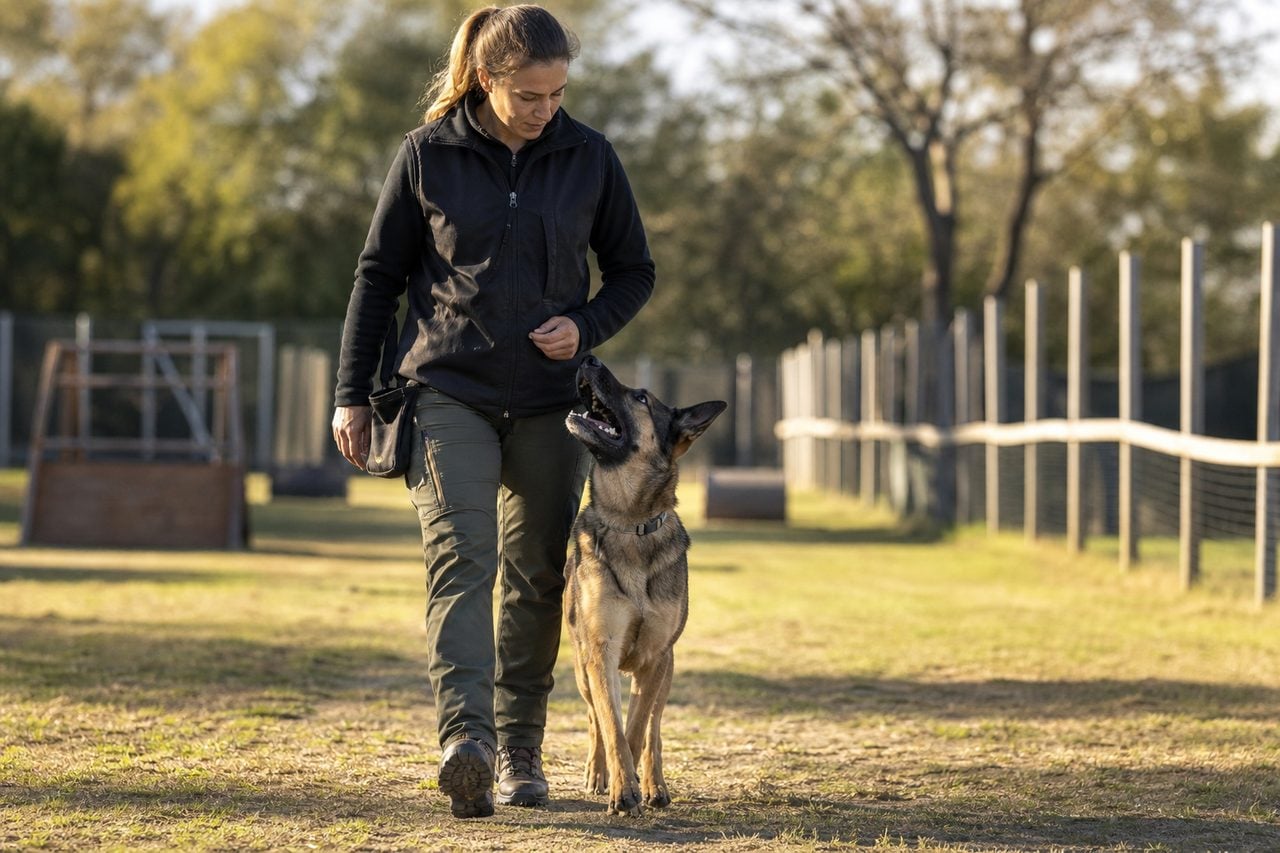
“Dog boot camp” is a marketing phrase more than a technical one. It usually describes an intensive residential training program — the dog stays with a trainer for a concentrated stretch and works every day — and it tends to be searched by owners who have reached the end of their patience. Something is genuinely wrong: the dog pulls so hard that walks have stopped, or bolts out the front door, or has become unmanageable somewhere between eight months and two years old. The word “boot camp” carries an implicit promise of a hard reset, and that promise is worth examining before you buy it.
- What “Boot Camp” Means in Practice
- Boot Camp, Board and Train, Day Training and Private Lessons
- Where Intensive Programs Genuinely Exist Locally
- What an Intensive Program Looks Like Day to Day
- Methods and Tools: The Questions That Matter
- What a Boot Camp Cannot Fix
- Preparing for the Program and Holding the Results
- Reviewed trainers
- FAQ
In the Terre Haute area, the practical reality is that boot camp and board and train describe the same category of service. Vigo County is a mid-sized market: the Wabash Valley has real, credentialed trainers running residential programs, but not a dozen of them, and the deeper bench of specialists sits about an hour and fifteen minutes east on I‑70 in Indianapolis. Knowing exactly what exists here, and what a residential program can and cannot accomplish, saves you both money and disappointment.
This guide breaks down what an intensive program actually looks like day to day, how it differs from day training and private lessons, which local providers genuinely offer it, what questions to ask about methods and tools, and — importantly — the problems that no boot camp will fix no matter how long you send the dog away.
What “Boot Camp” Means in Practice
Strip away the branding and a dog boot camp is a residential training program. Your dog lives with a trainer, either at a training facility or in the trainer’s home, and trains in multiple short sessions daily for a defined number of days. Nothing about the term implies a particular methodology, a particular set of tools, or a particular level of harshness. Some programs branded as boot camps are entirely reward-based; some are highly structured and compulsion-inclusive. The name tells you the format, not the philosophy, which is precisely why you have to ask.
The military framing does mislead people in one specific way. It suggests that intensity itself is the active ingredient — that a dog who is pushed hard for two weeks will come out fundamentally changed. What actually produces results is far less dramatic: frequency of clean repetitions, consistency of rules, prevention of rehearsal of the unwanted behavior, and a handler whose timing is good enough that the dog can figure out the pattern quickly. A well-run residential program delivers all four. It does not deliver them because it is tough; it delivers them because a professional has the dog around the clock.
It is also worth being clear about what the word attracts. Owners searching for boot camp are often at a breaking point, and that emotional state is easy to sell to. The trainers worth hiring will slow you down: they will ask what the dog actually does, in what circumstances, how often, and how it started, and they will sometimes tell you that a residential program is not the right tool. That conversation is a good sign, not a stalling tactic.
Boot Camp, Board and Train, Day Training and Private Lessons
Four formats cover almost everything on offer in the Wabash Valley, and they solve different problems.
Residential programs — boot camp, board and train, whatever the marketing calls them — are the most concentrated. The dog is in a controlled environment full-time, so it cannot practise the unwanted behavior between sessions. Best for building foundation obedience fast, for off-leash reliability, and for adolescent dogs who need structure imposed rather than negotiated. Most expensive per week, and carries the transfer problem discussed below.
Day training is the underrated middle option. A trainer works your dog during the day, often several days a week, and the dog sleeps at home. You get professional repetitions without removing the dog from its household, and coaching sessions are usually built in. For working owners who want expert help but are uneasy about a residential stay, this is frequently the better answer.
Private lessons put the trainer in your house or your neighborhood, working the problem where it actually happens. If your dog is fine everywhere except at the front door, or fine on every street except the one with the fence-running dog, private work targets that directly. It is the slowest format in calendar terms and the most demanding of the owner, but it produces the most durable results because you are the one being trained.
Group classes build skills under real, live distraction and are excellent for maintenance after any intensive program. They are also the cheapest way to find out whether your dog’s issue is a training gap or something deeper, because a good instructor watching your dog for six weeks will tell you.
Many households end up combining formats: a residential program to build the foundation, then group classes to maintain and generalize it. That sequence is more reliable than either piece alone.
Where Intensive Programs Genuinely Exist Locally
Two providers in the Terre Haute metro genuinely run residential training, and it is worth being precise about both because the local supply is thin.
K9.5 Training Academy at 3475 Erie Canal Road runs a 12-day board-and-train program plus a 6-day program in which the owner attends and trains alongside the dog, out of a purpose-built 10,000 square foot facility that also handles boarding, day play, and grooming. Owner Larry Hopper is the K9 Commander of the Vigo County Sheriff’s Office K9 Unit, a Master Trainer with DLE, and a former IPWDA trainer. That working-dog background is real experience with control, obedience under distraction, and handling dogs with drive — skills that transfer well to a strong-willed pet dog. It does not mean pet dogs are put through police-dog work.
Top Dog Training LLC, owned by Nicole Thraen, runs the in-home version of the same idea. Dogs live inside the trainer’s home on an 8-acre property, and board-and-train clients get access to weekly group classes reserved for them, which builds the follow-up phase into the program rather than leaving it to the owner’s discipline. Two caveats you should know before you plan around it: the business’s website is no longer live, and it has previously paused new-client intake. Call and confirm current intake rather than assuming a spot is available.
For contrast, Unlimited Pawsibilities at 1209 N Fruitridge Ave does not offer board and train — it is the metro’s class and behavior-modification practice, and a sensible starting point if what you actually have is a behavior problem rather than an obedience gap. If neither local residential option matches your timeline or your goals, the wider range of program lengths and specializations is in Indianapolis, roughly an hour and fifteen minutes east on I‑70.
What an Intensive Program Looks Like Day to Day
Owners often imagine hours of drilling. The reality in a well-run program is closer to the opposite: short, frequent, high-quality sessions separated by real rest, because dogs consolidate learning during downtime and a tired, over-aroused dog learns badly.
The first day or two are usually decompression and assessment. The trainer is watching how your dog handles a new environment, how it eats and sleeps, how it responds to handling and to pressure, and what it already knows. Nothing much appears to happen, and that is appropriate — starting hard work with a dog that is still stressed by the move produces poor results.
The middle of the program is where the foundation gets built. Marker or reward mechanics are established so the dog understands how information is being delivered. Position behaviors come in — sit, down, place, and a formal recall — first in a quiet space with no competition, then with mild distraction added deliberately. Leash mechanics are cleaned up. If the goal includes off-leash work, long-line proofing begins here. Each behavior is built in a low-distraction setting and then re-taught, essentially from scratch, in progressively harder ones.
The final stretch is generalization and handoff prep. The dog works in new places, around new people and dogs, with the trainer deliberately introducing the kind of chaos that occurs in real life. Video is typically taken for the owner. In an owner-attending format like the 6-day program at K9.5, the handoff work is happening continuously rather than in a single session at the end — which is a genuine structural advantage, because the owner is being trained in parallel with the dog.
Methods and Tools: The Questions That Matter
Because “boot camp” says nothing about methodology, and because Indiana does not license dog trainers, the burden of due diligence sits entirely with you. The most useful thing you can do is ask a trainer to describe, in plain language, exactly what will be done to your dog and in what circumstances.
Specifically: what tools might be used — flat collar, martingale, harness, long line, slip lead, prong collar, electronic collar — and at what point in the program each would be introduced. What does the trainer do when the dog gets something right, and what happens when the dog gets it wrong or refuses? How is the dog conditioned to any tool before it is used to communicate consequences? What is the plan if the dog shuts down, stops eating, or shows fear? Would the trainer be comfortable with you watching a session, and if not, why not?
You do not need to referee the industry’s methodology debates to evaluate the answers. What you are listening for is specificity, calm, and a willingness to be observed. A professional can explain their approach clearly, name their tools without defensiveness, describe how they would know if it was not working, and tell you what they would change. Evasiveness, irritation at being questioned, or an insistence that you simply trust the process are all meaningful warnings — not because any particular tool is disqualifying, but because a trainer who will not explain themselves to you will not explain themselves when something goes wrong either.
Ask, too, about video updates during the stay. Regular footage is both reassuring and informative: it shows you what your dog is actually doing and gives you a preview of the mechanics you are about to be asked to reproduce.
What a Boot Camp Cannot Fix
This is the section most program marketing leaves out, and it is the one most likely to save you money.
Pain and illness masquerade as behavior problems with remarkable frequency. A dog that has become snappy, that resists being touched in a particular place, that stopped wanting to walk, or that changed abruptly in temperament may have orthopedic pain, dental disease, a gastrointestinal problem, a thyroid issue, or declining vision or hearing. No amount of training resolves any of that, and drilling a painful dog makes things worse. Any behavioral change that is sudden, or that appears in an older dog, warrants a veterinary examination before a training program.
Separation-related distress is not a boot-camp problem. The dog’s difficulty is with being apart from its people; removing it from its people for two weeks does not treat that and often intensifies it. The same caution applies to generalized anxiety and to severe noise phobias, which frequently need a treatment plan that combines behavior modification with veterinary input.
Serious aggression with a bite history is in a different category altogether. It deserves an in-person assessment, a frank conversation about management and liability, and often a veterinary behavior workup rather than a package deal. A trainer who quotes you a residential price for a biting dog over the phone, without seeing the dog, is not being careful with your family’s safety.
And finally: a boot camp cannot fix a household. If the rules change the moment the dog gets home, if one adult enforces the crate routine and another does not, if the dog is rewarded for jumping by half the family, the program’s results will erode within weeks. This is not a knock on owners — it is simply how learning works. The program buys you a well-started dog. Keeping it is a household project.
Preparing for the Program and Holding the Results
Preparation starts before drop-off. Get vaccinations current and get the paperwork the facility requires well ahead of time. Bring the dog’s normal food to avoid a digestive upset layered on top of the environmental change. Write down your goals in concrete, observable terms — “walks on a loose leash past another dog,” “comes when called at the park,” “settles on a bed while we eat” — rather than “better behaved,” and give that list to the trainer. Specific goals produce specific programs and give you an honest way to evaluate the outcome.
Plan the first two weeks home before your dog comes back. Keep the trainer’s routine intact: the same crate schedule, the same feeding pattern, the same rules about doorways and furniture. Resist the urge to celebrate the homecoming by relaxing everything — that single decision undoes more programs than any training flaw. Practise the new skills daily in short sessions, in easy environments first.
Then generalize deliberately. Start in your own hallway and yard. Move to a quiet corner of Deming Park early in the morning, then a weekday stretch of the National Road Heritage Trail, then the trails at Dobbs Park & Nature Center, then Fowler Park or Hawthorn Park on a busier weekend. Each new place is a small re-teach, not an exam. If the dog struggles somewhere, that is information about the next training step, not evidence that the program failed.
Book the follow-up support and actually use it. Whether that is the transfer sessions included in your package or the weekly group classes that Top Dog Training reserves for its board-and-train clients, structured practice with a professional watching is what turns a two-week result into a permanent one. The households that keep their training are, almost without exception, the ones that stayed in contact with their trainer.
Dog Boot Camp in Terre Haute: Local Options & Nearest Specialists
Local Terre Haute-area options for dog boot camp:
- K9.5 Training Academy — 4.9★ (73 reviews)
- Top Dog Training LLC — 4.9★ (27 reviews)
Nearest dog boot camp specialists — Indianapolis
For complex cases, some families travel to the larger pool of specialists in the Indianapolis area for an assessment or a board-and-train stay. Top-reviewed options:
- Nate Schoemer Dog Training — 5.0★ (188 reviews)
- Good Bones K9 Training — 5.0★ (31 reviews)
- Steven’s Bootcamp Dog Training Indianapolis — 5.0★ (9 reviews)
- Lead & Learn Canine Solutions — 5.0★ (7 reviews)
- Paws a Moment Dog Training LLC — 5.0★ (1 review)
- Indy K-9 — 4.9★ (123 reviews)
- Big N’ Small Paws 317 — 4.9★ (97 reviews)
- Kingdom Bully Kennels — 4.9★ (58 reviews)
See all Indianapolis dog boot camp trainers →
Frequently Asked Questions
Is dog boot camp the same thing as board and train?
In practice, yes. Both describe a residential program where the dog stays with a trainer and works daily for a defined period. “Boot camp” is a marketing term and tells you nothing about the methods used — some programs using the name are entirely reward-based and others are highly structured. Because the label carries no information, ask every trainer to describe their methods and tools specifically before you book.
Are there boot-camp-style programs in Terre Haute?
Two local providers genuinely run residential training. K9.5 Training Academy on Erie Canal Road offers a 12-day board-and-train and a 6-day owner-attending program in a purpose-built 10,000 square foot facility. Top Dog Training LLC runs an in-home version on an 8-acre property, though its website is no longer live and it has previously paused new-client intake, so confirm availability by phone. Unlimited Pawsibilities does not offer residential training. A wider selection sits in Indianapolis, about an hour and fifteen minutes east on I‑70.
How old should a dog be for an intensive program?
Most residential programs are aimed at dogs past the early puppy stage, commonly from roughly six months upward, with the adolescent window between about seven and eighteen months being the most common time owners seek one out. Very young puppies are usually better served by socialization work in their own home and neighborhood, since the point of that stage is building positive associations with your actual life. Ask any trainer directly whether they take dogs your dog’s age and what they would do differently for one.
Will an intensive program fix aggression?
Aggression with a bite history should never be booked as a package over the phone. It needs an in-person assessment, an honest discussion of management and liability, and frequently a veterinary workup to rule out pain or a medical driver. Some cases respond well to structured behavior work; some require ongoing management rather than a cure. In the Terre Haute area, Unlimited Pawsibilities does behavior modification for aggression and reactivity, and VonBernd K9 Training Center also works behavior and aggression cases. For a veterinary behaviorist, you would look to Indianapolis or Purdue’s veterinary behavior service in West Lafayette.
What should I ask about the tools a trainer uses?
Ask which specific tools might be used on your dog, at what stage each is introduced, how the dog is conditioned to it beforehand, what happens when the dog gets something right, what happens when it refuses, and what the plan is if the dog shuts down or stops eating. Also ask whether you may observe a session. You are evaluating specificity and openness as much as the tools themselves — a trainer who will not explain their approach clearly is a risk regardless of methodology.
How do I stop the training from fading once the dog is home?
Keep the trainer’s structure for at least the first two weeks — same crate routine, same feeding schedule, same rules about doors and furniture — before relaxing anything. Practise daily in short sessions, starting in easy environments and adding difficulty gradually as you move from your yard to Deming Park, the National Road Heritage Trail, Dobbs Park and beyond. Make sure every adult in the household enforces the same rules, and use the follow-up sessions or group classes included in your program instead of letting them expire.
Related: read our complete dog boot camp guide or the full Terre Haute dog training overview.
Ready to find the right dog boot camp pro in Terre Haute?