
In-Home Dog Training in Akron, OH
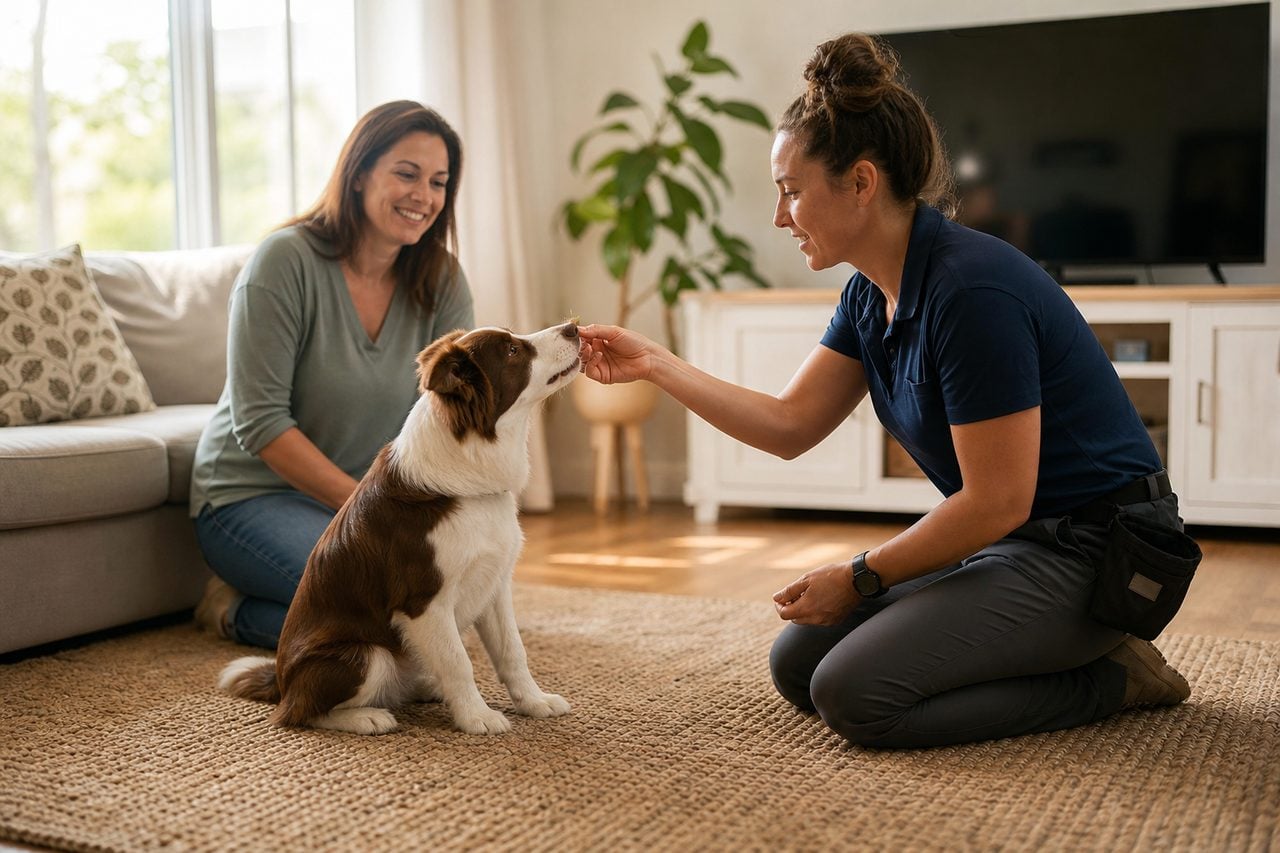
There is a reason in-home dog training has become the go-to choice for so many busy Akron households: real life does not happen in a training facility. Your dog does not bolt out the front door, jump on guests, or ignore the recall in a sterile classroom — it does those things in your living room, on your stairs, and at your back gate. When a trainer works with you in the exact place where the problems actually occur, the lessons stick faster because there is nothing to translate from one environment to another.
For working families across Summit County, the appeal is just as much about logistics as it is about results. Between the commute on 77 or 8, kids’ schedules, and everything else a week throws at you, loading the dog into the car and driving to a group class across town is one more thing to juggle — and one more reason to skip a week. In-home training flips that. The trainer comes to you, in Highland Square, Goodyear Heights, Wallhaven, Cuyahoga Falls, Stow, or out toward Hudson and Twinsburg, and the “commute” is the walk from your kitchen to your front room.
This guide walks through how the service-area, in-home model works in the Akron market, who it is the best fit for, what it realistically costs in Northeast Ohio, and how to get the most out of having a professional in your own space.
Why training where the problem happens works better
Dogs are notoriously bad at generalizing. A dog can learn a flawless “stay” in a quiet training room and then act like it has never heard the word the first time you try it at home with the TV on, the kids running through, and the doorbell ringing. Trainers call this context-dependent learning, and it is the single biggest reason group classes sometimes feel like they did not transfer to daily life.
In-home training removes that gap entirely. The dog learns to settle on its own bed, in its own house, with its own real-world distractions — the mail carrier on the porch, the squirrel on the deck rail, the smell of dinner cooking. When the lesson is built into the environment the dog already lives in, there is no transfer step. The behavior is learned where it needs to be used.
It also lets a trainer see the things you cannot describe over the phone. The way your dog charges the window when someone walks by, the exact spot on the stairs where the leash pulling starts, how the resource guarding plays out at the food bowl in the corner of the kitchen — a trainer in your home reads the full picture and tailors the plan to your actual layout, not a generic one.
How the service-area model works across Summit County
Most in-home trainers in the Akron area work on a service-area basis: they cover a radius of towns and drive to you. A typical coverage map stretches from Akron proper out through Cuyahoga Falls, Stow, Munroe Falls, Tallmadge, Fairlawn, Copley, and Bath, and often up into the northern suburbs — Hudson, Twinsburg, Macedonia, Richfield — and south toward Green, Barberton, Norton, and New Franklin. Some range further out to Medina, Wadsworth, or Kent.
A few practical things to know about how it tends to run:
- Travel radius matters. Trainers usually list the towns they cover. If you are on the edge of someone’s range — out past Richfield or down in New Franklin — ask whether a travel fee applies.
- Sessions are usually private. One-on-one means the plan is built entirely around your dog and your household, not paced to a group.
- The whole family can take part. One of the underrated perks of in-home work is that everyone who lives with the dog — spouse, kids, the teenager who feeds it — can learn the same cues and handling the same way, so the dog gets consistency instead of mixed signals.
- Scheduling is flexible. Many local trainers offer evening and weekend slots specifically because their clients work daytime hours.
Who in-home training is the best fit for
In-home, private training is not the cheapest option per session, but for the right household it is by far the highest-value one. It tends to be the strongest fit for:
- Busy and working families who cannot reliably get to a fixed weekly class across town and want the training to fit around their schedule instead of dictating it.
- Puppies in the critical early months, where building good house habits — potty training, crate comfort, settling, polite greetings — right in the home pays off for years.
- Dogs with home-specific issues like door-dashing, window reactivity, jumping on guests, counter surfing, or resource guarding, which are hard to recreate anywhere but the home.
- Reactive or nervous dogs that are overwhelmed in a room full of strange dogs and people, and learn far better in the security of their own space.
- New rescues and adopted dogs settling in, where a trainer can help you set up routines and management from day one.
Group classes still have their place — for a confident, social dog, the controlled distraction of other dogs is genuinely useful. But when the issues are tied to the home, or the logistics of a fixed class just do not work, the in-home model wins.
A realistic look at what sessions cover
Good in-home training is collaborative. The trainer is not there to “fix” the dog and hand it back; a huge part of the value is coaching you on handling, timing, and consistency so the results hold up after they leave. A typical arc across a package looks something like this:
- Session one — assessment. The trainer watches the dog in its normal environment, talks through your goals and frustrations, and builds a plan around your real layout and routine.
- Foundations. Core skills like name recognition, focus, loose-leash walking down your own street, a reliable recall, and a solid “place” or settle on a mat.
- Targeting the real problems. Whatever brought you to training — the front-door chaos, the pulling on walks toward Sand Run, the jumping on Grandma when she visits from Tallmadge.
- Generalizing and proofing. Taking the skills from the quiet living room out to the driveway, the yard, the sidewalk, and into more distracting situations so they hold up in the real world.
- Homework between sessions. Short daily practice you run on your own, which is where the actual learning compounds.
Because the work happens in your home, trainers can also help with the environmental management that prevents problems in the first place — where to put the crate, how to set up baby gates, how to manage the front entry so the door-dashing stops being rehearsed every day.
Cost expectations in the Akron area
In-home private training costs more per hour than a group class — you are paying for one-on-one attention, a customized plan, and the trainer’s drive time — but many families find it cheaper in the long run because the results come faster and actually transfer to daily life.
Northeast Ohio generally runs at or slightly below national averages, with one consistent pattern: the northern suburbs tend to price higher than Akron’s south side and the Barberton area. As realistic estimates for the local market:
- A single private in-home session often falls in the $75 to $150 range, depending on length and the trainer’s experience.
- Multi-session packages — usually four to eight sessions — are the norm and typically work out cheaper per session, often landing somewhere around $400 to $900 for a full program.
- Travel fees may apply if you are at the far edge of a trainer’s service area, out past Medina, Wadsworth, or into the rural townships.
- Specialized behavior work — serious reactivity or aggression — commands a premium over basic obedience.
When comparing quotes, ask what is included: number of sessions, length, between-session support by phone or text, and whether a written plan comes with it. The cheapest hourly rate is not always the best value if the program is thin on follow-up.
Getting the most out of an in-home program
The families who get the best results from in-home training treat the trainer as a coach rather than a mechanic. A few things that make a real difference:
- Get everyone on the same page. If one person enforces “off” and another lets the dog on the couch, the dog learns the rules are negotiable. Have the whole household sit in on at least the key sessions.
- Do the homework. Five or ten minutes a few times a day beats one long weekend cram. Dogs learn in short, frequent reps.
- Use real Akron life as your training ground. Practice loose-leash walking on the way to Sand Run Metro Park, work on calm greetings when neighbors stop by, and proof the recall in the fenced yard before trusting it anywhere open.
- Be honest about your habits. A trainer can only fix what they know about. If the dog gets table scraps or sleeps in the bed, say so — it changes the plan.
- Keep it up after the program ends. Skills fade without maintenance. The trainer’s job is to make you capable of keeping it going on your own.
Reviewed In-Home Dog Training Trainers in Akron
These reviewed Akron-area trainers from our directory handle in-home dog training. Each links to a full profile with specialties, verified credentials, reviews, and contact info:
- Zero To Hero Dog Training — 5.0★ (49 reviews)
- The People’s Pup – Adventures and Training — 5.0★ (45 reviews)
- Focus Dog Training — 5.0★ (36 reviews)
- Jackie the Dog Trainer / SouthPaw Pet Care & Training — 5.0★ (27 reviews)
- Hakuna Dogtata — 5.0★ (8 reviews)
- Ace Dog Training — 5.0★ (6 reviews)
- Sit Means Sit Dog Training Cleveland & Akron — 4.9★ (272 reviews)
- American Caniner Akron Dog Training Services — 4.9★ (152 reviews)
- The Dog Wizard Medina — 4.9★ (100 reviews)
- The Naughty Dog Training — 4.9★ (56 reviews)
See all Akron in-home dog training trainers →
Frequently Asked Questions
What areas around Akron do in-home trainers cover?
Most cover Akron and the surrounding Summit County suburbs on a service-area basis — commonly Cuyahoga Falls, Stow, Munroe Falls, Tallmadge, Fairlawn, Copley, Bath, Hudson, Twinsburg, Macedonia, Richfield, Green, Barberton, and Norton, with some ranging out to Medina, Wadsworth, or Kent. If you are near the edge of a trainer’s range, ask whether a travel fee applies.
Is in-home training better than a group class?
It depends on the goal. For problems tied to the home — door-dashing, jumping on guests, window reactivity — or for nervous dogs and busy schedules, in-home is usually the stronger fit because the dog learns where the behavior actually happens. For a confident, social dog that needs to practice around distractions, a group class adds value. Many owners use both.
How much does in-home dog training cost in Akron?
A single private session commonly runs about $75 to $150, and multi-session packages of four to eight sessions often land around $400 to $900 total, usually cheaper per session than booking one at a time. Northern suburbs like Hudson and Bath tend to price a bit higher than Akron’s south side, and travel fees may apply at the edges of a service area.
How many sessions will my dog need?
Basic obedience and puppy foundations often come together in roughly four to six sessions plus homework. More involved behavior issues like reactivity take longer. A good trainer gives you a realistic estimate after the first assessment rather than promising a fixed number up front.
Should the whole family be there for sessions?
Ideally yes, at least for the key ones. One of the biggest advantages of in-home training is that everyone who lives with the dog can learn the same cues and handling, so the dog gets consistent rules instead of mixed signals. Consistency across the household is often what makes or breaks the results.
Is in-home training good for puppies?
It is one of the best uses of it. The early months are the window for building house habits, potty training, crate comfort, settling, and polite greetings, and doing that work right in the home where it needs to stick gives a puppy a strong foundation and saves a lot of trouble later.
Related: read our complete in-home dog training guide or the full Akron dog training overview.
Ready to find the right in-home dog training pro in Akron?