
In-Home Dog Training in Cambridge, MA
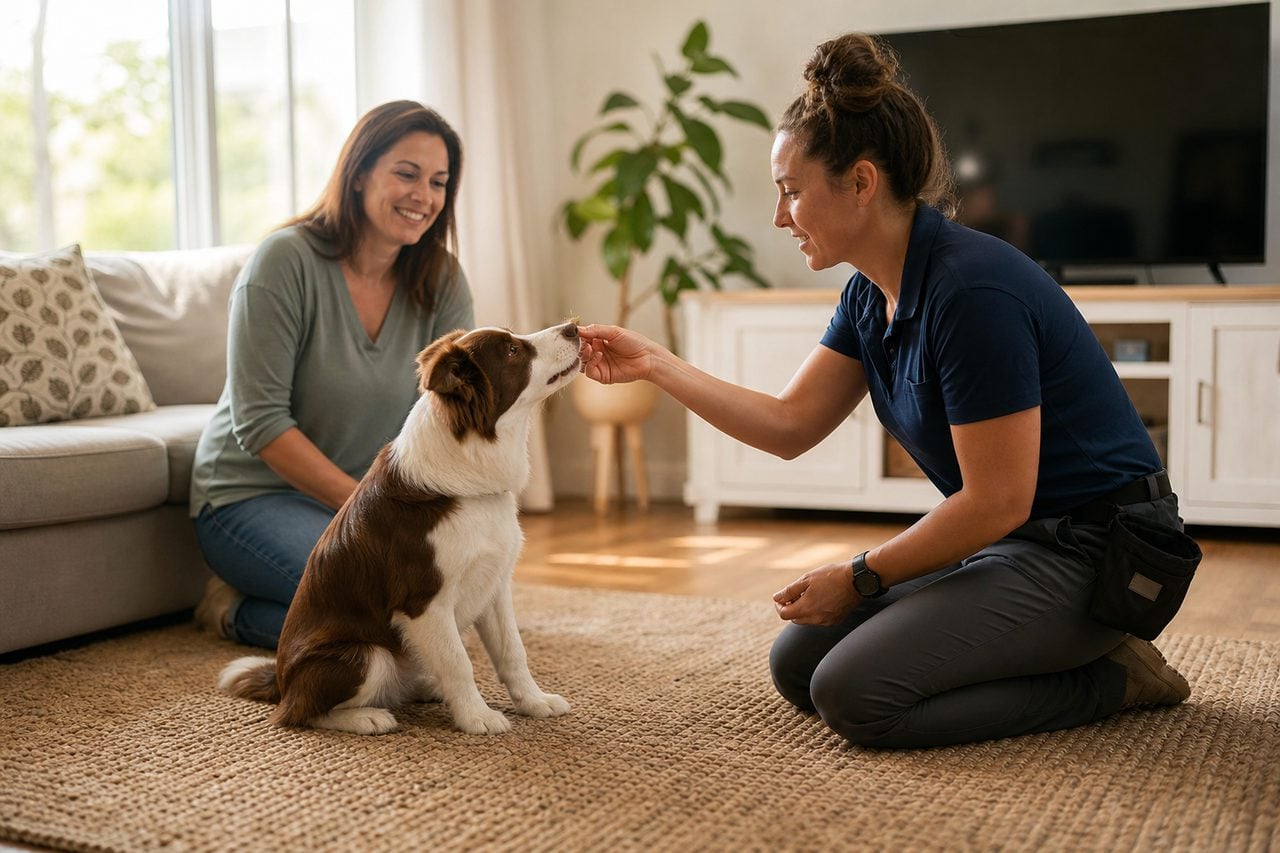
In-home dog training brings the trainer to your door, so your dog learns where problems actually happen: your entryway, your stairs, your street. Around Cambridge it is the most common way trainers work.
This page explains why training at home helps, the in-home formats offered by trainers across Cambridge and the surrounding towns, what a session looks like and how to get the most from it. Nine trainers listed for this area offer in-home training; full profiles are on this site.
Why train at home
Dogs learn best where they live. Jumping on visitors, pulling on the way to the corner, barking at the window, guarding the couch and trouble settling all happen at home and on your street, so practicing there makes the skills stick. In-home sessions also suit puppies who are not fully vaccinated, dogs who are anxious in new places and dogs who struggle near other dogs in classes.
For owners, home visits remove travel and let the whole household learn the same rules at the same time.
Home sessions also let a trainer see what is hard to describe: where the dog sleeps, how the door opens, what the window overlooks and how the household moves around the dog. Those details often explain a problem faster than any questionnaire.
Training at home is also easier on dogs who find car rides, waiting rooms or unfamiliar buildings stressful, because they can concentrate on learning instead of coping with a new place.
How Cambridge-area trainers deliver it
Nine trainers listed for this area offer in-home work. Formats include reward-based private lessons with flat-priced programs for puppies, adult obedience and behavior modification; force-free private lessons and done-for-you training; homeschool programs in which the trainer trains your dog while you are at work; and in-home behavior programs for reactivity, aggression and anxiety.
There is also family-focused in-home help for homes with babies and young children, behavior-analysis training offered in person or virtually, in-home trainers who pair lessons with real-world group classes, and an in-home franchise territory covering the northwest suburbs.
Behavior specialists who work in the home often start with a longer first visit to understand the whole picture, then move to shorter follow-up sessions or virtual check-ins as the plan settles.
What a session looks like
A first visit usually starts with questions about your dog’s history, health, routine and goals, followed by watching your dog in its normal setting. The trainer then teaches one or two key skills, practices them with you and leaves homework. Later sessions build on that homework and move practice outside, to your street and the places you walk.
For behavior problems, expect more time talking through triggers and management, and a written or video plan to follow between visits.
Many in-home trainers finish each visit with a short written summary or video clips of the exercises, so everyone in the household can practice the same way between sessions.
Questions before you book
- Which towns do you cover, and is there a travel fee?
- Will you train my dog, coach me, or both?
- What happens between sessions: homework, videos, messages?
- What methods and equipment do you use?
- How many visits does a dog like mine usually need?
Clear answers help you choose between a coaching-style trainer, a done-for-you or homeschool program and a behavior specialist, and they show how the trainer plans to measure progress.
It also helps to ask how the trainer handles cancellations, weather and access to your building, since visits depend on parking, buzzers and stairs as much as on the dog.
Getting the most from home visits
Be home and involved, even when the trainer works your dog alone, and invite everyone who lives with the dog. Have treats, leashes and any equipment ready, and keep a short log of what happens between visits so the trainer can see patterns.
Practice little and often. A few minutes several times a day beats one long session before the next visit. Use management between visits, such as a gate at the door or a covered window, so the problem is not rehearsed while training catches up.
If several people live with the dog, schedule at least one visit when everyone can attend. Consistent rules from the whole household often turn a good session into lasting change.
In-home training for common local problems
Dogs in the area often struggle with the same few things: barking at hallway or street noise, rushing doors, pulling toward dogs and bikes on narrow sidewalks, jumping on visitors and trouble settling in small spaces. In-home trainers can practice each of these in the exact place it happens.
Families expecting a baby or living with toddlers can also get in-home help preparing the dog for changes in routine, space and noise, which is far easier to plan before the baby arrives.
Building life can be part of the plan too: elevator manners, passing neighbors’ dogs in a stairwell and staying calm when deliveries arrive are all easier to practice at home than in a class.
Reviewed In-Home Dog Training Trainers in Cambridge
These reviewed Cambridge-area trainers from our directory handle in-home dog training. Each links to a full profile with specialties, certified credentials, reviews, and contact info:
- Bark Busters Boston Northwest — 5.0★ (103 reviews)
- Eric Temple Dog Training — 5.0★ (42 reviews)
- Good Dog Boston — 5.0★ (41 reviews)
- The Balanced Pack Dog Training — 5.0★ (33 reviews)
- The Dog Behavior Institute — 5.0★ (19 reviews)
- Pride and Joy Dog Training — 5.0★ (16 reviews)
- Boston K9 Concierge LLC — 5.0★ (12 reviews)
- Fingers and Paws Dog Training — 5.0★ (5 reviews)
- Dazzling Dog Training
See all Cambridge in-home dog training trainers →
Frequently Asked Questions
Is in-home training more effective than classes?
For many household problems, yes, because practice happens where the problem occurs. Classes are better for practicing around distractions, and many owners use both.
Do I need to be home during sessions?
For lessons, yes. For done-for-you or homeschool programs the trainer works your dog while you are out, but you should attend the lessons where skills are handed over to you.
Can in-home trainers help with reactivity or aggression?
Many can. Several in-home trainers around Cambridge run behavior modification programs for reactive, fearful and aggressive dogs.
Can in-home training help me prepare my dog for a baby?
Yes. At least one local trainer focuses on families with babies and young children and works with the household at home or remotely.
How far do trainers travel?
It varies. Many list the towns they cover, and some add a travel fee beyond their core area, so ask before you book.
Related: read our complete in-home dog training guide or the full Cambridge dog training overview.
Ready to find the right in-home dog training pro in Cambridge?