
In-Home Dog Training in Chattanooga, TN
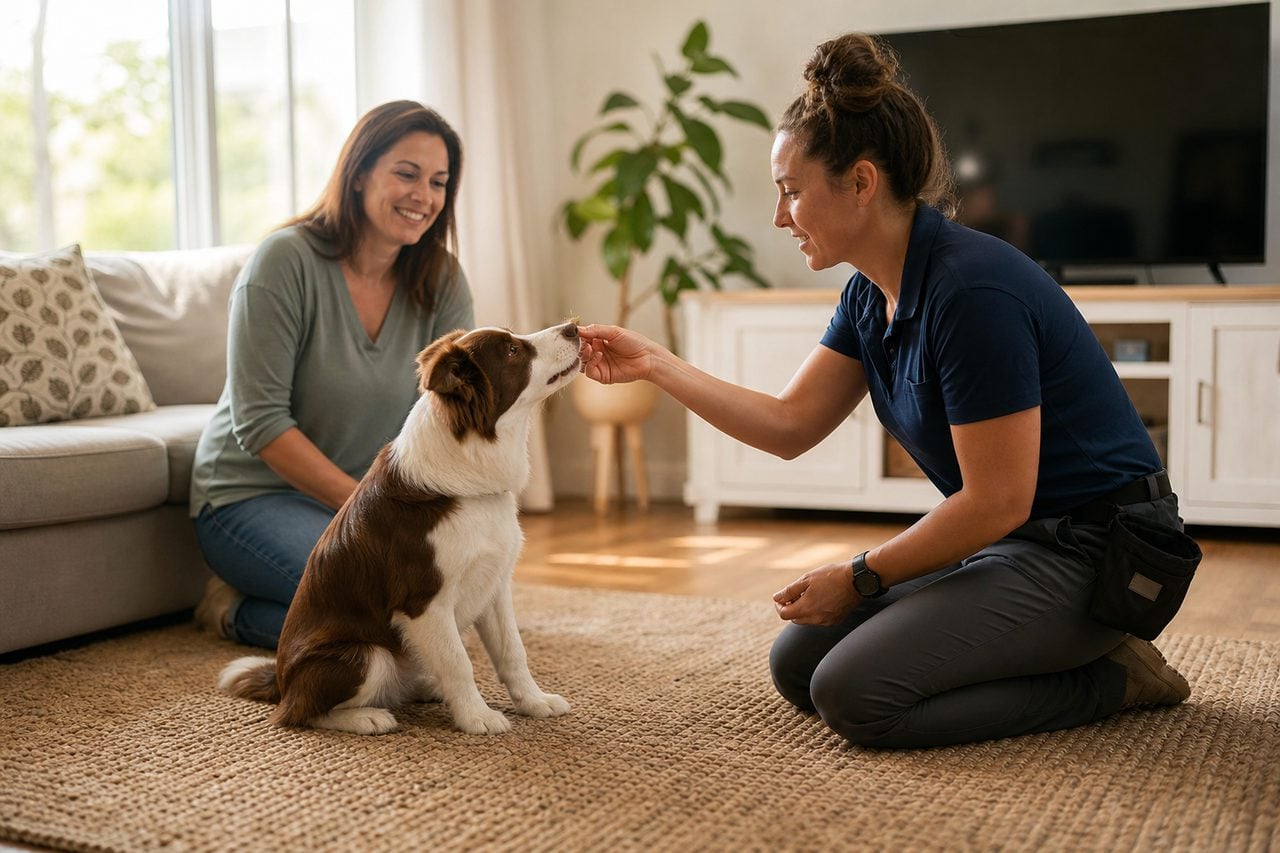
In-home training is the format that fits Chattanooga’s geography better than any other, and the local market reflects it: a large share of the trainers working in this metro are mobile rather than premises-based, and several state on their own websites that they come to you. That is not a coincidence. This is a metro where the trainer’s address and the client’s address can be separated by a river, a ridge, or a twenty-minute switchback descent, and where a weekly evening class in the wrong part of town simply does not survive contact with real life.
But the strongest argument for in-home work is not convenience. It is that a great many dog problems are problems of place. A dog that barks at the postman, lunges at the fence line, guards the sofa, mugs guests at the door, or falls apart when you leave for work is not doing any of that in a training hall. It is doing it at your address, cued by your doorway, your window, your neighbor’s dog and your morning routine, and the most efficient place to fix it is exactly where it happens.
The problems in-home work is genuinely best at
There is a clear category of behavior that belongs at home. Door manners — the dog that launches at anyone who knocks — is trained at your door, with your doorbell, using your hallway. Fence-line and window barking is trained at your fence and your window, because the trigger is a specific neighbor’s dog at a specific time of day. Resource guarding around furniture, beds and food bowls is trained around your furniture. Toileting problems are solved in your house on your schedule. Multi-dog household tension is worked out between your dogs, in the rooms where the tension happens.
Separation-related distress belongs here too and is almost impossible to address anywhere else, since the entire behavior is a response to being left in a particular place by particular people. The protocol has to be built at your door with your departure routine, and the homework happens between visits.
Reactivity on your own street sits in the same category more often than people expect. A dog that is fine in a parking lot but explodes at the corner of its own road has learned something location-specific, and walking that same route with a professional beside you is worth several sessions in a hall.
Where in-home work is the wrong tool
It is not the answer for building high-level obedience under heavy distraction, and it is not the answer for a dog that needs to learn to work in a room full of other dogs. Both of those need environments your house does not contain. In practice good local trainers handle this by starting at your address and then moving the sessions out — to your street, then a parking lot, then a riverside path or a park — as the dog’s ability catches up. If a trainer proposes to do everything in your living room for six weeks, ask how the skills will generalize.
It is also a poor value proposition when what you actually need is volume of repetition. In-home instruction teaches you to do the repetitions. If you will not do them, it is the wrong purchase.
And for a household with a genuinely dangerous dog, in-home work alone may not be enough. Those cases need an in-person assessment, an explicit safety and management plan, and often a veterinary conversation alongside the training.
How geography shapes this in Chattanooga
The mountains are the reason this format thrives here. From Signal Mountain, Walden or Lookout Mountain, getting down to a valley training facility at six in the evening is a serious round trip on switchback roads, and doing it every week through a wet January is a commitment most households quietly abandon. Mountain-top households disproportionately choose in-home or day training, and local trainers know it — several publish service areas that explicitly include the mountains.
The north county is the same story stretched out. Soddy-Daisy, Sale Creek and the communities up Highway 27 are thirty to forty minutes from central Chattanooga, and the practical answer for a household there is either a locally based trainer or a mobile one. Bradley County has enough of its own supply that Cleveland households rarely need to leave the county at all.
All of which produces one very practical rule: ask about travel before anything else. Does this trainer come to my address, is there a travel charge beyond a certain radius, and how far will they actually go? A mobile trainer’s real service area is often narrower than the map on their website, and finding that out at the booking stage saves everybody a wasted conversation.
What a session should look like
A first in-home session is largely diagnostic and it should feel like it. A competent trainer will want to watch the behavior happen rather than hear about it — to see the door, the window, the garden, the route you walk, where the dog sleeps and where it eats. Expect questions about the whole household routine, including who feeds the dog, who walks it, and what the teenager does differently from you.
You should come out of it with three things: a plain description of what is actually going on, a management plan that reduces the behavior immediately by changing the environment, and a small number of specific exercises with a stated frequency. Management first is the mark of a good local trainer — a dog that cannot rehearse the barking is a dog that is already improving before any training has taken effect.
Homework is the entire mechanism in this format. You are being coached, not served. Two short sessions a day between visits will beat one long one, and a trainer who checks in between appointments — a text, a short video review — is worth more than one who does not. Ask whether that is included.
Cost, cadence and what to ask
Ask five things before booking. Do you come to my address and is there a travel charge? Will the sessions move outside my house as the dog progresses, and where to? Is contact between sessions included? How many sessions do you expect this to take, and what happens if it takes more? And what will you not take on — which cases do you refer elsewhere?
That last question is the most informative one on the list. A trainer who names the cases they decline is showing you the edges of their competence, which is exactly what you want to know before you invite someone into your house to work on a problem you cannot solve yourself.
Reviewed In-Home Dog Training Trainers in Chattanooga
These reviewed Chattanooga-area trainers from our directory handle in-home dog training. Each links to a full profile with specialties, certified credentials, reviews, and contact info:
- Soul Healing Canine LLC — 5.0★ (26 reviews)
- K9 Solution Training — 5.0★ (7 reviews)
- Oak Creek K9 — 5.0★ (2 reviews)
See all Chattanooga in-home dog training trainers →
Frequently Asked Questions
Which problems are best fixed at home?
Anything cued by your address: door manners, fence-line and window barking, resource guarding around your furniture, toileting, tension between dogs in the same household, separation-related distress, and reactivity on your own street. These are location-specific behaviors, and training them anywhere else means the dog learns the skill in a place where the problem does not exist.
Will an in-home trainer come up the mountain?
Many will, and several local trainers publish service areas that include Signal Mountain, Walden and Lookout Mountain — the drive is exactly why mountain households choose this format. But a mobile trainer’s real service area is often narrower than their website map, and some charge for travel beyond a radius. Ask at the enquiry stage, before you get attached to a particular business.
Does in-home training work for a dog that pulls or will not come back?
It works for teaching you and the dog the mechanics, and the first sessions are best done at home and on your own street. But the skills have to generalize, so a good program moves out over time — your road, a parking lot, a park, a riverside path. If the problem is specifically off-lead recall around wildlife, be honest that it needs many repetitions in real terrain; buying those one hour at a time is expensive, and a residential or day-training arrangement may be better value.
Is one session enough?
Rarely. A single visit can give you a clear diagnosis and a management plan that reduces the problem quickly by changing the environment, and for a simple issue that is sometimes all you need. Genuine behavior change usually takes a course of three to six sessions spread over several weeks, with homework between them — the sessions are coaching, and the work happens on the days in between.
Related: read our complete in-home dog training guide or the full Chattanooga dog training overview.
Ready to find the right in-home dog training pro in Chattanooga?