
In-Home Dog Training in Columbus, OH — Private Trainers Who Come to You
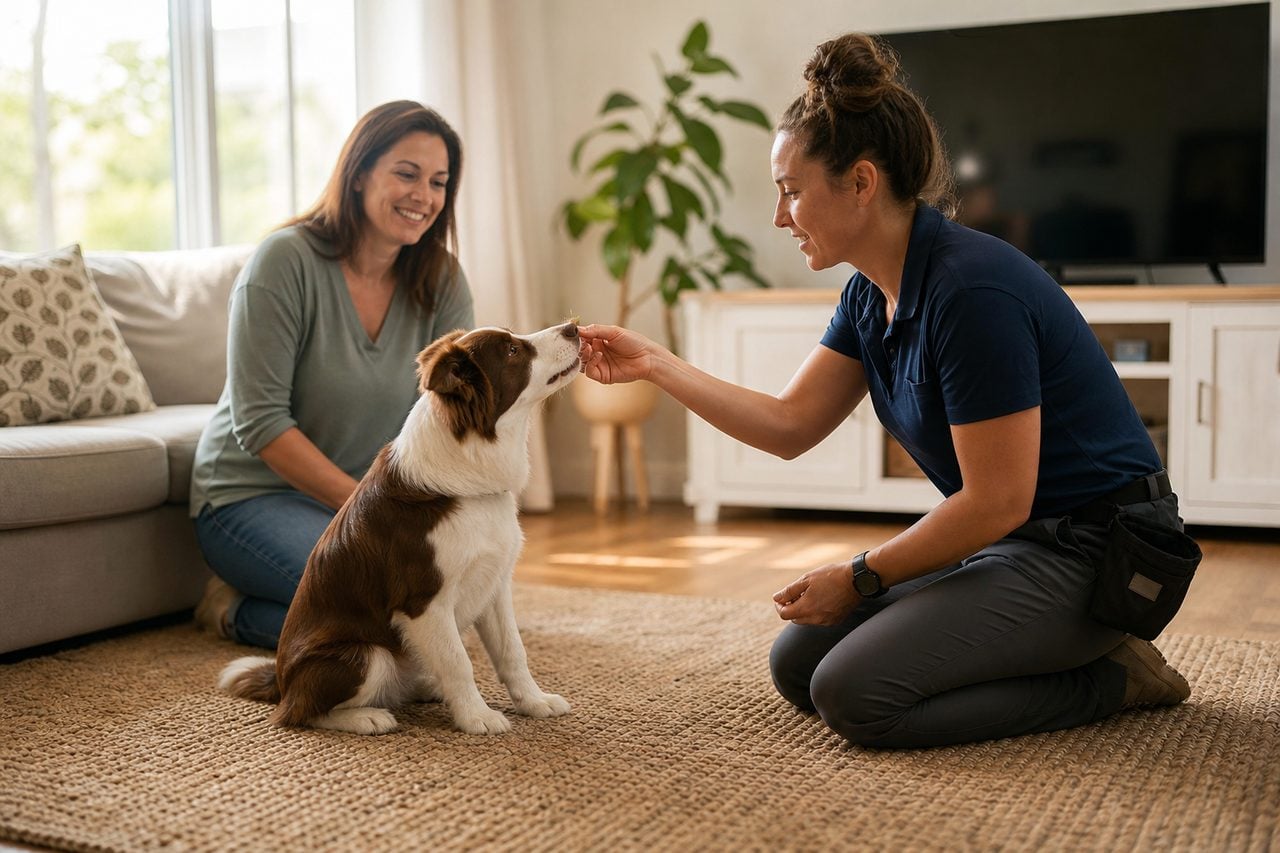
In-home dog training brings a professional trainer to your house to work with your dog in the environment where the behavior actually happens — no commute, no unfamiliar setting, no other dogs to manage around.
Not every dog trains well in a facility. And not every owner can make it to a 6pm Tuesday group class every week for six weeks straight. In-home training solves both problems: a trainer comes to you, works with your dog where the behavior happens, and coaches you through the techniques you need to maintain it.
In Columbus, in-home training is especially popular with families in Clintonville, German Village, and Upper Arlington where tight schedules and busy households make facility-based training logistically difficult. But it’s available across the entire metro area. For the bigger picture on every training format, see our Columbus dog training hub.
How In-Home Training Works
A typical in-home program in Columbus runs 4 to 8 sessions, scheduled weekly or biweekly. Each session lasts 60 to 90 minutes. The trainer comes to your home, assesses the situation, works directly with you and your dog, and leaves you with homework to practice before the next visit.
The first session is usually an assessment: the trainer observes your dog’s behavior in the home, asks about your goals and challenges, watches how your dog interacts with family members, and builds a training plan specific to your situation.
Subsequent sessions focus on teaching skills, addressing problem behaviors, and coaching you on timing, technique, and consistency. By the end of the program, you should be able to handle the training independently.
What makes in-home training fundamentally different from other formats is context. A dog who jumps on guests at the front door gets trained at the front door. A dog who counter-surfs gets trained in the kitchen. A dog who loses their mind when the doorbell rings gets trained with the actual doorbell. You’re not trying to transfer skills from a training facility back to real life — you’re building the skills in real life from day one.
What In-Home Training Costs in Columbus
| Service | Best for | Cost |
|---|---|---|
| Single session (60–90 min) | One-off issue or trial | $100–$175 |
| Package of 4 sessions | Focused single behavior | $350–$600 |
| Package of 6 sessions | Multiple behaviors | $500–$850 |
| Package of 8 sessions | Comprehensive program | $650–$1,100 |
| Behavior modification (per session) | Aggression, anxiety, fear | $150–$225 |
| Puppy start package (3–4 sessions) | Foundation work | $275–$500 |
Behavior modification runs higher because these cases require more expertise, longer sessions, and more detailed planning. Pricing in Columbus varies by trainer experience, travel distance, and complexity of the issue. Trainers based in central Columbus (Short North, Clintonville, Grandview Heights) may charge a travel surcharge for sessions in the outer suburbs — Pickerington, Delaware, Canal Winchester. Always ask upfront. For a full breakdown across formats, see our Columbus dog training prices guide.
When In-Home Training Is the Best Option
Your dog’s behavior problems are home-specific
Door manners, counter surfing, jumping on guests, barking at the mail carrier, guarding furniture, separation anxiety when you leave — these behaviors happen in the home and are best addressed in the home. Training them at a facility and hoping the skills transfer back is an unnecessary extra step.
Your dog is reactive or fearful around other dogs
Group classes are not the right starting point for reactive dogs. In-home training lets you build a foundation without the stress of other dogs in the room. Once your dog has impulse control and basic obedience down, you can transition to a reactive dog class.
You have a multi-dog household
A trainer who comes to your home can work with all your dogs in the same session, address inter-dog dynamics, and help you manage the household as a system rather than training each dog in isolation.
Your schedule is unpredictable
In-home sessions are scheduled at your convenience. No fixed weekly class time, no missed sessions because you got stuck at work. Most trainers in Columbus offer morning, afternoon, and evening appointments, and some work weekends.
You have young children or elderly family members at home
The trainer can observe and coach the entire family on how to interact with the dog safely and consistently. This is especially valuable for families with toddlers — the trainer can address both dog behavior and child safety protocols in the actual environment.
When In-Home Training Is NOT the Best Fit
Your dog needs intensive, daily training
If the behavior requires daily professional intervention (severe aggression, extreme anxiety, total lack of impulse control), board and train or day training may produce faster results. One session per week isn’t always enough for severe cases.
Your dog needs socialization
In-home training doesn’t provide exposure to other dogs. If socialization is a primary goal, group classes or a structured socialization program should be part of the plan — either instead of or in addition to in-home work.
You want the cheapest option
In-home training is a premium service. Group classes are 60 to 70% less expensive for the same number of weeks. If budget is the primary concern and your dog is social enough for a group setting, classes are the better value.
What Makes a Good In-Home Trainer
✅ Green flags
- Structured intake: detailed questions about history, behavior, medical background, and goals before session one
- Written training plan after the first session with order, timeline, and homework
- Demonstrates every exercise with your dog before asking you to do it, then coaches your timing
- Works with the chaos of a real home — kids, pets, doorbells — rather than creating a sterile setting
- Clear communication about methodology and tools before starting
🚩 Red flags
- Shows up knowing nothing about your dog
- Vague “we’ll see how it goes” approach with no written plan
- Talks at you for 90 minutes without working with the dog — that’s a lecture, not training
- Won’t tell you what tools or techniques they plan to use
How to Find an In-Home Trainer in Columbus
- Ask your vet. Clinics in Bexley, Worthington, and Dublin work with local trainers regularly and usually have strong referral networks.
- Check credentials. CPDT-KA (Certified Professional Dog Trainer) is the most widely recognized certification. For behavior modification cases, look for CAAB or a trainer who works under veterinary behaviorist supervision — see our Columbus dog behaviorist guide.
- Read in-home-specific reviews. A trainer might have great group class reviews but limited in-home experience. Look for reviews mentioning home visits and practical results in the client’s own home.
- Ask about their experience with your specific issue. A puppy-foundations specialist may not be right for a severe aggression case.
- Request a consultation before committing. Use it to evaluate communication style, understanding of your situation, and whether their approach aligns with your values.
Frequently Asked Questions
How many sessions will my dog need?
Most issues can be addressed in 4 to 6 sessions. Complex behavioral problems (aggression, severe anxiety, resource guarding) may require 8 to 12. A good trainer will give you a realistic estimate after the first assessment — if they can’t, they don’t have enough information yet.
Can you train my dog while I’m at work?
That’s day training, not in-home training. Some trainers offer both. Day training means the trainer comes to your home, works with your dog while you’re away, and leaves notes. It’s convenient but you miss the coaching component, so you’ll still need a few sessions where you’re present to learn the handling.
Will the trainer work with my kids too?
Good in-home trainers absolutely involve family members — including children old enough to follow instructions (usually 6 and up). They’ll teach kids how to interact safely, give commands properly, and respect the dog’s space. This is one of the biggest advantages of in-home over facility training.
My dog is aggressive — is in-home training safe?
In-home trainers who specialize in aggression are trained to manage safety. They’ll start with a thorough assessment, may require muzzle conditioning before hands-on work, and control the environment carefully. This is often safer than transporting an aggressive dog to an unfamiliar facility. See our aggressive dog training guide.
Can I split sessions between two locations?
Many trainers are flexible. Training in multiple environments helps with generalization — your dog learns the skills apply everywhere, not just the living room. Some trainers include “field trips” to nearby Columbus parks as part of later sessions. Discuss it during your consultation.
In-Home Training vs. Other Options at a Glance
| Service | Best for | Cost |
|---|---|---|
| In-home training (4–8 sessions) | Home-specific behaviors, reactive dogs | $100–$175/session |
| Group classes (5–6 weeks) | Obedience skills, social dogs | $175–$300 |
| Board and train (2–4 weeks) | Compressed timelines, resets | $1,500–$4,000+ |
| Day training (per session) | Supplementing owner-led training | $75–$125 |
Personalized, practical training in the environment that matters most — your home.