
In-Home Dog Training in Detroit, MI
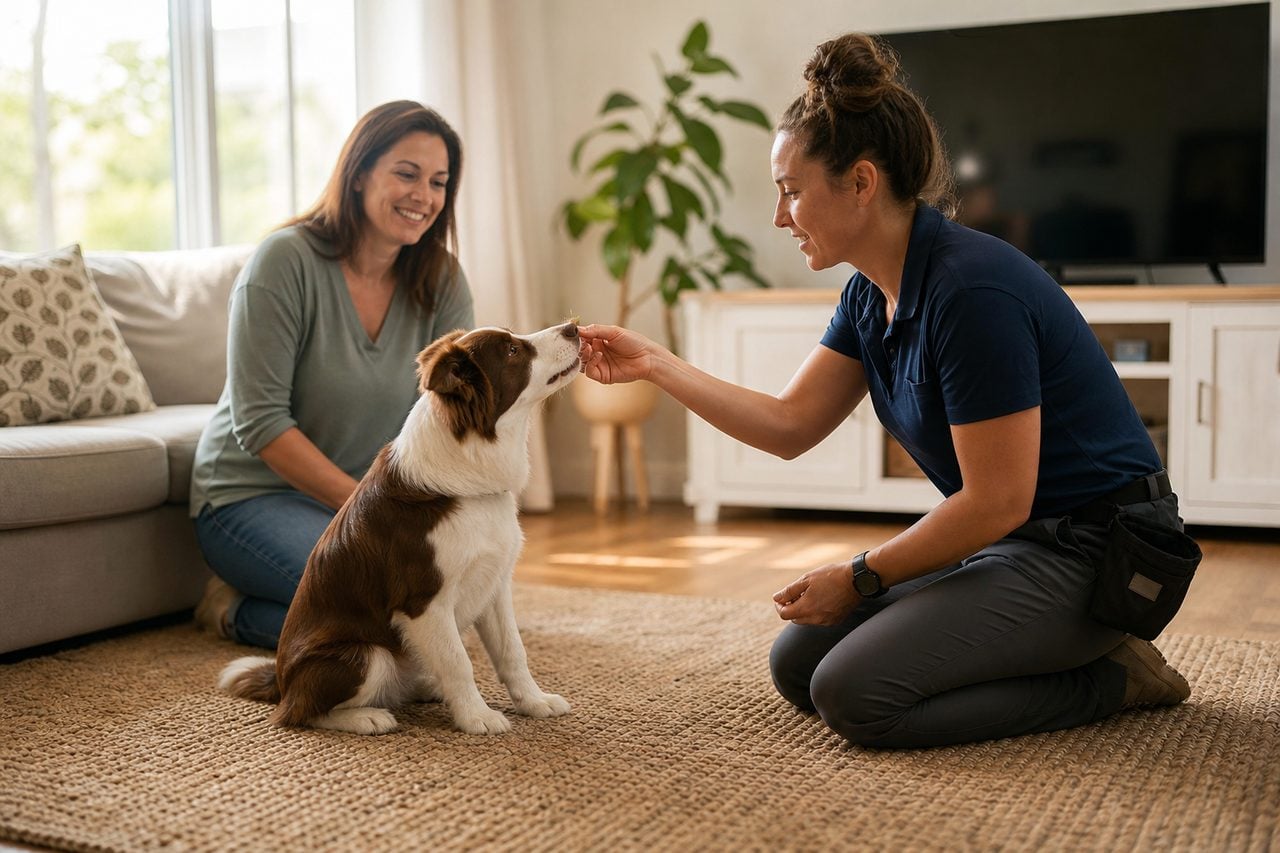
In-home dog training brings the trainer to you, working with your dog in the exact place where its behavior actually happens — your living room, your front door, your yard, your street. For many metro Detroit families, this is the most practical and effective format available, because so many of the problems that drive people to seek help are tied to the home itself: barking at everyone who walks past, chaos when guests arrive, pulling the moment you step onto the sidewalk.
- Why Training in Your Own Home Works So Well
- Problems In-Home Training Solves Best
- What a Typical In-Home Session Looks Like
- Preparing Your Home and Family for a Session
- How to Choose a Good In-Home Trainer
- Getting the Most Out of Your Investment
- Setting Realistic Expectations and Timelines
- Reviewed trainers
- FAQ
This guide covers what in-home training is, the kinds of problems it solves best, how a typical session unfolds, how to prepare your household, how to tell a strong trainer from a weak one, and how to set realistic expectations for the timeline. Whether you’re in a Birmingham colonial, a Ferndale bungalow, a Troy subdivision, or an apartment near downtown, the principles are the same — and because the trainer works around your setup and schedule, in-home training tends to be one of the more forgiving formats to fit into a busy life across the tri-county area.
Why Training in Your Own Home Works So Well
Dogs are deeply contextual learners. A behavior practiced in a training center doesn’t automatically transfer to your kitchen, because the dog associates commands with the place and circumstances where it learned them. In-home training removes that gap entirely — your dog learns the rules in the environment where it needs to follow them, so there’s nothing to transfer.
This matters most for problems rooted in the home. A dog that lunges at the mail carrier, guards the couch, counter-surfs, or loses its mind when the doorbell rings is responding to specific triggers in a specific place. A trainer standing in your entryway can watch the exact sequence unfold, identify what sets it off, and rework the pattern on the spot. That’s simply not possible in a classroom.
There’s also a practical advantage for the owner. The trainer sees your real setup — where the food bowls sit, how the crate is positioned, which door the dog bolts toward, how your family naturally interacts with the dog. Much of what a good trainer does is adjust the environment and coach the humans, and they can only do that well when they see the actual conditions rather than a description of them.
Finally, in-home training suits dogs and owners who don’t thrive in group settings. A reactive dog that can’t focus around other dogs, a nervous rescue still settling in, an owner with mobility limits, or a schedule that won’t bend to fixed class times — all of these are better served by a trainer who comes to the door. It’s private, focused, and built entirely around your dog and your household.
There’s a relationship benefit worth naming, too. Because the training happens in your space, with your family involved, it tends to strengthen the bond between you and your dog rather than outsourcing it. You’re not dropping the dog off and hoping; you’re learning to communicate with your own animal, in your own home, under a professional’s guidance. Many owners find this is the part that changes things for good — the dog starts looking to them for direction because they’ve become a clear, consistent leader in the environment where it matters most.
Problems In-Home Training Solves Best
Certain issues are almost tailor-made for the in-home format. Door behavior tops the list — dogs that bolt when the door opens, bark frantically at arrivals, or overwhelm guests are working off home-specific triggers, and there’s no better place to fix that than at your actual door with your actual doorbell.
House manners are another natural fit: jumping on people, counter-surfing, stealing food or laundry, begging at the table, refusing to settle. These behaviors live in the home and are shaped by the home’s layout and the household’s habits. A trainer in the room can spot the small ways the environment and family routines accidentally reward the behavior, then restructure them.
Reactivity and fear often benefit from starting at home too. A dog that’s overwhelmed in public can begin learning foundational focus and calm in a safe, familiar space before gradually working toward harder outdoor environments — a walk down a quiet Livonia side street, then a busier stretch, then eventually a trail at Kensington Metropark. Building confidence from the home outward is frequently more effective than throwing an anxious dog straight into a stimulating group class.
In-home training also shines for foundational obedience with real-life application. Loose-leash walking taught on your own block, recall practiced in your own yard, and place or settle commands anchored to your own furniture all translate directly to daily life. And for households integrating a new dog — a puppy, a rescue, or a second dog joining the family — having a professional help set up routines, management, and introductions in the home from day one prevents a lot of problems before they start.
What a Typical In-Home Session Looks Like
A first in-home session usually starts with conversation, not commands. The trainer will ask about the dog’s history, your goals, the household routine, and the specific behaviors that prompted the call. Meanwhile they’re observing — how the dog greets a stranger, how it moves through the space, how it responds to family members. This assessment shapes everything that follows.
From there the trainer typically demonstrates before asking you to try. They’ll show how to mark and reward a behavior, how to time a cue, how to hold the leash, how to read the dog’s body language. Then they hand it over to you, because in-home training is as much about coaching the humans as training the dog. Expect to be actively involved rather than watching from the sidelines.
Most sessions target one or two priorities rather than trying to fix everything at once. A single session might focus on calm door greetings and a solid “place” command, with the trainer breaking each into small, learnable steps you can practice. Trying to cover too much in one visit overwhelms both dog and owner, so a good trainer paces it deliberately.
Sessions almost always end with homework. The real learning happens in the days between visits, through short daily practice you fold into normal routines. Your trainer should leave you with clear, specific instructions — what to practice, how often, and what success looks like — plus a sense of what the next session will build on. A well-run program is a series of connected sessions with steady homework, not a one-time visit that magically resolves everything.
Preparing Your Home and Family for a Session
A little preparation makes each session far more productive. Before the trainer arrives, think through what you most want to accomplish and, if possible, jot down when the problem behaviors happen and what seems to trigger them. Concrete examples — “he lunges at skateboards but not bikes,” “she only guards the couch in the evening” — help the trainer diagnose faster than vague descriptions.
Get the whole household on board. Training that only one family member participates in tends to fail, because dogs learn the rules per-person and quickly figure out who lets them off the hook. If possible, have everyone who lives with the dog present for at least the first session so they hear the same instructions and buy into the same rules. This is especially important with kids, who often unintentionally reinforce jumping or begging.
Have the practical items ready. Ask the trainer in advance whether to have treats, a specific leash or harness, the crate, or a hungry dog (many trainers prefer working before a meal so food rewards are more motivating). Reducing distractions helps too — you might plan the session for a quieter part of the day, though for door-related problems the trainer may actually want the normal chaos so they can see it.
Finally, come in with realistic expectations and an open mind. A trainer may point out that something in your routine is feeding the problem — free-feeding, inconsistent rules, unintentional reassurance of anxious behavior. Hearing that isn’t a criticism of you; it’s the fastest route to change. The owners who make the most progress are the ones willing to adjust their own habits, not just their dog’s.
How to Choose a Good In-Home Trainer
Because a trainer will be in your home working closely with your family, fit matters as much as credentials. Start with how they communicate. In an initial call or consultation, a good trainer asks thoughtful questions about your dog and explains their approach in plain language. Someone who talks over you, dismisses your concerns, or can’t clearly describe what they’ll do is not the right person to invite into your house.
Ask about methods directly. You want a trainer who leans on rewarding the behavior you want and who can explain how they handle mistakes without relying on intimidation. For fearful or reactive dogs especially, an approach centered on building confidence and changing the dog’s emotional response tends to produce more durable results than one focused on suppression. Be wary of anyone promising to fix deep behavioral issues in a single visit.
Look for relevant experience with your specific issue. A trainer strong on puppy manners and basic obedience may not be the best choice for serious aggression, and vice versa. It’s fair to ask how often they work with cases like yours and what outcomes they typically see. For significant aggression or anxiety, a trainer who collaborates with your veterinarian — or refers to a veterinary behavior specialist when appropriate — is a sign of professionalism, not weakness.
Finally, weigh the practical details. Confirm what a session costs and what a full program looks like, whether they offer packages, how homework and between-session support work, and whether they serve your part of the metro — trainers vary in how far across the tri-county area they’ll travel. Ask for references from local clients and follow up. A trainer confident in their work will happily connect you with people they’ve helped.
Getting the Most Out of Your Investment
In-home training gives you a professional’s time and expertise, but the outcome ultimately depends on what you do between visits. The owners who see the best results treat the trainer as a coach and themselves as the primary trainer, practicing consistently rather than expecting the visits alone to transform the dog.
Practice in short, frequent sessions rather than occasional marathons. A few minutes several times a day — a recall in the backyard, loose-leash practice on the way to the car, a settle on place while you cook dinner — is far more effective than one long weekly drill. Woven into daily life, these reps compound quickly, and your dog learns that the rules apply all the time, not just during “training.”
Gradually raise the difficulty as your dog succeeds. Skills learned in the quiet of your living room need to be proofed against real-world distractions to hold up. Once a behavior is solid indoors, take it to the front yard, then a quiet street, then busier settings like a sidewalk in downtown Royal Oak or a path along the Detroit River. This staged progression is exactly how you build a dog that listens even when it’s exciting outside.
Keep notes and stay in touch with your trainer. Tracking what’s working and where you’re stuck makes each session more efficient, and a quick message when something isn’t clicking can save weeks of drifting. Above all, be patient and consistent. Real behavior change takes weeks and months, not days — but with a good in-home trainer and honest follow-through, the everyday problems that made you seek help genuinely do fade into the background.
Setting Realistic Expectations and Timelines
Perhaps the most valuable thing an in-home trainer gives you, beyond technique, is a realistic sense of how change actually happens. Behavior doesn’t flip like a switch. It shifts gradually as new habits replace old ones through repetition, and that process runs on the dog’s timeline, not yours. Owners who understand this up front are far more likely to stick with the plan long enough to see results.
Expect progress to be uneven. Dogs often improve quickly at first, then hit a plateau, then improve again. There may even be days that feel like backsliding, especially as you increase difficulty or introduce new distractions. This isn’t failure — it’s a normal part of learning, and a good trainer will help you read it correctly rather than panic and abandon an approach that’s actually working. Trusting the process through the flat stretches is what separates lasting change from a false start.
The timeline also depends heavily on the problem. Teaching a new manner like settling on a mat can click in days, while changing a deeply ingrained emotional response — fear of strangers, reactivity toward other dogs — is measured in weeks and months of patient work. If a trainer promises to erase a serious, long-standing behavior in a single visit, be skeptical. Honest professionals set expectations that match the difficulty of the case.
It helps to define what success looks like in concrete, livable terms. “Never barks again” isn’t realistic; “greets guests calmly instead of jumping” or “walks past another dog without lunging” is. These specific, achievable goals let you actually see the wins as they come, which keeps you motivated through the longer haul. And once the main issues are resolved, remember that maintenance is ongoing — the everyday reps you built into your routine are what keep the improvement in place for good.
Reviewed In-Home Dog Training Trainers in Detroit
These reviewed Detroit-area trainers from our directory handle in-home dog training. Each links to a full profile with specialties, certified credentials, reviews, and contact info:
- Paws Around Motown — 5.0★ (78 reviews)
- K9 AdvantEDGE Dog Training — 5.0★ (40 reviews)
- Iron Clad K9 Training — 5.0★ (13 reviews)
- New Tricks: Puppy and Dog Training LLC — 5.0★ (12 reviews)
- Tip Top K9 Sterling Heights Dog Training — 5.0★ (7 reviews)
- Paws N Play — 4.9★ (70 reviews)
- Four Legged Rascals — 4.9★ (16 reviews)
- Animal Behavior Consultants of Michigan — 4.7★ (29 reviews)
See all Detroit in-home dog training trainers →
Frequently Asked Questions
Is in-home training better than group classes?
It depends on your goals. In-home training is better for problems tied to your house — door-dashing, guarding furniture, guest chaos — and for dogs that struggle to focus around other dogs, because the dog learns exactly where it needs to behave. Group classes are better for socialization and general obedience at a lower cost. Many owners do both: in-home work for specific issues, then a class for real-world practice around distractions.
Should my whole family be present for the sessions?
Ideally yes, at least for the first session. Dogs learn rules per-person and quickly figure out who enforces them and who doesn’t, so training that involves only one family member tends to unravel. Having everyone hear the same instructions keeps the household consistent. This matters most with children, who often unintentionally reinforce jumping, begging, or overexcited greetings if they aren’t shown the plan.
How many in-home sessions will my dog need?
It varies with the dog, the problem, and how consistently you practice between visits. Basic manners might come together in a handful of sessions, while reactivity or anxiety usually takes longer and more gradual work. A good trainer will give you a realistic estimate after meeting your dog and will adjust as you go. Remember that the daily homework between sessions drives most of the progress, not the visits alone.
What should I have ready before the trainer arrives?
Ask your trainer in advance, but commonly it helps to have high-value treats on hand, the leash or harness you normally use, the crate accessible, and — for many trainers — a slightly hungry dog so food rewards are motivating. Jot down when problems happen and what triggers them. For door or greeting issues, the trainer may actually want the normal household activity so they can observe the behavior firsthand.
Can in-home training help with reactivity or aggression?
Yes, and starting at home is often ideal, because a dog can build foundational calm and focus in a safe, familiar space before working toward harder environments. That said, serious aggression is a specialized area. Look for a trainer experienced with these cases who uses methods focused on changing the dog’s emotional response rather than just suppressing behavior, and who will involve your veterinarian or refer to a veterinary behavior specialist when appropriate.
Do in-home trainers travel across the whole Detroit metro?
Coverage varies by trainer. Some serve a wide radius across Wayne, Oakland, and Macomb counties, while others stick closer to a home base and may add a travel consideration for longer distances. When you inquire, simply confirm they serve your specific suburb or neighborhood and ask how travel factors into scheduling and cost. Because the metro is large, it’s worth checking this early rather than assuming.
Related: read our complete in-home dog training guide or the full Detroit dog training overview.
Ready to find the right in-home dog training pro in Detroit?