
In-Home Dog Training in Fort Wayne, IN
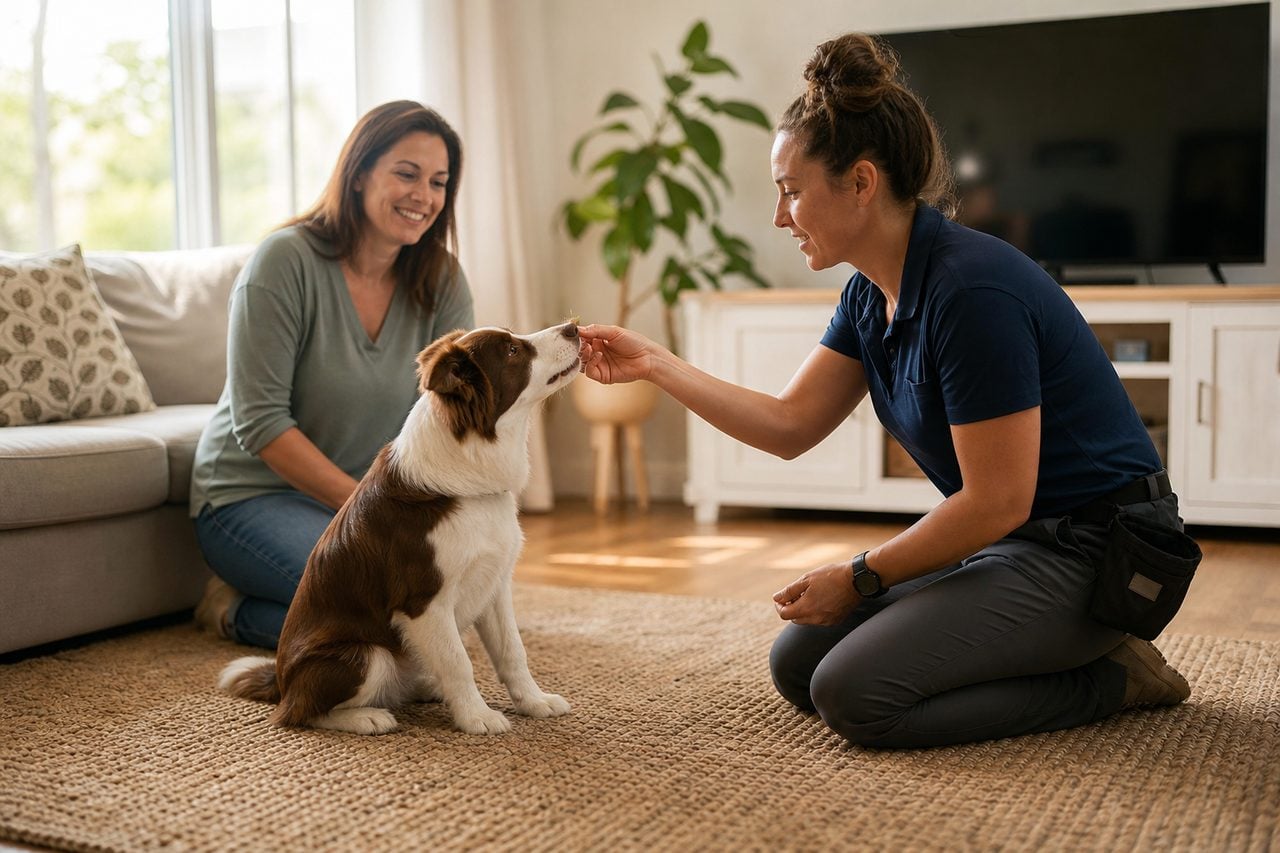
In-home dog training brings a professional trainer directly to your door in Fort Wayne, working with your dog in the exact place where most of its habits are formed — the living room, the backyard, the front hallway where the leash comes out. For families across the Summit City and the wider Allen County area, this format removes the friction of loading an over-excited dog into the car and driving to an unfamiliar facility, and it lets the trainer see the real picture: the counter your dog surfs, the window it barks out of, the door it bolts through when guests arrive.
- Why Train In the Dog’s Own Environment
- What Private Training Is Best For
- How In-Home Sessions Typically Work
- Training Methods and What to Look For
- The Fort Wayne Service Area and Local Considerations
- Local Rules and Responsible Ownership
- Preparing for Sessions and Making the Results Last
- Reviewed trainers
- FAQ
Private, one-on-one instruction also fits the reality of a busy household. Rather than sharing an instructor with five other dogs in a group class, your dog gets the trainer’s full attention, and the plan is built around your goals — whether that is a calm walk along the Rivergreenway, a dog that settles when the family sits down to dinner, or reliable manners with the grandkids visiting from Auburn or Columbia City.
This guide explains how in-home and private training works in the Fort Wayne area, what it is best suited for, how to choose a qualified trainer who travels across northeast Indiana, and how to keep the results going long after the sessions end.
Why Train In the Dog’s Own Environment
Dogs are contextual learners. A dog that sits politely in a training-center lobby may completely fall apart when the doorbell rings at home, because the two situations feel like different worlds to the animal. Training on your own turf closes that gap. The behaviors are taught, practiced, and reinforced in the precise setting where you actually need them, which shortens the path from a cue that works in class to a cue that works in real life.
The home environment is also where the problem behaviors live. A trainer who watches your dog counter-surf in your kitchen, lunge at the mail carrier from your porch, or guard a spot on your couch can diagnose the trigger far more accurately than one relying only on your description. The context, the layout, the sightlines, and the daily routine all become part of the assessment.
There is a practical comfort factor too. Dogs that are fearful, reactive, or simply young and unfocused often learn faster when they are not also coping with the stress of a strange building full of unfamiliar dogs and smells. Starting where the dog feels safe lets the animal give more attention to the actual lesson. Once the foundation is solid at home, a good trainer will deliberately add distraction and take the work on the road.
Finally, in-home training coaches the whole household, not just the dog. Because everyone lives with the dog, the trainer can show each family member — kids included, at an age-appropriate level — how to give cues consistently. Consistency across handlers is one of the biggest predictors of whether training sticks.
What Private Training Is Best For
In-home training suits a wide range of goals, but it is especially valuable for a few specific situations common among Fort Wayne dog owners.
- Puppy foundations. House-training, crate comfort, name recognition, gentle handling, and preventing the biting and jumping that turn cute puppy habits into adult-dog problems. Building these in the home, on the puppy’s real schedule, gives a strong head start.
- Everyday manners. Sit, down, stay, place, leave-it, loose-leash walking, polite greetings, and a reliable recall — the practical obedience that makes a dog easy to live with and welcome on a walk through Franke Park or around the neighborhood.
- Door and greeting behavior. Because it happens at your actual entryway with your actual routine, door manners and calm guest greetings are far easier to fix at home than in a class.
- Reactivity and fear. Dogs that overreact to other dogs, strangers, or noise often benefit from starting below threshold in a familiar space, then gradually generalizing. Serious aggression cases call for a trainer with specific behavior experience — more on vetting below.
- Newly adopted or rehomed dogs. A private plan helps a new dog settle into the household’s rhythm and learn the house rules from day one.
Private training is not always the single best fit for every goal. Dogs that specifically need to learn to focus around other dogs eventually need controlled exposure to other dogs, so many area trainers blend in-home foundations with later field trips or a graduated move into small group settings. The right structure depends on the individual dog.
It also helps to be realistic about what any single format can accomplish. In-home training is powerful precisely because it targets your real environment, but a dog that has only ever worked in the calm of its living room has not yet learned to hold those skills in a parking lot, a pet-friendly store, or on a crowded stretch of the Rivergreenway. That is why the strongest programs treat the home as the starting point and generalization as the destination. A trainer who explains that arc up front — here is what we build at home, and here is how we take it into the wider world — is setting expectations honestly, which tends to correlate with better long-term results.
How In-Home Sessions Typically Work
Most private programs in the Fort Wayne area begin with an initial consultation. The trainer gathers history — breed, age, health, diet, daily routine, what has already been tried — and observes the dog in the home. From that assessment comes a written or verbal plan with clear priorities, because trying to fix ten things at once rarely works.
Sessions usually run somewhere in the range of forty-five minutes to an hour and often land weekly, which gives the household time to practice between visits. Practice is the real engine of progress; the trainer’s job during a session is largely to teach the humans, troubleshoot what went sideways during the week, and raise the difficulty as the dog succeeds.
A typical arc looks like this:
- Session one: assessment, goal-setting, and one or two foundational skills plus management strategies to stop rehearsing bad habits immediately.
- Middle sessions: building the core skills, adding duration, distance, and distraction, and layering in real-life scenarios like the doorbell or a walk down the street.
- Later sessions: proofing the behaviors in harder contexts, generalizing to new locations, and handing the household a maintenance plan.
Good trainers give homework and are reachable between sessions for quick questions. Many also offer follow-up or check-in options so progress does not stall once the formal program wraps.
Between the structured visits, the trainer typically leaves you with specific, measurable targets rather than vague encouragement — for example, ten calm door greetings this week, or a thirty-second settle on the dog’s mat while you cook dinner. These concrete goals give the household something to aim at and give the next session a clear starting point. If a particular exercise is not working, a responsive trainer would rather hear about it mid-week than discover the stall at the following visit, which is one more reason to choose someone who welcomes questions between appointments. Progress in dog training is rarely a straight line; there are plateaus and the occasional backslide, and a good private trainer treats those bumps as normal data to adjust the plan around rather than as failures.
Training Methods and What to Look For
The dog-training industry in the United States is not licensed, which means anyone can call themselves a trainer. That makes it important to look past the label and ask real questions. The most widely respected approach today is rooted in positive reinforcement — rewarding the behavior you want so the dog chooses to repeat it — paired with sensible management that prevents the dog from rehearsing unwanted behavior in the first place.
Reputable trainers should be able to explain, in plain language, how they will teach a given skill and what they will do when the dog gets it wrong. Be cautious of anyone who promises guaranteed results, leans heavily on fear or intimidation, or cannot describe their methods clearly. Ask about:
- Experience and continuing education. Professional certifications and membership in national trainer organizations signal ongoing learning, though they are not a legal requirement. Ask what cases the trainer handles most.
- Approach to mistakes. How does the trainer respond when a dog does the wrong thing? The answer reveals the underlying philosophy.
- References and reviews. Talking to past clients in the area, or reading detailed local reviews, is one of the most reliable ways to judge fit.
- Scope. A trainer who is honest about the limits of their expertise — and who refers out serious aggression or complex behavior cases to a qualified behavior professional or a veterinary behaviorist — is showing good judgment, not weakness.
Fit matters as much as credentials. You and your family will be taking direction from this person in your own home, so a trainer who communicates clearly, listens to your goals, and is patient with the humans is worth a great deal.
The Fort Wayne Service Area and Local Considerations
One of the practical advantages of in-home training across northeast Indiana is that many trainers travel a wide radius. Because the region is spread out — Fort Wayne at the center, with New Haven, Huntertown, Grabill, Leo-Cedarville, and Woodburn nearby, and Auburn, Columbia City, Bluffton, Decatur, Huntington, and Angola within a reasonable drive — local trainers often cover much of Allen County and the surrounding counties rather than expecting clients to come to a single location.
When you call, it is worth confirming the service area and whether a travel fee applies for the outer towns. A trainer based near central Fort Wayne may cover New Haven and Huntertown as standard territory but charge for the longer runs out toward Angola or Bluffton. Clarifying this up front avoids surprises.
Local outdoor spaces also become part of the training progression once your dog is ready to generalize skills beyond the home. The Rivergreenway trail system that follows the St. Marys, St. Joseph, and Maumee rivers offers long, controlled stretches for practicing loose-leash walking. Franke Park, Fox Island County Park, and other public areas provide gradually more distracting environments to test a recall or a settled down-stay. A good in-home trainer will build toward these public outings deliberately, only after the behavior is reliable in quieter settings.
Weather is a real factor in this part of Indiana. Winters can be long and cold, which is another point in favor of in-home work — sessions continue indoors regardless of snow, and the plan simply adjusts to keep the dog engaged through the colder months.
Local Rules and Responsible Ownership
Indiana does not have a single statewide leash law, so the rules that apply to you come from local ordinances across the Fort Wayne area — the City of Fort Wayne, Allen County, and the individual towns each set their own requirements for leashing, licensing, and nuisance behavior such as excessive barking. Public parks and trails typically have their own posted rules as well, and most require dogs to be leashed and under control.
Responsible ownership pairs naturally with training. Keeping your dog licensed and current on vaccinations, picking up after it on the Rivergreenway and in the parks, and keeping it under control around other people and dogs are all baseline expectations that also happen to be exactly what a solid manners program produces. A dog with a reliable recall, a calm greeting, and good leash manners is easier to keep compliant with any local rule.
Before you rely on off-leash freedom anywhere public, confirm what the specific park or municipality allows, and be honest about your dog’s current level of reliability. Training builds toward that freedom step by step; it is not a shortcut around the rules. When in doubt, a leash and a little management keep everyone — your dog, other dogs, and the neighbors — comfortable and safe.
Preparing for Sessions and Making the Results Last
A little preparation before your trainer arrives makes each in-home session far more productive. Because the trainer’s time is best spent coaching and troubleshooting rather than waiting for the household to organize itself, a few simple habits pay off quickly.
Before a session, it helps to have the essentials ready: a well-fitted flat collar or harness and a standard leash, a supply of small, soft, high-value treats the dog does not get at other times, the dog’s favorite toy, and a quiet space cleared of clutter where the first repetitions can happen without competing distractions. Many trainers ask that the dog be a little hungry rather than freshly fed, since a food-motivated dog learns faster, and that the dog has had a chance to relieve itself and burn off the sharpest edge of its energy with a short walk beforehand. A dog that arrives at a session wired and bursting will spend the first fifteen minutes just settling, which wastes the very time you are paying for.
It also helps to think ahead about which family members should be present. For foundational skills, having the primary handler focus first and then bringing in other household members once the mechanics are clear tends to work better than everyone crowding in at once. Children can absolutely participate, but at a level matched to their age, and always with the trainer guiding how they give cues and rewards.
The real work, though, happens between sessions. A weekly visit is only as valuable as the practice that follows it. The most successful clients treat the trainer’s homework the way they would treat any other commitment — short, frequent practice sessions of just a few minutes, several times a day, woven into normal routines. Asking for a sit before meals, a wait at the door, or a settle while the family watches television turns everyday moments into training reps without carving out extra time.
To keep results durable after the program ends, consistency across the whole household is the single most important factor. Everyone should use the same cues and the same rules, so the dog is not rewarded for jumping by one person and corrected for it by another. It also helps to keep gradually raising the difficulty even after the trainer is gone — practicing the recall in new places, holding a stay a little longer, and occasionally rewarding good behavior so the dog stays motivated. Skills that are never practiced fade, while skills that are woven into daily life stay sharp for years. Many area trainers offer periodic tune-up sessions or check-ins, which can be a smart way to refresh the training or tackle a new goal as your dog matures.
Reviewed In-Home Dog Training Trainers in Fort Wayne
These reviewed Fort Wayne-area trainers from our directory handle in-home dog training. Each links to a full profile with specialties, certified credentials, reviews, and contact info:
- Dog Training Elite Northeast Indiana — 5.0★ (170 reviews)
- The Well Mannered Dog — 5.0★ (115 reviews)
- Dog Psychology and Training Center – Fort Wayne — 4.6★ (14 reviews)
See all Fort Wayne in-home dog training trainers →
Frequently Asked Questions
How much does in-home dog training cost in the Fort Wayne area?
Pricing varies widely depending on the trainer’s experience, the length of the program, and how far they travel. Many trainers offer both single sessions and multi-session packages, and some add a modest travel fee for the outer towns like Angola, Bluffton, or Decatur. Because there is no standard rate, the best approach is to contact a few local trainers, describe your goals, and ask for a clear quote that spells out what is included — the number of sessions, session length, and any between-session support.
How many sessions will my dog need?
It depends entirely on the dog and the goals. Basic puppy manners or a specific issue like door greetings might resolve in a handful of sessions with consistent practice at home, while reactivity or a full obedience program can take longer and be spread over weeks. A good trainer will give you a realistic estimate after the initial assessment and adjust as your dog progresses. The single biggest factor is how consistently the household practices between visits.
Is in-home training better than a group class?
Neither is universally better — they solve different problems. In-home training excels at household-specific issues, puppy foundations, fearful dogs, and situations where you need the behavior to work in your actual environment. Group classes shine when the goal specifically involves focusing around other dogs and people. Many owners in the area do both: private work to build the foundation, then a group setting or supervised outings to proof it under distraction.
Can a trainer fix aggression or reactivity in my home?
Many reactivity and fear cases respond very well to a private, home-based plan that starts below the dog’s threshold and gradually builds tolerance. Serious aggression, however, calls for a trainer with specific experience in that area, and sometimes a partnership with a veterinary behaviorist to rule out or address medical and emotional factors. A responsible trainer will be honest about whether a case is within their expertise and refer out when appropriate rather than promise a guaranteed fix.
Do I need to be present during the sessions?
Yes, and that is the point. In-home training is as much about coaching the humans as it is about the dog, because you are the one living with the animal every day. The trainer teaches you and your family how to give cues, reward correctly, and manage the environment so the results continue after the program ends. Having the whole household participate, at least some of the time, greatly improves consistency and outcomes.
What areas around Fort Wayne do in-home trainers cover?
Because northeast Indiana is spread out, many trainers travel a wide radius across Allen County and neighboring counties — commonly reaching New Haven, Huntertown, Grabill, Leo-Cedarville, and Woodburn, and often extending to Auburn, Columbia City, Bluffton, Decatur, Huntington, and Angola. Coverage and any travel fees vary by trainer, so confirm your specific location when you first make contact.
Related: read our complete in-home dog training guide or the full Fort Wayne dog training overview.
Ready to find the right in-home dog training pro in Fort Wayne?